
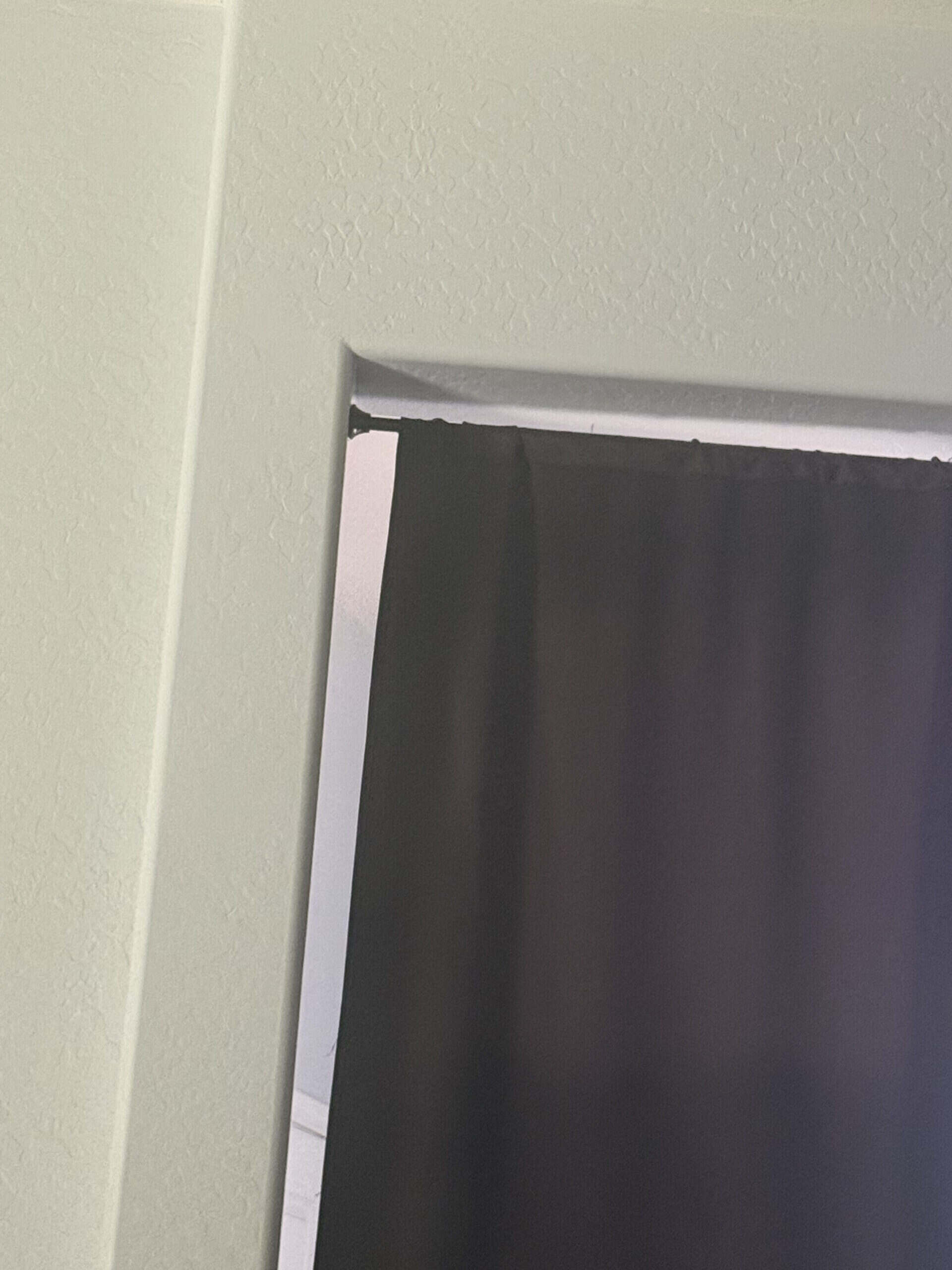
Most people buy blackout curtains, hang them, and find the room is still not dark. The fabric is doing its job; light is coming around it rather than through it, at the sides, the top, and underneath.
That is the whole problem in one sentence, and it is why a cheap curtain hung well beats an expensive one hung badly. Our comparison of blackout curtains and blinds covers the first decision.
Quick Answer
Block the window with curtains or shades, then deal with the gaps around them. Mount high and wide, extend past the frame on both sides, and handle any remaining leaks at the source before adding more layers.
Key Points
- Light leaks around curtains, not through them.
- Mounting high and wide does more than upgrading fabric.
- Sliding doors and shutters are the hardest cases.
- A sleep mask solves what a room cannot.
- Fully dark is not always the goal.
Where the Light Actually Gets In
The sides are the biggest offender. A curtain sized to the window rather than the wall leaves a gap at each edge, and light travels along the wall and around the fabric.
The top is second. A standard rod mounted just above the frame lets light spill over the curtain from a streetlight or an early sunrise.
The bottom matters less than people expect unless the curtain stops short. Floor-length fabric handles it; anything ending at the sill does not.
And the gaps between panels in the middle, where two curtains meet, produce a vertical stripe that is surprisingly bright at night. Our note on stopping light leaking around blackout curtains covers the fixes.
What I Actually Have
I have had blackout curtains for three or four years, and they are the standard kind rather than the thermal type. Some are on rods and hang to the floor; others are fitted into shutters, which is a different arrangement entirely.
They have faded slightly over that time, which is worth knowing before buying: the sun that they are blocking is also working on them.
The honest part is that the room I sleep in is dim rather than fully dark. There are blinds on a sliding door, and blinds are not curtains. Light gets around them in a way it does not around the floor-length panels. Our note on bedroom dim but not dark covers that in more detail.
I have not solved that, and I have stopped treating it as a problem to solve. Dim is enough for me, and chasing total darkness in a room with a large glass door means either a track system or accepting that a sleep mask does the last part.
Mount High and Wide
Above the frame, not on it
Mounting the rod well above the window and letting the curtain overshoot at the top removes the spill that a frame-height rod guarantees.
Wider than the window
Extend the rod several inches past the frame on both sides so the fabric overlaps wall rather than ending at glass.
Wrap-around rods
These curve back toward the wall at each end, which closes the side gap properly rather than reducing it.
Floor length
Curtains that stop at the sill leave the bottom open. Longer is better here even where it looks unnecessary. Our roundup of blackout curtain tracks and wrap-around rods covers the hardware.
The Hard Cases
Sliding glass doors are the worst of them. The opening is wide, the curtain has to clear the door to use it, and blinds mounted inside the frame leak at every slat edge.
Shutters look like they should solve darkness and generally do not. They control light well during the day and leave gaps at the louvres and around the frame at night.
Rented homes rule out drilling, which removes the mounting options that matter most. Tension rods and no-drill brackets exist and are weaker.
Doorways are the case people forget. Light from a hallway under or around a bedroom door can be as bright as anything from the window. Our roundup of no-drill blackout curtain rods covers the rental case, and our note on whether you need curtains with shutters covers that combination.
Layering
Adding a second layer over an existing curtain helps where the first is thin, and it does nothing about edges. Layering fabric solves the wrong problem if light is coming around the sides.
Where layering does work is combining a blind or shade inside the frame with a curtain outside it. The blind handles the glass and the curtain handles the perimeter.
Blinds alone rarely achieve darkness for the same reason shutters do not, since the mounting inside the frame guarantees an edge gap.
Our note on layering blackout curtains with regular curtains covers the combinations.
What Else Curtains Change
Heavy curtains dampen sound somewhat, which is a genuine secondary benefit rather than a marketing claim, though they are not soundproofing.
They affect temperature too, holding heat in during winter and blocking solar gain in summer. Thermal versions do more of this than the standard kind I have.
The trade nobody mentions is waking up. A properly dark room removes the morning light that helps you wake naturally, which is why some people find blackout curtains make mornings harder.
Our notes on whether blackout curtains help with noise, whether they block heat, and whether they make waking harder cover each.
When a Sleep Mask Is the Better Answer
A mask solves at the eyes what a room may never solve at the window, and it does it for a fraction of the cost and effort.
I have sleep masks and they handle exactly the situation my room leaves open: dim rather than dark, with a glass door I am not going to re-engineer.
They travel, which no curtain does, and they work in hotels and spare rooms where you control nothing.
The drawbacks are real. Some people cannot tolerate anything on their face, and a poorly fitted mask presses on the eyes or slips off. Our roundup of sleep masks covers fit, and our note on whether sleep masks actually help covers the evidence.
Light You Bring Into the Room
Standby LEDs on televisions, chargers, and air purifiers add up in a properly dark room in a way they never do in a dim one.
Phone screens are the larger problem, both for the light itself and for what you do while looking at one.
Where you need some light for getting up in the night, red light is the usual recommendation because it appears to interfere least with sleep.
Our roundup of red light bulbs covers those, and our note on whether red light helps you sleep covers the evidence behind it.
How Dark Is Dark Enough
Total darkness is the goal for shift workers sleeping during the day, and for anyone whose window faces a streetlight or an early sunrise.
For most people, dim is sufficient. A room where you cannot read but can see the outline of furniture is enough to sleep well in.
My room is that second category, and I sleep about as well in it as I would in a fully blacked-out one. The last few percent of darkness costs considerably more than the first ninety.
Deciding which you actually need before buying saves money and effort, since the measures that get a room from dim to fully dark are the expensive ones. Our roundup of blackout curtains for rooms that stay dim covers that middle ground.
Making a Bedroom Dark FAQ
Why is my room still bright with blackout curtains?
Light is coming around them rather than through them. The sides, the top, and the gap between panels are where it gets in, and no amount of better fabric fixes a mounting problem.
How high should I mount the rod?
Well above the window frame rather than just above it, so the fabric overshoots at the top. Combined with extending several inches past the frame at each side, that removes most leaks.
Do blinds work as well as curtains?
Rarely, because mounting inside the frame guarantees a gap at every edge. Blinds inside the frame plus a curtain outside it works better than either alone.
What about sliding glass doors?
The hardest case. The opening is wide, the covering has to clear the door to use it, and blinds leak at each slat. A track system helps; a sleep mask covers what remains.
Can I get a dark room in a rental?
Harder without drilling, since the mounting that matters most is what you cannot do. No-drill rods and tension systems exist and hold less weight and seal less well.
Do blackout curtains fade?
Mine have faded slightly over three or four years. They are absorbing the sunlight they block, so some change over time is expected rather than a defect.
Is a sleep mask as good as a dark room?
For many people, yes, and it costs far less. It also travels, which no curtain does. Fit is the deciding factor, since a mask that presses on the eyes or slips off helps nobody.
Do I actually need total darkness?
Usually not. Dim is enough for most people, and the last stretch from dim to fully dark costs considerably more than everything before it. Shift workers and very bright windows are the real exceptions.
Recommended Reading
See our note on bedroom floor lamps, and bedside lamps reading before bed, and bedside lamps with usb charging, and blackout curtains for sleep, and blackout curtains for sliding glass doors, and blackout curtains that dont reach the floor, and blue light blocking glasses for better sleep, and closet and wardrobe lighting, and curtain rods for doorways, and doorway curtains for privacy and light control, and lightweight blankets, and lightweight summer comforters.
