
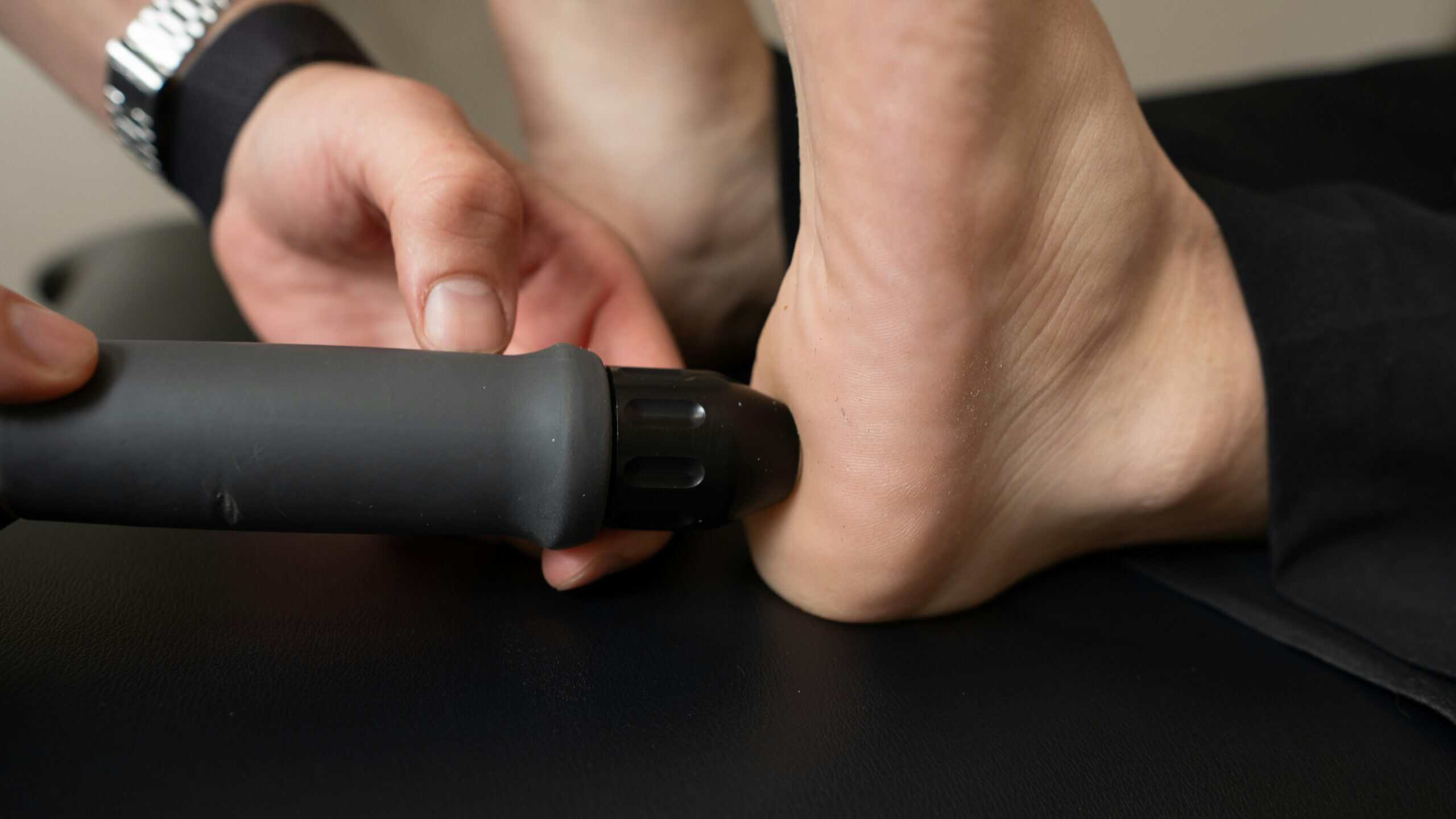
Most massage guns ship with four to six heads and most owners use one of them. The best massage gun attachments and heads are ball heads, because a round surface spreads pressure across muscle and suits almost every large area you would point a gun at. The rest of the set earns its place only in specific situations.
Head shape changes how force is delivered rather than how much there is. A flat face spreads it and a cone concentrates it.
That is the whole decision, and it is worth understanding before buying a bigger set. Our massage guns roundup covers the device itself.
Medical Disclaimer
This article is research, not medical advice. Percussive massage is a comfort and recovery practice, not treatment. Keep any head away from bone, joints, the spine itself and the front and sides of the neck, and see a doctor before using a massage gun if you take blood thinners, have a clotting disorder, have nerve damage, or are working around a recent injury or surgery.
Quick Verdict
The ball head is the one to default to and the one most people should accept they will use almost exclusively. A flat head suits broad flat muscle, a bullet is for small specific spots and the most easily overdone, a fork goes either side of the spine rather than on it, cushioned heads suit sensitive areas, and an adapter set matters only if you are mixing brands.
Key Takeaways
- Head shape changes pressure distribution, not the gun’s force or amplitude.
- Smaller contact area means more concentrated pressure at the same setting.
- Fork heads straddle the spine and are not meant to touch the vertebrae.
- Foam heads compress and lose shape faster than hard plastic ones.
- Thread size and shaft diameter vary between brands, so heads are not universally interchangeable.
- A larger set rarely means more use, since most routines settle on one or two heads.
How We Picked the Best Massage Gun Attachments and Heads
We compared head types rather than named products, because attachments are brand-specific while the shapes do the same jobs across every range.
Each section covers one shape, the area it suits and where it falls short. We weighted four things: how the contact area distributes pressure, which body parts it genuinely fits, what material it is made from, and how widely it fits across brands.
We have not published pressure figures or amplitude numbers. Those belong to the gun rather than the head, and a figure quoted here would describe nothing.
1. Ball Heads, Best Overall
Why It Stands Out
A round head, usually firm foam or dense rubber, with a broad curved contact face that rolls across muscle rather than digging into it.
The curve is what makes it forgiving. Pressure spreads over a wide patch, so an awkward angle does not turn into a sharp point of force.
It also suits the largest muscle groups, which is where most people actually use a gun: backs, glutes, quads and calves.
Worth Knowing
Foam balls compress and deform over months of use, and a flattened ball delivers force less evenly than a new one.
The broad face also makes it poor at anything specific. A tight spot the size of a thumbprint needs something smaller.
Best as the head that stays on the gun. Compare the approach with our foam rollers picks, which work the same areas differently.
Check Price on Amazon2. Flat Heads, Best for Broad Areas
Why It Stands Out
A flat disc face that contacts a wide area evenly and does not roll or wander the way a ball can on a flat plane.
On genuinely flat muscle, a flat face keeps consistent contact through a stroke, which feels more even than a ball bouncing across it.
Hard plastic flat heads also hold their shape indefinitely, unlike foam, so the delivery stays the same for years.
Worth Knowing
Flat heads are unforgiving at an angle. Catch an edge and all the force lands on that edge rather than the face.
They also transmit more of the gun’s harshness, since there is no compressible layer to soften the strike.
Best for thighs, chest and broad back muscle. See our muscle roller sticks picks for a lower-intensity alternative on the same areas.
Check Price on Amazon3. Bullet and Cone Heads, Best for Pinpoint Work
Why It Stands Out
A narrow tapered head that concentrates the gun’s output into a small area, intended for a single tight spot rather than a muscle group.
Trigger point work needs a small contact area, and nothing else in a standard set provides it.
These also reach places a broad head cannot, including the soles of the feet and the space between muscle groups.
Worth Knowing
This is the head most likely to cause a problem. The same force through a tiny area is far more intense, and bruising and nerve irritation come from here rather than from a ball.
Use the lowest setting, keep it moving, and keep it off bone entirely. Our massage balls picks do similar work with pressure you control by hand instead.
Best for specific tight spots in short bursts. Skip it if you tend to push harder when something hurts.
Check Price on Amazon4. Fork and Spine Heads, Best Around the Spine
Why It Stands Out
A two-pronged head designed to straddle a ridge, with the gap sitting over the spine and the prongs on the muscle either side.
The gap is a safety feature as much as a shape. It lets you work the paraspinal muscles without the head landing on the vertebrae.
The same geometry suits an Achilles tendon, a calf midline and the forearm, where a central ridge needs avoiding.
Worth Knowing
The name invites exactly the wrong use. A fork head is not permission to run a massage gun up your spine, and bone is off limits regardless of the attachment.
Prong spacing is also fixed, so it fits some backs well and others poorly.
Best for the muscle either side of the spine and the Achilles. Our guide to sleeping with lower back pain covers the overnight side.
Check Price on Amazon5. Cushioned and Air-Filled Heads, Best Gentle Option
Why It Stands Out
Soft foam or inflatable heads that compress noticeably on contact, taking the edge off each strike before it reaches you.
Softening the delivery is the point. For sensitive areas, for bonier regions and for anyone finding a gun uncomfortable, this changes whether the tool is usable at all.
Air-filled versions also spread over a curved surface better than firm foam, since they deform to the shape.
Worth Knowing
Less force reaches the muscle, which is the trade. If you want deep work, this is the wrong head.
These also wear fastest of any type, and an air-filled head that has lost pressure is doing nothing useful.
Best for sensitive areas and for easing into percussive massage. Our recovery tools for bedtime tension roundup covers gentler options generally.
Check Price on Amazon6. Adapter Sets and Storage Cases, Best Compatibility
Why It Stands Out
Thread adapters that let heads from one brand fit another gun, plus foam-insert cases that keep a set together.
Attachments are not standardized. Shaft diameters and thread types differ between manufacturers, and an adapter is often the only way to use a head you already own.
A case matters more than it sounds, because loose heads in a drawer are heads you do not use.
Worth Knowing
Adapters add length, which changes the angle and can introduce a wobble at high speed. A head seated directly is always better.
Compatibility claims are also loose, so check your gun’s shaft size rather than trusting a universal label.
Best when you are mixing brands or have lost the original case. Our guide to using a massage gun and a TENS unit together covers combining tools.
Check Price on AmazonAttachment Types at a Glance
| Head | Contact Area | Intensity | Suits | Risk Level |
|---|---|---|---|---|
| Ball | Broad, curved | Moderate | Back, glutes, legs | Lowest |
| Flat | Broad, flat | Moderate to firm | Thighs, chest, back | Low |
| Bullet or cone | Very small | Highest | Single tight spots, feet | Highest |
| Fork | Two prongs | Moderate | Either side of the spine | Moderate |
| Cushioned or air | Broad, compliant | Lowest | Sensitive areas | Lowest |
| Adapters and cases | Not applicable | Not applicable | Mixed-brand sets | Not applicable |
How to Choose Massage Gun Attachments
Check your gun’s shaft and thread first
Attachments are not universal. Measure or look up the shaft size before buying anything beyond your own brand’s range.
Match contact area to the area you are working
Large muscle wants a large head. If you find yourself reaching for a bullet on a whole back, the head is the wrong one.
Prefer hard plastic for longevity
Foam and air-filled heads degrade. Hard heads keep the same delivery for years, at the cost of comfort.
Buy small rather than large
Most routines use one or two heads. A set of twelve is mostly packaging, and buying the two you need costs less.
Keep the case
Heads that live in a drawer get lost and stop being part of the routine. This is the least glamorous advice here and the most practical.
More Heads or a Different Tool?
When another head is the answer
If the gun works for you and one area is awkward, a shape change is cheap and solves it. A fork for the paraspinals or a cushioned head for a bony area are genuine fixes.
When a different tool is the answer
If percussion itself is uncomfortable, no head fixes that. A foam roller or a ball applies pressure you control with your own body weight, and our guide to foam roller against massage gun compares the two properly.
Common Attachment Mistakes to Avoid
Using a bullet head because it feels like it is working
Intensity is not progress. The concentrated heads are where bruising and nerve irritation come from.
Running any head along the spine
Bone is off limits with every attachment, and a fork head exists to avoid the spine rather than to travel along it.
Going near the front or sides of the neck
There are vessels and nerves close to the surface there. No attachment makes that area appropriate for a percussion device.
Holding it in one place
Percussive tools are meant to move across muscle. Parking a head on one spot concentrates everything into that spot.
Buying a twelve-head kit
Most of it will sit in the case. Two well-chosen heads cover almost every realistic use.
Recommended Reading
Best Massage Gun Attachments and Heads FAQ
What are the best massage gun attachments and heads?
The ball head is the best all-rounder and the one most people use almost exclusively, because its curved face spreads pressure across large muscle groups. A flat head suits broad flat areas, a fork works either side of the spine, and cushioned heads make the tool usable on sensitive regions.
Which massage gun head should I use most?
The ball, in almost every case. It is forgiving at awkward angles, suits backs, glutes and legs, and is the hardest head to hurt yourself with. The others are situational, and a routine that uses one head is not a routine missing anything.
What is the fork attachment actually for?
Straddling a central ridge so the prongs land on muscle and the gap passes over bone. That means the muscle either side of the spine, the Achilles tendon and the forearm. It is not for running up the spine itself.
Are massage gun heads universal?
No. Shaft diameters and thread types vary between manufacturers, so a head from one brand often will not seat in another gun. Adapters exist and add length, which changes the angle and can introduce wobble, so a directly seated head is always better.
Which head is best for the neck?
A cushioned or ball head on the lowest setting, used only on the muscle at the back and sides of the upper shoulders, and never on the front or sides of the neck where vessels and nerves sit close to the surface. If neck pain is persistent, that deserves assessment rather than a different attachment.
Do foam heads wear out?
Yes. Foam compresses and deforms with use, and a flattened ball delivers force less evenly than it did new. Hard plastic heads keep their shape indefinitely, which is the tradeoff against comfort.
Can you use a massage gun on bruises or injuries?
No. Percussion over a bruise, a fresh injury, a suspected fracture or a recent surgical site can make things worse, and no attachment changes that. Those situations need a clinician rather than a different head.
When should I see a doctor?
See a doctor before using a massage gun if you take blood thinners, have a clotting disorder, have nerve damage or reduced sensation, or are recovering from an injury or surgery. Also see a doctor for pain that is severe, worsening, or accompanied by numbness, tingling or weakness.
Sources
- National Institute of Arthritis and Musculoskeletal and Skin Diseases. Sprains and Strains. National Institutes of Health. https://www.niams.nih.gov/health-topics/sprains-and-strains
- MedlinePlus. Muscle Aches. National Library of Medicine. https://medlineplus.gov/ency/article/003178.htm
- National Center for Complementary and Integrative Health. Massage Therapy. National Institutes of Health. https://www.nccih.nih.gov/health/massage-therapy-what-you-need-to-know
- National Institute of Neurological Disorders and Stroke. Peripheral Neuropathy. National Institutes of Health. https://www.ninds.nih.gov/health-information/disorders/peripheral-neuropathy
