
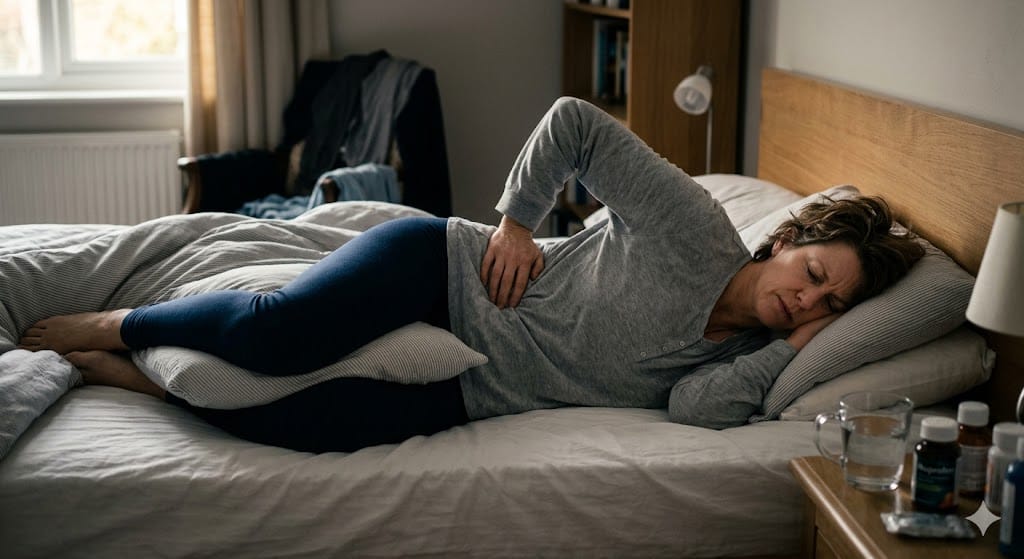
If you’re shopping, start with our guide to the best sleep positions for back pain. You wake up at 3 AM and the pain is there again. A dull ache across your lower back that wasn’t there when you fell asleep. You try to roll over and realize you can’t, something catches in your lumbar region and you freeze. You calculate the slowest possible movement that won’t trigger the sharp stab. Eventually you make it onto your back. It feels marginally better for about 90 seconds before the aching returns, different this time but equally present. By 6:30, your back has decided you’re not walking upright for the first twenty minutes of your morning. You hobble to the bathroom like a person twice your age. For more, see how to relieve pain for better sleep.
Lower back pain during sleep affects roughly 80% of adults at some point in their lives. For about 20% it becomes chronic, persisting for three months or longer and dramatically reducing sleep quality. Unlike daytime back pain, which you can adjust around through posture changes and movement, sleep-related back pain traps you in positions that your body cannot modify without waking up. You sleep fewer hours. The sleep you get is less restorative. Sleep deprivation itself makes pain perception worse the next day. Each night of poor sleep makes the next night’s pain worse, creating a compound cycle.
Medical Disclaimer
This is general information about bedding and consumer products, not medical advice. Bedding can affect comfort and it does not treat pain conditions, and persistent pain warrants assessment by a doctor or physical therapist rather than a purchase.
How sleep modifications can relieve lower back pain
The good news is that sleep-related lower back pain responds well to specific interventions. Sleep position modifications, strategic pillow placement, appropriate mattress surface, and occasional targeted sleep aids can reduce or eliminate pain within 2-4 weeks of consistent application. A common frustration is that generic advice (“try sleeping on your back!”) doesn’t account for individual anatomy. It also ignores the specific cause of your pain or the real-world logistics of maintaining sleep positions through a full night. This guide walks through specific, evidence-based approaches that actually work. You’ll learn how to identify which approach matches your pain pattern, and when back pain requires medical evaluation beyond sleep surface solutions.
If you’re shopping for specific products to support back pain relief, our guides on best mattresses for back pain and best mattress toppers for back pain cover the sleep surface options that address this specific problem. For readers comparing the two options, our heat and ice comparison lays them out side by side.
Why sleep worsens lower back pain for most sufferers
Sleep creates unique demands on your lower back that your daytime body doesn’t experience. Understanding these demands helps explain why specific interventions work while others fail.
Loss of active spinal support
During the day, your lumbar spine maintains its natural curve through constant micro-adjustments of the core muscles. When you lie down, these muscles relax. Your spine falls into whatever curve your sleep surface creates. If the mattress is too firm, your lumbar curve becomes exaggerated, your lower back arches more than its neutral position, which strains the posterior ligaments and facet joints. If the mattress is too soft, your lumbar curve flattens or even reverses. Your hips sink and your lower back rounds, which strains the anterior structures including the discs themselves.
Position-specific strain
The second problem is position-specific. Side sleeping, which roughly 74% of adults default to, creates lateral pressure on the lumbar spine. Without proper support at the waist (where your body narrows between hip and shoulder), your spine bends sideways throughout the night. Stomach sleeping, used by about 16% of adults, forces you to turn your head to one side. Meanwhile, your lumbar region hyperextends to maintain a neutral pelvic position, a combination that strains both the neck and lower back simultaneously. Back sleeping, used by only 10% of adults but often recommended for back pain, exposes your lumbar spine to gravitational load without the cushioning that side sleeping provides.
The cost of position transitions
The third problem is position transitions. A healthy adult changes sleep position 20-30 times per night. Each transition involves brief muscle activation and spinal movement. This shouldn’t cause pain in a neutral spine, but it does cause pain in a spine that’s been strained by the preceding position. That’s why you can fall asleep comfortably and wake up in pain. The positions you were in during the night caused gradual strain that your waking-up transition finally made apparent.
The sleep disruption cycle
The fourth and often overlooked problem is sleep disruption itself. Pain disrupts sleep; disrupted sleep elevates inflammatory markers; elevated inflammation worsens pain perception the next day; worse pain perception disrupts the following night’s sleep. This compound cycle is why lower back pain sufferers often get “stuck” in a pattern that seems impossible to break. Breaking free requires intervening at multiple points simultaneously rather than addressing only one factor.
What sleep position changes do NOT solve: Pain from herniated discs, spinal stenosis, or other structural conditions typically requires medical intervention beyond sleep surface modifications. If your back pain includes leg numbness, tingling, weakness, or bladder or bowel problems, consult a physician before relying on sleep-based interventions alone. The recommendations in this guide address mechanical lower back pain, the most common type, and should not replace medical evaluation for symptoms suggesting structural problems.
The best sleep positions for lower back pain
Not all sleep positions are equal for lower back pain relief. Research and clinical experience converge on a specific hierarchy.
Side sleeping with knees bent and a pillow between them
This is the position most frequently recommended by physical therapists and sleep specialists for lower back pain. Lying on your side with both knees bent to approximately 45 degrees and a pillow between them does several things simultaneously. It aligns the pelvis horizontally, preventing the upper hip from rotating forward and twisting the lumbar spine. It also reduces strain on the piriformis muscle, which can contribute to sciatica-type pain. Finally, it maintains a neutral spinal curve throughout the night.
The pillow between your knees matters more than most people realize. Without it, your upper leg naturally falls forward as you sleep. This pulls your upper hip forward and creates rotational strain on the lower back. A firm pillow between the knees, ideally a dedicated knee pillow rather than a soft general-purpose pillow, keeps the upper leg stacked above the lower leg so the pelvis remains neutral.
For best results, sleep on your left side when possible. Left-side sleeping reduces pressure on the inferior vena cava (the major blood vessel returning blood to the heart). This improves nighttime circulation and is particularly recommended during pregnancy.
Back sleeping with pillow under knees
Back sleeping is often recommended for back pain but requires specific setup to work. A common mistake is lying flat on your back, which allows your lumbar spine to arch too much and creates pain by morning. The correct setup places a pillow (or rolled blanket) under your knees. This bends the knees to approximately 15-20 degrees and naturally flattens the lumbar curve toward a neutral position.
The knee pillow doesn’t need to be thick, roughly 4-6 inches of compressed height works for most people. Some sleepers benefit from an additional small rolled towel placed under the lower back itself to support the lumbar curve, though this depends on individual anatomy and requires experimentation.
Back sleeping works particularly well for lower back pain because it distributes your body weight uniformly across the mattress rather than concentrating it at side-sleeping pressure points. It’s especially useful for the first 2-4 weeks of a back pain flare-up, when side sleeping may aggravate the specific irritated area.
Fetal position on the side
Curling into a loose fetal position, lying on your side with knees drawn toward your chest, can provide temporary relief for certain types of lower back pain. This works particularly well when the pain stems from facet joint irritation or from vertebral compression. The position opens the spaces between vertebrae in the lumbar region, which reduces pressure on irritated nerves and facet joints.
Caution: don’t curl into a tight fetal position, which can exacerbate pain by putting the spine into an unnaturally flexed curve all night. A loose fetal position, knees bent to about 60-70 degrees from the torso, is the therapeutic version.
Stomach sleeping (position to avoid if possible)
Stomach sleeping is widely considered the worst position for lower back pain. The hyperextension of the lumbar spine throughout the night strains the posterior spinal structures, and the necessary head turn adds cervical strain. If you’re a lifelong stomach sleeper and cannot change, a thin pillow under the pelvis (not under the head) reduces some of the lumbar hyperextension.
For stomach sleepers trying to transition to side sleeping, a body pillow in front of you helps the transition. It simulates the pressure sensation of lying on your stomach while actually lying on your side. Most transitioning sleepers adapt within 2-3 weeks, though some never fully adjust.
Pillow placement strategies that actually work
Pillow placement affects sleep-related back pain more than most sufferers realize. Here’s where each pillow goes and why.
The head pillow
Your head pillow height should position your head so that your cervical spine stays in line with your thoracic and lumbar spine. For side sleepers, this typically means a pillow approximately 4-6 inches thick when compressed, enough to fill the space between your shoulder and your ear. For back sleepers, a thinner pillow (2-4 inches) works better, because your head doesn’t need to be raised as much.
A pillow that’s too thick for your position pushes your head forward. That strains the cervical spine and can refer pain downward to the lumbar region through neural pathways. A pillow that’s too thin lets your head drop backward (for side sleepers) or your chin jut upward (for back sleepers), which creates similar neural tension.
For combination sleepers who change positions throughout the night, an adjustable loft pillow, typically memory foam shreds that you can add or remove, provides the flexibility to approximate different heights for different positions. Our best pillows for combination sleepers guide covers options in this category.
The knee pillow (or pillow between knees)
For side sleepers, this is the most important secondary pillow for back pain. As described above, the knee pillow prevents pelvic rotation that causes lumbar twist throughout the night. Dedicated knee pillows with contoured shapes hold position better than general-purpose pillows, which tend to slip out during the night.
For back sleepers, the pillow goes under the knees rather than between them. This bends the knees slightly and flattens the lumbar curve toward neutral.
The lumbar support pillow (optional)
Some back sleepers benefit from additional lumbar support, a small rolled towel or dedicated lumbar support pillow placed under the lower back itself. This fills the natural gap between your lower back and the mattress surface, maintaining the lumbar curve throughout the night.
Caution: lumbar support pillows are personal. Some sleepers find them transformative; others find them uncomfortable. Experiment with a rolled towel before buying a dedicated product to determine if additional lumbar support helps your specific anatomy.
The arm support pillow (for side sleepers)
Many side sleepers with lower back pain also wake with shoulder or arm numbness. That itself can contribute to the pattern of disrupted sleep that worsens back pain perception. A small pillow hugged in front of your chest, sometimes called a “cuddle pillow”, rests your upper arm forward rather than letting it drape across your chest. This reduces shoulder compression and prevents arm numbness.
The wedge pillow for reflux-related sleep problems
If gastroesophageal reflux contributes to your sleep disruption (about 20% of lower back pain sufferers also experience GERD), a bed wedge pillow can help. Elevating your upper body to approximately 30-45 degrees reduces reflux while maintaining enough horizontal position for side sleeping. This addresses a confounding factor that can make back pain seem worse than it actually is.
The mattress firmness question for lower back pain
Mattress firmness affects lower back pain significantly, but the relationship is more nuanced than common recommendations suggest.
Why “firm is best” is oversimplified
The standard advice, “firm mattresses are best for back pain”, comes from a specific type of structural concern: sagging, unsupportive mattresses that don’t maintain spinal alignment. For this specific problem, firmer is better than softer. But firmer is not universally better.
Medium-firm is the sweet spot
Medium-firm is optimal for most lower back pain sufferers. A 2003 study in the Lancet randomized 313 adults with chronic lower back pain to firm vs medium-firm mattresses for 90 days. The medium-firm group reported significantly less pain both in bed and upon arising. Subsequent research has consistently supported medium-firm as the sweet spot, typically measured as 5-7 on the 1-10 firmness scale.
The reason medium-firm outperforms firm is subtle but important. A too-firm mattress creates pressure points at the hips and shoulders during side sleeping. That causes the waist to stay elevated and the lumbar spine to bend sideways throughout the night. A medium-firm mattress allows the hips and shoulders to sink slightly while providing enough support to keep the waist aligned, which produces a neutral spinal curve.
Too-soft mattresses (3 or below on the firmness scale) are clearly problematic. They allow excessive sinking in the middle region, which causes the spine to curve unnaturally in a hammock-like pattern.
Toppers and mattress age
If your existing mattress is wrong, a topper is often the most cost-effective fix. Adding a 3-4 inch topper to a too-firm mattress softens the surface to medium-firm range. Adding a firm topper to a sagging mattress can extend its life temporarily, though severely sagging mattresses eventually need replacement. Our best mattress toppers for back pain guide covers options specifically targeting this problem.
Mattress age matters independently of firmness. Mattresses older than 7-8 years typically lose structural integrity regardless of their original firmness rating. If your mattress is over 8 years old and you’re experiencing new lower back pain, mattress replacement is often the actual solution, even if the mattress still “looks fine” from the outside.
The morning routine that prevents back pain re-injury
How you get out of bed matters almost as much as how you slept. Lower back pain sufferers frequently re-injure themselves during the transition from sleeping to standing.
The five-step wake-up sequence
Step 1: Gentle movement before getting up. Before leaving bed, spend 2-3 minutes doing gentle stretches while still lying down. Knee-to-chest pulls (one leg at a time), gentle pelvic tilts, and slow trunk rotations warm up the spine and reduce the stiffness that causes morning pain.
Step 2: The log roll. Rather than sitting up directly (which strains the lumbar region), roll onto your side as a single unit. Keep your back straight and your knees bent together. This moves your whole body as a rigid unit, avoiding the twisting motion that aggravates back pain.
Step 3: Use your arms to push up. From the side-lying position, push up with your arms while swinging your legs over the edge of the bed. Let your arm strength do the work rather than your core. The push-up motion keeps the spine neutral throughout the transition.
Step 4: Pause before standing. Once you’re sitting on the edge of the bed, pause for 30-60 seconds before standing. This gives your circulation time to adjust and lets your back muscles warm up for the weight-bearing transition to standing.
Step 5: Stand slowly and walk for 2-3 minutes. The first movements after standing should be slow and deliberate. Walking for 2-3 minutes before doing anything else, including showering or making coffee, allows your spine to adjust to full vertical loading gradually. That beats shock-loading it with bending or lifting motions.
This routine takes about 5 minutes each morning. For chronic lower back pain sufferers, it’s one of the highest-leverage interventions available, and it costs nothing beyond the time investment.
Sleep surface products worth considering for lower back pain
Specific products address lower back pain in sleep more effectively than others. Below are the categories that have the strongest evidence for helping, with links to our curated recommendations.
A medium-firm mattress is the foundation. If your existing mattress is too firm, too soft, or too old, replacing it often produces dramatic improvement. The best mattresses for back pain guide covers top options across budgets.
A mattress topper is the lower-cost intervention if your mattress is still structurally sound but firmness-mismatched. The best mattress toppers for back pain guide covers memory foam, latex, and gel options at multiple price points.
A knee pillow for side sleepers is the single cheapest high-impact intervention. At typically $20-40, a good knee pillow reduces lumbar rotation throughout the night. Our best knee pillows for side sleepers guide covers the category.
A lumbar support pillow works for back sleepers who need additional lumbar curve support. Worth experimenting with a rolled towel first to determine if this helps your specific anatomy before investing in a dedicated product.
An adjustable bed base helps with severe lower back pain that responds to specific inclination angles. This is a larger investment ($500-2,000+) but transformative for some sufferers. Our best adjustable beds guide covers the category.
A body pillow suits transitioning stomach sleepers or side sleepers who want enhanced positional support. Less critical than the interventions above but helpful for specific sleep pattern modifications.
When sleep position changes aren’t enough
Some lower back pain requires intervention beyond sleep surface changes. Recognize these signs and consult a physician if they apply to you.
Leg symptoms. Pain, numbness, tingling, or weakness in one or both legs (especially below the knee) suggests nerve involvement that won’t resolve with sleep position changes. Sciatica, piriformis syndrome, and spinal stenosis all require evaluation and typically physical therapy or medical management.
Progressive worsening over weeks. Back pain that gradually gets worse over 4-6 weeks despite consistent sleep modification suggests structural or inflammatory causes that won’t respond to positional interventions alone.
Morning pain that doesn’t improve with movement. Pain that’s worst in the first hour after waking and improves with activity may indicate inflammatory conditions like ankylosing spondylitis, which require medical diagnosis and specific treatment.
Night pain that wakes you up. Pain that consistently wakes you from sleep at a specific time (often 3-4 AM) can indicate inflammatory conditions. Rarely, it may signal more serious causes that require medical evaluation.
Loss of bladder or bowel control. This is a medical emergency, cauda equina syndrome can cause permanent nerve damage if untreated. Seek immediate care.
History of cancer with new back pain. Any history of cancer combined with new back pain warrants medical evaluation to rule out metastatic disease.
For mechanical lower back pain, the kind that improves with movement, gets worse with prolonged sitting or certain positions, and doesn’t include the warning signs above, sleep position modifications alone can produce dramatic improvement. For everything else, sleep modifications are part of a larger treatment plan that should include medical guidance.
The recovery timeline for sleep-related back pain
How quickly you’ll see improvement with sleep modifications depends on the severity and chronicity of your pain.
Week 1: You’ll notice immediate improvement in some aspects, waking up less frequently, different quality of morning stiffness, slightly easier movement transitions. Don’t expect complete resolution; you’re changing long-established sleep patterns.
Week 2-3: The cumulative effect of consistent sleep position changes becomes more apparent. Morning pain is usually substantially reduced, and you’re falling asleep more easily because your body has learned the new positions. Position transitions during the night still feel awkward; this will improve.
Week 4-6: For mechanical lower back pain without structural causes, most sufferers experience 70-80% reduction in sleep-related pain by this point. If you’re still experiencing significant pain, reassess, the mattress may be the bottleneck rather than the positioning, or additional interventions (physical therapy, massage, exercise) may be needed.
Week 8-12: If sleep modifications alone haven’t produced satisfying improvement by this point, consider upgrading individual components. Start with the mattress or topper if you haven’t already, then add specific pillows you haven’t tried.
Ongoing: Lower back pain sufferers who successfully modify their sleep patterns typically maintain the improvements indefinitely, with occasional flare-ups that respond quickly to returning to the established routine. The sleep modifications become automatic within 6-12 weeks and stop requiring conscious effort.
When to expect faster or slower improvement:
- Faster improvement (1-2 weeks): Young sufferers with recent-onset pain, those with acute injuries, those with mild chronic pain
- Standard improvement (4-6 weeks): Most adult sufferers with moderate chronic pain, those aged 40-60
- Slower improvement (8-12 weeks): Older sufferers, those with decades of back pain, those who also need to lose weight or address other contributing factors
The lifestyle factors that compound sleep-related back pain
Sleep position changes work better when combined with daytime factors that affect back health. Here are the high-leverage lifestyle interventions.
Daytime posture awareness. If you sit at a desk for 8+ hours daily, your lumbar spine is under sustained strain regardless of how well you sleep. Adjustable desks (standing portions of the day), lumbar-supportive chairs, and hourly 2-minute walk breaks all reduce the daytime strain that amplifies nighttime pain.
Regular core strengthening. A strong core reduces lumbar strain in all positions, including during sleep. Even 10 minutes of daily core exercise (planks, bird-dogs, dead bugs) produces measurable improvement over 4-6 weeks.
Weight management. Excess abdominal weight increases lumbar strain throughout the day and night. Sleep surface optimizations work but produce smaller improvements for sufferers who carry significant extra weight at the abdomen.
Stress management. Psychological stress elevates muscle tension in the lower back specifically, a well-documented mechanism that contributes to “stress-related back pain.” Sleep modifications address the mechanical component but not the stress component. For chronic stress-related back pain, adding stress management techniques (meditation, therapy, exercise) substantially improves outcomes.
Hydration. Your intervertebral discs are 80% water, and chronic mild dehydration reduces their cushioning capacity. Drinking adequate water throughout the day (half your body weight in ounces is a reasonable target) supports spinal health and amplifies the benefits of sleep surface optimization.
Our summary: the specific protocol for most lower back pain sufferers
Here’s the condensed protocol if you want to start immediately.
The six-step protocol
Step 1: Adjust your sleep position to side-sleeping with a knee pillow. Start tonight. Use any firm pillow between your knees. Sleep on your left side when possible.
Step 2: Check your head pillow height. For side sleeping, the pillow should fill the space between your shoulder and ear, approximately 4-6 inches of compressed height. Adjust if too thick or too thin.
Step 3: Assess your mattress age and firmness. If your mattress is over 8 years old or clearly too firm or too soft, a quality topper is the fastest intervention. If the mattress itself is failing, plan for replacement in the next 3-6 months.
Step 4: Implement the morning routine. Spend 2-3 minutes doing gentle stretches before leaving bed. Log roll to the side before sitting up. Pause on the edge of the bed before standing. Walk for 2-3 minutes before any bending or lifting.
Step 5: Give it 4-6 weeks. Don’t evaluate after one or two nights. Sleep position changes require consistent application over weeks to produce cumulative improvement.
Step 6: Add secondary interventions if needed. If 4-6 weeks of position changes don’t produce adequate improvement, add in order: (a) a better mattress or topper, (b) targeted core strengthening exercises, (c) professional evaluation for physical therapy or medical management.
What this protocol achieves
This protocol resolves 70-80% of mechanical lower back pain for most sufferers within 4-8 weeks of consistent application. For persistent or severe pain, medical evaluation remains important, but the sleep protocol provides meaningful relief even when additional intervention is needed.
The broader point: lower back pain during sleep is usually solvable, and the interventions that work are well-established and inexpensive. Most sufferers improve substantially without spending money on products. Those who do invest in products (mattresses, toppers, pillows) typically see the investment pay off within weeks rather than months. Don’t accept chronic lower back pain as inevitable. Start with position changes tonight and plan for the cumulative improvement over the next 4-6 weeks.
Related guide: wedge and leg elevation pillows.
Frequently asked questions
What’s the best sleep position for lower back pain?
For most sufferers, side sleeping with bent knees and a pillow between the knees produces the best outcomes. This position aligns the pelvis horizontally and prevents the lumbar rotation that causes morning pain. Back sleeping with a pillow under the knees is the second-best option and may work better for some anatomical types. Stomach sleeping is generally the worst position for lower back pain and should be modified if possible.
Should I use a firm or soft mattress for lower back pain?
Medium-firm mattresses (approximately 5-7 on the 1-10 firmness scale) produce the best outcomes for lower back pain according to multiple clinical studies. Too-firm mattresses create pressure points that cause lateral spinal bending during side sleeping. Too-soft mattresses allow excessive sinking that causes spinal curvature. The exception: if your existing mattress is sagging, firmer is better than more sagging. Consider a quality topper or replacement if your current mattress falls outside the medium-firm range.
How long does it take for sleep changes to help lower back pain?
Most sufferers notice some improvement within the first week of consistent sleep modification. Substantial improvement (70-80% pain reduction for mechanical back pain) typically occurs within 4-6 weeks. Chronic severe back pain may take 8-12 weeks to respond, and some cases won’t fully resolve without additional intervention like physical therapy. Don’t evaluate after only 1-2 nights, the cumulative effect requires consistent application over weeks.
Is sleeping on my back good for lower back pain?
Yes, when set up correctly. Back sleeping with a pillow under the knees is the second-best position for lower back pain (after side sleeping with a knee pillow). The pillow under the knees bends your legs slightly and flattens the lumbar curve toward neutral, reducing overnight strain. Lying flat on your back without knee support often worsens back pain by allowing lumbar hyperextension throughout the night.
Can a pillow between my knees really help with back pain?
Yes, this is one of the most evidence-based and cost-effective interventions for sleep-related lower back pain in side sleepers. Without a pillow between the knees, the upper leg naturally falls forward during the night. That pulls the upper hip forward and creates rotational strain on the lumbar spine. A firm pillow between the knees keeps the pelvis aligned and substantially reduces overnight lumbar strain. Most users notice improvement within the first week.
When should I see a doctor about my lower back pain?
See a doctor if you experience any of the following: pain, numbness, or weakness extending into your legs; progressive worsening over weeks despite consistent sleep modifications; pain that wakes you at the same time every night; loss of bladder or bowel control (medical emergency); back pain with fever; or back pain with a history of cancer. For mechanical back pain without these warning signs, sleep modifications typically produce substantial improvement within 4-6 weeks, and medical evaluation can wait if improvement is occurring.
What kind of pillow is best for lower back pain?
For the head, use a medium-thickness pillow that maintains cervical alignment, about 4-6 inches compressed for side sleepers, 2-4 inches for back sleepers. Between the knees (side sleepers) or under the knees (back sleepers), a firm contoured knee pillow is ideal. If you need optional lumbar support as a back sleeper with a significant lumbar curve, a rolled towel or dedicated lumbar support pillow can help. Head pillow thickness matters more than most people realize. Pillows that are too thick or too thin refer strain down to the lower back through neural tension.
Does a bed wedge pillow help with back pain?
Sometimes. Bed wedge pillows (which elevate the upper body) help with back pain when the pain is associated with gastroesophageal reflux, specific breathing problems, or certain spinal conditions that respond to elevation. For most mechanical lower back pain, a wedge pillow isn’t the primary solution, side sleeping with a knee pillow works better. However, if you also experience reflux that disrupts your sleep, addressing the reflux with a wedge can indirectly improve back pain by allowing deeper, more consistent sleep.
Recommended Reading
See also our guides to window insulation kits for quiet sleep, and why do i drool in my sleep.
Related Reading
Explore more: Inversion Tables That Take the Pressure Off Your Back in 202, late exercise and sleep, Talking in Your Sleep? The Science Behind Somniloquy, how to sleep with sciatica, how to sleep on a plane, seat cushions for tailbone pain, how screens affect sleep, and how alcohol affects sleep.
Sources
- American Academy of Orthopaedic Surgeons. OrthoInfo patient resources. https://orthoinfo.aaos.org/
- National Institutes of Health. MedlinePlus health topics. https://medlineplus.gov/
