
I have lived with chronic insomnia for years, so the memory foam vs spring mattress question was never abstract for me. It decided whether I spent the night asleep or staring at the ceiling. When you toss and turn the way I do, the surface under you stops being a comfort detail and becomes the thing that either settles your body or keeps it restless. Comparing options? See our best memory foam pillows roundup.
The two construction types produce dramatically different nights. One conforms slowly and absorbs every shift you make. The other responds fast and lets you move freely. Neither is the universal answer. The right pick depends on your sleep position, body weight, temperature, and how much a restless partner affects you.
Most people choose wrong because they default to whatever they slept on last. A bad spring mattress pushes them toward foam. A bad foam mattress pushes them back to springs. Neither reaction looks at what each construction actually does well. This guide walks through support, motion isolation, temperature, durability, and price, and it points each type toward the sleeper it fits instead of crowning a winner.
If you already know which type you want, our best mattresses for stomach sleepers with back pain and best mattress toppers for back pain guides cover specific products by construction type.
Disclosure: RestRight is reader-supported. As an Amazon Associate, we earn from qualifying purchases made through links on this page, at no extra cost to you.
What a Memory Foam Mattress Does
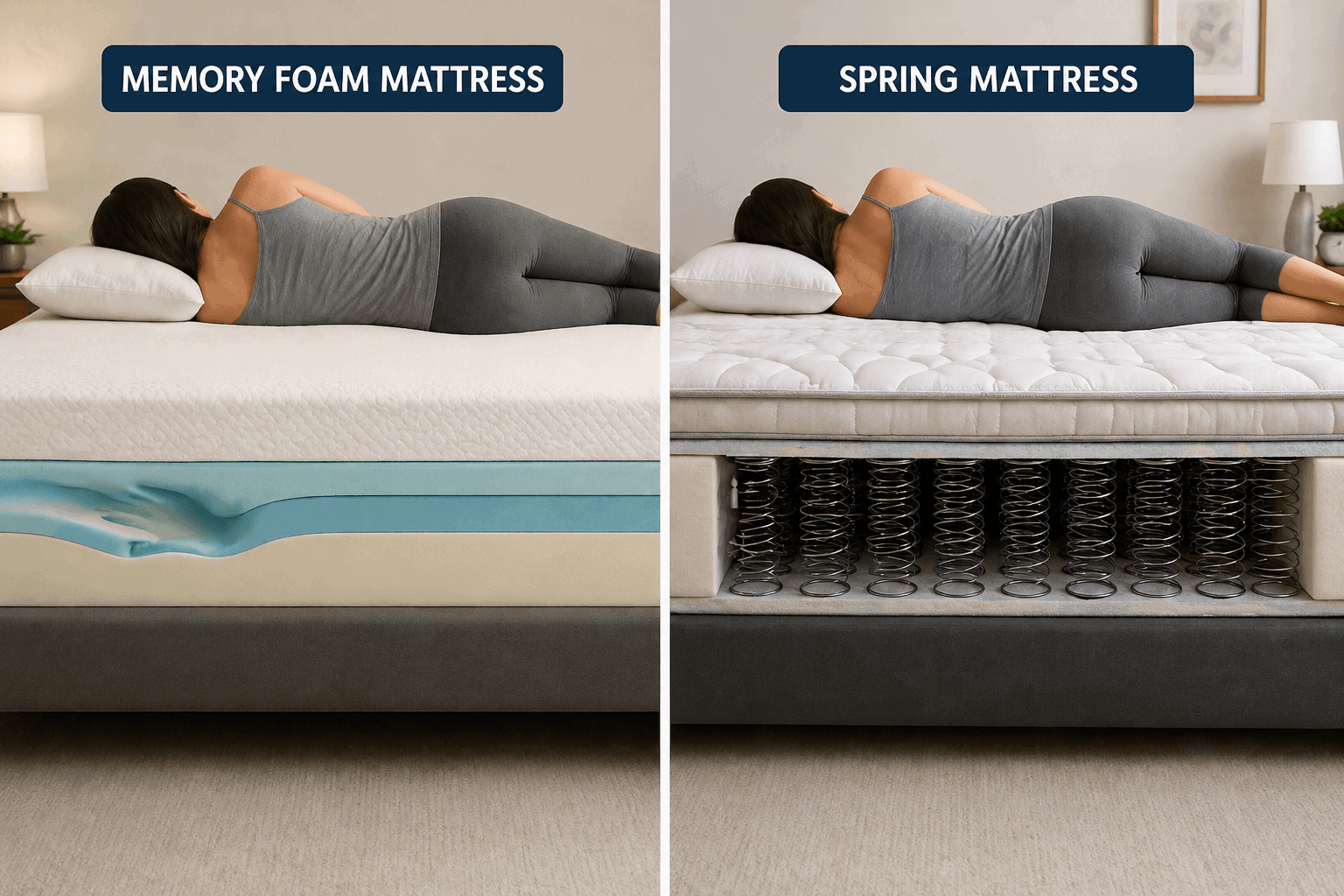
Memory foam mattresses use layered foam. The top layer is viscoelastic foam that conforms to body shape under heat and pressure. The support core is a denser polyurethane foam that holds the structure. Together, they create the slow-sinking feel memory foam is known for.
How memory foam supports the body
Memory foam responds to body heat. The areas under the heaviest pressure, usually the hips and shoulders, soften and conform. Lighter-pressure areas stay firmer. The result is even pressure distribution, and the pressure points that build up on firmer surfaces tend to fade.
The slow response time creates the cradling sensation. Movement leaves impressions that take 2 to 5 seconds to recover, so the mattress molds to whatever position you settle into.
Motion isolation strengths
Memory foam isolates motion better than any other mattress construction. A partner moving on one side produces almost no movement on the other. This matters most for two groups:
- Couples with different schedules. An early riser barely registers on the other side of the bed.
- Light sleepers with active partners. Movement that would jolt you awake on springs often goes unnoticed.
Temperature concerns
Traditional memory foam sleeps warmer than spring mattresses. The dense foam traps body heat against the sleeper, and hot sleepers often find it uncomfortable for that reason.
Modern memory foam includes cooling technologies that target the problem:
- Gel infusion pulls heat away from the surface.
- Copper infusion conducts heat outward.
- Open-cell construction improves airflow through the foam.
- Phase-change covers regulate surface temperature.
These help, but they reduce the temperature gap rather than erase it.
What a Spring Mattress Does
Spring mattresses use coils as the main support layer with thinner comfort layers on top. The coils give the bounce and quick response that define this type. Innerspring, pocketed, and continuous coils each behave differently.
How springs support the body
Coils compress under weight and push back instantly. Response time is essentially zero, so movement produces immediate counter-pressure. The pushback feels like active support rather than a slow sink.
Pocketed coils, individual springs wrapped in fabric, support body zones independently. The hip can sink while the shoulder stays elevated. That zoned response delivers pressure relief close to memory foam without the slow conformity.
Motion transfer concerns
Traditional innerspring mattresses transfer motion across the whole surface. A partner rolling over moves the entire bed. Pocketed coil designs isolate motion far better, though they still transfer more than memory foam. Couples whose schedules clash heavily should lean toward memory foam or hybrid construction.
Temperature strengths
Spring mattresses sleep cooler. The space between coils allows air to move through the mattress, so body heat dissipates rather than builds up. Hot sleepers strongly prefer springs, and this cooling edge holds steady across price points.
Bounce and edge support
Spring mattresses bounce when you sit on them, which makes getting in and out of bed easier than on foam. Edge support is also usually stronger. Reinforced perimeter coils prevent the roll-off feeling some foam mattresses produce near the edges.
Check Price on AmazonSide-by-Side Comparison
The table below sums up the practical differences. I added a restlessness row because, for anyone who tosses and turns, it is the line that matters most. Prices are rough estimates and shift with sales and seasonal promotions, so treat them as a range rather than a quote.
| Feature | Memory Foam | Spring |
|---|---|---|
| Pressure relief | Excellent | Good |
| Motion isolation | Excellent | Fair to good (pocketed coils) |
| Restlessness / insomnia sufferers | Excellent: dampens tossing so one restless shift does not ripple into more | Fair: easy to reposition and never feel stuck, but movement carries across the surface |
| Cooling | Fair to good | Excellent |
| Bounce and responsiveness | Slow | Fast |
| Edge support | Fair | Excellent |
| Durability | 8 to 10 years typical | 7 to 10 years typical |
| Price range | $400 to $3,000 | $300 to $2,500 |
| Body conforming feel | Cradling | Supportive |
| Off-gassing | Initial off-gassing common | Minimal |
One nuance behind that restlessness row: memory foam wins if your problem is physical restlessness that compounds, because it quiets each movement. Springs win if your problem is feeling trapped, because the quick response lets you turn over without fighting the surface. Restless sleepers fall into both camps, so be honest about which one describes you.
Which Sleeper Fits Each Type
Memory foam fits these sleepers best.
- Side sleepers. The conforming layers fill the gap between the shoulder and hip that creates pressure points on firmer surfaces.
- People with chronic pain. Fibromyalgia, arthritis, and herniated discs often flare less overnight when pressure points ease and joints stay supported.
- Light sleepers with active partners. Partner movement that wakes you on springs frequently goes unnoticed on foam.
Spring mattresses fit these sleepers best.
- Hot sleepers. The temperature gap matters more than most people expect, and springs run cooler.
- Heavy sleepers over 230 pounds. Coils hold hips elevated, while foam can let heavier sleepers sink too deeply.
- Back and stomach sleepers. Fast-responding coils hold spinal alignment without the slow sink that pulls these positions out of neutral.
- People often get in and out of bed. Pregnant women, people with mobility issues, and parents of young children move more easily on a surface that bounces.
Hybrid Mattresses: The Middle Ground
Hybrid mattresses combine memory foam comfort layers with pocketed coil support cores. The aim is to capture the strengths of both while trimming the drawbacks.
What hybrids do well
Hybrids pair foam pressure relief with the cooling and bounce of springs. The coil core breathes better than all-foam construction, and the foam top conforms better than thin spring comfort layers. They work well for couples with different preferences, since the mix satisfies both partners more often than either pure type. Motion isolation beats a plain spring mattress, though it stops short of all-foam.
What hybrids do poorly
Hybrids cost more than comparable pure foam or pure spring options. Premium hybrids run $1,500 to $3,000, where comparable pure builds land at $1,000 to $2,000. They also weigh more, usually 100 to 150 pounds in queen size, which makes moving or rotating them harder.
When to choose a hybrid
- You want foam pressure relief, but cannot tolerate the heat of pure foam.
- Partners disagree on construction preference.
- Your budget reaches the premium tier, where hybrids perform best.
For specific hybrid recommendations, our best mattresses for stomach sleepers with back pain guide covers hybrid options that work well for back pain.
Check Price on AmazonCost and Lifespan
Memory foam pricing and lifespan
Memory foam ranges from $400 budget options to $3,000 premium ones. The mid-range $800 to $1,500 tier delivers the best value for most buyers. Quality mid-range foam lasts 8 to 10 years before meaningful softening. Premium foam lasts 10 to 12 years. Budget foam lasts 5 to 7 years, since lower-density foam compresses faster.
Spring mattress pricing and lifespan
Spring mattresses range from $300 budget options to $2,500 premium ones. The mid-range $700 to $1,400 tier offers the best value. Quality mid-range springs last 7 to 10 years. Premium coil construction reaches 10 to 12 years, and budget springs last 5 to 7 years. Coil quality drives longevity more than the sticker price.
Cost-per-year math
The math favors mid-range options, whichever construction you pick. A $1,200 mattress lasting 10 years costs $120 a year. A $400 mattress lasting 5 years costs $80 a year, slightly cheaper but with worse sleep. A $2,500 mattress lasting 12 years costs $208 a year and rarely delivers proportional improvement. The $800 to $1,500 tier balances upfront price, build quality, and lifespan best.
Our Verdict
Memory foam is the right call for side sleepers, people with chronic pain, light sleepers with active partners, and anyone who values pressure relief over cooling and bounce. The conforming layers ease pressure points, and the motion isolation lets restless sleepers and their partners get through the night. Cooling technologies soften the heat issue without removing it.
Spring is the right call for hot sleepers, heavy sleepers, back and stomach sleepers, and anyone who values cooling, bounce, and edge support. Pocketed coils deliver motion isolation close to foam while keeping the cooling and responsiveness. If your restlessness comes from feeling stuck rather than from compounding movement, it sets you free to turn over without a fight.
Hybrids split the difference for couples with conflicting preferences and sleepers who want pressure relief without heat. The premium tier earns its price for buyers who fit that case. On a tight budget, choose pure foam or pure spring over a budget hybrid that compromises on both.
One honest caveat: a mattress is a sleep environment, not a cure. It shaped my nights, but it sits alongside routine, light, and stress, and chronic insomnia that does not improve is worth raising with a doctor. For specific product recommendations within each category, our best mattresses for stomach sleepers with back pain and best mattress toppers for back pain guides cover picks by construction type and sleep need.
Frequently Asked Questions
What is better, memory foam or a spring mattress?
Neither construction is universally better. Memory foam works better for side sleepers, people with chronic pain, and couples where one partner sleeps lightly. Spring mattresses work better for hot sleepers, heavy sleepers, back and stomach sleepers, and anyone who values cooling and responsiveness. The right choice depends on sleep position, body weight, temperature, and partner sensitivity.
Do memory foam mattresses sleep hot?
Traditional memory foam sleeps warmer than springs because the dense foam traps body heat. Modern foam adds gel infusion, copper infusion, open-cell construction, and phase-change covers that reduce the buildup. These help without erasing the gap. Hot sleepers usually do better on spring or hybrid mattresses than on even the best cooling foam.
How long do memory foam and spring mattresses last?
Mid-range memory foam lasts 8 to 10 years, and mid-range springs last 7 to 10 years. Premium options of either type reach 10 to 12 years, and budget options of either type last 5 to 7 years. Lifespan depends more on build quality than construction. Higher-density foams and higher-quality coils both outlast budget alternatives in the same category.
Is a memory foam or spring mattress better for back pain?
Both can work, depending on the cause. Memory foam helps back pain driven by pressure points and suits people with chronic pain conditions. Spring mattresses help back pain driven by inadequate support and suit stomach sleepers. Correct firmness matters more than construction for most back pain, and hybrids often perform best by combining foam relief with spring support.
Are hybrid mattresses worth the extra cost?
Hybrids earn their cost when your budget reaches the $1,500 to $3,000 premium tier, where they perform best. Below that tier, hybrid construction often compromises on both foam and coil quality compared with pure foam or pure spring at the same price. Couples with conflicting preferences and sleepers who need pressure relief without heat get the most value from premium hybrids.
Which mattress type is best if I toss and turn all night?
It depends on why you move. If restlessness compounds, where one shift wakes you and leads to more, memory foam helps because it absorbs movement instead of returning it. If you feel stuck and struggle to reposition, a spring mattress helps because the quick response lets you turn over freely. Honest self-diagnosis of your pattern matters more than the construction label.
Does a mattress affect how fast I fall asleep?
A mattress influences comfort and physical restlessness, both of which affect how settled you feel at bedtime. A surface that eases pressure points and limits disruptive movement removes some obstacles to falling asleep. It is one factor among many, alongside routine, light exposure, caffeine, and stress, rather than a single fix for slow sleep onset.
When should I see a doctor about my sleep?
If poor sleep persists for weeks despite a comfortable mattress and a steady routine, talk to a doctor or sleep specialist. Ongoing insomnia, loud snoring with pauses in breathing, or daytime exhaustion can point to conditions a mattress cannot address. A mattress is a comfort tool, not a treatment, and persistent sleep problems deserve medical attention.
Recommended Reading
See also our guides to how to store a mattress, memory foam vs gel memory foam mattress, and memory foam vs latex mattress.
Related Reading
Explore more: why is my mattress sagging, how to store a mattress, mattress cleaners, memory foam vs gel memory foam mattress, memory foam vs latex mattress, memory foam vs down alternative pillow, king vs california king mattress, and mattress topper vs mattress pad.
