
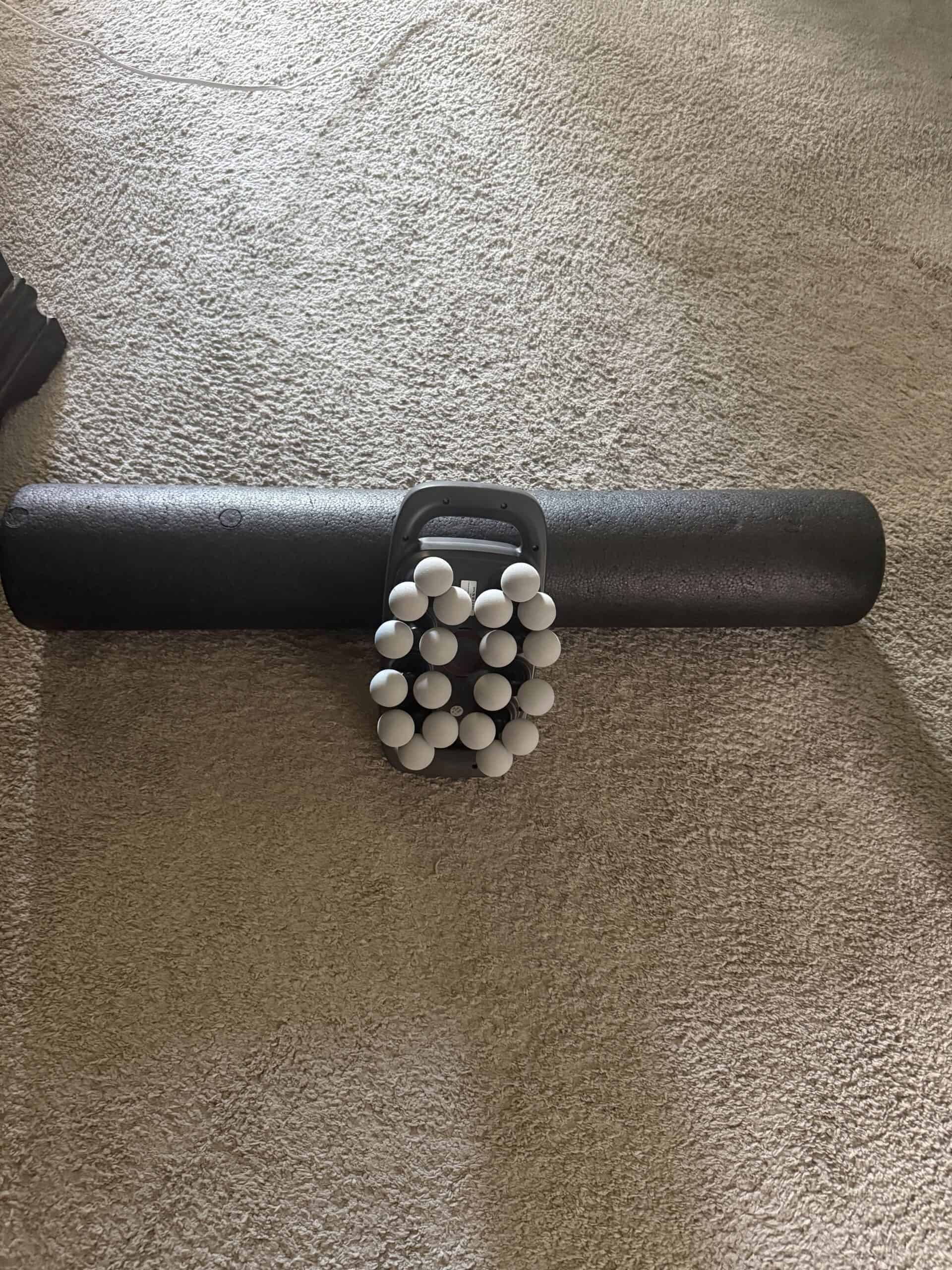
A foam roller and a massage gun look like competing answers to the same problem, and in practice they are not. One covers large areas with your bodyweight behind it. The other puts concentrated pressure exactly where you point it. I own both, and they have divided the work between themselves without me deciding anything.
Important
This is general information and my own experience, not medical advice. Neither tool treats an injury. Sharp pain, radiating pain, numbness, or anything lasting weeks needs a doctor or physical therapist rather than a device.
Quick Verdict
Roller for large muscles and general tightness, mostly legs. Gun for targeted relief on one specific spot. If you buy one, buy the roller: it does the broad work that most people actually need, it costs a fraction as much, and there is nothing to charge. Pairing a gun with electrical stimulation is a different question again, and our guide on using a massage gun and a TENS unit together covers the order that makes sense.
Key Takeaways
- The roller is broad. The gun is precise. That is the entire difference.
- Bodyweight sets the roller’s pressure. A motor sets the gun’s.
- The roller wins on cost, durability, and having no battery.
- The gun wins on reaching a specific spot without getting on the floor.
- Neither breaks up scar tissue or releases fascia, whatever the marketing says.
The Split
| Foam roller | Massage gun | |
|---|---|---|
| Coverage | Large areas, whole muscle | One spot at a time |
| Pressure from | Your bodyweight | A motor |
| Best at | Legs, general tightness | Targeted relief |
| Effort | You do the work | It does the work |
| Cost | Low | Considerably more |
| Battery | None | Yes, and it will die eventually |
| Quiet | Silent | No |
How They Actually Divide Up
I did not plan this. It settled on its own after a while of owning both.
The roller does legs. Broad passes, whole muscle at a time, bodyweight doing the work while I move slowly. It handles general tightness and soreness, which is most of what I have.
The gun is for targeted relief. When there is one specific place that needs attention, that is what comes out. It is precise in a way the roller cannot be, because a roller is a cylinder and your body is not.
I also have a massage ball, which relieves pressure on specific areas, and it overlaps with the gun more than either overlaps with the roller. That tells you something: the roller is the odd one out, and it is the one doing the job the other two cannot.
Why Bodyweight Matters
This is the mechanical difference that drives everything else.
On a roller, you are on top of it. Gravity supplies the force, and you regulate it by how much of your weight you commit and how you position yourself. That means real pressure is available without any effort from your arms, and it means the pressure spreads across whatever part of the cylinder you are on.
A gun works the opposite way. A motor drives a head into the muscle, and you hold it there. The force is whatever the device produces, concentrated into a small head, aimed by your hand.
So the roller gives you force with poor aim, and the gun gives you aim with moderate force. Neither is better. They are answers to different questions, which is also why choosing a roller is mostly about density and length rather than about beating a gun on anything.
What the Roller Does Better
Legs, and it is not close.
Quads, hamstrings, calves are large muscles, and going after them with a gun means working across a big area a few square inches at a time. The roller covers the whole thing in a pass. For general post-day or post-training tightness spread across a muscle, that is exactly right.
It is also cheaper by a wide margin, it never needs charging, there is nothing to break, and it is silent. Mine has been going at least three years and looks the same as it did. A gun has a battery and a motor, and both of those are things that eventually stop.
And at night, the roller wins by default. The gun is percussive and loud and feels like operating a tool. Rolling before bed works partly because it is a quiet, passive thing you do lying on the floor.
What the Gun Does Better
One spot, precisely, without getting on the ground.
If there is a specific knot or a specific area that wants attention, the gun goes straight there. A roller has to approximate: you get on it, shift around, and try to line the cylinder up with something the cylinder was never shaped for.
The gun also reaches places the roller cannot, because rolling requires you to press a body part against the floor. That works for legs and an upper back. It does not work for a shoulder or a forearm, and it certainly does not work while you are sitting at a desk.
That is the honest case for owning one: it does a thing the roller structurally cannot. The gun roundup covers what separates them, and a massage ball gets at much the same use for a lot less money.
Buy One First
If it is one or the other, the roller.
Most people’s problem is general tightness in large muscles, mostly legs, and that is exactly the roller’s job. It is cheap enough that a wrong guess costs little. It has no battery to die and no motor to fail. And if it turns out you want precision later, a massage ball adds that for very little, which makes the gun the third purchase rather than the second.
Buy the gun first if your problem is genuinely specific: one recurring spot, or somewhere you cannot press against the floor. That is a real situation and the roller does not solve it. It is just not the common one.
What Neither One Does
Both categories oversell, so it is worth being plain.
Neither breaks up scar tissue. Neither releases fascia in any structural sense. Neither lengthens a muscle. The Cleveland Clinic’s guidance on rolling is a sober read, and the research supports short-term flexibility and reduced post-exercise soreness. That is a modest, real set of benefits, and it is what both tools deliver by different routes.
My own use matches the modest version: soreness, mild tightness, some tension relief. Nothing transformative, and I go in phases with it besides. How often you roll matters more than which device you bought.
When Neither Is the Answer
Both are for ordinary tightness in healthy muscle.
Sharp pain, pain shooting down a limb, numbness, or anything that has run for weeks is a doctor or physical therapist conversation, and buying a device instead delays the thing that would help. Do not use a gun over a joint, a bone, or an injury, and do not roll your lower back.
And if the reason you are shopping is that you wake up sore or stiff, the answer may not be a recovery tool at all. Waking up in pain often points at what you are sleeping on, and a topper has solved more of that than any gadget.
Recommended Reading
See choosing a roller and using one. For picks, see foam rollers and massage guns, and using a foam roller before bed.
Foam Roller vs Massage Gun FAQ
Should I buy a foam roller or a massage gun?
The roller, if it is one or the other. Most people’s actual problem is general tightness across large muscles, mostly legs, which is precisely what a roller is for. It costs a fraction as much, has no battery, and nothing on it can fail. The gun solves a narrower problem.
What is the real difference between them?
Where the force comes from. On a roller your bodyweight supplies the pressure and it spreads across the cylinder, so you get real force with poor aim. A gun has a motor driving a small head wherever you point it, so you get precise aim with moderate force. Everything else follows from that.
Do I need both?
No, though I own both and they have ended up doing different jobs without me planning it. The roller does legs and general tightness; the gun does targeted relief on one spot. If you later want precision, a massage ball adds it for very little money, which makes the gun the third purchase rather than the second.
Is a massage gun better for knots?
It is better at reaching one specific place, yes. A roller is a cylinder and has to approximate, so you end up shifting around trying to line it up with something it was never shaped for. That said, a massage ball does much the same job for a fraction of the price.
Which is better before bed?
The roller, comfortably. A gun is percussive and loud and feels like operating equipment, none of which suits the hour. The roller is passive: you lie on it and move slowly. When I use one at night it is for leg tension, and the quiet matters.
Which lasts longer?
The roller, and it is not really a contest. Mine is at least three years old and is indistinguishable from new. It is dense foam around a core with nothing to fail. A gun has a battery and a motor, and both of those have a finite life.
Can either replace a massage?
No. Both are for ordinary tightness and post-exercise soreness in healthy muscle, and the honest evidence supports short-term flexibility and less soreness. Neither breaks up scar tissue, releases fascia, or lengthens muscle, whatever the packaging claims.
Can I use a massage gun on my lower back?
Be careful, and the same caution applies to rolling there. Avoid bone, joints, and anything injured. If your lower back is the actual problem, that is a physical therapist question, and it is worth ruling out your mattress before blaming your muscles.
For the third option, where a ball fits alongside both.
Part of our full guide: the complete guide to easing pain for better sleep.
