
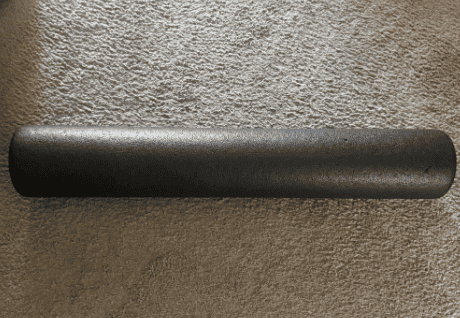
Choosing a foam roller comes down to three decisions: how firm, how long, and smooth or textured. Everything else is marketing. I have used a smooth foam roller for at least three years, and the thing nobody tells you is that the best roller is the one you will actually pull out of the closet, which argues for less aggressive than you think.
Important
This is general information and my own experience, not medical advice. Foam rolling is not appropriate for every condition, and pain that is sharp, radiating, or persistent needs a doctor or physical therapist rather than a roller. Do not roll directly over an injury, a joint, or your lower back.
Quick Verdict
Get a smooth, medium-density roller around 18 to 36 inches. Smooth is enough for almost everyone, and a textured roller is a preference rather than an upgrade. Firmness matters more than any other spec, and most people buy too firm and then stop using it.
Key Takeaways
- Density is the real decision. Too firm and it becomes a chore you skip.
- Smooth handles almost everything. Texture is preference, not performance.
- Length decides what you can do. Long rolls your back, short travels.
- A foam roller and a stick roller are different tools, not competing versions of one.
- The roller you use twice a week beats the aggressive one you own and avoid.
The Three Decisions
| Decision | Options | What I would pick |
|---|---|---|
| Density | Soft, medium, firm | Medium. Firm is where good intentions go to die. |
| Surface | Smooth, textured | Smooth. Mine is smooth and I have never wanted otherwise. |
| Length | 12in, 18in, 36in | Long enough to lie across. Mine is the bigger size. |
| Diameter | 5in, 6in | Six. Five sits you lower and works your core harder. |
| Hollow core | Yes/no | Irrelevant unless you are checking a bag. |
Density Is the Whole Decision
If you get one thing right, get this one. Density determines whether the roller becomes part of your week or an object in a closet.
The instinct is that firmer means more effective, and it is the wrong instinct. A firm roller on tight legs is genuinely unpleasant, and unpleasant things do not get done. I go in phases with mine, using it often and then not at all for stretches, and I am fairly sure a punishing roller would have turned those quiet phases into permanent ones.
Medium density does what you need. It gives enough to be tolerable and enough resistance to reach the tissue. Soft rollers exist and they are reasonable if you are starting from a very tight, very sore place, though most people outgrow them.
The frequency question matters more than the intensity question, and how often you should roll gets into why consistency beats effort here.
Smooth or Textured
Textured rollers, the ones with ridges and knobs, are sold as targeting knots more precisely. My honest read after three years on a smooth one: I have never felt like I was missing something.
The case for texture is that the raised sections concentrate pressure into smaller areas. That is true, and it is also what makes them harder to tolerate, which loops back to the density problem. If you want concentrated pressure on a specific spot, a roller is the wrong shape for it anyway. That is what a ball is for.
Smooth spreads the load across the muscle, which is what you want for legs, which is the majority of what anyone actually rolls. Start smooth. If you later find you want something more pointed, buy a ball rather than a spikier roller.
You can see the range in the roller roundup, and the more focused tools live in trigger point balls.
Length, and What It Lets You Do
Length is not about storage. It decides which movements are possible.
A 36-inch roller is long enough to lie on lengthwise along your spine, which opens up chest and thoracic work that a short one cannot do. It is also stable under both legs at once. Mine is the bigger size and I would not go back.
Shorter rollers, 12 to 18 inches, work one limb at a time and fit in a bag. That is a real benefit if you travel with it and a non-benefit if it lives beside your bed.
Diameter matters less but is worth a thought. Six inches is standard. Five puts you closer to the floor, which demands more from your core to hold position and makes the whole thing harder work.
A Stick Roller Is Not a Foam Roller
This trips people up because the categories get blended together, and they are genuinely different tools.
I own a handheld stick roller as well, and it is not foam. You hold it and push it along the muscle with your hands, which means your arms control the pressure and your bodyweight has nothing to do with it. A foam roller works the other way: you put yourself on top of it and gravity sets the intensity.
That difference is the whole thing. The stick gives you fine control and less force. The foam roller gives you real pressure and less precision. Neither replaces the other, and if you are shopping for one, buying the other because it looked similar is a common and annoying mistake. Stick rollers are their own category for a reason.
Where a Roller Fits Among the Other Tools
I own a foam roller, a massage gun, and a massage ball, and they have settled into different jobs without me planning it.
The roller is for large areas. Legs, mostly. It covers a lot of muscle with bodyweight behind it and no thought required. The gun is for targeted relief, and the ball is for relieving pressure on specific areas. That leaves the roller doing the broad, unfocused work, which is what it is best at.
If you are choosing between them rather than accumulating all three, the roller and gun comparison is the one worth reading, since those two overlap the most on paper and the least in practice.
What It Is Actually For
Worth being clear about the claims, because this category oversells.
Foam rolling is reasonably well supported for short-term flexibility and for reducing the soreness that shows up after exercise. The Cleveland Clinic’s guidance is a sober read on what it does and does not do. What it does not do is break up scar tissue, lengthen muscle, or release fascia in any structural sense, whatever the packaging says.
My use is unglamorous and matches that: soreness, and mild pain. It helps with tension. That is a modest claim and it is the honest one. Using one properly matters more than which one you bought.
When a Roller Is the Wrong Answer
A roller is for ordinary tightness and soreness in healthy muscle. It is not a treatment.
Sharp pain, pain that shoots down a limb, numbness, or anything that has been going on for weeks is a doctor or physical therapist conversation. Rolling directly on your lower back is a bad idea, since there is no bony protection there and you are compressing structures that do not want compressing. Same for rolling over a joint or a fresh injury.
And if the reason you are shopping is that you wake up in pain, the roller may be treating a symptom of something else entirely. Morning back pain and how you sleep with it are worth ruling out first, and a topper sometimes does more than any recovery tool.
Recommended Reading
See how to use one and how often. For the sleep angle, see rolling and sleep. For picks, see foam rollers.
Choosing a Foam Roller FAQ
What density foam roller should I buy?
Medium, for almost everyone. Firmer is not more effective, it is just less pleasant, and unpleasant tools stop getting used. That is the failure mode nobody warns you about. Soft rollers make sense if you are very tight or very sore starting out, though most people move past them.
Smooth or textured foam roller?
Smooth. Mine has been smooth for three years and I have never felt short of anything. Texture concentrates pressure into small areas, which mostly makes it harder to tolerate. If you want concentrated pressure on one spot, a roller is the wrong shape anyway and a massage ball is the right one.
What length foam roller do I need?
Long, unless you travel with it. A 36-inch roller lets you lie along your spine for chest and upper back work and sits stably under both legs. Short rollers do one limb at a time and fit a suitcase. Length decides which movements are available to you, not just where it stores.
Is a stick roller the same as a foam roller?
No, and they are not interchangeable. I own both. A stick roller is held in your hands, so your arms set the pressure. A foam roller has your bodyweight on it, so gravity does. The stick gives control with less force; the foam roller gives force with less precision. Buying one expecting the other is a common mistake.
Foam roller or massage gun?
They do different jobs and I use both. The roller covers large areas, mostly legs, with bodyweight behind it. The gun is for targeted relief on a specific spot. If I could only keep one it would be the roller, because broad leg work is most of what I actually need.
Does an expensive foam roller do more?
Not meaningfully. It is dense foam around a core. What you pay extra for is branding, texture patterns you probably do not need, and occasionally vibration. Get the density and length right and the price is close to irrelevant.
Can I foam roll my lower back?
Don’t. There is no bony protection there, and you are compressing structures that do not benefit from it. Upper back over the shoulder blades is fine because the ribs and scapulae take the load. If your lower back is the problem, that is a physical therapist question rather than a roller question.
How do I know if I need something other than a roller?
If the pain is sharp, radiates down a limb, involves numbness, or has lasted weeks, stop shopping and see someone. A roller is for ordinary tightness and post-exercise soreness in healthy muscle. It is not a treatment for an injury, and using it as one delays the thing that would actually help.
Beyond the roller itself, the wider kit for tension before bed.
Part of our full guide: the complete guide to easing pain for better sleep.
Density affects lifespan as much as comfort. roller lifespan by type covers what wears out first.
