
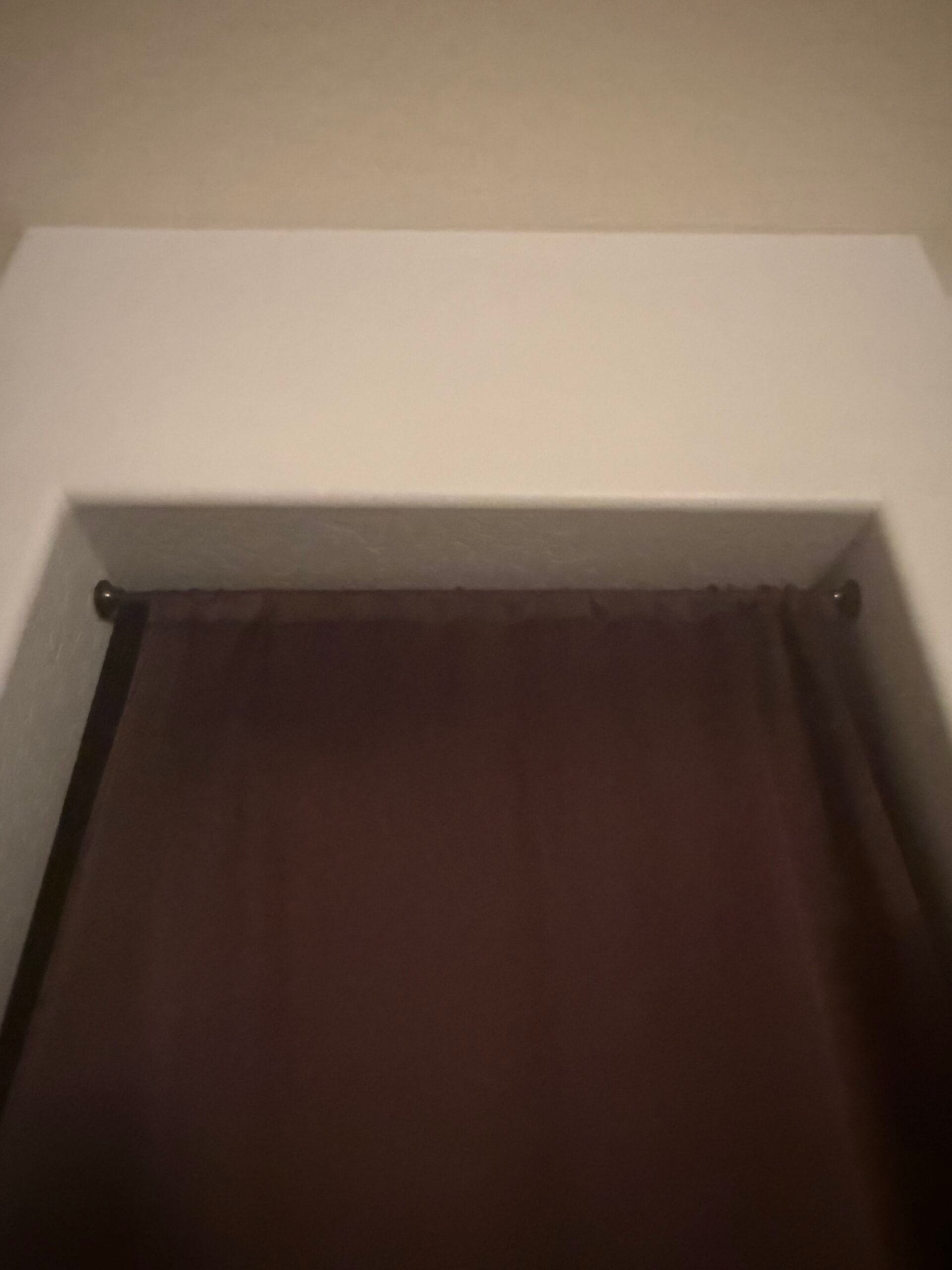
Blackout panels are heavy, and that is the whole problem with mounting them without drilling. Lightweight curtains stay up on almost anything. A pair of thermal-lined blackout panels on a wide window puts real load on whatever is holding them, and most no-drill solutions were designed for sheers. For more on this, see our guide to mounted tracks and wrap-around rods.
Tension rods handle it better than people expect, provided the span is right and the rod is rated for the weight. Beyond that, the alternatives are working with fixtures you already have rather than adding new ones. For more on this, see our guide to rods for doorways.
My Experience
Mine is a non-drilled tension rod and it has been completely sturdy. No sagging, no coming down, no issues at all, which was not what I expected going in given how much blackout panels weigh.
That one covers a doorway rather than a window. The curtains on my actual window are woven in with the shutters that were already there, and they cover the window fully that way without needing a rod at all.
Worth saying because it is the option nobody mentions. If a window already has shutters, blinds, or an existing rod, threading panels through or hanging from what is there solves the mounting problem before you buy anything.
Quick Verdict
A tension rod rated above the weight of your panels handles most windows up to a moderate span. Check the rod’s stated capacity rather than its diameter, since the two do not track reliably. Where a window already has shutters or blinds, working with those beats adding hardware.
How We Picked
Weight capacity came first, because blackout panels with thermal lining are several times heavier than standard curtains and most tension rods are rated for far less.
Span mattered next. Tension rods lose holding force as they extend, so a rod that holds firmly at forty inches may slip at seventy.
Surface damage counted, since the point is protecting a deposit. Anything that marks paint or pulls at drywall defeats the purpose even if it holds.
We left out adhesive hooks rated below a few pounds, which are fine for sheers and fail predictably under blackout panels.
Heavy-Duty Tension Rod
Why It Stands Out
The straightforward answer, and it works better than its reputation suggests. A tension rod built for weight uses a stronger internal spring and wider end caps that spread pressure across more wall area.
Installation takes a minute and leaves nothing behind. For renters that combination is difficult to beat, and it moves with you.
Worth Knowing
Capacity drops as the rod extends, so buy for your actual span rather than the maximum stated. A rod used near the top of its range holds far less than the box implies.
The mounting surfaces have to be parallel and solid. Textured walls, tile, and anything slightly out of square all reduce grip.
Best for windows and doorways within a moderate span where the surfaces are sound. Skip on very wide windows, where sag and slippage both become likely.
Twist-and-Fit Tension Rod
Why It Stands Out
Tightens by twisting rather than relying on spring pressure alone, which produces considerably more holding force. That mechanism is what makes the difference on heavier panels.
Adjustment is also finer, so you can dial in pressure rather than accepting whatever the spring provides.
Worth Knowing
Over-tightening can mark or dent drywall, which is the failure mode that costs a deposit. Firm rather than maximum is the setting.
These cost more than spring rods and the difference is real on anything heavy.
Best for blackout panels specifically, where standard tension rods struggle. Skip for lightweight curtains, where the extra capacity is unnecessary.
Over-the-Door Curtain Hooks
Why It Stands Out
Hangs from the door frame itself rather than gripping a wall, which removes the pressure question entirely. For doorways and closets it is more secure than tension.
Nothing touches the paint, and the hooks lift off in seconds when you move.
Worth Knowing
Only works where there is a frame to hook over, so it rules out most windows.
Door thickness varies and hooks are sized for a range. Measuring first avoids a return.
Best for doorways, closets, and room dividers. Skip for windows unless the frame protrudes enough to hook over.
Magnetic Curtain Rod
Why It Stands Out
Attaches directly to a steel door or frame, which is common on apartment entry doors and some window frames. No pressure, no adhesive, no marks.
Repositioning takes seconds, which suits anyone still working out where they want light blocked.
Worth Knowing
Requires a ferrous surface, and plenty of frames are aluminium or vinyl. A magnet from your fridge tells you in seconds whether this is an option.
Magnet strength varies considerably, and weaker ones slide under blackout weight rather than holding.
Best for steel doors and metal window frames. Skip entirely if the surface is not magnetic.
Adhesive Curtain Rod Brackets
Why It Stands Out
Mounts a standard rod on brackets held by removable adhesive, which handles wider spans than tension can. That makes it the option for large windows where a tension rod would sag.
Removable adhesive designed for wall mounting comes off cleanly when pulled correctly, leaving no residue.
Worth Knowing
Weight ratings are the entire specification here, and blackout panels routinely exceed what standard adhesive strips hold. Buy well above your expected load.
Surface preparation matters more than people bother with. Clean, dry, and fully cured before hanging anything, which usually means waiting a full day.
Best for wide windows in rentals where drilling is prohibited. Skip on textured or freshly painted walls, where adhesion is unreliable.
Blackout Panels With Existing Fixtures
Why It Stands Out
Uses shutters, blinds, or a rod already installed rather than adding hardware. Threading panels through existing slats or clipping to an existing rod solves the mounting question before it arises.
It also costs nothing beyond the panels themselves, and there is nothing to remove when you leave.
Worth Knowing
Coverage depends on what is already there. Existing fixtures rarely extend past the window frame, which leaves light gaps at the edges.
Panel weight can strain lightweight blinds, so this suits solid shutters better than vinyl slats.
Best for windows with shutters or sturdy existing fixtures. Skip where the existing hardware is flimsy or where full edge coverage matters. Panel options sit in blackout curtains for sleep.
Mounting Options at a Glance
| Option | Holds blackout weight | Works on | Leaves marks |
|---|---|---|---|
| Heavy-duty tension rod | Moderate spans | Windows, doorways | Rarely |
| Twist-and-fit rod | Yes | Windows, doorways | If overtightened |
| Over-door hooks | Yes | Door frames only | No |
| Magnetic rod | Depends on magnets | Steel surfaces | No |
| Adhesive brackets | Depends on rating | Smooth walls | If removed badly |
| Existing fixtures | Depends on fixture | Shutters, blinds | No |
Why Blackout Panels Are Different
Thermal lining is what adds the weight. A blackout panel is effectively two or three layers bonded together, and a pair on a wide window can weigh several times what standard curtains do.
That weight is also concentrated at the top edge, pulling downward on whatever holds the rod rather than being distributed.
Most no-drill hardware is rated for sheers and light cotton. Checking the stated capacity against the panel weight, rather than assuming, is the step that prevents a rod on the floor at three in the morning. Panel construction sits in blackout curtains against blinds.
Getting Full Darkness Without Drilling
Light leaks at the edges more than through the fabric. A rod mounted inside the window recess leaves gaps at both sides regardless of panel quality.
Extending the rod beyond the frame is the usual fix and it needs a mounting point outside the recess, which is where tension rods stop being an option and adhesive brackets start.
Layering handles the rest. Panels over existing blinds block more than either alone, and a draught stopper at the bottom of the door catches hallway light, covered in draft stoppers.
What to Check Before Buying
Weigh your panels
Bathroom scales work. Knowing the actual number turns rod selection from guesswork into matching a specification.
Measure the span you need
Not the maximum the rod extends to. Tension capacity falls as the rod extends, so buy for your window rather than the range.
Test the surface
A fridge magnet tells you whether magnetic mounting works. Pressing on the wall tells you whether it is solid or hollow.
Check your lease
Some leases permit small holes, which makes a drilled rod the simpler answer. Worth asking before engineering around a restriction that may not exist.
Recommended Reading
- panels worth hanging
- comparing the two approaches
- the heat side
- the cheaper alternative
- blocking light under doors
- curtains as heat control
- making a bedroom dark
Related: how do you stop light leaking around blackout curtains.
Frequently Asked Questions
Can a tension rod hold blackout curtains?
Yes, provided it is rated for the weight and the span is moderate. Blackout panels are several times heavier than sheers, so a standard tension rod often is not enough while a heavy-duty one is.
Why do my tension rods keep falling down?
Usually the span or the surface. Tension capacity drops as a rod extends, and textured, uneven, or hollow surfaces reduce grip. Buying for your actual span rather than the maximum helps most.
How do I hang curtains without drilling in a rental?
Tension rods for moderate spans, adhesive brackets for wider windows, over-door hooks for doorways, or working with shutters and blinds that are already installed.
Do adhesive curtain brackets actually work?
With the right weight rating and proper surface preparation, yes. Blackout panels routinely exceed what standard strips hold, so buy well above your expected load and let adhesive cure before hanging.
Will a magnetic curtain rod work on my window?
Only on a ferrous surface. A fridge magnet against the frame answers it in seconds, and many apartment frames are aluminium or vinyl, which rules it out.
How do I stop light leaking at the edges?
Extend the rod beyond the window frame rather than mounting inside the recess, which usually means adhesive brackets rather than tension. Layering panels over blinds blocks more than either alone.
Can I use curtains with existing shutters or blinds?
Often, and it is the option people overlook. Threading panels through slats or clipping to an existing rod removes the mounting problem entirely, at the cost of coverage limited to what is already there.
Light control is part of cooling a room too. cooling a bedroom for better sleep covers blocking daytime heat.
