
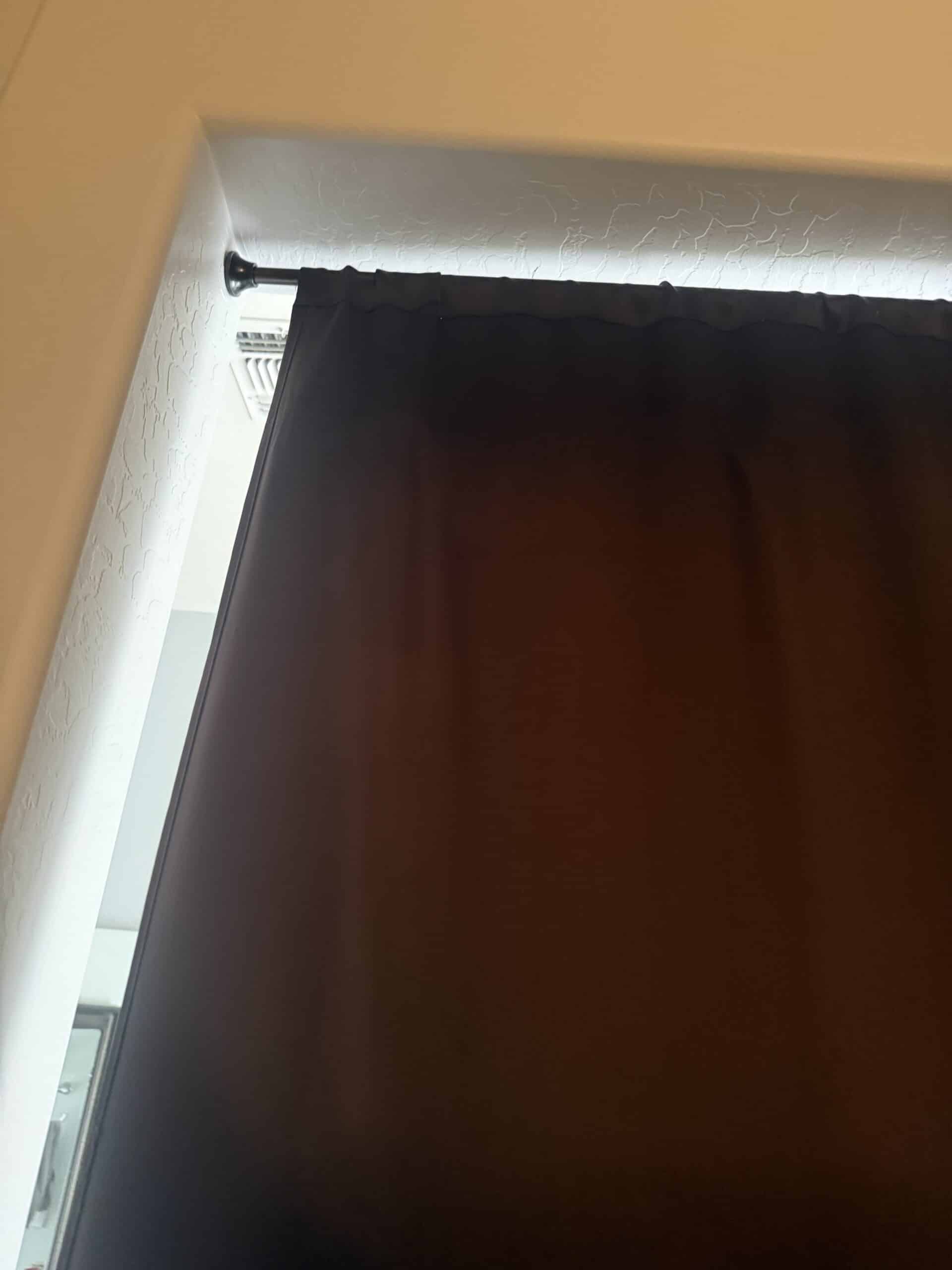
A little, and less than the marketing implies. Heavy fabric absorbs some sound and softens how a room echoes, and it does close to nothing about noise coming through the window itself.
Mine seem to make the acoustics somewhat better, and I would not put it more strongly than that. It is a subtle change in how the room sounds rather than a reduction in what I can hear from outside.
Quick Answer
Blackout curtains absorb mid and high frequency sound inside the room, which reduces echo and slightly softens sharp noises. They do not block traffic, voices, or low-frequency sound coming through glass, since the window itself is the weak point.
A Quick Note
This covers room acoustics rather than sleep disorders. Persistent difficulty sleeping in a quiet room is worth raising with a doctor rather than solved with furnishings.
Absorption Is Not Blocking
| What curtains do | What they do not do |
|---|---|
| Absorb some mid and high frequencies | Block sound entering through glass |
| Reduce echo and reverberation | Stop low-frequency noise |
| Soften sharp indoor sounds | Seal gaps around a window frame |
| Slightly reduce perceived harshness | Provide measurable sound insulation |
Sound blocking requires mass and an airtight seal. A curtain has modest mass and hangs loose, so it cannot do the job a wall or a sealed window does.
Absorption is different. Soft porous material converts some sound energy to heat as it passes through, which reduces reflections within the room.
That is a real effect and it is why a room with heavy curtains sounds less echoey than a bare one. It is also why the change is easiest to notice on sounds made inside the room rather than outside it.
What I Notice
The acoustics seem somewhat better with mine closed. That is about as confident as I am willing to be about it.
It is not something I would have noticed if I were not paying attention, and I could not tell you whether it is the curtains or the fact that closing them usually coincides with the room being quieter anyway.
What I can say is that they have not changed what I hear from outside. Traffic and neighbors sound the same closed or open.
I run fans year-round, which masks a good deal, so my baseline is a room that already has consistent sound in it, covered in white noise machines.
The honest summary is that I bought them for light and I get a marginal acoustic benefit I would not have paid extra for.
Why the Window Is the Weak Point
Sound follows the path of least resistance, and in most bedrooms that is the window rather than the wall.
Single-pane glass transmits sound readily. Double glazing improves it considerably, and the gap between panes matters more than the glass thickness.
Air gaps around the frame matter more still. A window that whistles in wind is also passing sound, and sealing it does more than any curtain will.
That is why window insulation approaches outperform fabric for actual noise reduction, covered in window insulation kits for quiet sleep.
What Makes Some Curtains Better Than Others
Weight and density
Heavier fabric absorbs more. Triple-weave blackout material outperforms a thin panel with a coated backing, and the difference is measurable in echo rather than in transmission.
Fullness
Curtains gathered to twice the window width absorb considerably more than flat panels, since folds create more surface area and trap air.
Coverage
Floor-to-ceiling and wall-to-wall coverage absorbs more than a panel sized to the window, which is the same principle as acoustic treatment.
Layering
A curtain plus a separate liner, with an air gap between, does more than one thicker layer, covered in blackout curtains for sleep.
Where Curtains Do Make a Real Difference
There are situations where the absorption effect is worth having rather than incidental, and they are worth naming since the general answer is so qualified.
Hard-surfaced rooms benefit most. A bedroom with tile or wood floors, bare walls, and minimal soft furnishing echoes noticeably, and heavy curtains are one of the few practical fixes.
Sounds made inside the room change most. A partner moving around, a door closing, a phone on a hard surface. Those reflect off surfaces and curtains reduce the reflections.
Apartments with shared walls sometimes benefit indirectly. Curtains do not stop sound coming through a wall, and reducing echo makes what arrives less noticeable.
Rooms used for calls or recording are the clearest case, which is why people hang moving blankets rather than buy acoustic panels when improvising a space.
None of that helps with a road outside, and all of it is real in the situations where it applies.
What Actually Reduces Outside Noise
Sealing gaps around the window frame with weatherstripping or acoustic caulk. Cheap, unglamorous, and the highest-impact change available to most people.
Secondary glazing or an acrylic insert over the existing window, which adds mass and an air gap without replacing anything.
Masking with steady sound, which works differently by making intrusive noise less noticeable rather than reducing it, covered in quiet fans for sleeping.
Earplugs, which block at the ear and outperform every room treatment for a fraction of the cost.
Why the Marketing Says Otherwise
Curtains described as soundproof are common, and the gap between that word and what fabric can do is worth understanding.
The underlying claim usually rests on a real measurement of absorption, which fabric genuinely provides. Absorption and transmission loss are different properties, and a product can be good at one while doing almost nothing for the other.
Testing conditions help the claim along. A curtain measured against a hard bare wall in an empty room shows a large improvement, because the comparison is with the worst possible case rather than with a furnished bedroom.
People also report improvement honestly and attribute it to the wrong thing. A room that echoes less sounds calmer, and calmer gets remembered as quieter even when the sound arriving from outside is unchanged.
Buying them for light and finding the room slightly softer is a good outcome. Buying them expecting to stop hearing a road is how people end up disappointed with a product that is working exactly as designed.
Setting Expectations Before Buying
Curtains marketed as soundproof are not, and that word is doing work no fabric can support. Sound-dampening is the accurate description.
If noise is your main problem, spend on window sealing and masking first, then buy curtains for light.
If you were buying blackout curtains anyway, the acoustic effect is a small bonus rather than a reason to pay more.
And the effect people report most reliably is the room sounding softer, which is genuine and is not the same as hearing less from outside, covered in blackout curtains against blinds.
Related Reading
- blackout curtains for sleep
- window insulation kits
- earplugs for sleeping
- white noise machines
- curtains against blinds
- white noise machine against fan
Part of our guide to improving sleep quality naturally.
Frequently Asked Questions
Do blackout curtains help with noise?
Marginally. They absorb some mid and high frequency sound and reduce echo inside the room, and they do not block noise coming through the window itself.
Are soundproof curtains real?
Not as marketed. Blocking sound needs mass and an airtight seal, which loose fabric cannot provide. Sound-dampening describes what they actually do.
Why do they help with echo but not traffic?
Absorption reduces reflections of sound already in the room. Blocking transmission through glass requires mass and sealing, which is a different mechanism entirely.
What curtain features help most acoustically?
Weight, fullness, and coverage. Heavy fabric gathered to twice the window width, running floor to ceiling, absorbs considerably more than a flat panel.
What actually reduces outside noise?
Sealing gaps around the window frame, secondary glazing, masking with steady sound, and earplugs. All outperform curtains for transmitted noise.
Do they help with low-frequency noise?
Very little. Bass passes through soft materials readily, which is why you hear the thump of music through a wall but not the detail.
Do they help more in a hard-surfaced room?
Noticeably. A bedroom with tile or wood floors and bare walls echoes, and heavy curtains are one of the few practical ways to reduce that.
Is it worth buying them for noise alone?
No. Buy them for light and treat any acoustic improvement as a small bonus, and spend the noise budget on sealing and masking instead.
Sources
- World Health Organization. Night Noise Guidelines for Europe. https://www.who.int/europe/publications/i/item/9789289041737
- Sleep Foundation. How Noise Affects Sleep. https://www.sleepfoundation.org/bedroom-environment/how-noise-affects-sleep
Recommended Reading
See our note on making a bedroom dark.
