
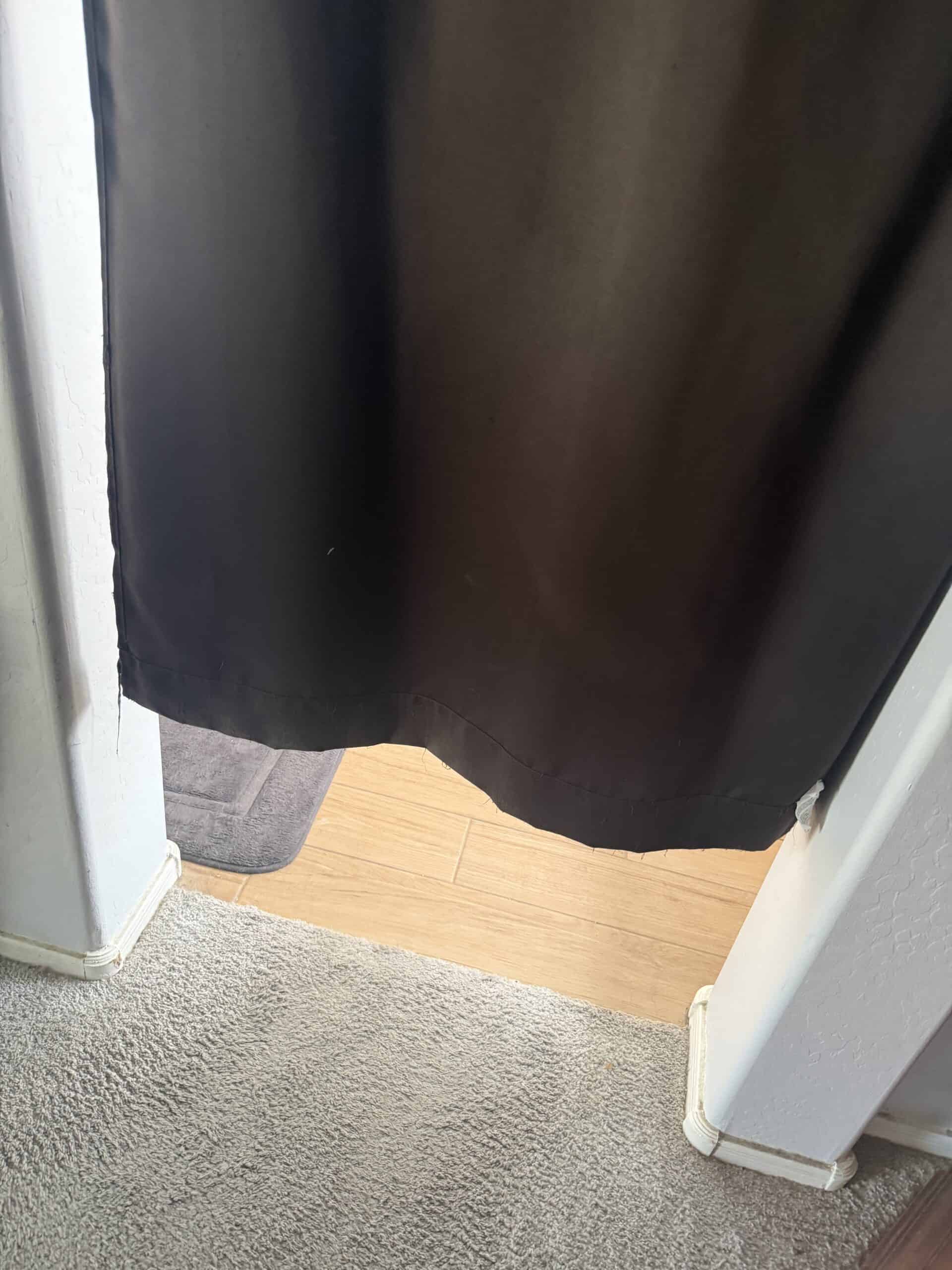
Almost every blackout curtain guide assumes floor-length panels, and plenty of windows do not want them. A curtain over a radiator, above a windowsill, or across a doorway has to stop short, and the received wisdom says that ruins the blackout.
Mine stop a foot or two above the floor and have for three or four years. The room is dim rather than fully dark, and the reason for that is a sliding door with blinds, not the length of the curtains. Our note on why a bedroom is dim but not dark covers where the light actually comes from.
Where Short Panels Work
| Situation | Why short is right | Watch out for |
|---|---|---|
| Over a radiator | Heat needs to escape | Gap at the bottom |
| Sill-length windows | Furniture below | Side leaks matter more |
| Doorways | Must clear the floor | Rod stability |
| Fitted into shutters | Frame depth limits length | Louvre gaps |
| Rentals | No drilling for long rods | Tension rod weight limits |
| Cafe-style | Lower half only | Not a blackout solution |
How We Picked
Selections are grouped by the situation forcing a shorter panel rather than by fabric weight, since the constraint is usually the window or the room rather than a preference.
Descriptions come from documented construction and materials, alongside three or four years living with short blackout panels including a set hung over a doorway.
Length Is Not Where the Light Gets In
The gap under a curtain is the least important of the four edges, and it is the one people fixate on.
Light enters mainly at the sides, where a panel sized to the window rather than the wall leaves an open channel, and over the top, where a rod mounted at frame height lets light spill above the fabric.
The vertical seam between two panels is third, producing a bright stripe that is obvious once your eyes adapt.
The bottom gap only matters if something bright sits below it. Mine stop well short of the floor and the room is no brighter for it. Our note on stopping light leaking around blackout curtains covers the edges that count.
1. Sill-Length Blackout Panels, Best Overall
Why It Stands Out
Ending at or just below the sill is the standard short length, and it suits windows with furniture, radiators, or a window seat underneath.
Less fabric also means less weight on the rod, which matters for tension rods and no-drill mounting.
Worth Knowing
Because the bottom is open, side coverage becomes the whole game. Extend the rod several inches past the frame on each side.
Shorter panels move more in a draft than long ones. Our roundup of blackout curtains for sleep covers full-length options.
This suits most short-panel situations. Skip it if nothing is blocking floor length.
2. Doorway Blackout Panels, Best for Openings
Why It Stands Out
A curtain over a doorway has to clear the floor to be usable, so short is the only option rather than a compromise.
I have panels hanging over a doorway leading to a bathroom and closet, on a tension rod, and it handles an opening that would otherwise stay permanently uncovered.
Worth Knowing
Doorway curtains get pulled repeatedly rather than left in place, so fabric that creases badly shows it.
Rod stability matters more here than at a window. Our roundup of doorway curtains covers the category.
This suits open doorways. Skip it where a door already exists.
3. Panels Sized for Shutter Frames, Best for Fitted Windows
Why It Stands Out
Shutters control daytime light well and leak at every louvre and around the frame at night. A curtain fitted inside the frame handles the darkness the shutter cannot.
Some of mine are fitted into shutters and that pairing is the one that actually works: the shutter does the day, the curtain does the night.
Worth Knowing
Frame depth limits both length and how far the fabric can extend sideways.
Shutters alone will not produce a dark room. Our note on whether you need curtains with shutters covers the combination.
This suits shuttered windows. Skip it if you can hang outside the frame instead.
4. Tension Rod Panels, Best for Renters
Why It Stands Out
No drilling, no brackets, and no damage to a rental. Shorter panels weigh less, which is exactly what a tension rod needs.
Mine has been on a tension rod for years without falling or needing reseating, which is not the usual reputation these have.
Worth Knowing
Weight limits are real, and heavy full-length blackout fabric is what makes tension rods fail.
They need a snug fit between two solid surfaces. Our roundup of no-drill blackout curtain rods covers the hardware.
This suits rentals. Skip it for wide windows with heavy fabric.
5. Thermal-Backed Short Panels, Best for Insulation
Why It Stands Out
Thermal backing adds insulation alongside light blocking, which is useful where a short panel sits above a cold window.
The extra layer also improves opacity, so a shorter panel does not give up darkness for length.
Worth Knowing
Heavier than standard blackout fabric, which pushes back against tension rods.
Mine are standard rather than thermal, so I cannot speak to the insulation difference. Our roundup of thermal curtains covers those.
This suits cold windows. Skip it above a radiator, where trapped heat is the problem.
6. Wide Short Panels, Best for Side Coverage
Why It Stands Out
Since the bottom is open anyway, extra width is where a short panel earns its darkness. Panels considerably wider than the window overlap wall rather than ending at glass.
Wider fabric also allows proper overlap where two panels meet, closing the vertical stripe.
Worth Knowing
More fabric on a short panel still weighs less than a full-length one, so the rod trade is favorable.
Bunched fabric at the sides is more visible on a short curtain. Our roundup of tracks and wrap-around rods covers closing side gaps.
This suits anyone whose short panels still leak. Skip it in a narrow space.
What Three or Four Years Has Shown
They have faded slightly. Fabric absorbing daily sunlight changes over time, and that is expected rather than a defect, though nobody mentions it when selling them.
The short length has caused no problem I can identify. Nothing bright sits below them, so the open bottom lets in nothing.
The tension rod over the doorway has held the entire time without falling or being reseated, which surprised me more than it should have.
And the room is dim rather than dark, entirely because of a sliding door with blinds. Longer curtains at the windows would not change that by any amount. Our roundup of curtains for rooms that stay dim covers that middle ground.
Measuring for a Short Panel
Sizing a short curtain is different from sizing a full-length one, because you are choosing where it stops rather than accepting the floor.
Decide the bottom point first based on what is below: several inches clear of a radiator, just below a sill where furniture sits, or clear of the floor for a doorway.
Measure from the rod position rather than from the top of the window, since mounting high adds length that has to be accounted for.
Width is where people undersize. Measure the wall you intend to cover rather than the window itself, and add generously on both sides.
Where two panels meet, allow enough overlap that they can be pulled past each other rather than just touching, since a butt joint leaves a visible line.
Mounting Matters More Than Length
Mount high
Well above the frame rather than on it, so fabric overshoots at the top. This does more than any amount of extra length.
Mount wide
Several inches past the frame on both sides, so the panel overlaps wall instead of ending at glass.
Overlap the middle
Where two panels meet, overlap them or clip them together. That stripe is brighter than the bottom gap.
Check the doorway
Hallway light under a bedroom door is frequently brighter than anything from a window. Our note on how high to hang blackout curtains covers mounting.
Fabric Weight and Short Panels
Less fabric changes how a curtain behaves, and it cuts both ways.
The advantage is weight. A short panel puts far less load on a rod, which is what makes tension rods and no-drill mounting viable where a full-length curtain would slip.
The disadvantage is that a light panel moves. Without the weight of fabric reaching the floor, short curtains billow in a draft or when a door opens, and a moving curtain lets light in at the edges.
Heavier fabric solves the movement and reintroduces the weight problem, which is the trade to think about when choosing between standard and thermal.
Weighted hems exist for exactly this and are worth looking for on a short panel, since they add stability without much overall weight. Our roundup of cooling mattress pads covers hardware that helps.
Common Mistakes to Avoid
Assuming short means bright
The bottom edge matters least. Sides and top are where light enters, and length does nothing about either.
Buying panels sized to the window
Width should be measured against the wall you are covering, not the glass.
Overloading a tension rod
Heavy thermal fabric on a wide span is what makes them slip. Short standard panels are well within tolerance.
Ignoring what is below
A short curtain above a bright lamp or a light-colored radiator lets that light straight into the room. Our roundup of sleep masks covers the fallback.
Recommended Reading
See our comparison of blackout curtains and blinds, our note on layering curtains, our roundup of curtains for sliding glass doors, and a note on whether blackout curtains make waking harder, and making a bedroom dark.
Short Blackout Curtain FAQ
Do blackout curtains have to reach the floor?
No. Mine stop a foot or two above the floor and the room is no brighter for it. Light enters at the sides and top far more than underneath.
Where does the light actually get in?
Sides first, where a panel ends at the glass instead of overlapping wall. Then the top, if the rod sits at frame height. Then the seam between panels.
When does the bottom gap matter?
Only when something bright sits below it, such as a lamp, a light-colored radiator, or a low window in an adjoining room.
Can I use short panels over a doorway?
That is the situation where short is mandatory rather than optional. Mine hang over a doorway on a tension rod and have not fallen in years.
Will a tension rod hold blackout fabric?
Short panels, yes. Full-length thermal blackout on a wide span is what makes tension rods slip, since weight is the limiting factor.
Do curtains work with shutters?
Together they do. Shutters handle daytime light and leak at the louvres at night, so a curtain fitted into the frame covers what the shutter cannot.
Do blackout curtains fade?
Mine have faded slightly over three or four years. The fabric is absorbing sunlight daily, so some change is expected rather than a fault.
How wide should short panels be?
Wider than you think, since side coverage is doing the work the length is not. Several inches past the frame on each side, with overlap where two panels meet.
