
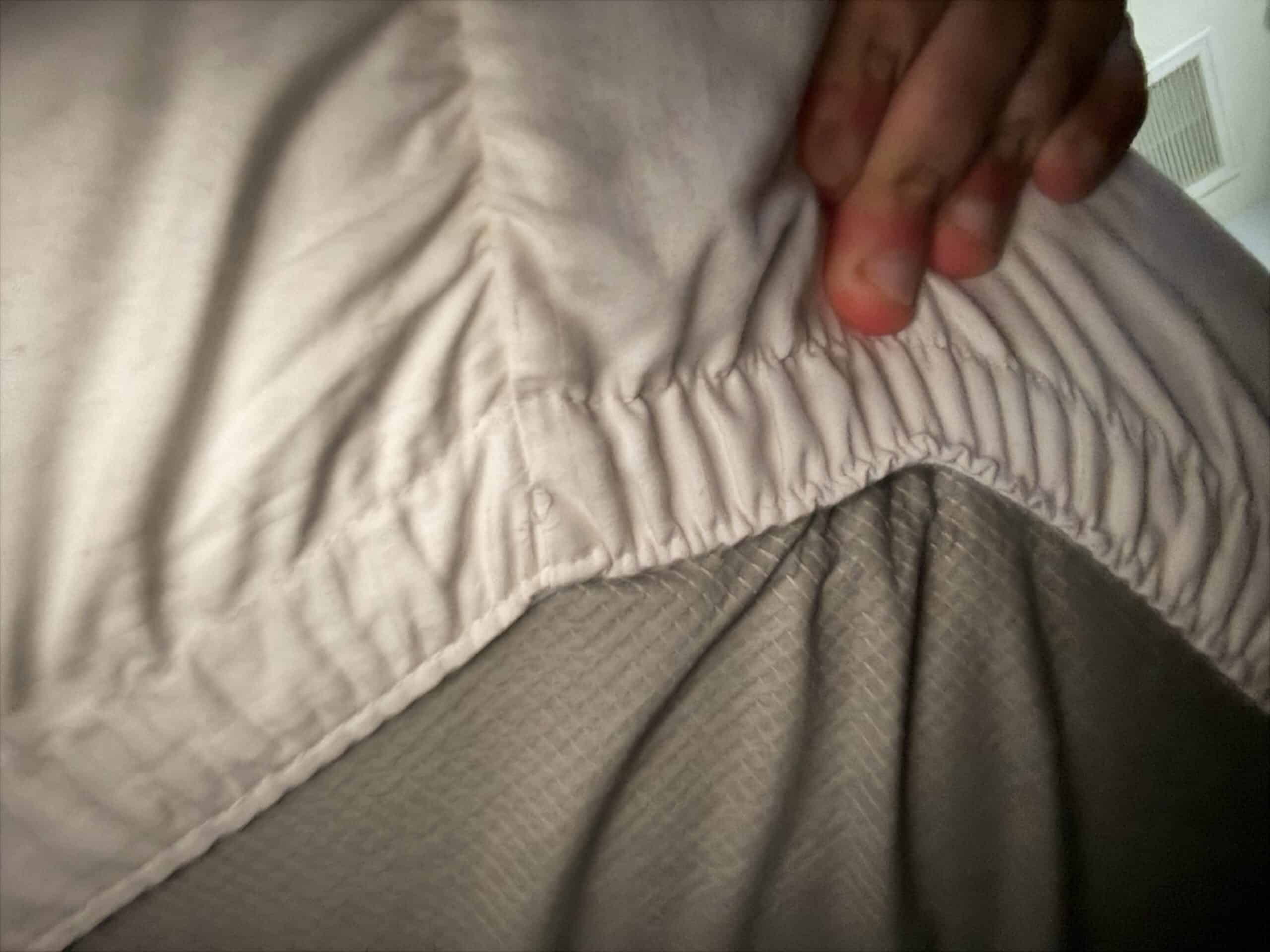
Mattress size is the easy part and it is not where sheets fail. A queen sheet on a queen mattress still pops off the corners if the pocket is too shallow for how thick that mattress actually is.
Depth is the measurement nobody takes, and it changes the moment you add a topper. I have a thin gel topper under my sheets and I honestly do not know whether that is what holds them in place or whether it is the sheets themselves. Our note on choosing sheets covers the wider decision.
Quick Answer
Match the mattress size, then measure its actual depth including any topper and buy a pocket deeper than that. Depth is what decides whether a fitted sheet stays on.
The Two Numbers
| Measurement | What it covers | How people get it wrong |
|---|---|---|
| Mattress size | Length and width | Rarely, it is on the label |
| Pocket depth | How far the sheet wraps down | Almost always, never measured |
| Topper thickness | Adds to effective depth | Forgotten entirely |
| Mattress protector | Adds a little more | Also forgotten |
| Flat sheet size | Overhang on each side | Too small to tuck |
How to Measure Depth
Strip the bed and measure from the top surface of the mattress straight down to where it meets the frame, at the side rather than the corner.
Then add anything that sits on top. A topper adds its full thickness to what the sheet has to cover, and a protector adds a little more.
Buy a pocket deeper than that total rather than equal to it, since a sheet stretched to its exact limit has no grip left and pops off the first time you move.
Deeper than necessary is the safer error. Excess fabric bunches under the mattress, which is untidy rather than a problem. Our roundup of deep pocket sheets covers the thick end.
The calculator below turns those two numbers into sizes you can shop for. Enter the mattress size and depth, add a topper if there is one, and it returns the pocket depth to look for plus comforter and flat sheet dimensions. Pocket depth is the figure that decides whether a corner stays on.
Mattress Size Is the Easy Half
Length and width are printed on the mattress and rarely go wrong, and a few situations still catch people out.
Sizes vary between countries, so a sheet bought abroad or from an international seller may be close without fitting.
Some sizes share a width and differ in length, which produces a sheet that fits across and pulls short at the foot.
Split mattresses on adjustable bases need either split sheets or a sheet that tolerates the two halves moving independently.
Older mattresses can differ slightly from current standards, which matters more for a snug fit than most people expect. Our note on choosing a mattress covers the sizes.
Why Toppers Change Everything
They add real depth
A topper is not a thin layer in sizing terms. Its full thickness has to be wrapped, and a standard pocket frequently cannot.
They change the surface
Foam grips differently from a mattress cover, which affects whether a sheet slides even when the depth is right.
They can help retention
A sheet pulled over both topper and mattress holds the topper in place, which is a side benefit people discover by accident.
Two layers move independently
Topper and mattress shift against each other, and a sheet that is snug over both reduces that. Our note on keeping a topper from sliding covers it.
What I Actually Have
A thin gel topper under the sheets, and satin sheets on top of that.
The satin set is better quality than an older, thinner set I have, and it grips the mattress noticeably better. Whether that is the sheets or the topper underneath doing the work, I could not tell you, and I would rather say that than guess.
I keep cotton and satin in rotation, and the satin is thicker, which is why I do not want it in summer when something lighter suits better.
What has not happened is the fitted sheet coming off the corners, which is the failure this article is really about. Our note on stopping fitted sheets coming off covers fixes.
Material Affects Fit
Sheets with elastic all the way around grip considerably better than ones with elastic only at the corners, and that difference matters more than a few inches of pocket depth.
Thicker fabric holds shape and resists being pulled off, where thin worn fabric stretches and lets go.
Slippery materials are the awkward case. Satin is smooth enough that people expect it to slide, and mine does not, which may be the weight of the fabric or may be the topper beneath it.
Fabric that has been washed many times loses elastic tension permanently, so an old sheet in the right size can still fail. Our roundup of fitted sheets that don’t slip off covers grip.
Flat Sheets and Duvet Covers
Flat sheets are sized by overhang rather than by fit, so a deep mattress needs a larger flat sheet to have enough left to tuck.
Sizing up one step is common for anyone who tucks properly or who wants the sheet to reach comfortably on both sides.
Duvet covers should match the duvet rather than the bed, and a cover larger than its duvet lets the filling shift into a corner.
None of that carries the failure mode of a fitted sheet, since a flat sheet that is slightly small is an inconvenience rather than something that comes off in the night.
Sizing for Two Sets in Rotation
Anyone keeping more than one set for different seasons has a sizing question people rarely mention.
The sets need to fit the same bed, and thickness varies between materials. A thick winter set and a thin summer one can need different pocket depths on the same mattress.
I keep cotton and satin in rotation, and the satin is the thicker of the two. The heavier set is the one that grips better, and the lighter one is what I want when the room is warm.
Buying both at the same pocket depth is the simple approach and it means the thinner set is working with less margin.
Where a topper is involved that margin shrinks further, which is why measuring once and buying deeper than the number is worth doing for every set rather than just the first one.
Common Mistakes to Avoid
Buying by mattress size alone
Size gets you the right length and width and tells you nothing about whether the sheet stays on.
Forgetting the topper
It adds its full thickness to what the pocket has to cover, and it is the most common reason a correctly sized sheet fails.
Buying a pocket equal to the depth
A sheet at its exact limit has no grip in reserve. Deeper is the safer error.
Assuming old sheets are the same size
Elastic loses tension permanently with washing, so an old sheet in the right size can still let go. Our note on how often to replace sheets covers lifespan.
Sheet Size FAQ
What size sheet do I need?
Match the mattress size for length and width, then measure the actual depth including any topper and buy a pocket deeper than that total.
How do I measure pocket depth?
Strip the bed and measure from the top surface straight down to the frame at the side, then add the thickness of any topper and protector.
Does a mattress topper change the size I need?
Yes, and it is the most commonly missed factor. The topper’s full thickness has to be wrapped by the sheet, and a standard pocket frequently cannot manage it.
Should I buy the deepest pocket available?
Deeper than you need is the safer error, since excess fabric bunches under the mattress rather than failing. Far deeper than necessary just looks untidy.
Why do my sheets still come off?
Usually pocket depth, and after that the elastic. Sheets with elastic all the way around grip better than corner-only, and washing degrades elastic permanently.
Do slippery materials like satin slide off?
Mine do not, and I have a thin gel topper underneath so I cannot say whether the sheets or the topper are responsible. Fabric weight probably matters more than smoothness.
What size flat sheet do I need?
Sized by overhang rather than fit, so a deep mattress wants a larger one to leave enough to tuck. Sizing up one step is common.
Is a thicker sheet better?
For staying on, generally yes, since it holds shape and resists being pulled off. Thicker also means warmer, which is why I keep a lighter set for summer.
