
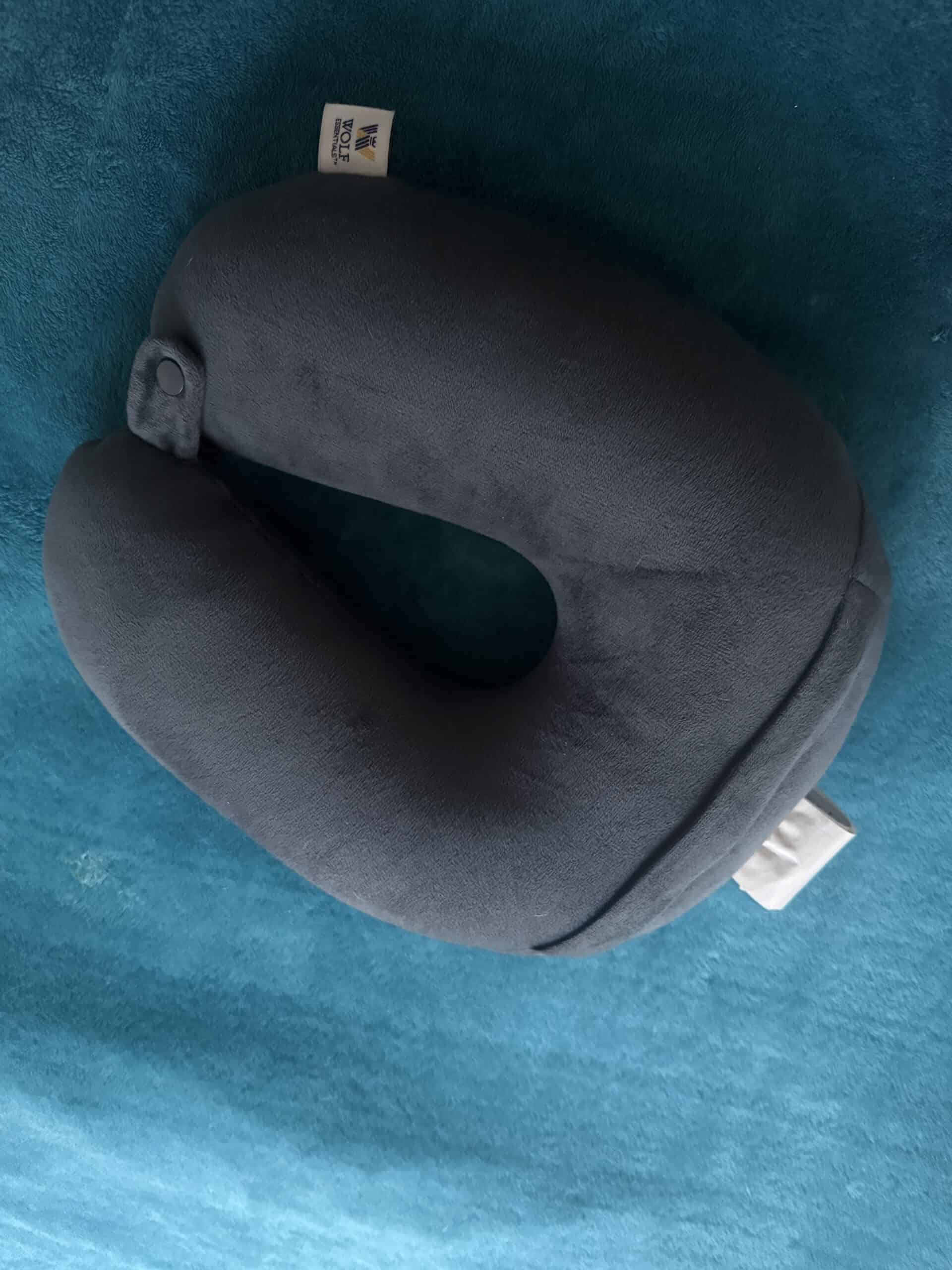
Travel pillow sizing is not about how big you are. A U-shaped pillow works by filling the gap between your shoulder and your ear, so what matters is the space it has to fill and how firm the filling is.
Mine is a U-shaped memory foam pillow I have had for more than five years, which is long enough to know what the size actually costs you. It is bulky, and that is the trade nobody mentions when you buy one. Our roundup of travel pillows for neck pain covers the category.
Quick Answer
Fit is set by the opening at the front and the height of the sides. Too small pinches, too large lets your head tip. Packed size is a separate decision and frequently the one that matters more.
The Two Measurements That Matter
| Dimension | What it does | Wrong when |
|---|---|---|
| Neck opening | Fits around your neck | Pinches, or gaps at the front |
| Side height | Fills shoulder-to-ear gap | Head still tips sideways |
| Overall depth | Pushes your head forward | Chin forced toward chest |
| Firmness | Resists compressing | Flattens under head weight |
| Packed size | Whether you bring it | Too bulky to carry |
| Weight | Carrying it all day | Noticeable on a long walk |
Why Side Height Decides Support
The job is stopping your head falling sideways, and that gap is the distance from the top of your shoulder to the bottom of your ear.
A pillow with sides shorter than that gap lets your head tip until it hits the pillow, which is the position you were trying to avoid.
Sides too tall push your head upward at an angle, which is uncomfortable in a different way and produces neck ache rather than preventing it.
Broad-shouldered people generally need more height than the standard, which is the closest thing to a body-size rule in this. Our note on why your neck hurts in the morning covers the mechanism.
The Neck Opening
The gap at the front is the measurement that decides comfort rather than support, and it is the one people notice immediately when it is wrong.
Too tight and the pillow presses against the throat, which is unpleasant enough that most people take it off rather than adjust to it.
Too loose and the pillow rotates around the neck, so the thick part ends up under the chin or behind the head instead of at the sides where it does its work.
Some designs use a clasp or a strap at the front, which converts a fixed opening into an adjustable one and solves this properly.
Mine has no adjustment at the opening, which has been fine, and it means the fit was decided at purchase rather than being something I could tune afterward.
Firmness Substitutes for Size
Memory foam
Holds its shape under head weight, so the stated height is roughly the height you get. Mine is this and the support has been consistent for years.
Inflatable
Adjustable, which means one pillow covers several fits, and it deflates gradually over a long journey.
Microbead
Conforms readily and compresses considerably under load, so a large one may support less than a smaller firm one.
Down or fiber fill
Comfortable and the softest, which means the least support for the same measured size. Our roundup of travel pillows for road trips covers the types.
The Bulk Problem
This is where size stops being about fit and starts being about whether you use the thing.
Memory foam does not compress for packing. Mine is bulky, and although it has a clip for attaching to a bag, a U-shaped foam pillow hanging off luggage is still a large object swinging around.
That is the honest cost of the size that supports properly. Firmer and larger means better support and a worse thing to carry.
Inflatable and compressible designs solve the carrying and give up some support, which is a real trade rather than a compromise one side wins. Our roundup of travel pillows that attach to luggage covers carrying.
None of that is visible in a product listing, which is why fit complaints about travel pillows are so much more common than complaints about any other pillow.
Matching Size to How You Travel
Flying upright in a seat is the classic case, and it wants a pillow tall enough to fill the shoulder gap with a seat back behind you.
Car passenger seats recline further, which changes the geometry and means a smaller pillow frequently works.
Trains and coaches sit between the two, and the seat back is usually the deciding factor rather than the pillow.
Anyone traveling light should weigh packed size heavily, since the best-fitting pillow left at home supports nothing. Our note on sleeping on a plane covers the situation.
Heat Is a Size Problem Too
The warmth complaint about memory foam travel pillows is partly about the material and partly about how much of it is touching you.
A larger pillow wraps more of your neck, and every additional contact area is somewhere heat cannot escape. Bigger is warmer for the same material.
Memory foam is the worst offender because it is dense and conforms closely, so there are no gaps for air to move through.
Mine runs warm, and after five years I would describe that as a property of the design rather than a defect in this particular pillow.
Inflatable and microbead designs run cooler partly because they contact less and partly because air moves through them, which is one more reason the size decision and the material decision are the same decision. Our roundup of cooling pillowcases covers reducing that.
Where the Standard Size Fails
Most travel pillows are made in one size, which is why fit complaints are so common.
Children need considerably smaller, and an adult pillow on a child pushes the head forward rather than supporting it.
Very broad shoulders need more height than a standard pillow provides, and no amount of adjusting position fixes an undersized one.
People who sleep with their head forward rather than to the side want a different shape entirely, since a U-shape is designed to stop sideways movement. Our comparison of wedge and leg elevation pillows covers shape mattering more than size.
What Five Years Has Shown
The support has held. Memory foam has not collapsed or thinned in a way I have noticed, which is more than I would have expected.
The bulk has not improved, because it cannot. It is the same size it always was and the same awkward object to carry.
It also runs warm, which is a property of memory foam wrapped around your neck rather than a fault in this particular one.
What I would weigh differently buying again is packed size against support, because the support was never the problem. Our roundup of cooling pillows covers the heat side.
Travel Pillow Size FAQ
How do I know what size travel pillow I need?
Measure the gap from the top of your shoulder to the bottom of your ear. The pillow’s sides need to roughly fill that, and neck opening decides whether it pinches.
Does body size matter?
Shoulder width does, since broader shoulders mean a larger gap to fill. Height and weight matter very little by comparison.
What happens if it is too small?
Your head tips sideways until it reaches the pillow, which is the position the pillow was meant to prevent. Firmness cannot compensate for insufficient height.
What if it is too large?
It pushes your head up at an angle or forces your chin toward your chest, both of which cause neck ache rather than preventing it.
Does firmness change the size I need?
Considerably. A soft pillow compresses under head weight, so its effective height is less than its measured height. Memory foam holds close to its stated size.
Should I prioritize support or packed size?
Depends whether you will carry it. Mine supports well and is bulky, and a clip for attaching it to a bag does not stop it being a large object swinging around.
Do travel pillows come in sizes?
Mostly one size, which is why fit complaints are common. Children and broad-shouldered adults are the two groups a standard pillow serves worst.
How long does one last?
Mine has held its support for more than five years of use, which surprised me. Memory foam holding shape is the reason to consider it despite the bulk.
Recommended Reading
See our note on what size sheet you need.
