
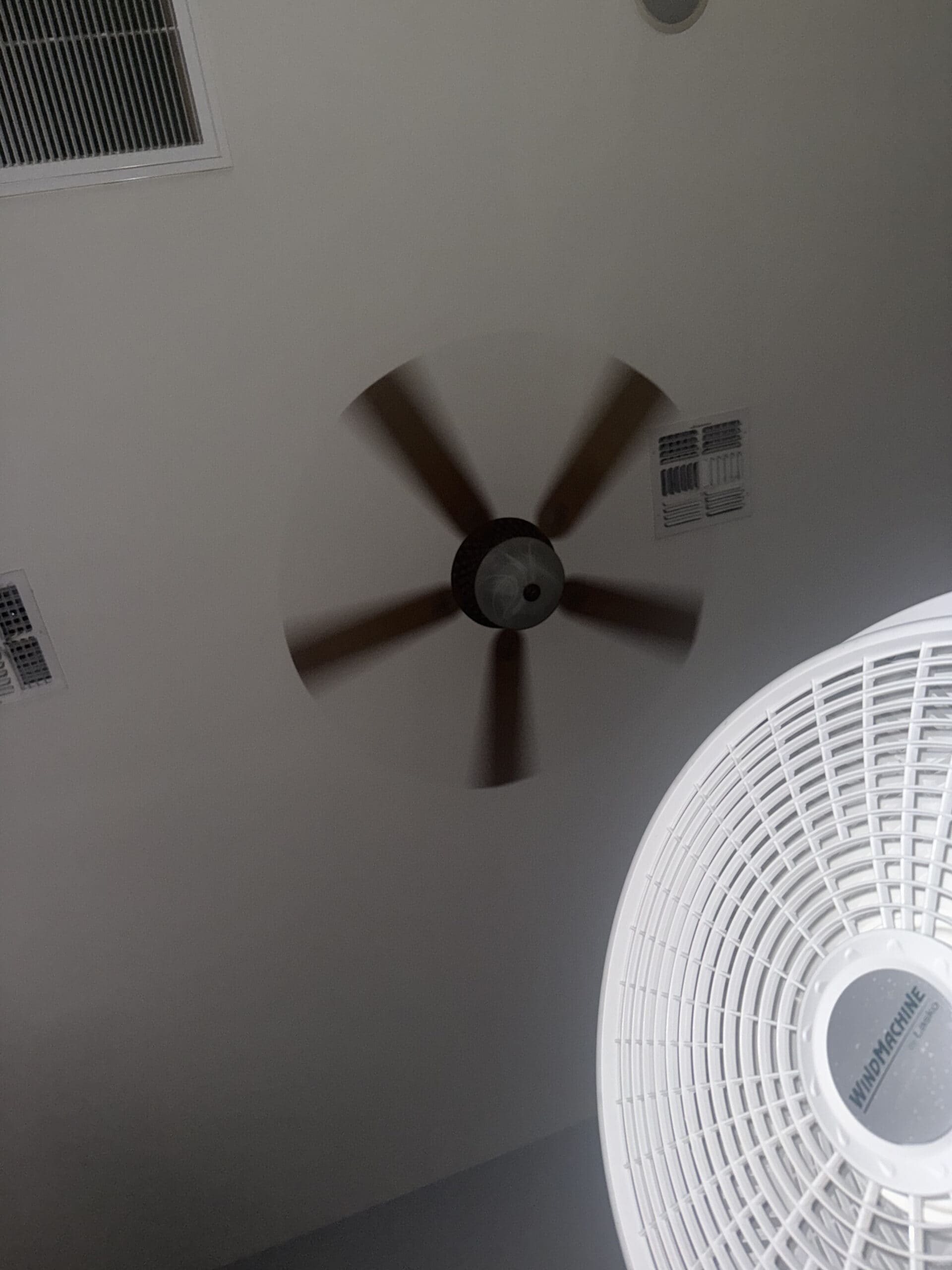
A fan that runs eight hours while you sleep is judged on things a daytime fan never is. Noise character matters more than noise level, the bearing type decides whether it survives thousands of hours, and any indicator light becomes a light source in a dark room. Most fan reviews test in the afternoon and miss all three. Our roundup of quiet fans for sleeping covers the noise question directly.
Quick Verdict
A DC motor fan with a ball-bearing assembly and a display that switches off handles overnight running better than a cheaper AC fan, and the running cost difference over a summer is real rather than marginal.
Key Takeaways
- Continuous running exposes bearing quality faster than anything else.
- DC motors draw noticeably less power over eight-hour stretches.
- Noise character matters more than the decibel figure.
- Indicator lights are a genuine problem in a dark room.
- Fans move air; they do not lower room temperature.
How We Picked
Fans are grouped by how they behave over long continuous runs rather than by peak airflow, since a fan running all night is a different duty cycle from one running for an hour. Motor type, bearing construction, and display behavior are weighted above raw output.
Selections reflect documented specifications. Descriptions come from product research except where personal use is stated directly.
1. A DC Motor Tower Fan, Best Overall
Why It Stands Out
DC motors draw considerably less power than AC equivalents, which over a full summer of overnight running becomes a measurable difference rather than a specification detail.
They also run quieter at low speeds and offer finer speed control, which matters when the difference between comfortable and too loud is narrow.
Worth Knowing
DC fans cost more upfront, and the payback depends on how many hours they actually run. A fan used occasionally will not recover the difference.
Check that the display switches off rather than dimming. Our comparison of bedside and tower fans covers the form factors.
This suits nightly summer use. Skip it for occasional running.
2. A Ball-Bearing Floor Fan, Best Durability
Why It Stands Out
Sleeve bearings are cheaper and wear faster under continuous operation, which is exactly the duty cycle overnight running imposes. Ball bearings are the specification that decides whether a fan lasts several summers.
Rattle and hum developing after a season is nearly always bearing wear rather than a fault.
Worth Knowing
Bearing type is often buried in specifications or omitted entirely, so it takes looking for.
Ball-bearing fans can be marginally louder at startup and quieter over their life. Our note on why fans help sleep covers the sound side.
This suits anyone replacing fans every couple of years. Skip it if you rarely run one overnight.
3. A Fan With a Full Display Off, Best for Dark Rooms
Why It Stands Out
A glowing panel in an otherwise dark bedroom is a light source, and plenty of fans dim rather than switching off entirely. A genuine off setting removes the problem.
This is the specification most commonly discovered after purchase rather than before.
Worth Knowing
Auto-dim is not off, and some fans return to full brightness on any button press, including the remote.
Tape over a light works and is not a solution you should have to reach for. Our roundup of blackout curtains covers other light sources.
This suits anyone keeping the room genuinely dark. Skip it if a small light does not bother you.
4. An Air Circulator, Best for Moving Air Around
Why It Stands Out
Circulators throw a focused column of air that moves the whole room rather than blowing directly at one spot, which suits running alongside an air conditioner.
Aiming one away from the bed still improves circulation, which matters if direct airflow dries you out overnight.
Worth Knowing
Circulators are often louder at a given speed than tower fans, since the airflow is more concentrated.
They also take floor space rather than fitting into a corner. Our note on running a fan and AC together covers the combination.
This suits rooms with an AC unit. Skip it if you want airflow aimed at you.
5. A Fan With a Sleep Mode, Best Automatic Adjustment
Why It Stands Out
Sleep modes step the speed down over the first hours, which suits the common pattern of wanting more airflow falling asleep than at four in the morning.
It also avoids waking up to reach for a remote.
Worth Knowing
Implementations vary considerably, and some sleep modes only reduce speed once rather than progressively.
Check whether the mode also dims the display, since many do not. Our roundup of bedside fans covers close-range options.
This suits people who overheat early and cool later. Skip it if one speed works all night.
6. A Ceiling Fan, Best Whole-Room Option
Why It Stands Out
A ceiling fan moves the entire room’s air from above without occupying floor space or aiming at anyone, which suits sleepers who dislike direct airflow.
Running one alongside a floor fan covers both whole-room circulation and localized airflow.
Worth Knowing
Ceiling fans are an installation rather than a purchase, and blade wobble or a failing bearing is a repair rather than a replacement.
They also cannot be repositioned, so the airflow pattern is whatever the room gives you. Our roundup of ceiling fans for bedrooms covers choosing one.
This suits permanent whole-room airflow. Skip it if you rent or want direction control.
Overnight Fan Types at a Glance
| Type | Running cost | Noise at low speed | Best for |
|---|---|---|---|
| DC tower | Lowest | Lowest | Nightly summer use |
| Ball-bearing floor | Moderate | Low | Longevity |
| Display-off model | Varies | Varies | Genuinely dark rooms |
| Air circulator | Moderate | Higher | Running with AC |
| Sleep mode fan | Varies | Drops overnight | Changing needs |
| Ceiling fan | Low | Low | Whole-room airflow |
What I Run Overnight
Three things run at once through an Arizona summer: the ceiling fan, a floor fan in the room, and a portable air conditioner. All three, all night, for months at a time.
That combination exists because no single one of them is enough. The ceiling fan moves the room, the floor fan puts air where I am, and the AC is the only one actually lowering the temperature. The fans make the AC’s work feel like more than it is, which is the whole reason to run them together rather than choosing.
What I would say about overnight running specifically is that it is a different demand from what most people are buying for. Eight hours a night for four months is thousands of hours in a season, and that is the number that decides whether a fan is still quiet the following year.
What I cannot compare is DC versus AC motors, sleep modes, or circulators, since I have not run those side by side. Those sections come from research rather than from fans I have owned.
What to Look For
What kind of bearings?
Ball bearings survive continuous running; sleeve bearings develop rattle. This is the specification that decides lifespan and it is frequently omitted.
Does the display switch off?
Not dim, off. A glowing panel is a light source in a room you are trying to keep dark, and this is the most common post-purchase regret in the category.
What does it sound like, not how loud?
A steady broadband hum is easier to sleep through than a quieter fan with a whine or a periodic tick. Decibel figures do not capture this.
How many hours a season?
A fan running nightly for months justifies a DC motor on running cost alone. One used occasionally does not.
One Fan or Several?
One fan
Simplest, cheapest, and adequate in a small room or a mild climate. A single well-placed fan does most of what two poorly placed ones do.
Several
Ceiling for whole-room movement plus a floor fan for direct airflow covers two different jobs. In a hot climate with an AC running as well, the fans are what make the cooled air reach you. Our comparison of ceiling and floor fans covers the split.
Common Mistakes to Avoid
Judging by maximum airflow
Overnight fans run at low speed. How a fan behaves at its lowest setting matters far more than its peak output.
Ignoring bearing type
Continuous running is what kills cheap fans. A fan that developed a rattle after one summer had sleeve bearings.
Expecting a fan to cool the room
Fans move air and add a small amount of heat from the motor. The cooling you feel is evaporative and only works on skin.
Accepting a dimmed display
Dim is not off. Check for a genuine off setting before buying rather than reaching for tape afterward. Our note on whether ceiling fans cool a room covers the physics.
Recommended Reading
See our comparison of cooling blankets and fans, our note on white noise machines and fans, our roundup of ceiling fan remotes, and a guide to bedroom cooling setups for hot climates, and cooling a bedroom for better sleep.
Overnight Fan FAQ
Is it safe to run a fan all night?
Generally yes for a fan in good condition with clear airflow. Fans should not be covered or run with a damaged cord, and one that has developed a burning smell or a grinding noise should be taken out of service rather than run unattended.
Does running a fan overnight cost much?
Far less than air conditioning, and the difference between motor types adds up over a season. DC motors draw noticeably less than AC equivalents, which matters when a fan runs eight hours a night for months.
Why did my fan get noisy after one summer?
Almost always bearing wear. Sleeve bearings are cheaper and degrade under continuous running, which is exactly what overnight use imposes. Ball-bearing fans cost more and survive that duty cycle considerably better.
Should I point the fan at me?
It depends on whether direct airflow dries you out or stiffens your neck, which some people find happens. Aiming a fan across the room rather than at the bed still improves circulation without the direct stream.
Do fans actually cool a room?
No. They move air and add a small amount of heat from the motor. The cooling sensation is evaporative and works on skin, which is why a fan in an empty room does nothing to the temperature.
Is a ceiling fan enough on its own?
In a mild climate, often. In a hot one, a ceiling fan moves the room while a floor fan puts air where you are, and they do different jobs. Running both is common in hot climates for that reason.
What about the display light?
Check for a genuine off setting rather than auto-dim, since many fans only reduce brightness. Some also return to full brightness on any remote press, which is worth knowing before it wakes you.
Should I run a fan with the air conditioner?
It generally helps, since the fan distributes cooled air that would otherwise pool. The fan does not cool anything itself, and it makes the AC’s output reach further, which is why the combination is common in hot climates.
