
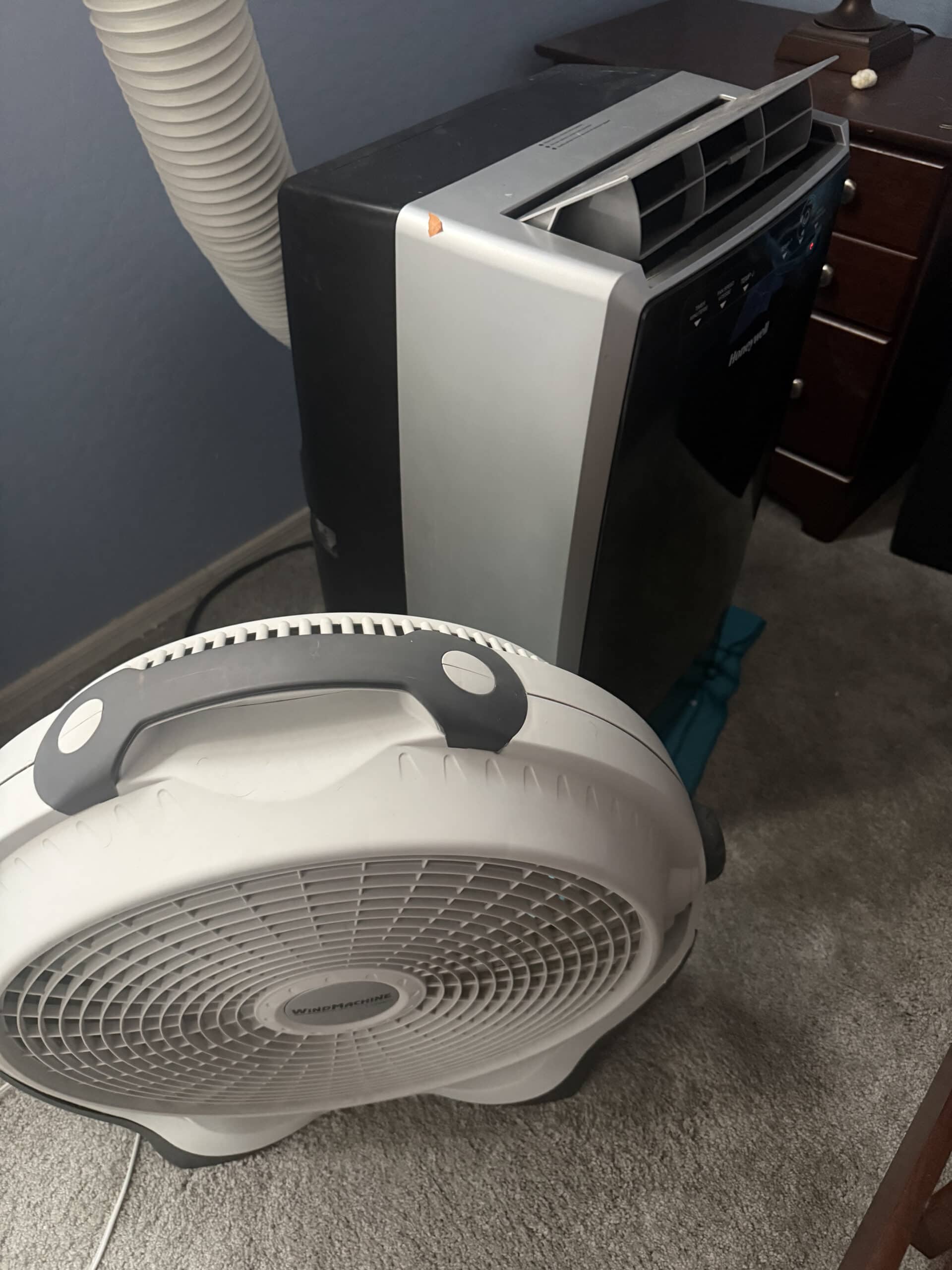
An air conditioner removes heat. A fan does not. Once that distinction is clear, the reason people run both stops being a compromise and starts being a division of labor: the AC produces cooled air in one part of the room, and the fans decide whether it reaches you.
That matters most with a single-hose portable unit, which is the type most bedrooms end up with and the type that benefits most from help moving air around. Our note on running a fan and AC together covers whether to do it at all.
Combinations at a Glance
| Setup | Cools | Moves air | Best for |
|---|---|---|---|
| Portable AC alone | Yes | Poorly | Small rooms |
| AC plus ceiling fan | Yes | Whole room | Even distribution |
| AC plus floor fan | Yes | At the bed | Direct airflow |
| AC plus both fans | Yes | Both | Hot climates |
| Window AC plus fan | Yes, more efficiently | Where aimed | Owned homes |
| Fans alone | No | Yes | Mild climates only |
The short version: in a genuinely hot climate you need something that removes heat and something that distributes it, and those are different machines.
How We Picked
Combinations are grouped by what each part contributes rather than by product tier, since the common failure is buying two things that do the same job. Distribution capability is weighted alongside cooling capacity.
Selections reflect documented specifications. Descriptions come from product research except where personal use is stated directly.
1. Portable AC Plus a Floor Fan, Best Overall
Why It Stands Out
A portable unit cools a limited volume around itself, and a floor fan carries that air to the bed. This is the pairing that turns an adequate unit into a comfortable room.
It also lets you position the cooling and the airflow independently, which a single machine cannot do. The unit can sit where the window is while the fan sits where you actually sleep.
Worth Knowing
Single-hose portables draw room air to cool the condenser and expel it outside, which pulls warm air in from elsewhere. That is a known inefficiency of the type rather than a fault.
The unit needs a window and the hose run should be short and unkinked. Our roundup of whether a portable AC is worth it for one room covers the units.
This suits most hot bedrooms. Skip it if a window unit is possible.
2. AC Plus a Ceiling Fan, Best Even Distribution
Why It Stands Out
A ceiling fan moves the entire room from above rather than aiming at a spot, which evens out the temperature difference between the cooled corner and the rest of the space.
It also takes no floor space, which matters in a room already holding a portable unit and its hose. Floor area disappears quickly once cooling equipment is in the room.
Worth Knowing
Ceiling fans should run counterclockwise in summer to push air downward, and plenty of people never check the switch.
They cannot be repositioned once installed. Our roundup of ceiling fans for bedrooms covers selection.
This suits whole-room evenness. Skip it if you rent and cannot install one.
3. A Dual-Hose Portable, Best Efficiency Upgrade
Why It Stands Out
Dual-hose units draw outside air for the condenser rather than room air, which avoids the negative pressure that pulls warm air in around doors and windows.
In a hot climate that difference is meaningful over a long season, since the negative pressure a single-hose unit creates works against it continuously rather than occasionally.
Worth Knowing
They cost more, weigh more, and need a wider window fitting, so this is an upgrade decision rather than an obvious default.
Two hoses also occupy more of the window. Our comparison of single-hose and dual-hose units covers the trade.
This suits hot climates and long seasons. Skip it in a mild climate.
4. An Air Circulator Alongside the AC, Best Reach
Why It Stands Out
Circulators throw a focused column rather than a wide breeze, which moves cooled air across a long room in a way a standard fan does not.
Aiming one away from the bed still improves distribution without a stream of air on you all night.
Worth Knowing
Circulators are typically louder than tower fans at comparable settings because the airflow is concentrated.
They also need a clear path, so furniture placement matters. Our roundup of quiet fans for sleeping covers noise.
This suits long or awkward rooms. Skip it in a small square bedroom.
5. A Window Unit Plus a Fan, Best Efficiency Overall
Why It Stands Out
Window units are considerably more efficient than portables, since the whole heat exchange happens outside rather than through a hose. Adding a fan handles distribution.
They are also generally quieter inside, because the compressor sits in the window rather than in the room with you. That is a substantial difference for anyone sleeping in the same space.
Worth Knowing
Installation is permanent for the season and many rentals prohibit them, which is why portables exist despite being less efficient.
Window units block the window and the light. Our note on bedroom cooling setups for hot climates covers the options.
This suits owned homes. Skip it if your lease forbids it.
6. A Bedside Fan for Direct Airflow, Best Fine Control
Why It Stands Out
A small fan close to the bed lets you adjust airflow at your own level without changing anything about the room, which suits two sleepers who disagree about breeze.
It also runs at low speed quietly, since it does not need to move much air to reach you.
Worth Knowing
Direct airflow overnight dries some people out and stiffens necks, so aiming past rather than at is worth trying.
A bedside fan does nothing for the rest of the room. Our roundup of bedside fans covers the format.
This suits personal adjustment. Skip it as the only air movement in a hot room.
My Summer Setup
Three machines run overnight through an Arizona summer: a ceiling fan, a floor fan, and a single-hose portable AC that sits between the window and the bed. All three, all night, for months at a stretch.
The AC has been going five or more summers and is self-evaporating, so I have never emptied a tank. I check the filter roughly every couple of months during the season, which is the only maintenance it gets.
What the fans do is make the AC’s output reach me. The unit cools a limited area around itself, and without air moving, the far side of the room stays noticeably warmer. The ceiling fan handles the room and the floor fan handles the space around the bed, and those are separate jobs rather than redundancy.
Take the AC out of that and the fans do not compensate. That is the thing worth being clear about, because in a hot enough climate no amount of air movement substitutes for removing heat.
What I cannot compare is dual-hose units, window units, or circulators, since I have not run those. Those sections come from research rather than from equipment I own.
What to Look For
What is each machine doing?
One should remove heat and the others should move air. Two devices doing the same job is the common and expensive mistake.
Single hose or dual?
Single-hose units pull room air for the condenser, creating negative pressure that draws warm air in. Dual-hose avoids that and costs more.
Where does the cooled air go?
A unit in a corner cools that corner. Fan placement decides whether the rest of the room benefits.
Can you install a window unit?
If your situation allows one, it is meaningfully more efficient than a portable. Many rentals do not allow it, which is the usual constraint.
Common Mistakes to Avoid
Expecting fans to cool
Fans move air and add motor heat. In a hot climate they improve comfort and do not lower the temperature.
Long or kinked exhaust hoses
Portable AC efficiency drops sharply with hose length and bends, since the hose radiates heat back into the room. Short and straight matters.
Sealing the window badly
Gaps around a window kit let hot air back in continuously, which undoes a meaningful share of the cooling.
Skipping the filter
A clogged filter reduces airflow and makes the unit work harder. Checking it periodically during the season is the main maintenance these need. Our note on portable AC filters covers timing.
Worth reading next: our comparison of ceiling and floor fans, our note on what a portable AC costs to run overnight, our guide to whether ceiling fans cool a room, and a roundup of cooling sheets, and cooling a bedroom for better sleep.
Fan and AC FAQ
Should I run a fan and air conditioner together?
In most hot bedrooms, yes. The AC removes heat and the fan distributes the cooled air, which would otherwise pool near the unit. They do different jobs, so running both is not redundant.
Does a fan make the AC work harder?
No, and it often helps, since better distribution means the thermostat sees a more representative temperature. The fan’s own power draw is small compared with the compressor.
Where should the fan go?
Positioned to carry air from the cooled area toward the bed, rather than aimed at the AC unit or directly into a wall. Aiming across the room generally distributes better than aiming at a person.
Is a single-hose portable AC bad?
Less efficient rather than bad. Drawing room air for the condenser creates negative pressure that pulls warm air in from elsewhere. They work, and dual-hose units do the same job with less of that penalty.
Can fans replace an air conditioner?
In a mild climate, often. In a genuinely hot one, no. Fans move air and do not remove heat, so once the room itself is too warm, air movement stops being enough regardless of how many fans are running.
Which direction should a ceiling fan spin in summer?
Counterclockwise viewed from below, which pushes air downward and creates the breeze you feel. The reverse setting pulls air up and is intended for winter, and plenty of fans are left on the wrong one year-round.
How often should I clean the AC filter?
Manufacturers typically suggest checking every few weeks during heavy use, and a visual check every couple of months is a common practical rhythm. A clogged filter reduces airflow and makes the unit work harder.
Do I need a dehumidifier as well?
Air conditioners remove some humidity as a byproduct of cooling, which is often enough. In a genuinely humid climate, or during a wet season, a dehumidifier addresses what a fan cannot, since humid air slows the evaporation that makes fans feel effective.
