
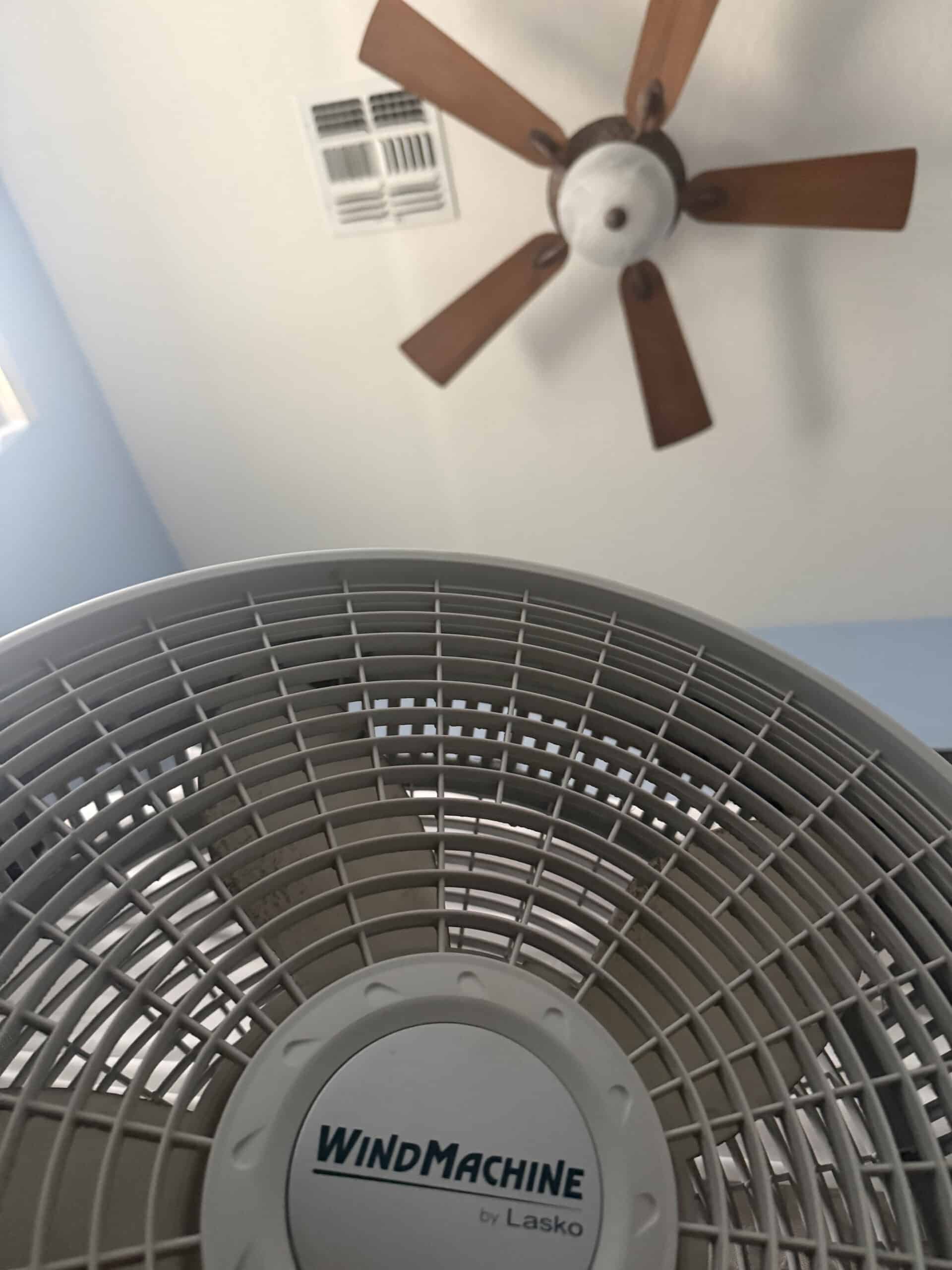
The honest answer for most bedrooms is one, positioned properly. Adding a second fan to a room where the first one is badly placed produces more noise and not much more comfort, which is how people end up with three fans and a room that still feels stuffy.
Where multiple fans genuinely help is when they are doing different jobs: one moving the whole room, another putting air where you actually are. That distinction is what decides whether a second fan is worth buying. Our comparison of ceiling and floor fans covers the split.
Quick Answer
One well-placed fan suits most bedrooms in a moderate climate. Two make sense when a ceiling fan handles the room and a floor fan handles you. Beyond two, you are usually solving a ventilation or temperature problem that fans cannot address.
Key Points
- Placement beats quantity in almost every case.
- Two fans help when they do different jobs, not the same one.
- Fans cool skin, not rooms.
- Each additional fan adds noise and a small amount of heat.
- Cross-ventilation needs an exhaust path, not more fans.
When One Is Enough
A single fan handles a small to moderate bedroom in a temperate climate, provided it is positioned to move air through the space rather than into a wall or the side of the bed.
The most common mistake is placing a fan close and aiming it directly, which creates a strong local breeze and leaves the rest of the room still. Moving the same fan further away and angling it across the room often works better with no additional purchase.
A ceiling fan alone also suffices for many people, particularly those who dislike direct airflow. Our roundup of ceiling fans for bedrooms covers that route.
When Two Make Sense
Different jobs
A ceiling fan moves the whole room from above; a floor fan directs air at the bed. Those are genuinely separate functions and running both covers more than either alone.
Alongside air conditioning
An AC unit cools air in one part of the room. Fans move that cooled air to where you are, which is why the combination outperforms either on its own.
Awkward room shapes
Long rooms, alcoves, and beds tucked into corners create dead air that one fan cannot reach. A second fan placed to break that up does real work.
Two sleepers who disagree
One person wanting direct airflow and one not is a genuine reason for two fans at different settings, and it is a practical solution rather than a compromise.
What Three Fans Actually Solves
Very hot climates, where the answer is not really more fans but more of everything. In an Arizona summer a bedroom can need whole-room movement, direct airflow, and actual cooling at the same time, and each of those is a different machine.
That is the case where three makes sense, and it is worth being clear that the third one is usually not a fan. Adding a third fan to two existing fans rarely changes much; adding cooling does.
Our note on running a fan and AC together covers the combination.
What I Run
Three things run overnight through summer here: a ceiling fan, a floor fan in the room, and a portable air conditioner. All three, all night, for months.
Two of those are fans and the third is doing the actual cooling, which is the distinction worth drawing. The ceiling fan moves the room, the floor fan puts air where I am, and the AC is the only one lowering the temperature. Take the AC away and the two fans do not make up for it.
What I would take from that is that the fans are doing separate jobs rather than adding up. If I removed the floor fan I would notice it directly; if I removed the ceiling fan the room would feel stiller overall. They are not redundant, and neither of them is cooling anything.
What I have not tried is a single more powerful fan in place of the two, so I cannot say whether that would work as well. The setup grew from what the room needed rather than from comparing options.
Placement Before Quantity
Across the room, not at the bed
Air aimed across a space circulates it. Air aimed at a person creates a local breeze and leaves the room otherwise still.
Away from walls
A fan close to a wall recirculates the same air. A few feet of clearance behind it makes a noticeable difference.
Height matters
Cool air settles low and warm air rises. A floor fan moves the cooler layer; a fan on a dresser moves warmer air around.
Try moving it first
Before buying a second fan, spend a couple of nights with the first one somewhere else. This resolves the problem more often than people expect.
What Fans Cannot Do
Fans do not lower room temperature. They move air, and the motor adds a small amount of heat, so a fan running in an empty room makes it marginally warmer rather than cooler.
The cooling you feel is evaporative and works on skin. That is why a fan helps enormously when you are in the room and does nothing for a pet left behind, which is worth knowing.
Humidity also limits how well that works. In humid air, evaporation slows and a fan feels less effective regardless of speed. Our note on whether ceiling fans cool a room covers the mechanism.
The Cost of Each Additional Fan
Noise is the main one. Two quiet fans are louder than one, and the sound of two motors running at slightly different pitches is considerably more intrusive than a single steady tone at the same volume.
Power draw is modest per fan and adds up across a season of nightly running. Motor type affects this more than the number of fans does, so two efficient fans can cost less to run than one inefficient one.
There is also the practical cost of floor space and cords in a room you move through in the dark. Our roundup of quiet fans for sleeping covers noise specifically.
Bedroom Fan FAQ
Is one fan enough for a bedroom?
For most bedrooms in a moderate climate, yes, provided it is positioned to move air through the room rather than aimed at the bed from close range. Repositioning an existing fan solves the problem more often than adding another one.
Do two fans cool a room twice as much?
No, because fans do not cool rooms at all. Two fans doing the same job add noise without much benefit. Two doing different jobs, such as a ceiling fan for the room and a floor fan for the bed, genuinely help.
Should I run a fan with the air conditioner?
It usually helps, since the fan distributes cooled air that would otherwise stay near the unit. The fan is not cooling anything, it is making the AC’s output reach further, which is why the combination is standard in hot climates.
Where should I put a bedroom fan?
Far enough from a wall to draw air freely, angled across the room rather than directly at the bed, and low rather than high if you want to move the cooler air layer. Trying different positions costs nothing.
Does a ceiling fan replace a floor fan?
They do different things. A ceiling fan moves the whole room gently; a floor fan directs air at you. People who dislike direct airflow often prefer a ceiling fan alone, and people who want a breeze on them generally do not.
Will more fans help in high humidity?
Only somewhat. The cooling sensation is evaporative, and humid air slows evaporation, so fans feel less effective regardless of how many are running. A dehumidifier addresses that; more fans do not.
Is running several fans expensive?
Individually modest and cumulative over a season of nightly use. Motor type matters more than count, since DC motors draw considerably less than AC equivalents over the same hours.
When is the answer not more fans?
When the room is genuinely too hot rather than too still. Fans move air; they do not remove heat. If the room stays uncomfortable with good airflow, the problem is temperature or ventilation and needs cooling or an exhaust path instead.
Recommended Reading
See our note on cooling a bedroom for better sleep.
