
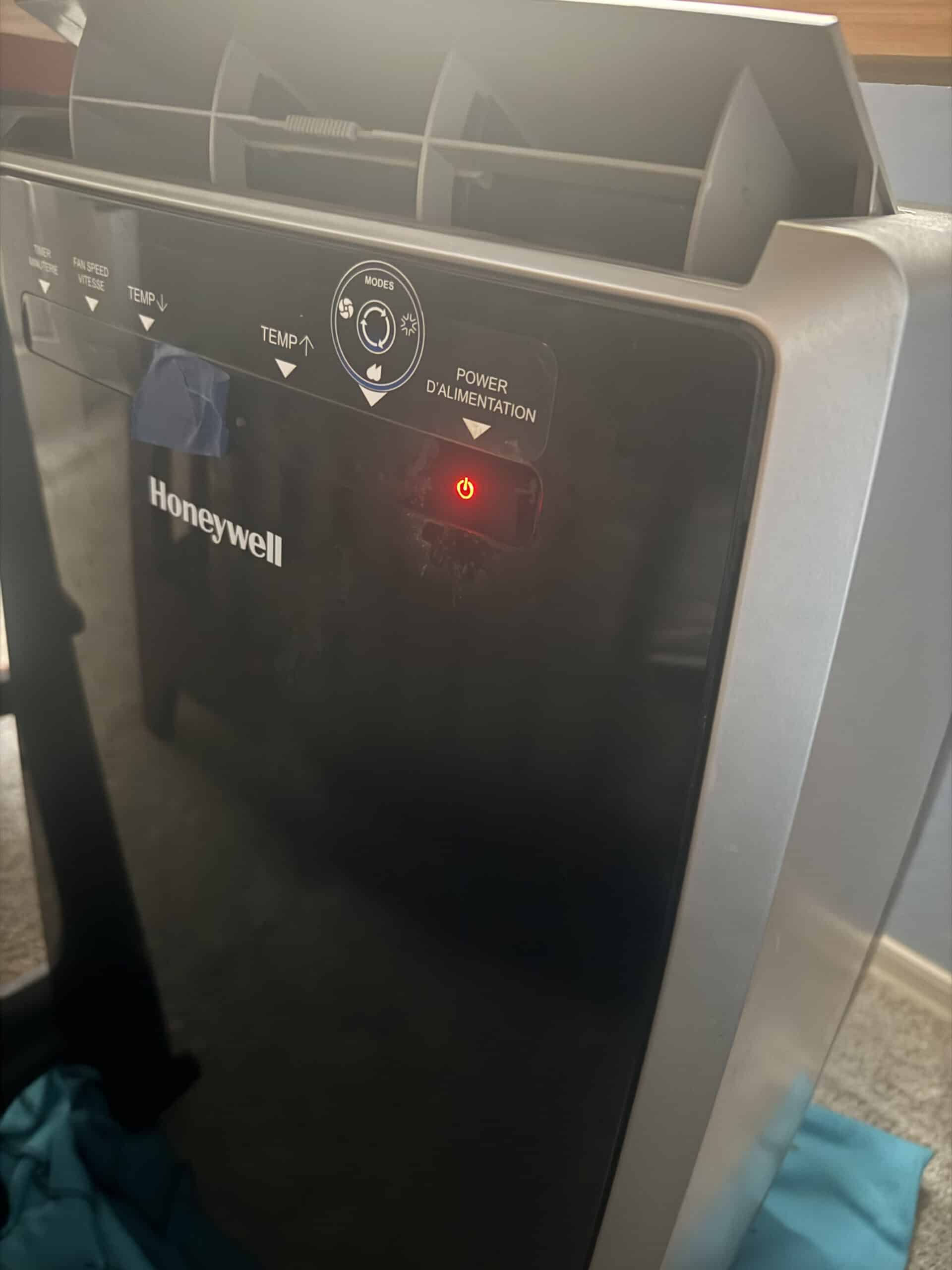
A self-evaporating portable AC recycles the water it pulls from the air and pushes most of it out through the exhaust hose as vapor, which means there is usually no tank to empty. The best self-evaporating portable ACs make that the normal experience rather than a marketing claim, and they hold it up in humid weather as well as dry. If you are still deciding on the format, our roundup of bedroom air conditioners covers the wider category.
The feature matters most at three in the morning. A unit that fills a reservoir shuts down and wakes you up, and a unit that evaporates its own condensate does not.
The honest limit is humidity. Every self-evaporating unit works better in dry air than in wet air, and no marketing copy admits it.
Quick Verdict
Buy a self-evaporating unit sized to the room rather than to the largest number on the box, and treat the drain plug as a backup rather than a defect. In a dry climate you may go entire summers without touching it. In a humid one, expect to drain occasionally in the worst weeks, and plan for a hose you can attach rather than a tank you carry.
Key Takeaways
- Self-evaporating means condensate leaves through the exhaust hose as vapor.
- Dry climates get the cleanest version of the experience.
- Humidity is the real limit, and performance drops off gradually rather than failing.
- Every unit still has a drain plug, and that is normal.
- Hose insulation and a good window seal matter more than the BTU rating.
How We Picked
These selections rest on published specifications, condensate handling design, stated noise levels and consistent owner feedback, alongside five-plus summers with one single-hose self-evaporating unit in a hot dry climate.
The criteria that carried weight were how the unit handles condensate, whether the drain is accessible without moving the machine, noise at the speed the unit runs overnight, and how well the window kit seals.
Room sizing was treated seriously, because an oversized unit cycles on and off and an undersized one runs constantly. Both are worse than a correct match.
Marketing language got discounted throughout. Almost every portable AC now claims to be self-evaporating, and the claim means different things depending on the design.
Single-Hose Self-Evaporating Unit
Why It Stands Out
The single-hose design is the most common and the simplest. One hose carries hot air and evaporated condensate out of the window, and the unit draws replacement air from the room.
Setup takes minutes and there is only one hose to route, which matters in a bedroom where the machine sits near the bed.
Worth Knowing
This is the category I own, so here is the observed version. Mine has been going five or more summers, it is self-evaporating, and I have never emptied a tank in that time.
I check the filter roughly every couple of months during the season, and that is the only maintenance it gets. The one honest caveat is humidity: when the monsoon comes up you can tell it gets a little worse, though it still keeps up.
Single-hose units also pull conditioned air out of the room to cool the compressor, which creates slight negative pressure and draws warm air in from elsewhere. Our comparison of single-hose versus dual-hose portable AC covers the trade properly.
Best for bedrooms, dry climates and anyone who wants the simplest setup. Skip it for a large open space or a very humid region.
Check Price on AmazonDual-Hose Self-Evaporating Unit
Why It Stands Out
Dual-hose units draw outside air in through one hose to cool the compressor and expel it through the other. Room air stays in the room, so there is no negative pressure pulling warm air back in.
That efficiency gain also helps the evaporation side, since the unit moves more air through the condenser.
Worth Knowing
Two hoses mean a bulkier window kit and more to route. In a small bedroom that is a genuine inconvenience.
These units usually cost more for the same cooling capacity. The efficiency pays that back over a season in a hot climate and probably not in a mild one.
Best for larger rooms, sustained heat and anyone prioritizing efficiency over simplicity. Skip it if window access is tight or the budget is fixed.
Check Price on AmazonCompact Unit for Small Bedrooms
Why It Stands Out
Smaller units in the eight to ten thousand BTU range suit a single bedroom properly. They evaporate condensate more easily than a large unit in the same room, because they produce less of it per hour.
Footprint matters more than people expect. A portable AC has to sit near a window and near enough to be useful, and in a bedroom that is usually a tight corner.
Worth Knowing
Small units struggle once a room exceeds roughly two hundred square feet or gets strong afternoon sun. Sizing charts assume average insulation and no direct sun.
Noise is not automatically lower. Compressor size and fan design matter more than capacity, and our guide on whether portable ACs are loud enough to disturb sleep covers what to look for.
Best for bedrooms under two hundred square feet and apartments where space is scarce. Skip it for open-plan rooms.
Check Price on AmazonHigh-Capacity Unit for Large or Sunny Rooms
Why It Stands Out
Units in the twelve to fourteen thousand BTU range handle rooms that a smaller machine cannot. West-facing bedrooms, poorly insulated spaces and upper floors all fall into this group.
Larger units also tend to have better-engineered condensate systems, since they produce more water and the manufacturer has to deal with it.
Worth Knowing
Oversizing is a real mistake. A unit that cools the room too fast cycles off before it has removed much humidity, which leaves the room cold and clammy.
These are heavy. Moving one between rooms or floors is a two-person job, so treat placement as permanent for the season and read where to put a portable AC in a bedroom before you commit.
Best for large, sunny or badly insulated rooms. Skip it for a standard bedroom, where it will short-cycle.
Check Price on AmazonQuiet-Focused Model for Light Sleepers
Why It Stands Out
Some manufacturers engineer specifically for low noise, using variable-speed compressors and larger slower fans. The difference at night is substantial.
A quieter unit also lets you run a middle fan speed instead of the lowest, which improves both cooling and evaporation.
Worth Knowing
Published decibel figures almost always describe the lowest fan speed with the compressor off. Look for a stated range instead of a single number.
Inverter models are the ones worth paying for here, since they modulate rather than switching the compressor fully on and off. That kick-on is what wakes people.
Best for light sleepers and anyone whose bedroom is small enough that the unit sits close to the bed. Skip it if noise has never been your issue.
Check Price on AmazonBudget Self-Evaporating Unit
Why It Stands Out
Self-evaporation is not a premium feature any more. Inexpensive units handle condensate the same way, because the alternative is a tank that customers complain about.
For a spare room, a rental or a first portable AC, the cheap end of the market does the job.
Worth Knowing
Window kits are where budget units cut corners, and a poor seal undoes the cooling. A separate kit is a worthwhile upgrade, as our roundup of portable AC window kits and seals covers.
Uninsulated exhaust hoses radiate heat straight back into the room. That is the other easy fix, covered in portable AC hoses and insulation wraps.
Best for spare rooms, rentals and short seasons. Skip it as the primary cooling for a room you sleep in every night of a long summer.
Check Price on AmazonSelf-Evaporating Portable ACs at a Glance
| Type | Best for | Trade |
|---|---|---|
| Single hose | Bedrooms, dry climates | Negative pressure pulls warm air in |
| Dual hose | Larger rooms, efficiency | Bulkier kit, costs more |
| Compact | Small bedrooms, tight corners | Struggles past 200 square feet |
| High capacity | Sunny or large rooms | Short-cycles if oversized, heavy |
| Quiet focused | Light sleepers | Premium price for inverter models |
| Budget | Spare rooms and rentals | Weak window kit and hose |
How to Choose a Self-Evaporating Portable AC
How humid is your climate?
This is the first question and it decides how well the feature works. Dry air lets a unit evaporate everything it condenses, so the drain plug never comes out.
Humid air produces more condensate than the unit can evaporate, so expect occasional draining in the worst weeks. Our guide on how often you empty a portable AC sets realistic expectations.
Is the drain accessible?
Even if you never use it, check where it is. A plug on the lower rear panel means tipping the machine or sliding it out, which is miserable on a hot night.
Units with a continuous drain port let you run a hose to a floor drain and forget it entirely.
What size is the room, honestly?
Measure the floor area and adjust up for sun exposure, poor insulation, and upper floors. Then buy for that number rather than for the room you wish you had.
Oversizing leaves a clammy room. Undersizing leaves a running compressor and a bill that reflects it.
How will you seal the window?
The included kit is usually the weakest part of the whole product. Gaps around a sliding panel let hot air straight back in and make the unit run constantly.
Foam, tape and a proper seal cost very little and change the result more than a BTU upgrade would.
Self-Evaporating or Tank Draining
When self-evaporating genuinely delivers
In a dry climate the feature does exactly what it says. Five summers without emptying anything is a realistic outcome, and it removes the one chore that makes people resent portable units.
It also means the unit keeps running unattended, which matters overnight and while you are out.
When you should plan to drain
Humid regions, basements and shoulder seasons all produce more condensate than the exhaust can carry. The unit will not break, it will just fill and stop.
Running a dehumidifier alongside reduces the load considerably, which our roundup of bedroom dehumidifiers covers.
What Trips People Up
Thinking the drain plug means it is not self-evaporating
Every unit has one, because every unit can be overwhelmed. The plug is a backup, not a contradiction of the feature.
Ignoring the filter
A clogged filter cuts airflow, which cuts both cooling and evaporation. Checking it every couple of months through the season is enough, and it is the main maintenance these units need.
Blaming the unit for warm air at night
Warm output usually means a sealing problem, a kinked hose, or a full reservoir rather than a failing compressor. Our explainer on why a portable AC blows warm air at night runs through the causes.
Running it alone in a large room
Air needs moving. Pairing the unit with a fan spreads the cooling and lets the AC work at a lower setting, as running a fan and AC together explains.
Recommended Reading
Self-Evaporating Portable AC FAQ
Do self-evaporating portable ACs ever need emptying?
In dry conditions, often never. Mine has run five or more summers without a tank being emptied. In humid weather the unit produces more condensate than it can evaporate, so occasional draining becomes normal rather than a fault.
How does self-evaporation actually work?
The unit sprays or slings collected condensate onto the hot condenser coil. The water turns to vapor and leaves through the exhaust hose along with the hot air, which is also why it improves cooling efficiency slightly.
Are self-evaporating units worse in humid climates?
Less effective rather than worse. More humidity means more condensate, and there is a limit to how much the exhaust can carry away. You notice it as a gradual drop rather than a failure, and a dehumidifier alongside takes the pressure off.
Do I still need a drain hose?
Not usually, but check the machine has a continuous drain port before buying if you live somewhere humid. Being able to attach a hose and forget it is far better than moving a heavy unit to reach a plug.
Is single hose or dual hose better for self-evaporation?
Dual hose has a slight edge, because it moves outside air across the condenser instead of room air. In practice the climate matters far more than the hose count, and single-hose units are simpler to set up in a bedroom.
How often should I clean the filter?
Every couple of months during the season is enough for most bedrooms, more often with pets or dust. It is genuinely the only regular maintenance these units need, and a blocked filter hurts evaporation as much as cooling.
Can I run one overnight safely?
Yes, and that is what most people buy them for. Use a proper wall outlet rather than an extension cord, keep the exhaust hose as short and straight as you can, and make sure the window seal is intact.
Will a self-evaporating unit dehumidify the room?
It removes moisture as a side effect of cooling, but it puts most of that back out the window rather than into a tank. If humidity rather than heat is your actual problem, a dedicated dehumidifier does the job far better.
