
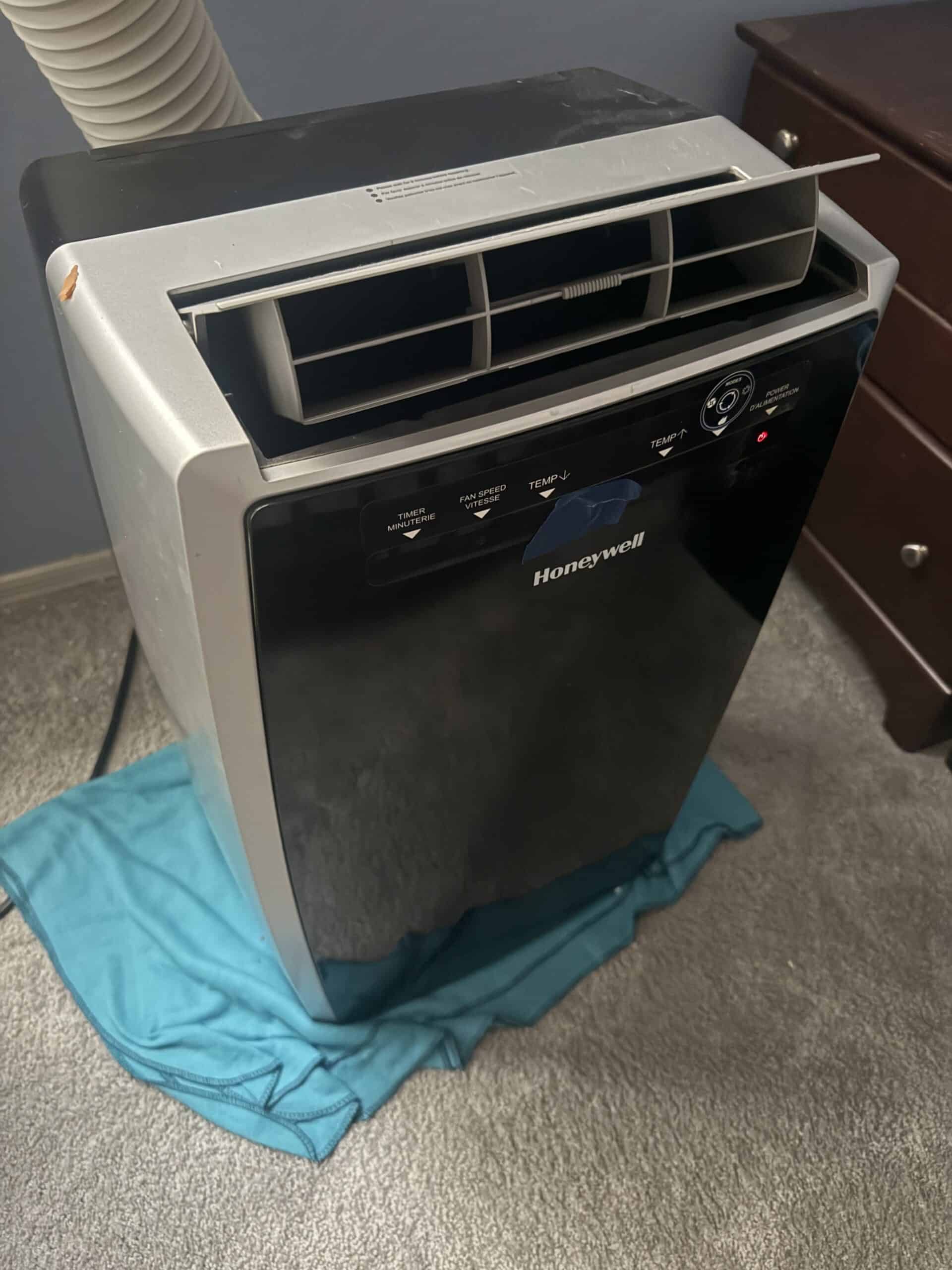
It depends entirely on whether yours collects water or drains it. Most modern units are designed to evaporate the majority of what they condense, and the ones that do collect can usually be set up to drain continuously instead, which turns a daily job into no job at all.
I have never emptied mine. Five summers of running it overnight in Arizona, and emptying a tank has simply never been part of owning it.
Quick Answer
Self-evaporating units in normal conditions may never need emptying. Units with a tank in humid conditions can fill in eight to twelve hours. Attaching a drain hose to the continuous drain port removes the task entirely if gravity allows it.
What Determines How Often
| Situation | Typical emptying |
|---|---|
| Self-evaporating, dry climate | Rarely or never |
| Self-evaporating, humid weather | Every few days |
| Tank model, moderate humidity | Every day or two |
| Tank model, high humidity | Every 8 to 12 hours |
| Continuous drain fitted | Never |
Humidity is the variable that matters. An air conditioner removes moisture as a side effect of cooling, so the wetter the air, the more water it produces.
That is why the same unit that never fills in a dry climate needs daily attention somewhere humid, and why the answer people give varies so widely.
Three Different Designs
Self-evaporating
Most current units spray condensate onto the hot condenser coil, where it evaporates and exits through the exhaust hose. In moderate humidity this handles nearly all of it.
Partially self-evaporating
The same mechanism with a reservoir for the excess. These handle normal conditions without intervention and fill during humid spells.
Tank collection
Older and cheaper units collect everything in a removable tank. Reliable and the version that produces the daily chore.
Continuous drain
Almost all units have a drain port, whichever design they use. Fitting a hose to it bypasses the tank entirely, covered in whether a portable AC is worth it for one room.
Why I Have Never Emptied Mine
Mine is a self-evaporating unit. There is no drain port I have ever opened and no tank I have ever pulled out, and in five summers no water has collected anywhere I have noticed. The condensate goes out through the exhaust hose as vapor, which is how these units are designed to work.
That has been the arrangement for more than five years of summer use, running overnight in the bedroom. It is one less thing to think about, and it is the reason I would not describe emptying as part of owning one.
The tradeoff is a second hose that has to go somewhere sensible, alongside the exhaust hose that already does. In a bedroom that means two things running across a corner of the room.
It also constrains placement further, since a drain hose only works running downhill. That matters in a room where placement is already decided by the window, covered in where to put a portable AC in a bedroom.
Climate is doing some of the work here. Arizona summers are dry, so there is far less moisture in the air to condense in the first place than there would be somewhere humid. The same unit in a damp climate would likely produce more water than it could evaporate and would start asking to be drained.
Setting Up Continuous Drainage
Find the drain port, usually a capped outlet low on the back of the unit. Some have separate ports for the pump and gravity drain.
Attach a garden hose or the supplied drain line, then run it to a floor drain, a shower, or a container placed lower than the port.
Gravity is the whole constraint. The hose has to slope downward along its entire length, and any upward section stops the flow and backs water up into the unit.
Where gravity is not available, a condensate pump lifts water to a higher outlet. They cost more, add noise, and are the answer for upper floors with no nearby drain.
When a Full Tank Is Telling You Something Else
A unit filling faster than it used to is worth reading as information rather than as a chore that got worse.
Rising humidity is the obvious cause, and in a seasonal climate that tracks the wet weeks. If your tank suddenly needs daily attention in July and never did in May, the weather explains it.
A poor window seal is the less obvious one. Gaps around the panel pull humid outside air into the room continuously, and the unit then dehumidifies air that keeps being replaced. Sealing the kit reduces both the water and the runtime, covered in window insulation kits.
An undersized unit also produces more water than expected, because it runs almost continuously and every hour of running condenses moisture.
Drying laundry indoors or an ensuite bathroom nearby will do it too, and those show up as a tank that fills unpredictably rather than steadily.
A tank that fills much faster than the room feels humid usually points at air coming in from outside rather than at moisture generated inside, and dedicated moisture removal sits in bedroom dehumidifiers.
Signs the Tank Needs Attention
The unit stops cooling
Most shut off the compressor when the tank fills, leaving the fan running. A unit blowing room-temperature air is usually full rather than broken.
A warning light or beep
Nearly all tank models signal this. Ignoring it means the unit stops rather than overflows, which is a design safety feature.
Reduced cooling before shutdown
Performance often drops before the cutoff triggers, so a unit that seems weaker overnight may be approaching full.
Water around the base
Rare and worth investigating, since it usually means a blocked drain line or a unit sitting unlevel rather than a full tank.
What to Do With the Water
Condensate is distilled water pulled from the air, which makes it cleaner than tap water in mineral terms and dirtier in biological ones.
It picks up dust, mold spores, and whatever is living on the coils as it passes through, so it is not drinking water and it is not safe for pets to drink either.
Plants are the common suggestion and it is a qualified yes. The lack of minerals suits some houseplants, and the biological content makes it a poor choice for anything you intend to eat.
Down a sink or an outside drain is the simple answer, and the practical one for anyone emptying daily.
Do not pour it back into the unit or leave a full container standing in a warm room, since both create exactly the conditions that grow what you would rather not have circulating.
Keeping the Water Side Clean
Standing water in a tank or a drain line supports bacterial and mold growth, which is the reason to care about this beyond convenience.
Empty and dry the tank at the end of the season rather than leaving water in it through storage. That is the single most important maintenance step. For more on this, see our guide to filters and replacement filters.
Flush the drain line periodically if you run continuous drainage, since algae builds in a permanently damp hose and eventually restricts flow.
Filters need cleaning every few weeks during heavy use, and a clogged filter reduces cooling in a way people usually blame on the unit aging, covered in bedroom air conditioners.
Related Reading
- is a portable AC worth it
- where to put one
- portable AC noise
- bedroom air conditioners
- bedroom dehumidifiers
- cooling setups for hot climates
Part of our guide to cooling a bedroom for better sleep.
Frequently Asked Questions
How often do you empty a portable AC?
Anywhere from never to twice a day, depending on design and humidity. Self-evaporating units in dry conditions rarely need it, and tank models in humid weather can fill overnight.
Do all portable ACs need emptying?
No. Most modern units evaporate the majority of condensate through the exhaust hose, and almost all have a drain port for continuous drainage.
How do I set up continuous drainage?
Attach a hose to the drain port and run it downhill to a drain or a lower container. The hose must slope down along its whole length or water backs up.
Why does mine fill so fast?
Humidity. An air conditioner removes moisture while cooling, so damp air produces far more condensate than dry air does.
What happens if I do not empty it?
Most units shut the compressor off and keep the fan running, so you get room-temperature air rather than an overflow. It is a safety cutoff rather than a fault.
Can I use a pump instead of gravity?
Yes. A condensate pump lifts water to a higher outlet, which suits upper floors without a nearby drain. It costs more and adds some noise.
Does the water need any treatment?
Not for use, and the tank and drain line should be emptied and dried at the end of the season, since standing water supports mold and bacterial growth.
