
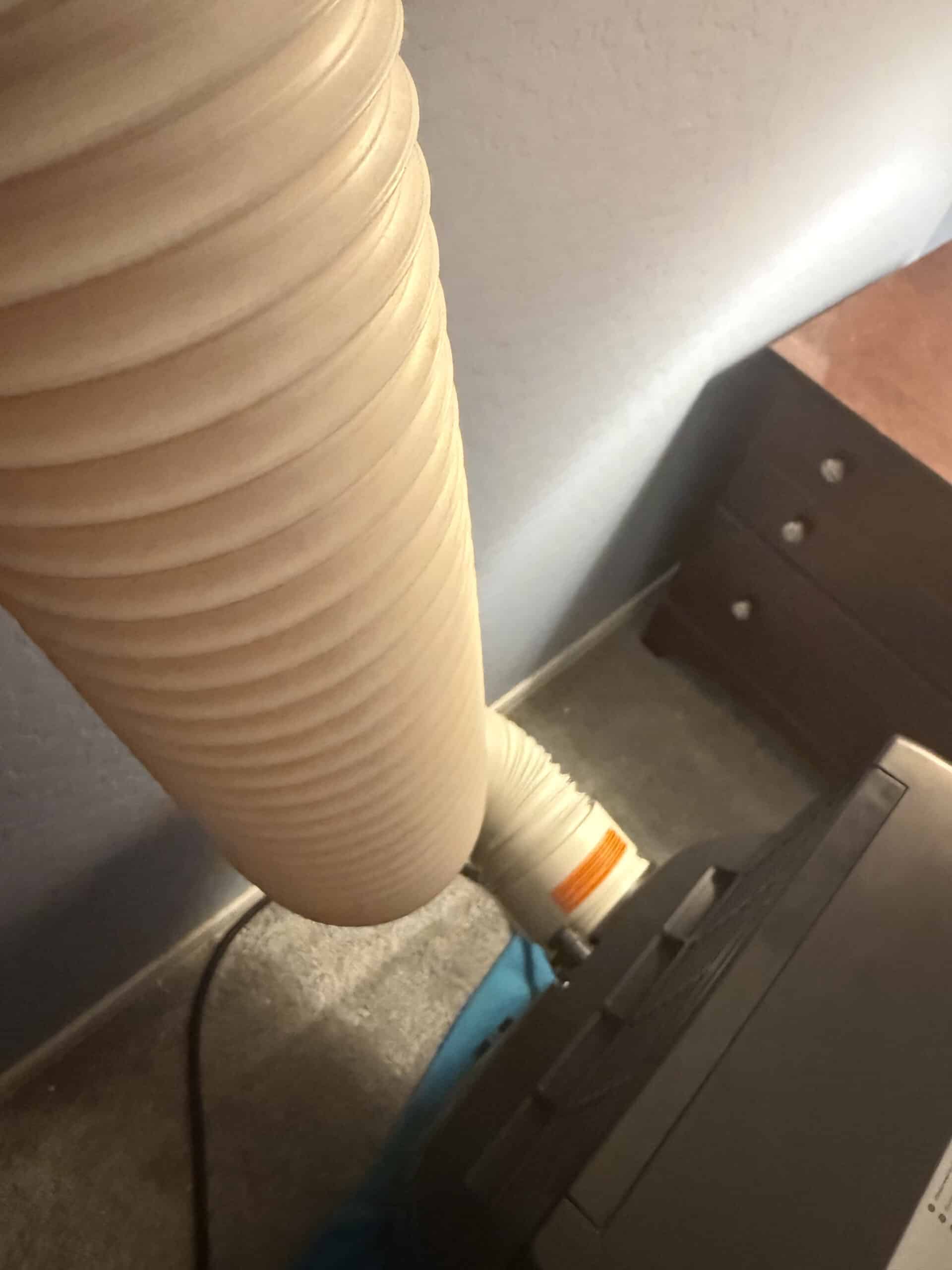
The exhaust hose on a portable air conditioner carries hot air out of the room, and while it does that it gets hot itself and radiates into the space it is crossing. On a single-hose unit the hose can run warm enough to feel from a foot away, and every degree it puts back is a degree the compressor has to remove again. Insulating it is a small job that most owners never do. Our roundup of bedroom air conditioners covers the units these attach to.
Quick Verdict
An insulating sleeve over the existing hose is the highest-value fix and costs very little. Keep the hose as short and straight as the layout allows, since length and bends both cost efficiency, and replace a cracked or stretched hose rather than taping it.
Key Takeaways
- An uninsulated exhaust hose radiates heat back into the room.
- Short and straight beats long and coiled every time.
- Single-hose units are more affected by this than dual-hose ones.
- Stretched hoses lose their shape and leak at the couplings.
- Extensions reduce airflow and increase back pressure.
How We Picked
Products are grouped by whether they insulate, replace, or extend the hose, since those solve different problems and only one of them is usually a good idea. Heat transfer is weighted heavily, because it is the part of this that affects how well the unit actually cools.
Selections reflect construction and documented compatibility. Descriptions come from product research except where personal use is stated directly.
1. An Insulating Hose Sleeve, Best Overall
Why It Stands Out
A padded or foil-lined sleeve slides over the existing hose and stops most of the radiant heat reaching the room. It requires no modification to the unit and takes a couple of minutes to fit.
This is the single most effective thing you can do to an exhaust hose, and it is also the cheapest.
Worth Knowing
Sleeves are sized by hose diameter, and portable AC hoses come in a few standard sizes. Measure yours rather than assuming, since a loose sleeve slides and a tight one will not go on.
Some sleeves reduce how far the hose flexes, which matters if your unit sits at an angle to the window. Our note on positioning a portable AC covers the layout question.
This suits every single-hose unit. Skip it only if the hose run is very short and already cool to touch.
Check Price on Amazon2. A Replacement Exhaust Hose, Best for Worn Units
Why It Stands Out
Original hoses stretch, crack, and lose their coil shape over several seasons, and a hose that no longer holds its form leaks warm air along its length rather than only at the ends.
Replacements cost far less than a new unit and restore performance that has degraded gradually enough not to be noticed.
Worth Knowing
Diameter and the coupling thread both have to match, and these vary between manufacturers. Check the specification against your unit rather than buying by length alone.
A hose that has been stretched permanently will not shrink back, which is why treating a stretched hose with tape is a temporary measure at best.
This suits units several seasons old. Skip it if the original is still in good shape.
Check Price on Amazon3. Foil Tape and Coupling Seals, Best Small Fix
Why It Stands Out
The joints where the hose meets the unit and the window panel are where warm air escapes first, and foil tape seals those without any disassembly.
It costs almost nothing and addresses a leak that is easy to miss because the hose itself looks intact.
Worth Knowing
Use foil tape rather than duct tape. Ordinary cloth tape softens with heat and unpeels, leaving adhesive on the hose and the panel.
Do not tape over a hose that needs removing seasonally without expecting to redo it each year. Our roundup of portable AC window kits and seals covers the other end of the same run.
This suits leaky couplings. Skip it as a fix for a damaged hose.
Check Price on Amazon4. A Hose Support or Hanger, Best for Layout Problems
Why It Stands Out
Where the unit cannot sit next to the window, a support holds the hose up and straight rather than letting it sag across the floor. Straighter runs move air better and radiate less onto things you touch.
Keeping the hose off the floor also stops it warming carpet or bedding it happens to rest against.
Worth Knowing
Supports need something to attach to, and a rental wall may not be an option. Freestanding versions take floor space in a room that already has an air conditioner in it.
Lifting the hose does not shorten it, and length remains the bigger factor.
This suits awkward room layouts. Skip it if the unit sits right at the window.
Check Price on Amazon5. A Hose Extension, Best Last Resort
Why It Stands Out
Where the unit genuinely cannot reach the window, an extension is the only option that makes the setup work at all.
Some manufacturers sell matched extensions, which fit properly and avoid the coupling problems generic ones introduce.
Worth Knowing
Extending an exhaust hose increases back pressure and gives the hot air more distance to radiate from, both of which reduce cooling. Manufacturers generally advise against it for that reason.
If an extension is unavoidable, insulate the whole length rather than only the original section. Our guide to cooling a bedroom covers alternatives worth trying first.
This suits rooms where nothing else works. Skip it if the unit can be moved closer instead.
Check Price on Amazon6. A Reflective Barrier Panel, Best Supporting Addition
Why It Stands Out
A reflective panel placed between the hose and the bed blocks radiant heat from reaching you directly, which matters when the layout puts the hose close to where you sleep.
It is a cheap addition where the hose cannot be rerouted.
Worth Knowing
This redirects heat rather than removing it, so the room total is unchanged. It improves comfort at a specific spot.
Panels near an operating appliance need to be non-combustible and positioned so they do not block airflow into the unit.
This suits hoses that pass close to the bed. Skip it if insulating the hose already solved it.
Check Price on AmazonHose Products at a Glance
| Product | Fixes | Effort | Worth doing? |
|---|---|---|---|
| Insulating sleeve | Radiant heat | Minutes | Yes, first |
| Replacement hose | Cracks and stretching | Minutes | If several seasons old |
| Foil tape | Coupling leaks | Minutes | Yes, cheap |
| Hose support | Sagging and long runs | Some mounting | Layout dependent |
| Extension | Unit far from window | Minutes | Last resort |
| Reflective panel | Heat near the bed | Minutes | Situational |
My Unit and the Hose Run
I have run a single-hose portable air conditioner in my bedroom for over five years. It sits between the window and the bed, which is not where anyone would put it by choice and is what the room allows.
That placement is exactly the situation this article is about. The hose runs from the unit to the window across a short stretch of the room, and it is close to where I sleep rather than tucked out of the way.
Worth being clear that I use the setup as it came rather than having rebuilt it. The point of writing this is that the hose is the part of a portable AC most people never think about, and after five years of living beside one I would say it deserves more attention than it gets.
Single-hose units have this problem more than dual-hose ones do, because everything the unit exhausts leaves through that single pipe. If yours is single-hose, the hose is doing more work and getting hotter than the equivalent on a dual-hose machine.
What to Look For in Hose Products
What diameter is your hose?
Portable AC hoses come in a few standard sizes, and sleeves and replacements are sold by diameter. Measure before ordering rather than assuming a standard.
How long is the run?
Shorter is better in every respect. Before buying anything, check whether the unit can move closer to the window, since that beats any product here.
Is the hose damaged?
Cracks, permanent stretching, and a lost coil shape all mean warm air escaping along the length. Tape is a stopgap; replacement is the fix.
Single-hose or dual-hose?
Single-hose units draw room air and exhaust it, which creates negative pressure and makes both hose insulation and window sealing more important.
Insulate or Replace?
Insulate first
A sleeve costs little, fits in minutes, and addresses the heat radiating into the room, which is the problem almost every setup has. Do this before considering anything else.
Replace when the hose is worn
A hose that has stretched permanently or cracked is leaking rather than only radiating, and insulation over a leaking hose does not help. Several seasons of use is roughly when this becomes worth checking. Our note on emptying a portable AC covers the other routine maintenance.
Common Hose Mistakes to Avoid
Coiling excess hose
A coiled hose has more surface area radiating into the room and more resistance to airflow. Keep it as short and straight as the layout permits.
Using duct tape on couplings
Cloth tape softens near a warm hose and peels, leaving residue. Foil tape is designed for this and stays put.
Extending the hose to suit the furniture
Extensions reduce cooling through back pressure and added radiating length. Moving the unit is almost always better than lengthening the hose.
Ignoring the hose entirely
It is the part of the system that sits in the room getting hot, and almost nobody insulates it. That makes it the cheapest available improvement on most setups. Our roundup of window kits and seals covers the other half of the same job.
Recommended Reading
See our note on what a portable AC costs to run overnight, our roundup of bedside fans, our cooling mattress pad picks, and a guide to what to change first if you sleep hot.
Portable AC Hose FAQ
Does insulating the exhaust hose actually help?
Yes, because an uninsulated hose radiates heat into the room while carrying it out. A sleeve stops most of that reaching the space, which means the unit is not fighting heat it just produced. It is the cheapest meaningful improvement available on most setups.
Why does my hose get so hot?
It carries hot exhaust air from the compressor, and thin plastic conducts that readily. On a single-hose unit everything the machine removes leaves through that one pipe, so it runs hotter than the equivalent on a dual-hose model.
Can I extend the exhaust hose?
You can and manufacturers generally advise against it. Extensions increase back pressure and give the hot air more distance to radiate from, both of which reduce cooling. Moving the unit closer to the window is the better answer where possible.
How long should the hose be?
As short as the layout allows. Length and bends both cost efficiency, and a coiled hose radiates from more surface area. If there is slack, shortening the run does more than any accessory.
When should I replace the hose?
When it has cracked, stretched permanently, or lost its coil shape, since all three mean warm air escaping along the length rather than only at the ends. Several seasons of use is roughly when this is worth inspecting.
What tape should I use on the couplings?
Foil tape rather than duct tape. Cloth-backed tape softens against a warm hose and unpeels, leaving adhesive residue behind. Foil tape is made for warm ducting and holds.
Is a dual-hose unit better?
Generally yes for efficiency, because it draws outside air for the condenser rather than pulling conditioned air from the room. Single-hose units create negative pressure that draws warm air in through gaps, which is why sealing and insulating matter more with them.
Can I run the hose through a wall vent instead?
Some setups allow it and it is a permanent modification rather than a seasonal one, which rules it out in most rentals. It also needs the correct diameter and a proper external termination, so it is a job rather than an accessory purchase.
