
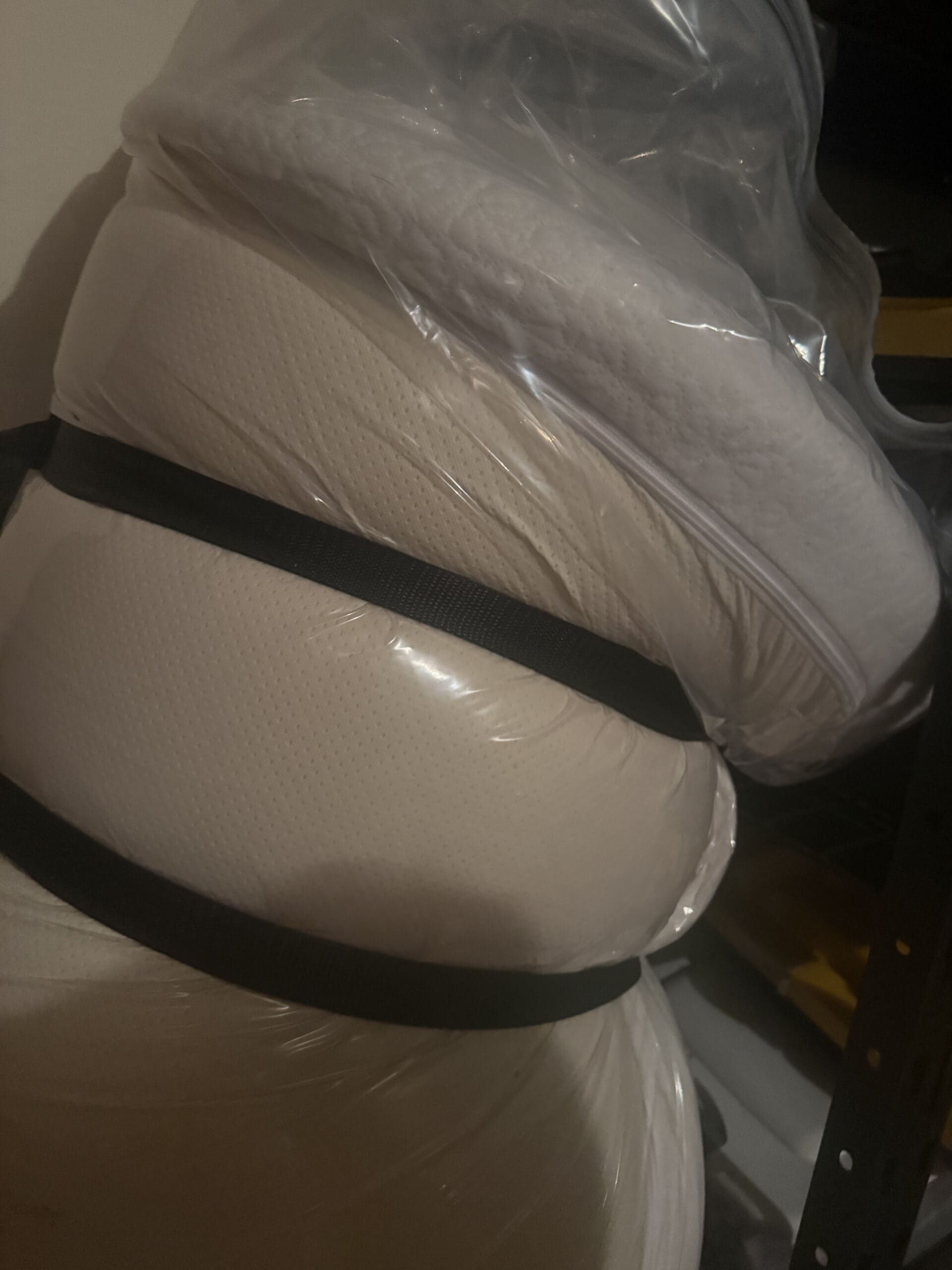
A mattress bag is doing one of two jobs, and they are not the same. Moving is a short exposure to dirt, rain, and stair edges. Storage is months of moisture, dust, and pests with nobody checking.
I have one compressed with a shop vac in a heavy plastic bag, stored standing on end for over six months. The vacuum seal has not held over that time. The bag is visibly slack now and the mattress has expanded back out against the straps I put around it, which are what is actually holding the shape.
Types at a Glance
| Type | Best for | Limitation |
|---|---|---|
| Heavy-gauge plastic | Both moving and storage | Tears at corners if dragged |
| Bag with built-in handles | Stairs and tight turns | Handles are the weak point |
| Woven reinforced bag | Long-term storage | Not fully airtight |
| Zippered bag | Repeated access | Zip fails before the bag does |
| Vacuum-seal bag | Compressing for storage | Not for innerspring or hybrid |
| Multi-pack set | A whole-house move | Thinner gauge in most sets |
How We Picked
Selections are grouped by construction and closure, since gauge and seal quality decide whether a bag survives a move or a storage period.
Descriptions come from documented specifications rather than hands-on evaluation of every option, alongside my own experience storing one long term.
1. A Heavy-Gauge Plastic Bag, Best Overall
Why It Stands Out
Thick plastic resists punctures from door frames and stair nosings, which is where thin bags fail during a move.
Mine is heavy plastic and has been sealed for over six months with no tears, which is the property that matters most for storage.
Worth Knowing
Corners are the vulnerable point, particularly if the mattress gets dragged rather than carried.
Sealing needs good tape rather than the strip supplied. Our note on how to store a mattress covers the process.
This suits most situations. Skip it only if you need repeated access.
2. A Vacuum-Seal Mattress Bag, Best for Compression
Why It Stands Out
Removing the air shrinks a foam mattress dramatically at the moment you do it, which is the difference between a mattress occupying a wall and occupying a corner. Storage time has limits, and how long it can stay bagged covers what happens to foam left compressed.
What I found is that the compression is not permanent. Mine went down easily with a shop vac and has expanded back out over six months, and the bag is now loose rather than tight against the foam.
Worth Knowing
Compression suits foam. Innerspring and hybrid mattresses should not be compressed, and manufacturers generally warn against it.
Plan on straps, because the bag alone will not hold it. Our roundup of under-bed storage covers other space problems.
This suits foam going into storage alongside straps. Skip it for anything with springs.
3. A Bag With Built-In Handles, Best for Stairs
Why It Stands Out
Handles give you something to hold other than the mattress itself, which matters on stairs where grip is the limiting factor.
A mattress is awkward rather than heavy, and the handles change how two people can position themselves.
Worth Knowing
Handles concentrate load and are the most common failure point on these bags.
Less useful once the mattress is stationary. Our roundup of bed frames covers what it goes back onto.
This suits a move with stairs. Skip it for storage.
4. A Woven Reinforced Bag, Best Durability
Why It Stands Out
Woven polypropylene resists tearing far better than plastic sheet and survives being reused across several moves.
Sturdy enough that dragging does not immediately ruin it.
Worth Knowing
Not airtight, so it does not exclude moisture the way sealed plastic does.
Cannot be used for vacuum compression. Our note on why mattresses sag covers storage damage.
This suits repeated moves. Skip it for damp storage or compression.
5. A Zippered Mattress Bag, Best Closure
Why It Stands Out
A zip closes properly without tape and reopens without destroying the bag, which suits anything you may need to check on.
Neater than a taped seam and faster to fit.
Worth Knowing
Zips fail before the material does, particularly on cheaper bags.
A zip is rarely as airtight as a taped seal. Our roundup of mattress protectors covers in-use protection.
This suits storage with periodic access. Skip it for a sealed long-term setup.
6. A Multi-Pack Set, Best for a Full Move
Why It Stands Out
A house with several beds needs several bags, and buying them together costs considerably less than individually.
Sets usually include a range of sizes.
Worth Knowing
Multi-packs are typically thinner gauge than a single heavy-duty bag.
Sizing is approximate across the set. Our roundup of metal bed frames covers reassembly.
This suits a whole-house move. Skip it for long-term storage of one mattress.
Vacuum Sealing Is Not for Every Mattress
Compression works on foam because foam recovers its shape when air returns.
Innerspring and hybrid mattresses contain coils that are not designed to be compressed sideways, and manufacturers generally advise against it.
Compressing one of those can damage the coil structure permanently, and it may affect a warranty.
Mine is compressed and has held, and it went into the bag knowing which type it was. That check comes before the shop vac. Our note on choosing a mattress covers construction types.
The Vacuum Seal Will Not Hold. Straps Will.
This is the part most guidance skips, and it is the thing I would tell anyone doing this.
Getting a foam mattress compressed is easy. A shop vac moves enough air to do it in a few minutes, where a household vacuum stalls on that volume.
Holding it compressed is the hard part. A plastic bag is not a purpose-built vacuum vessel, and air finds its way back in through the seam, the closure, and any pinhole in the material. Mine is slack now and the foam has pushed back out against the plastic.
Straps are what actually maintain the shape. I put two around mine and they are visibly taking the load, with the mattress bulging out either side of them.
So the honest sequence is compress with a shop vac, get straps on immediately while it is still down, and treat the bag as protection from dust and moisture rather than as the thing holding the compression. The straps matter as much as the bag, and our roundup of lifting straps and tie-downs covers what actually holds compression. Getting it out of the room is the other half, and our roundup of furniture dollies covers pushing rather than carrying.
What Straps Need to Do
Go on before the air returns
The window is short, so have them ready rather than fetching them afterward.
Wide rather than thin
Narrow straps cut into foam and concentrate the load in one line.
Ratchet or cam buckle
Something that can be pulled tight and stays tight rather than tied.
More than two on a larger mattress
Two leaves long unsupported spans that bulge, which is what mine does.
Getting the Mattress Dry First
An airtight bag preserves whatever condition the mattress went in with, which cuts both ways.
A mattress that is even slightly damp when sealed has nowhere for that moisture to go, and months in a bag is exactly the condition mold needs.
Foam is the difficult case here because it holds moisture internally and shows nothing at the surface, so a mattress that feels dry can still be carrying water from a recent clean.
Leaving it stripped and uncovered in a warm room with airflow for a day or two before bagging costs nothing and removes the risk.
Mine went in dry and has no smell after more than six months, which is the outcome that matters and also the one that tells you nothing went wrong at the start. Our roundup of mattress cleaners covers cleaning before storage.
Storing on Concrete
Standard advice is to keep a mattress off a concrete floor, because concrete transmits moisture and temperature more than a timber floor does.
Mine is standing on end directly on concrete, and after more than six months there is no damp and no smell.
That is one mattress, in one space, sealed inside heavy plastic, which is worth saying plainly because the seal is most likely doing the work rather than the concrete turning out to be harmless.
A wooden pallet or even a sheet of board underneath costs almost nothing and removes the question entirely, which is what I would suggest to anyone setting this up from scratch.
Flat or on Edge
Storage guidance generally favors lying flat, on the reasoning that a mattress stored on edge for a long period can deform.
Mine has been on end for over six months and has held its overall shape, though it has expanded outward between the straps rather than staying at the compressed size.
Space is usually the reason people stand them up, and a compressed foam mattress is a rather different case from an uncompressed innerspring resting on its side.
Where floor space allows, flat is the safer default. Our note on rotating a mattress covers shape maintenance.
Pests and Sealed Bags
Storage guidance mentions pests frequently and rarely explains what a bag actually does about them.
A properly sealed heavy plastic bag is a physical barrier, and that is most of its value in a space where insects and rodents have access.
Where it fails is at the seam and at any puncture, which is another argument for tape over the supplied adhesive strip and for carrying rather than dragging.
Woven bags are tougher against tearing and are not sealed, so they keep dust off without excluding anything smaller.
Checking the bag periodically rather than assuming is worth doing, since a tear discovered at month two is a different problem from one discovered at month twelve. Mine has no tears and I have looked. Our roundup of mattress encasements covers pest exclusion in use.
What to Look For
Gauge rather than brand
Thickness is what resists punctures, and it is usually stated.
A valve if you plan to compress
Ordinary bags have nothing to attach a vacuum hose to.
Proper tape, not the supplied strip
The adhesive strip on most bags is not adequate for long storage.
Size up rather than down
A tight bag tears at the corners during fitting.
Common Mistakes to Avoid
Compressing an innerspring mattress
Coils are not made for it, and damage can be permanent.
Relying on the supplied adhesive strip
Use packing tape over the seam for anything longer than a move.
Dragging rather than carrying
Corners are where these bags fail first.
Sealing a mattress that is not fully dry
An airtight bag traps whatever moisture was already inside it.
Recommended Reading
See our roundup of clean a mattress, our note on when to replace your mattress, our roundup of mattress toppers for too firm mattresses, and a roundup of bunkie boards.
Mattress Bag FAQ
Do I need a mattress bag for a short move?
Worth it. A mattress picks up dirt from door frames and floors, and rain during loading is the common problem.
Can you vacuum seal a mattress?
Foam yes, innerspring and hybrid no. Coils are not designed for sideways compression and manufacturers generally advise against it.
Have you done it?
Yes. Foam mattress, heavy plastic bag, shop vac, stored on end for over six months. The compression did not last without straps.
Does it stay compressed?
Not from the bag alone. Mine expanded back out over six months and the bag is now slack. The straps I added are what hold the shape.
Household vacuum or shop vac?
Shop vac. It moves far more air and handles the volume, where a household vacuum tends to stall on something this size.
Is storing on concrete a problem?
Standard advice is to raise it off concrete. Mine is standing on concrete with no damp after six months, though the sealed bag is likely doing the work.
Flat or standing up?
Flat is the safer default for long storage. Mine has been on end for over six months with no visible change, which is one case rather than a rule.
What tape should I use?
Packing tape over the seam. The adhesive strip supplied with most bags is fine for a move and not for months of storage.
