
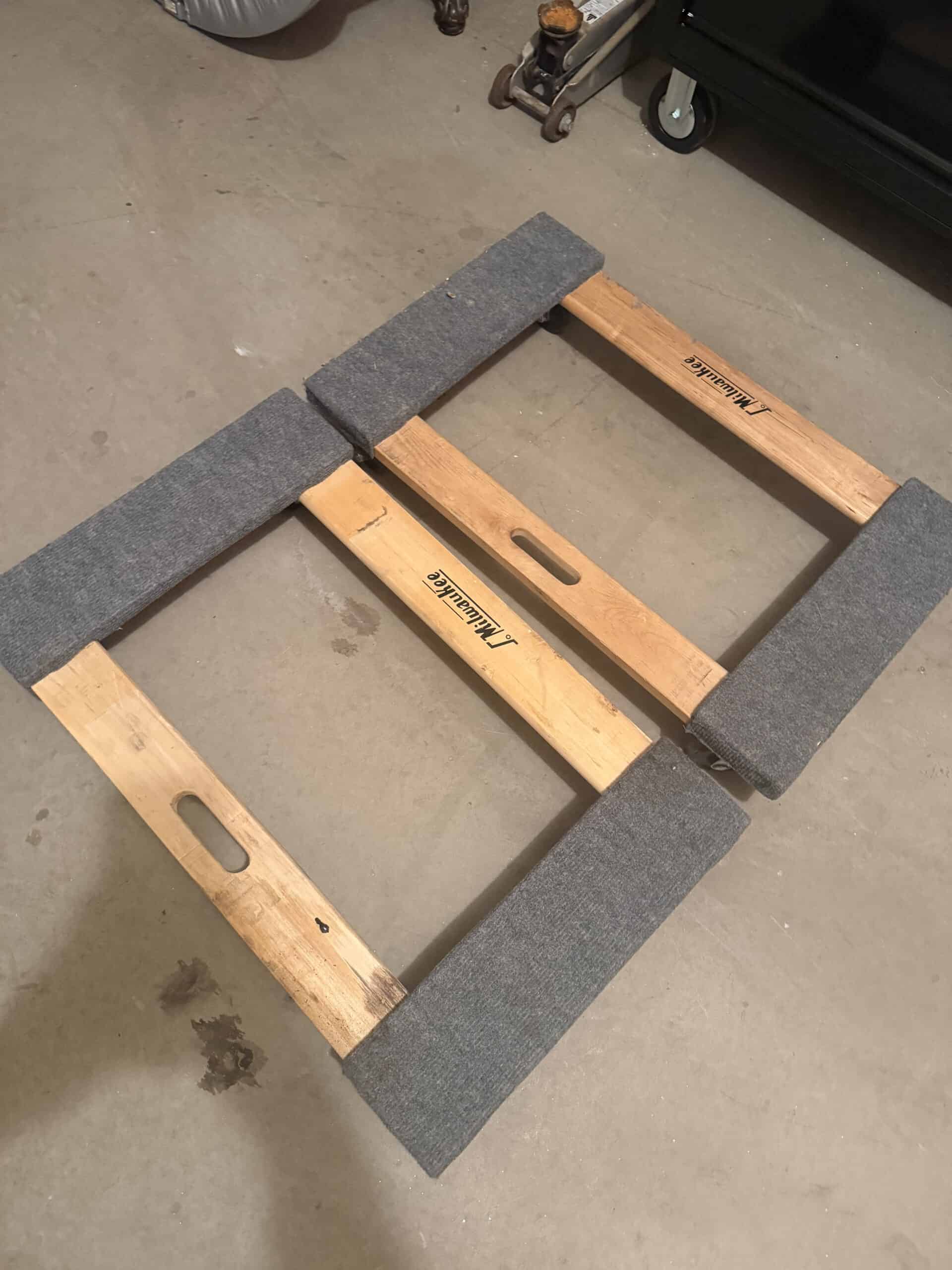
A dolly turns carrying into pushing, which changes what one person can move on their own. That is the whole value, and it matters more than any specification on the box.
I have two. A flat four-wheel platform dolly and a convertible hand truck that folds from upright into a flat lay-down position. Both have been around for several years, bought separately, and I moved the bagged mattress on a dolly rather than carrying it. Our roundup of mattress bags covers what it was in.
Types at a Glance
| Type | Best for | Limitation |
|---|---|---|
| Flat platform dolly | Boxes, appliances, anything flat | Nothing holds the load on |
| Upright hand truck | Stacked boxes, stairs | Load must lean back |
| Convertible hand truck | Both jobs from one tool | Conversion can be stiff |
| Appliance dolly with strap | Tall heavy items | Bulky, single purpose |
| Furniture sliders | Short moves across a floor | Only works on smooth surfaces |
| Stair-climbing dolly | Multi-floor moves | Expensive, heavy |
How We Picked
Selections are grouped by what they carry and how, since the load shape decides which design works rather than any capacity rating.
Descriptions come from documented specifications alongside my own use of a platform dolly and a convertible.
1. A Flat Platform Dolly, Best Overall
Why It Stands Out
Four wheels under a flat deck handles almost anything that will sit on it, and it needs no technique beyond loading and pushing.
Mine is the one I reach for by default, and it is what a bagged mattress goes on rather than being carried.
Worth Knowing
Nothing secures the load, so anything tall or unbalanced can slide off.
Awkward to store standing up. Our roundup of moving straps covers securing loads.
This suits most moving jobs. Skip it if you need to go up stairs.
Check Price on Amazon2. A Convertible Hand Truck, Best Versatility
Why It Stands Out
Folds between an upright two-wheel hand truck and a flat four-wheel cart, which covers two different jobs from one piece of equipment.
Genuinely useful if storage space only allows one dolly.
Worth Knowing
The conversion mechanism is the weak point. Mine is sometimes hard to get into flat mode, which is the one real complaint I have about it.
Heavier than either dedicated design. Our note on moving a mattress without a truck covers the job.
This suits one-dolly households. Skip it if you have room for two.
Check Price on Amazon3. An Upright Hand Truck, Best for Stairs
Why It Stands Out
Two large wheels and a leaning load is the only design that goes down stairs in a controlled way, one step at a time.
Also the fastest to load and unload for stacked boxes.
Worth Knowing
The load has to lean, which rules out anything that cannot tip back safely.
Narrow footprint means less stability. Our roundup of bed risers covers other lifting hardware.
This suits multi-floor moves. Skip it for wide flat objects.
Check Price on Amazon4. An Appliance Dolly With Strap, Best for Tall Loads
Why It Stands Out
A ratcheting strap holds a tall item against the frame, which is what makes moving a fridge or a washer possible without it tipping.
Stair climbers on the back let it walk down steps under control.
Worth Knowing
Large, heavy, and single purpose, which is why most people rent rather than buy.
Overkill for anything smaller. Our roundup of under-bed storage covers what else moves.
This suits appliance moves. Skip it for general furniture.
Check Price on Amazon5. Furniture Sliders, Best for Short Moves
Why It Stands Out
Pads placed under legs let heavy furniture slide across a floor with no lifting at all, which suits rearranging rather than relocating.
Cheap enough to keep a set permanently.
Worth Knowing
Hard plastic works on carpet and felt works on hard floors, and using the wrong type either does nothing or scratches.
Only useful within a single room or floor. Our note on storing a mattress covers surfaces.
This suits rearranging. Skip it for actually moving anything anywhere.
Check Price on Amazon6. A Budget Platform Dolly, Best Value
Why It Stands Out
A basic wooden or plastic platform with four casters costs very little and does the core job of turning carrying into pushing.
Adequate for occasional use rather than a full house move.
Worth Knowing
Cheaper casters bind and shed wheels under real weight.
Lower capacity ratings than they appear. Our roundup of metal bed frames covers heavy items.
This suits light occasional moving. Skip it for anything genuinely heavy.
Check Price on AmazonWheels Decide Whether It Works
Small hard casters roll well on smooth flooring and stop dead at a carpet edge, a threshold strip, or a pebble on a driveway.
Larger wheels roll over obstacles that small ones catch on, which is the difference between a dolly that works outside and one that does not.
Rubber or pneumatic wheels are quieter and gentler on floors, and hard plastic rolls with less effort on flat smooth surfaces.
Swivel casters on all four corners steer easily and wander under load, while two fixed and two swivel tracks straighter. Our note on choosing a mattress covers the load itself.
Where the Convertible Falls Short
The mechanism is the weak point
Mine is sometimes hard to get into flat mode, which is the one thing I would change.
It is heavier than either dedicated design
Carrying the versatility around costs weight.
Neither mode is quite optimal
The flat mode is smaller than a real platform dolly.
It still beats owning nothing
One dolly that does both is better than none for most households.
One Person or Two
A dolly changes the number of people a job needs, and that is worth thinking about before deciding which one to buy.
Getting a load onto a platform dolly is still a lift, and it is the moment where a second person helps most even though the pushing afterward does not need one.
An upright hand truck is the design that genuinely works solo, since the blade slides under the load and the tilt does the lifting rather than your back.
That is the argument for a hand truck over a platform dolly for anyone who moves things alone, even though the platform is more versatile once loaded.
Straps bridge the gap for awkward items, since something with no grip point can be lifted onto a dolly by two people using webbing far more easily than by hand. Our roundup of blackout curtains for sleep covers that step.
Capacity Ratings Are Static
Published capacities describe a static load sitting still on a level surface, which is not what happens during a move.
Rolling over a threshold strip or a single step transfers the weight suddenly onto one or two wheels, and that momentary load sits far above the average across all four.
Going down any kind of slope adds force in the direction of travel, and stopping a fully loaded dolly on a ramp is considerably harder than getting it started was.
Working well below a rating is the sensible approach, particularly on cheaper casters where the wheel is the failure point rather than the deck.
Storage Is the Overlooked Problem
A flat platform dolly is an awkward object to keep. It does not stand up reliably, it does not hang easily, and it takes floor space it does not deserve for how rarely it gets used.
Upright hand trucks store better because they already stand, and folding models flatten against a wall.
That is a genuine argument for a convertible, since one awkward object beats two.
Mine live where they fit rather than anywhere convenient, which is the usual outcome. Our roundup of storage for small spaces covers the wider problem.
Protecting the Load and the Floor
The deck a load sits on matters as much as the wheels underneath it, and this is where cheap dollies show their price.
Carpeted or padded decks grip the load and stop it sliding as the dolly turns, which is why moving-company platform dollies are almost always carpeted rather than bare.
A bare wooden or plastic deck lets anything smooth slide around, and that movement is what tips loads off at corners.
Floors take the other half of the risk. Hard casters concentrate the whole weight onto four small contact points, which dents vinyl and marks hardwood under load.
Non-marking rubber wheels cost slightly more and remove that entirely, and the difference only becomes obvious after the marks are already there. Our note on when to replace a mattress covers the load.
What to Look For
Wheel size over deck size
Large wheels clear obstacles that stop small casters entirely.
A capacity well above your load
Ratings are static and moving loads spike well past the average.
Non-marking wheels for indoor use
Hard casters leave marks on vinyl and scratch hardwood.
Somewhere to put it
These are awkward to store and easy to forget about when buying.
Common Mistakes to Avoid
Buying on deck size alone
Wheel size decides whether it crosses a threshold, which matters more.
Assuming the rating applies while moving
Static capacity does not describe what happens hitting a step.
Using the wrong slider type
Hard plastic for carpet, felt for hard floors. Reversed, they scratch or do nothing.
Loading tall items on a flat dolly
Nothing holds them on, and a platform dolly has no strap.
Recommended Reading
See our roundup of bunkie boards, our note on rotate a mattress, our roundup of storage benches, and a note on whether you need a box spring.
Furniture Dolly FAQ
Which dolly should I buy?
A flat platform dolly for most jobs. An upright hand truck if stairs are involved. A convertible if you only have room for one.
What do you use?
Both a flat four-wheel platform dolly and a convertible hand truck, bought separately several years apart. I moved the bagged mattress on a dolly.
Are convertibles worth it?
For a one-dolly household, yes. The mechanism is the weak point, and mine is sometimes hard to get into flat mode.
What wheel size do I need?
Larger than you think. Small hard casters stop dead at a carpet edge or a threshold strip, which is where most dollies actually fail.
Can I move a mattress on one?
Yes, and it beats carrying. A bagged mattress on a platform dolly is pushed rather than lifted, which is the whole point.
Sliders or a dolly?
Different jobs. Sliders move furniture across a room without lifting. A dolly moves things between rooms or out to a vehicle.
Do capacity ratings mean anything?
They describe a static load on a level surface. Rolling over a step spikes the load on one wheel well above that, so work below the rating.
Where do I keep it?
That is the real question and nobody asks it before buying. Platform dollies do not stand up or hang well, which favors a convertible.
