
Once an air conditioner is running, a cooling topper can look redundant. The room is cold, so why pay for something that also promises cooling? The answer is that the two are working on different things, and whether you need both depends on a question people rarely separate: is your bed hot, or is your room hot?
A cool room does not fix a mattress that traps heat. Plenty of people run air conditioning and still wake up warm, and that is the situation a topper addresses. Our comparison of cooling blankets and toppers covers the choice between them.
Quick Answer
If you run AC and still sleep hot, the mattress is likely the cause and a topper is the fix. If AC alone leaves you comfortable, a topper adds little and you can skip it.
Key Points
- AC cools the room; a topper affects the surface you lie on.
- Memory foam traps heat regardless of air temperature.
- Running AC harder is an expensive substitute for a topper.
- Toppers cost nothing to run once bought.
- If AC alone works for you, you do not need one.
Why a Cool Room Can Still Sleep Hot
Your body sheds heat continuously overnight, and most of it goes into the surface underneath you. A mattress that conforms closely, particularly memory foam, wraps around the body and reduces the air movement that would otherwise carry that heat away.
Cooled room air does not reach the part of you pressed into the mattress. It reaches the air around you, which is why a cold room and a hot back are entirely compatible.
That is the specific situation where a topper earns its place alongside air conditioning rather than instead of it. Neither one is redundant, because neither reaches what the other handles. Our roundup of toppers for mattresses that run hot covers the products.
The Cheaper Half of the Equation
Running an air conditioner a couple of degrees colder to compensate for a hot mattress is an expensive way to solve a bedding problem, and it runs every night for the life of the unit. The cost is invisible because it arrives as a slightly larger bill rather than a purchase.
A topper is a one-time cost with no running expense, no noise, and no effect on the electricity bill. Where it removes the need to drop the thermostat further, it pays for itself over a hot season.
That is the practical argument for owning both in a hot climate: the AC handles the room and the topper stops you overcooling the whole space to fix one surface. Our note on what a portable AC costs overnight covers the numbers.
Running Both
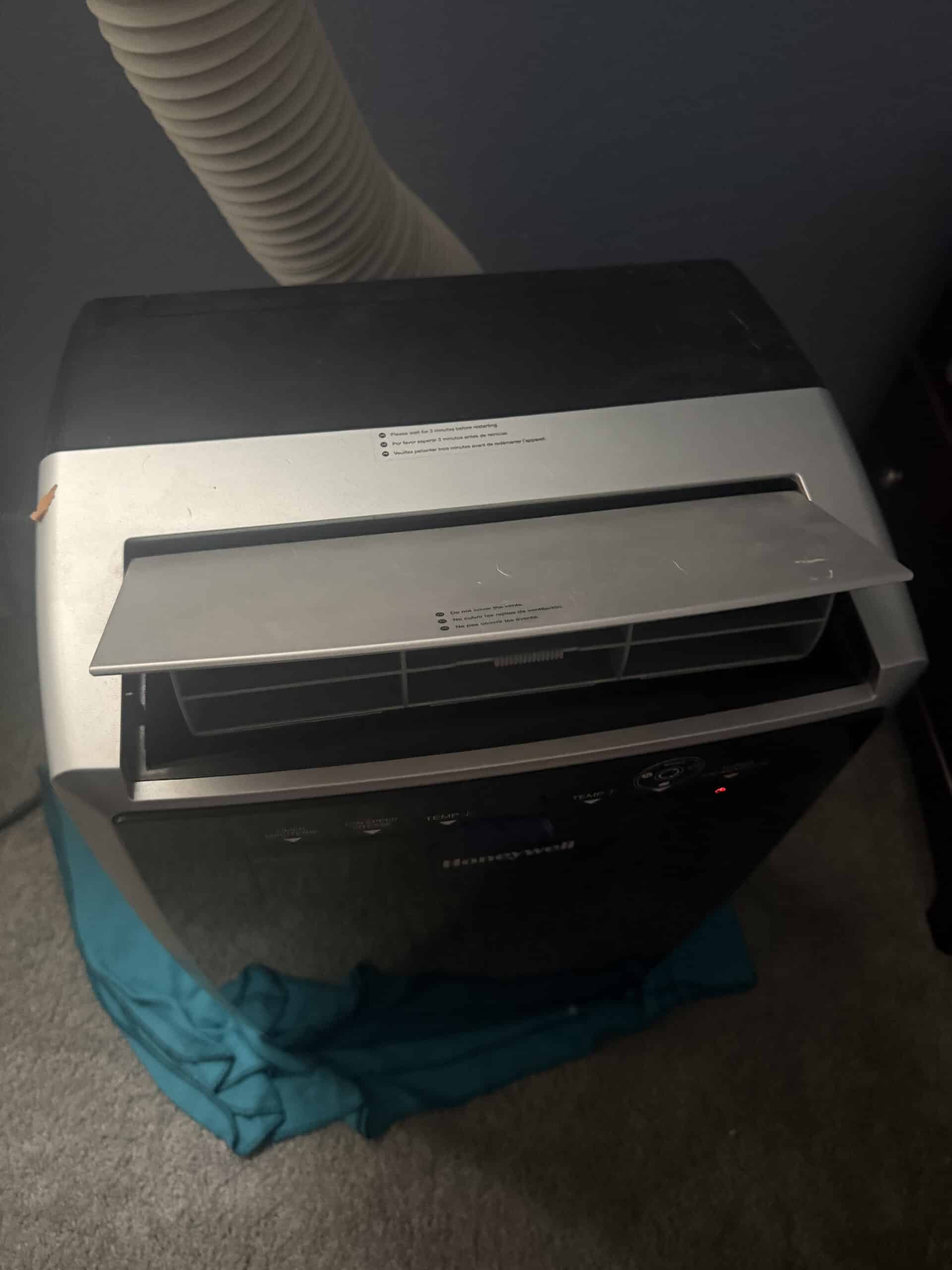
My cooling topper has been on the bed three or four years and stays on year-round, and the portable air conditioner runs every night through summer. Both, all season, and neither replaced the other.
The reason is that my mattress runs hot. I kept it because the support suits me, and the topper is what deals with the heat side of that. The AC is dealing with an Arizona summer, which is a different problem entirely.
What I would say to anyone in a cooler climate is that the topper is doing the work that would matter to you, and the AC is doing the work that matters here specifically. If my room were temperate I suspect the topper alone would cover it.
The topper also stays on through winter, and I have never found the bed cold because of it. It disperses heat rather than producing cold, which is a distinction that matters more than it sounds when deciding whether to remove it seasonally.
What I cannot tell you is whether the topper reduced how hard the AC has to work, since I have not run the room without it to compare.
When You Do Not Need One
AC alone leaves you comfortable
The simplest case. If you sleep well with air conditioning and no complaints about the bed, a topper solves a problem you do not have.
A breathable mattress
Innerspring and hybrid mattresses move air far better than dense foam, since the coil layer leaves space for it to circulate. Heat retention is much less common on these, and a topper becomes a comfort choice rather than a fix.
You sleep cold
People who run cool overnight often find a cooling topper unhelpful or actively unwanted, particularly in an air-conditioned room.
Budget is tight
If the AC is already handling things adequately, this is a comfort upgrade rather than a necessity. Our note on whether toppers are worth it covers the wider question.
Testing Before Buying
Sleep a few nights and pay attention to what is actually warm. If you wake with a hot back and shoulders while the room feels fine, that is the mattress. If you are warm all over and the air feels stuffy, that is the room.
Try cooler bedding first, since sheets and a heavy mattress protector can trap more heat than people expect and both are cheaper to change than buying a topper. A waterproof protector in particular can be the entire problem.
Dropping the thermostat a degree for a couple of nights is also informative. If that fixes it, the room was the problem; if you are still warm at the surface, it was not. Our roundup of cooling sheets covers the cheaper experiment.
Common Mistakes to Avoid
Overcooling the room to fix the bed
Expensive, and it makes the whole room uncomfortable to solve a problem confined to one surface.
Adding a waterproof protector over a cooling topper
This blocks the airflow the topper depends on, which is a common and unrecognized way of cancelling the effect entirely.
Expecting a topper to lower room temperature
It works on body heat at the surface and does nothing to air temperature. In a warm room it will disappoint.
Removing the topper in winter without reason
Most people find these do not make the bed cold, since they disperse heat rather than producing it. Our note on whether cooling toppers work in winter covers that.
Topper With AC FAQ
Is a cooling topper pointless if I have air conditioning?
Not if you still sleep hot with the AC running, which usually means the mattress is trapping heat rather than the room being warm. Cooled air does not reach the surface your body is pressed into, so the two address different things.
Will a topper let me run the AC warmer?
Potentially, if the reason you set it low is a hot bed rather than a hot room. Solving the surface problem directly is cheaper than cooling the entire space further, and the topper has no running cost.
Why am I hot in bed when the room is cold?
Because heat leaves your body into the mattress, and a dense foam mattress that conforms closely restricts the airflow that would carry it away. Room air cools the air around you rather than the surface underneath you.
Do I need a topper with an innerspring mattress?
Less often. Innerspring and hybrid constructions allow considerably more air movement than dense foam, so heat retention is a much smaller problem and a topper is more of a comfort choice.
Should I take the topper off in winter?
Most people leave them on year-round without the bed feeling cold, since these disperse heat rather than producing cold. Anyone who sleeps cold may prefer to remove it, and that is a personal call rather than a rule.
Does a mattress protector cancel the cooling?
A waterproof one largely can, since it blocks the airflow the topper depends on. A breathable protector is a better match, and this is one of the most common reasons a topper seems ineffective.
What should I try before buying a topper?
Cooler sheets, removing a heavy protector, and dropping the thermostat a degree for a couple of nights. Those are cheaper and they also tell you whether the problem is the bed or the room, which decides what to buy.
Will a fan do the same job?
A fan moves air around you and does not reach the surface you are lying on, so it helps with ambient warmth rather than a hot mattress. It is a useful addition and not a substitute for either a topper or an air conditioner.
Recommended Reading
See our note on choosing a mattress.
