
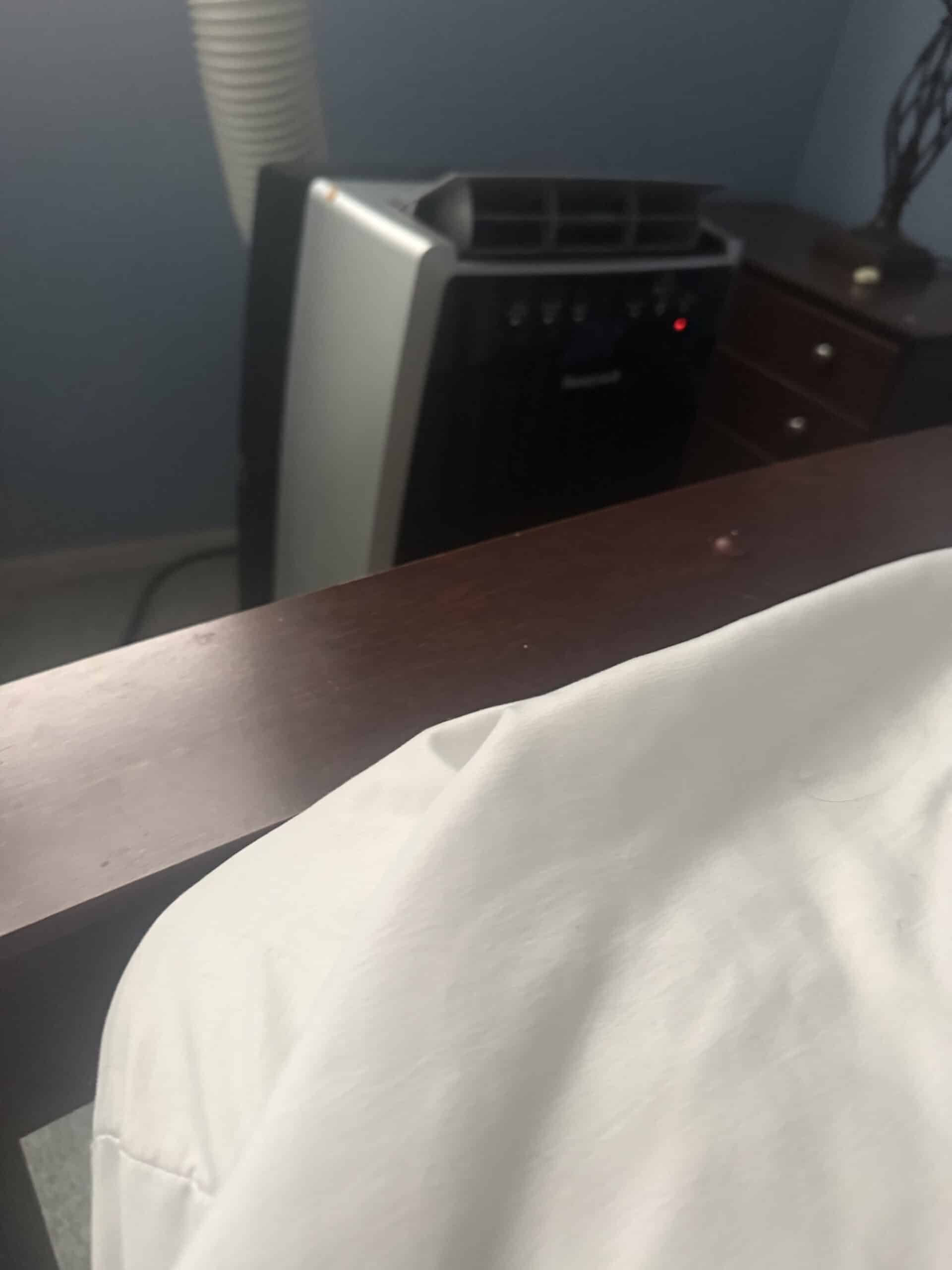
These get compared because they are both sold as answers to a hot bedroom, and they are not doing the same thing at all. A portable air conditioner removes heat from the room. A cooling topper does not remove any heat from anywhere. It changes how quickly your body’s heat leaves you, which feels similar and works completely differently.
That distinction decides which one solves your problem, and in a genuinely hot climate it decides whether one of them can solve it at all. Our roundup of toppers for mattresses that run hot covers the topper side.
Quick Verdict
If the room is comfortable and the bed is hot, a cooling topper is the right purchase. If the room itself is too warm, no topper fixes that and an air conditioner is the only one of the two that will.
What Each One Does
A portable air conditioner
Extracts heat from room air and expels it outside through a hose. It lowers the actual air temperature, which is the only mechanism here that does.
A cooling topper
Sits on the mattress and changes the thermal behavior of the sleep surface, usually through gel infusion, open-cell foam, phase-change material, or a breathable structure that lets body heat disperse rather than accumulate.
The practical difference
An AC works whether or not you are in the room. A topper only does anything while you are lying on it, because it works on heat you are producing.
Why both exist
A mattress can run hot in a cool room, and a room can be too warm regardless of what you sleep on. Those are separate problems with separate answers.
Cost and Running
A cooling topper is a single purchase with no running cost, no noise, and no installation. It occupies no floor space and needs no window.
A portable AC costs more upfront, uses meaningful electricity every night it runs, produces compressor noise, and needs a window with a working seal. Over a long hot season the running cost is not trivial.
Against that, an AC is the only one that makes a hot room habitable. Cost comparisons that ignore this treat them as alternatives when they often are not. Our note on what a portable AC costs to run overnight covers the figures.
At a Glance
| Cooling topper | Portable AC | |
|---|---|---|
| Lowers room temperature | No | Yes |
| Running cost | None | Meaningful nightly |
| Noise | None | Compressor cycling |
| Needs a window | No | Yes |
| Works when you leave | No | Yes |
| Best for | Hot mattress, cool room | Hot room |
When the Topper Is Enough
A cool or moderate room with a mattress that traps heat is the case where a topper genuinely solves the problem, and memory foam mattresses are the common culprit since the material conforms closely and restricts airflow around the body.
Mild climates and shoulder seasons also suit a topper alone, where the room is not the issue for most of the year.
Anyone who runs hot personally rather than living somewhere hot is also in topper territory, since the problem is the interface rather than the environment. Our note on whether cooling toppers actually work covers the mechanism.
When Only the AC Will Do
A bedroom that is genuinely warm at bedtime is beyond what a topper addresses. Once ambient air is above a certain point, your body cannot shed heat efficiently regardless of what the mattress does, and a cooling surface has less of a gradient to work with.
Humid climates compound this, since evaporative cooling from skin slows and the sleep surface has more moisture to deal with.
Upper floors, west-facing rooms, and anywhere the day’s heat lingers into the night fall here too. Our guide to bedroom cooling setups for hot climates covers the full picture.
What I Run
I have both, and they are not substitutes for each other. The cooling topper has been on the bed three or four years and stays on year-round, and the portable air conditioner runs every night through summer.
My mattress runs hot, which is why the topper is there. I kept the mattress because the support suits me and added the topper rather than replacing it, and that has worked as a solution to the mattress problem specifically.
What it has never done is make the room cooler, because that is not what it does. Through an Arizona summer the AC is the thing making the room survivable, and the topper is handling the surface I am lying on. Take the AC away and the topper would not begin to compensate.
The honest version is that if I lived somewhere temperate I would probably only need the topper, and the reason I run both is the climate rather than the bedding. Anyone comparing these should start with which of those two problems they actually have.
What I cannot tell you is how a topper performs as the only cooling in a hot room, since I have never tried to make it do that.
Which Should You Buy?
Buy the topper if
The room is comfortable and the bed is not. Memory foam mattresses, personal heat, and mild climates all point this way, and it is the cheaper experiment by a wide margin.
Buy the AC if
The room is warm at bedtime and stays warm. Nothing you put on the mattress addresses ambient temperature, and buying a topper first in this situation usually means buying the AC afterward anyway.
Buy both if
You live somewhere genuinely hot and your mattress also traps heat. They solve different halves and neither covers the other.
Try the topper first if unsure
It is the lower cost and lower commitment of the two, and if it does not resolve things you have learned the problem is the room. Our roundup of cooling toppers for year-round use covers choosing one.
Common Mistakes to Avoid
Expecting a topper to cool a hot room
It works on body heat at the surface and has no effect on air temperature. In a warm room the result disappoints and the product was not at fault.
Buying an AC for a bed problem
A cool room with a hot mattress is still uncomfortable, and running an air conditioner to fix a mattress is an expensive way to avoid a cheaper purchase.
Ignoring the window seal
Portable AC efficiency depends heavily on the window kit sealing properly and the hose being short and unkinked, since a long hose radiates heat back into the room.
Assuming a topper stops working
Cooling foams do not have a lifespan in that sense, though compression over years reduces airflow through the material. Our note on how a topper changes firmness covers the feel.
Recommended Reading
See our comparison of cooling blankets and toppers, our note on where to put a portable AC, our guide to cooling sheets, and a roundup of toppers for hot sleepers, and using a topper alongside AC, and choosing a mattress, and continuous drain on a portable AC.
Cooling Topper vs AC FAQ
Can a cooling topper replace air conditioning?
Not in a hot room. A topper works on heat your body produces at the sleep surface and does nothing to air temperature. If the room itself is warm at bedtime, only something that removes heat will help.
Which is cheaper overall?
The topper, considerably, since it is a single purchase with no running cost. An air conditioner costs more upfront and uses electricity every night, which over a long hot season adds up meaningfully.
Do cooling toppers actually work?
For a mattress that traps heat in a room that is otherwise comfortable, many people find they help. The mechanism is dispersing body heat rather than producing cold, so expectations set by the word cooling are often higher than what happens.
Should I get both?
If you live somewhere genuinely hot and your mattress also runs warm, they address different halves of the problem. In a mild climate the topper alone is usually enough, and in a cool room with a good mattress neither may be needed.
Which should I try first?
The topper, if you are unsure, since it costs less and commits you to nothing. If it does not solve the problem, you have learned the issue is the room rather than the bed, which is useful information either way.
Does a cooling topper work in winter?
Most people leave them on year-round without finding the bed cold, since the material disperses heat rather than actively chilling. Anyone who sleeps cold may notice it more, and removing it seasonally is an option.
Is a portable AC noisy?
The compressor cycles audibly, and units vary considerably. Some sleepers find the steady sound helpful and others find the cycling on and off disruptive, which is worth considering alongside cooling capacity.
Will a fan do instead of either?
A fan moves air and does not remove heat, so it helps in a moderately warm room and not a genuinely hot one. Fans work well alongside an air conditioner by distributing cooled air, which is a different job again.
