
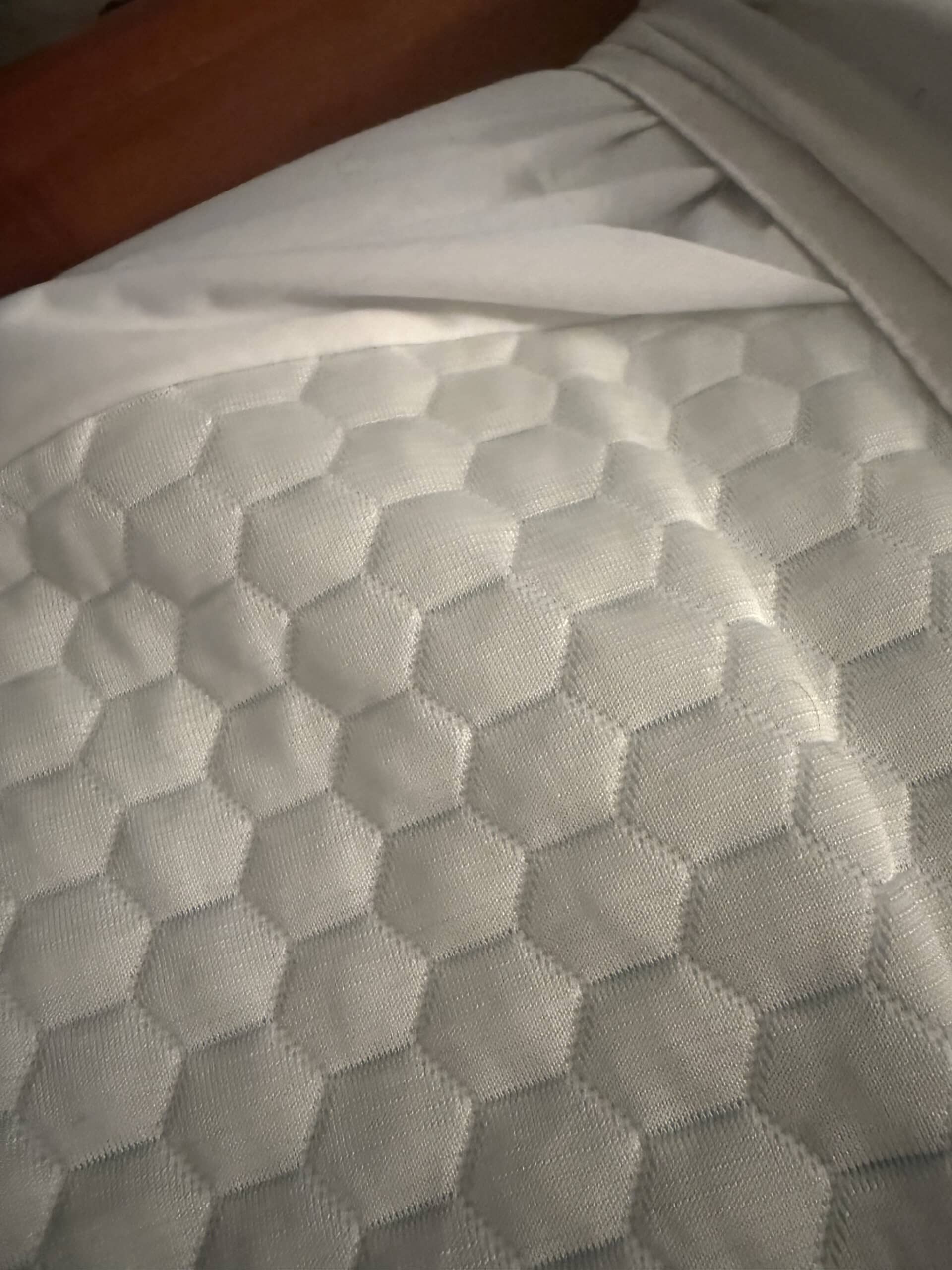
Most people buy a cooling topper in summer and then wonder in November whether it should come off. The honest answer for the majority of them is no, because cooling toppers slow heat buildup rather than actively chilling, and that effect largely disappears when the room is already cool. The ones worth buying are the ones that behave sensibly in both seasons, which narrows the field more than the marketing suggests. Our note on whether a cooling topper works in winter covers the underlying question.
Year-Round Toppers at a Glance
| Material | Summer | Winter | Upkeep |
|---|---|---|---|
| Gel memory foam | Good | Neutral | Low |
| Open-cell foam | Very good | Neutral | Low |
| Latex | Very good | Neutral | Low, heavy |
| Wool | Good | Warming | Needs fluffing |
| Phase-change fabric | Good on contact | Neutral | Wash as bedding |
| Thick unventilated foam | Poor | Warming | Low |
The short version: gel, open-cell, and latex all sit neutral in winter rather than cold, which is what makes them year-round options. Wool is the only material here that actively warms, and thick unventilated foam is the one that fails in both directions.
How We Picked
Toppers are grouped by how they behave when the room is cold as well as when it is warm, since a genuinely year-round topper is one you never think about seasonally. Storage burden is weighted in too, because a topper that comes off for six months has to live somewhere.
Selections reflect materials and construction. Descriptions come from product research except where personal use is stated directly.
1. A Gel Memory Foam Topper, Best Overall
Why It Stands Out
Gel infusion moves heat away in summer and does essentially nothing in winter, which is exactly what you want from something that stays on the bed permanently.
Memory foam also contours, so the topper earns its place as cushioning during the months the cooling is irrelevant.
Worth Knowing
The cooling is a slowing of heat buildup rather than a chilling effect, which is precisely why it does not make a bed cold in January.
All foam toppers soften the surface somewhat, so a bed kept for firm support will feel a little less firm. Our note on whether a cooling topper changes firmness covers that.
This suits most beds and most climates. Skip it if you need firmness unchanged.
2. An Open-Cell Foam Topper, Best Airflow
Why It Stands Out
Air moving through the foam structure handles summer heat and humidity, and in winter it simply means the topper does not trap warmth against you either way.
Ventilated foam also dries faster, which matters for anything left on a bed permanently.
Worth Knowing
Open-cell foam is less dense, so it contours less than a solid block and may compress sooner over years of continuous use.
Airflow needs somewhere to go, so a non-breathable protector over the top reduces the benefit considerably.
This suits humid climates and permanent use. Skip it if deep contouring is the point.
3. A Latex Topper, Best Longevity
Why It Stands Out
Latex sleeps cool by structure rather than by additive, so there is nothing to wear out or lose effectiveness over years on the bed.
It is also the most durable material here, which matters more for something never removed than for something stored half the year.
Worth Knowing
Latex firms the surface rather than softening it, which is the opposite trade from memory foam and suits a soft mattress better than a firm one.
It costs considerably more and is heavy enough that rotating the mattress becomes a two-person job. Our note on how long a topper lasts covers durability.
This suits long-term permanent use. Skip it on a budget or an already firm bed.
4. A Wool Topper, Best Two-Season Behavior
Why It Stands Out
Wool moderates in both directions, moving moisture away in summer and insulating gently in winter, which is the closest thing here to a material that changes with the season.
For anyone who finds cooling materials too neutral in cold months, this is the one that adds something back.
Worth Knowing
Wool compresses and needs periodic fluffing to keep its loft, which is more upkeep than any foam requires.
It also warms rather than staying neutral, so in a hot climate with a long summer it is the wrong choice. Our roundup of toppers for hot sleepers covers warmer climates.
This suits genuine four-season climates. Skip it where summer dominates.
5. A Phase-Change Fabric Topper, Best Thin Option
Why It Stands Out
Thin phase-change toppers feel cool on contact and add almost no thickness, so they change nothing about how the mattress feels the rest of the year.
They also wash like bedding rather than needing a cover, which suits permanent use.
Worth Knowing
The cooling sensation equalizes with body temperature after you settle, so the effect is strongest at the moment you lie down.
These add no cushioning at all, so they solve temperature and nothing else. Our note on how thick a topper should be covers the trade.
This suits beds you do not want to change. Skip it if you want cushioning too.
6. A Dual-Sided Topper, Best Seasonal Flip
Why It Stands Out
Toppers with a cooling face and a warmer quilted face let you flip rather than remove, which handles both seasons without storing anything.
For anyone genuinely bothered by a neutral surface in winter, this is the practical answer.
Worth Knowing
Flipping means stripping the bed twice a year, which is more effort than most people sustain past the first season.
Two-sided construction also tends to be thicker, which works against summer cooling. Our guide to choosing a mattress topper covers matching to your climate.
This suits cold winters and warm summers. Skip it if you will not flip it.
Mine Has Never Come Off
I have used a cooling topper for three or four years and it stays on the bed year-round. I have never taken it off for winter and never wanted to.
That is the useful data point, because the seasonal question is the one people ask before buying. A cooling topper does not make a bed feel cold in the colder months. It slows heat buildup, and when the room is already cool there is much less heat to build, so the topper stops being noticeable rather than becoming a problem.
It also means never storing anything. A topper removed for half the year has to live in a closet, and a two or three inch foam slab is an awkward object to keep. Leaving it in place avoids that entirely.
The one change I did notice was at the start rather than seasonally: adding it made the bed feel a bit softer. That has held steady since and it is not something that varies with the weather.
What I cannot compare is wool, latex, or dual-sided toppers, since I have used one. Those sections come from research rather than from beds I have slept on across seasons.
What to Look For in a Year-Round Topper
Does it cool actively or passively?
Passive materials like gel and open-cell foam go neutral in winter, which is what makes them year-round. Anything that would actively chill is the wrong choice for permanent use.
How thick is it?
Thicker means more insulation, which helps in winter and works against summer cooling. Two inches is the usual compromise for permanent use.
Will you actually flip it?
Dual-sided toppers work for people who strip the bed twice a year. Be honest about whether that is you before paying for the feature.
Where would it go otherwise?
A seasonal topper needs storage. If a closet is short on space, a year-round material removes the problem rather than solving it.
Leave It On or Take It Off?
Leave it on
Gel, open-cell, and latex all sit neutral once the room is cool, so there is nothing to gain from removing them. You also avoid storing a bulky object and re-fitting sheets twice a year.
Take it off
Only really applies to thick unventilated foam, which insulates enough to feel warm in winter, or if you want to swap in something warming instead. Our note on whether cooling toppers actually work covers what to expect from each type.
What Trips People Up
Expecting a cold bed in winter
Cooling materials move heat rather than generating cold. With little heat to move, they do nothing noticeable, which is why they can stay on.
Buying thick for a hot climate
Thickness insulates. A three-inch topper in a warm bedroom traps more than a two-inch one moves, regardless of what is infused in it.
Choosing wool for a long summer
Wool is the one material here that genuinely warms. That is an advantage in a four-season climate and a problem where summer runs most of the year.
Covering it with a waterproof protector
A non-breathable layer over ventilated foam cancels much of the airflow you paid for. Breathable protectors exist and are worth seeking out. Our roundup of mattress protectors covers them.
Worth reading next: our note on how long it takes to adjust to a cooling topper, our guide to cleaning a mattress topper, our comparison of cooling blankets and cooling toppers, and a note on whether toppers are worth it, and whether cooling toppers stop working, and choosing a mattress.
Year-Round Topper FAQ
Should I take my cooling topper off in winter?
Usually not. Gel, open-cell, and latex toppers slow heat buildup rather than producing cold, so with a cool room there is little heat to move and the topper becomes unnoticeable rather than uncomfortable. Thick unventilated foam is the exception, since it insulates.
Will a cooling topper make my bed cold?
No. Cooling materials conduct heat away from the surface, which requires heat to be there. In a cold room the effect essentially disappears, which is exactly why most people leave them on all year.
What is the best material for year-round use?
Gel-infused or open-cell foam for most people, since both sit neutral in winter and manage heat in summer. Latex behaves similarly and lasts longest. Wool is the outlier, actively warming, which suits genuine four-season climates.
Does leaving a topper on all year wear it out faster?
Continuous use compresses foam over time, though the difference against seasonal use is modest since the wear comes from being slept on rather than from being in place. Rotating it periodically evens out the compression.
Are dual-sided seasonal toppers worth it?
Only if you will actually flip them, which means stripping the bed twice a year. Most people stop after the first season, at which point you have paid for thickness that works against summer cooling.
How thick should a year-round topper be?
Two inches suits most situations. It gives enough material for gel or ventilation to work with while limiting how much it insulates. Three inches or more helps with firmness and hurts summer performance.
Can I use a cooling topper with a heated blanket?
Generally yes, and check the blanket manufacturer’s guidance since some advise against use over thick foam. The topper does not fight the blanket, since it moves heat rather than resisting it.
Do I need to store it if I do take it off?
Roll rather than fold, since creases in foam can become permanent, and keep it somewhere dry and out of direct sun. The storage burden is a genuine reason to choose a material you can leave in place instead.
