
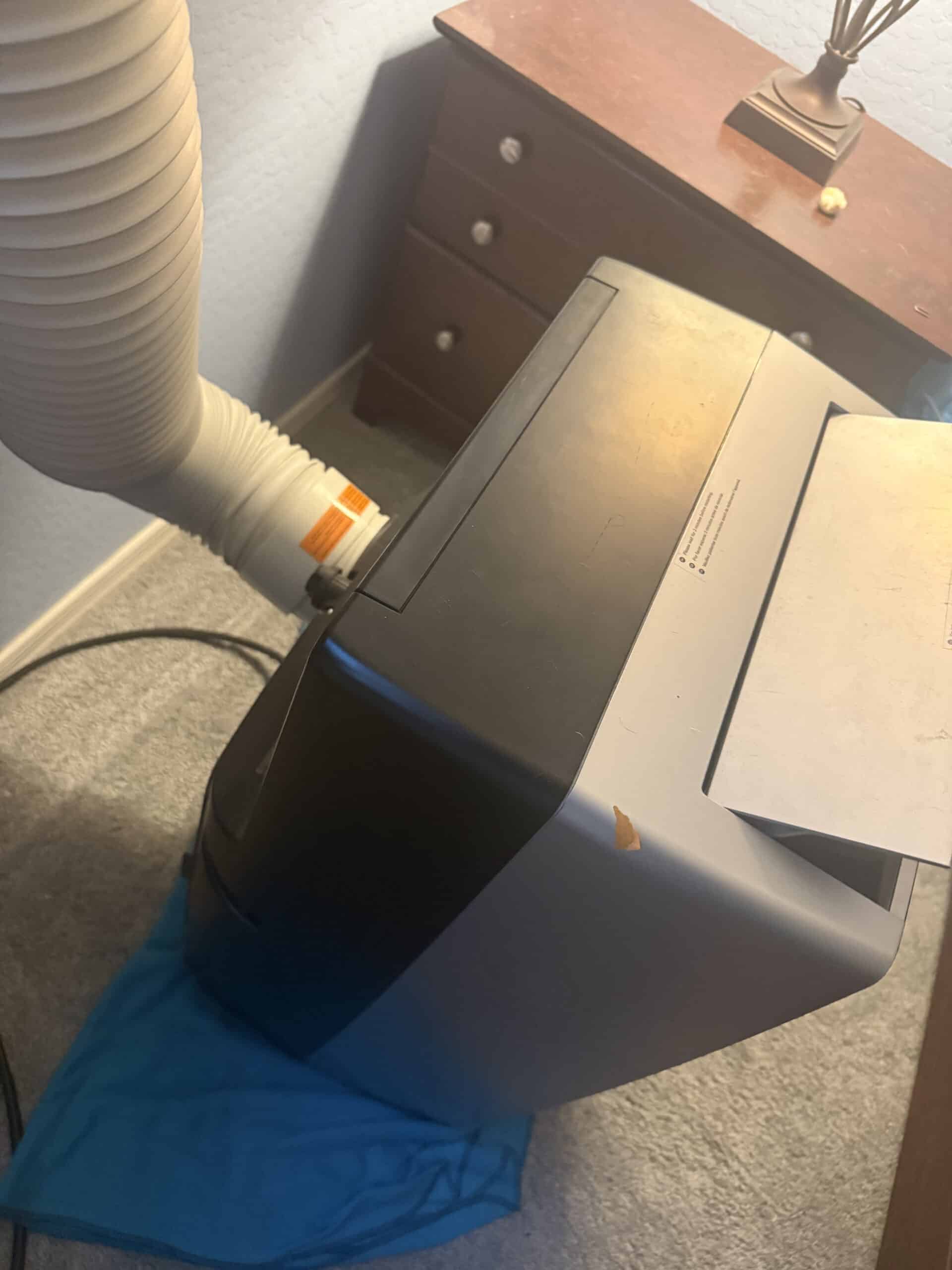
Most portable air conditioners collect condensate in an internal tank and shut down when it fills, which in humid weather means emptying it during the night. Nearly all of them also have a drain port that lets you bypass the tank entirely.
Mine is set up that way and has been for years, which removes the failure mode where the unit stops at two in the morning. Our note on how often you empty a portable AC covers the alternative.
A Safety Note
Water and mains electricity share a room here. Route any drain hose so it cannot be tripped over or leak onto the unit, and check the connection after setting it up. If your unit’s manual restricts continuous drain to certain modes, follow that rather than general advice. Some units avoid the question entirely, and our roundup of self-evaporating portable ACs covers the models that recycle condensate rather than collecting it.
Quick Answer
Most portable ACs support it through a drain port near the base. Attach a hose, run it to a lower drain point using gravity, and the unit never fills its tank.
How It Works
Cooling air pulls moisture out of it, and that condensate has to go somewhere. By default it collects in a reservoir with a float switch that stops the unit when full.
A continuous drain port sits low on the housing behind a cap or plug, and connecting a hose there lets water leave as it forms.
The mechanism is gravity rather than a pump on most units, and that is the single constraint deciding whether this works in your room. Water will not run uphill for you.
Some units have a condensate pump and can push water upward, and those are less common and usually more expensive. Our roundup of portable AC hoses covers the fittings.
My Setup
Single-hose unit, over five years old, running on continuous drain rather than the tank. It sits between the window and the bed.
Five years is long enough to say the arrangement holds up over time. The reason I set it up that way was the obvious one: a unit that shuts itself off partway through the night defeats the entire purpose of having it in a bedroom.
Single-hose matters here in a way that people consistently underestimate. Single-hose units exhaust room air outside and pull replacement air in from the rest of the house, which makes them less efficient than dual-hose designs but simpler to set up.
The tradeoff has been acceptable for years, and I would not describe it as ideal. Our comparison of single-hose and dual-hose portable ACs covers the difference properly.
What You Need
The drain port
Usually near the base behind a rubber plug or threaded cap. The manual identifies which port is continuous drain, since units often have more than one.
A hose that fits
Many units include one. Standard garden hose thread is common, and a short length of clear tubing works where the fitting suits it.
Somewhere lower for the water to go
A floor drain, a shower, or a container. The destination has to sit below the drain port.
A way to secure the hose
So it cannot be kicked loose. A hose that separates while you sleep produces a considerably worse problem than a full tank. Our roundup of window kits and seals covers the other connection.
Setting It Up
Find the correct port first. Units frequently have two, one for continuous drain during operation and one lower down for emptying the tank completely, and using the wrong one gets you a tank that still fills.
Remove the plug or cap and expect a small amount of water to come out, so have a cloth ready rather than discovering that afterward.
Attach the hose and check the fit. A loose connection is the failure that produces water on the floor overnight, which is the outcome you set this up to avoid.
Run the hose with a continuous fall to wherever it drains, then test it before relying on it. Running the unit for an hour and checking the connection and the destination tells you whether it works.
Secure the hose where it crosses a floor. Anything that can be kicked will eventually be kicked, usually at night.
Maintenance Once It Is Running
Check the connection periodically rather than assuming it holds. Vibration works fittings loose over months.
Look inside the hose occasionally, particularly clear tubing, since buildup restricts flow gradually and the first symptom is water backing up.
Clean the filter on schedule regardless. Continuous drain removes one maintenance task and does not remove the others.
At the end of the season, drain the unit fully using the lower port rather than leaving standing water inside it over the winter. Our roundup of portable AC filters covers the rest of the upkeep.
The Gravity Problem
The drain port on most units is only a few inches off the floor, which leaves very little height to work with.
That rules out draining into a sink or a bath edge unless the unit is raised, and raising a portable AC introduces its own stability question.
A shallow container works and needs emptying, which reintroduces the problem you were solving, though on your schedule rather than the unit’s.
The hose also needs a continuous downward run. A dip in the middle holds water, and a section rising even slightly stops flow entirely.
When the Tank Is Actually Fine
In a dry climate a portable AC extracts very little water, and the tank may go days without filling. Continuous drain solves a problem you do not have.
Some units are also designed to evaporate condensate through the exhaust rather than collecting it, and those rarely need draining at all under normal conditions.
Humid weather is where it matters. During monsoon season here the moisture load rises sharply and that is when a tank fills fast enough to interrupt a night.
If you have never had the unit shut off on you, there is no reason to set this up. Our note on dehumidifiers during monsoon season covers the humid-weather side.
What Goes Wrong
The hose working loose is the main one, and it is why securing the connection matters more than the hose itself.
Algae and slime build up in a drain hose over time, particularly clear tubing left in place for months. That eventually restricts flow and it is worth checking rather than assuming.
Using the wrong port is a common early mistake. Some units have a separate port for full-tank drainage that is not intended for continuous use.
And on units where continuous drain is only supported in certain modes, using it in dehumidify mode when the manual says cooling only produces water where you did not expect it.
Portable AC Continuous Drain FAQ
Can every portable AC drain continuously?
Most support it through a drain port near the base, and the manual confirms which port and whether any modes are excluded. Some self-evaporating units rarely need it at all.
Do I need a pump?
Only if you cannot get the destination below the drain port. Most units rely on gravity, and the port sits low enough that finding somewhere lower is the actual challenge.
Where does the water go?
Anywhere below the port: a floor drain, a shower, or a container. A container still needs emptying, though on your schedule rather than when the unit decides to stop.
Is it worth doing?
In humid conditions, yes, because it removes the overnight shutdown. In a dry climate the tank may barely fill and there is nothing to solve.
How long has yours run this way?
Over five years on a single-hose unit. The reason was straightforward: an air conditioner that switches off in the middle of the night is not doing its job.
What can go wrong?
The hose working loose is the main risk, and buildup inside the hose restricting flow is the slow one. Both are worth checking rather than setting up and forgetting.
Does the hose need a downward slope the whole way?
Yes. A dip holds water and any upward section stops flow entirely, since gravity is doing all the work on most units.
Does single-hose versus dual-hose change this?
Not for draining. It changes efficiency, since single-hose units exhaust room air and pull replacement air from elsewhere in the house. The drain arrangement is the same either way.
