
Squeaking comes from two surfaces rubbing under load, and almost every case traces to a joint that has worked loose. Metal frames squeak more than wood because metal-on-metal contact has nothing to absorb movement, and bolted joints loosen with every night of shifting weight.
Solid platform bases beat slats on this for a simple reason: fewer separate pieces means fewer places for movement to start. A frame with twenty slats has twenty contact points that can develop noise, and a solid deck has almost none. Loose or broken slats are a common source of that noise, and replacement slats and holders address it directly. A frame that shifts also marks the wall behind it, which our wall protector picks address.
My Experience
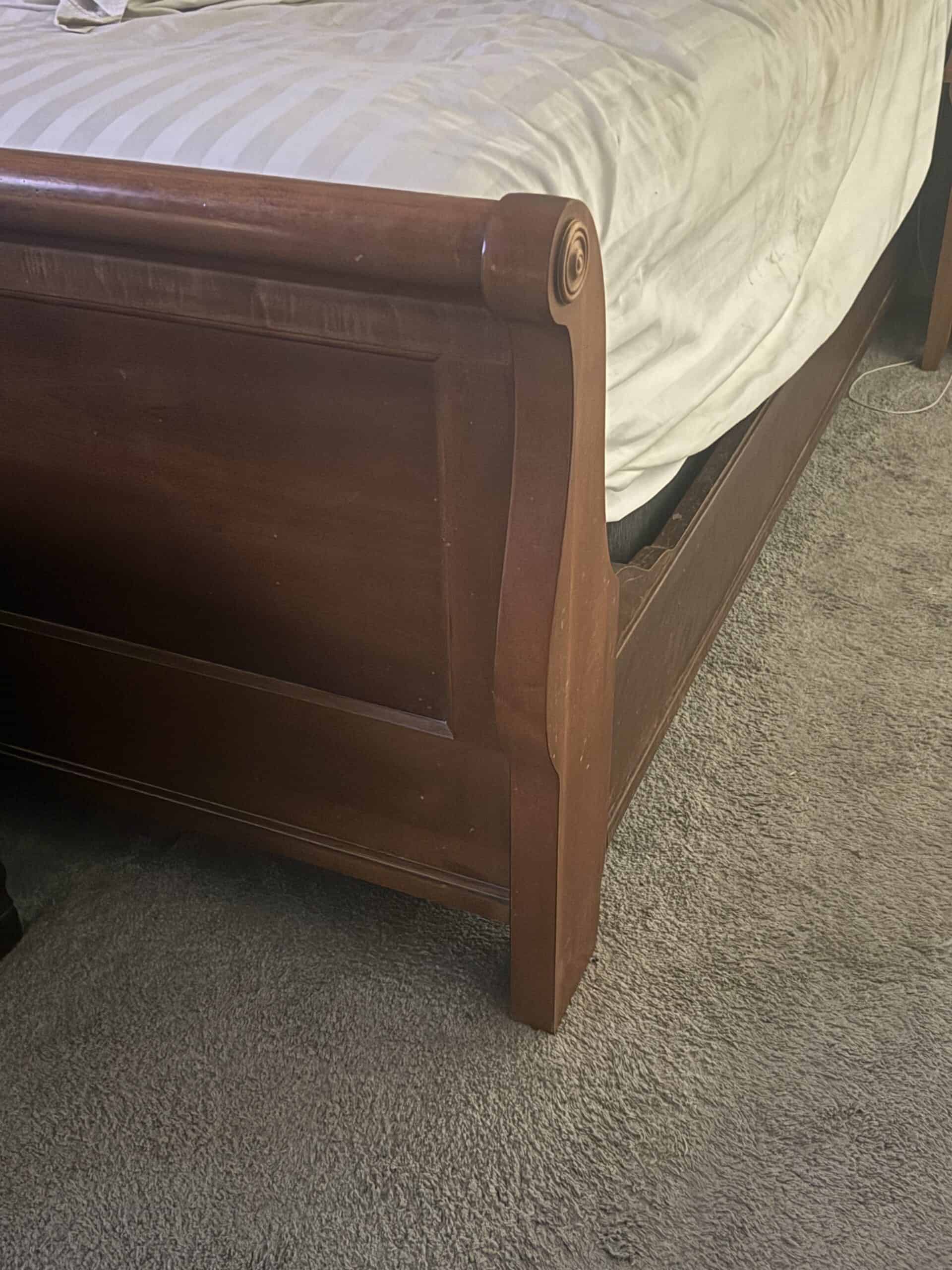
Mine is a wood platform frame with a solid base, and it has been in the family for over a decade with no squeak at all.
The part I would point at is that I have assembled it multiple times across several moves. Repeated disassembly and reassembly is what loosens joints and starts noise, and it has come through that silent, which says more about the construction than a frame that has sat undisturbed in one room.
It sits on carpet, which helps by absorbing some movement between the frame and the floor.
The frame I had before it squeaked, and it was old and metal. That comparison is the whole reason I would point people toward wood if quiet matters to them.
Quick Verdict
A solid wood platform is the quietest common construction. Avoid metal frames with bolted joints, since metal-on-metal contact and repeated loosening are the main causes of noise. Where you already have a squeaky frame, tightening every fastener and adding felt at contact points fixes most cases.
How We Picked
Joint count came first. Every separate connection is a potential noise source, and frames with fewer, larger components are quieter than ones assembled from many small pieces.
Material contact mattered next. Wood against wood compresses slightly and absorbs movement, while metal against metal transmits it as sound.
Fastener design counted because the failure mode is loosening rather than breaking. Frames using bolts with lock washers or barrel nuts hold position far better than those relying on friction alone.
We favored solid decks over slats where the option exists, since slat systems introduce dozens of contact points that all move independently.
Solid Wood Platform Frame
Why It Stands Out
The quietest common construction, and the reason is structural. A solid deck removes the slat contact points entirely, and wood joints compress slightly under load rather than sliding against each other.
Wood also stays quiet through disassembly and reassembly better than metal, which matters for anyone who moves regularly.
Worth Knowing
Heavy, and a solid deck reduces airflow under the mattress, which matters for foam mattresses in warm rooms.
Solid hardwood costs considerably more than engineered wood, and cheaper particleboard decks can sag over years even while staying quiet.
Best for anyone prioritizing silence, and for households that move often. Skip if you need under-mattress airflow or a frame you can lift alone.
Check Price on AmazonWood Slat Platform Frame
Why It Stands Out
Wooden slats provide airflow under the mattress while keeping wood-on-wood contact, which is quieter than any metal system. It is the compromise most people end up with.
Slats are also individually replaceable, so one that develops a problem does not condemn the frame.
Worth Knowing
Slat count and thickness decide both support and noise. Widely spaced thin slats flex under weight, and flexing is where movement starts.
Slats that simply rest in a channel shift over time. Designs that fix each slat in place stay quieter for longer.
Best for foam mattresses that need airflow. Skip designs with fewer than a dozen slats or with slats that sit loose in a rail.
Check Price on AmazonUpholstered Platform Frame
Why It Stands Out
Fabric over a wood structure adds a layer that damps small movements before they become audible. Upholstered frames are often quieter than their bare equivalents for that reason.
The padding also removes headboard rattle, which is a separate noise source from the frame itself.
Worth Knowing
The frame underneath still matters. Upholstery over a flimsy metal structure hides the appearance and not the noise.
Fabric collects dust and is harder to clean than bare wood, which is worth weighing for anyone with allergies.
Best for bedrooms where a headboard is part of the setup. Skip if you cannot verify the construction underneath the fabric.
Check Price on AmazonHeavy-Gauge Steel Frame With Locking Joints
Why It Stands Out
Not all metal frames squeak. Heavy-gauge steel with locking fasteners and welded corners removes most of the movement that causes noise in cheaper metal designs.
Steel also carries far more weight than wood at the same footprint, which matters for heavier sleepers and adjustable bases.
Worth Knowing
Gauge is the specification that separates quiet from noisy, and it is often omitted from listings. Thin tubular steel with bolt-together joints is the classic squeaker.
Metal-on-metal contact points still need attention over time, and felt or rubber washers at connections prevent most of it.
Best for heavy loads and adjustable bases. Skip lightweight tubular steel frames entirely if noise matters.
Check Price on AmazonBunkie Board
Why It Stands Out
A flat panel laid over slats that converts a slat system into a solid deck. It removes the contact points causing noise without replacing the frame.
It also improves support for foam mattresses, which sag between widely spaced slats over time.
Worth Knowing
It reduces airflow, which is the tradeoff. On a foam mattress in a hot room that matters, and cooling layers sit in cooling mattress pads.
It also raises the bed height slightly, which affects how a fitted sheet sits.
Best for fixing a noisy slat frame without buying a new one. Skip if under-mattress airflow is a priority.
Check Price on AmazonAnti-Squeak Felt Pads and Washers
Why It Stands Out
The cheapest fix for a frame you already own. Felt or rubber placed at every point where two surfaces meet gives the movement something soft to happen against.
Combined with retightening every fastener, this resolves the majority of squeaks without any structural change.
Worth Knowing
It treats the symptom. A frame squeaking because a joint has worn will keep loosening, and felt buys time rather than fixing it.
Finding every contact point takes patience, and the noisy one is often not where the sound seems to come from.
Best for anyone with a frame that started quiet and became noisy. Skip if the frame is visibly damaged or a joint has failed.
Check Price on AmazonFrame Types at a Glance
| Type | Squeak resistance | Airflow | Survives reassembly |
|---|---|---|---|
| Solid wood platform | Best | Low | Very well |
| Wood slat platform | Good | Good | Well |
| Upholstered platform | Good | Depends on base | Depends on base |
| Heavy-gauge steel | Good | Excellent | Moderate |
| Light tubular steel | Poor | Excellent | Poorly |
| Box spring on frame | Varies with age | Good | Not applicable |
Where the Noise Actually Comes From
Loose fasteners
The most common cause by a wide margin. Bolts back off gradually under nightly movement, and a quarter turn of play is enough to produce sound.
Slats moving in their channels
Slats that rest loose rather than being fixed shift under weight and rub against the rail. This is the second most common source.
Frame against the floor
Feet moving on a hard floor produce noise that sounds like it comes from the frame. Carpet absorbs this, and pads under the feet fix it on hard floors.
The mattress rather than the frame
Innerspring coils develop their own noise with age, and it is easy to blame the frame. Lifting the mattress onto the floor for a night identifies which it is, covered in when to replace a mattress.
Diagnosing a Squeak
Strip the bed and press on each corner in turn, then the middle. The noise usually reveals itself under direct pressure at one point rather than across the whole frame.
Check every fastener with a tool rather than by hand. Bolts that feel tight often have a small amount of play, and that is enough.
Test the mattress separately by putting it on the floor overnight. If the noise follows the mattress, the frame was never the problem.
Rock the frame side to side with the mattress off. Movement at a joint that should be rigid points directly at the culprit.
Keeping a Frame Quiet
Retighten every fastener twice a year. This single habit prevents most squeaks from ever developing, and it takes ten minutes.
Add felt or rubber at metal contact points during assembly rather than after a squeak appears. Prevention is easier than diagnosis.
Move the frame carefully rather than dragging it, since dragging stresses joints in directions they were not designed for.
Where a frame has been assembled repeatedly across moves, check whether the fastener holes have widened. Enlarged holes never hold properly again, and that is when a frame is genuinely finished.
Recommended Reading
- foundations and what they support
- telling frame noise from mattress noise
- sudden changes in how a bed feels
- adjustable bases and frame requirements
- movement between two people
- support failure underneath
Frequently Asked Questions
Why does my bed frame squeak?
Almost always a loose fastener or slats shifting in their channels. Metal-on-metal contact transmits movement as sound, which is why metal frames squeak more than wood ones.
Are wood or metal frames quieter?
Wood, generally. Wood joints compress slightly under load and absorb movement, while metal surfaces slide against each other. Heavy-gauge steel with locking joints is the exception.
How do I stop a bed frame from squeaking?
Retighten every fastener with a tool, then add felt or rubber washers at contact points. That resolves most cases without replacing anything, and it is worth doing before buying a new frame.
Do slats cause squeaking?
They can, particularly when they rest loose in a channel rather than being fixed. A bunkie board laid over slats converts the system to a solid deck and removes those contact points.
Is it the frame or the mattress?
Put the mattress on the floor for a night. If the noise follows it, aging innerspring coils are the source and no amount of frame work will fix it.
Does carpet help?
Yes, by absorbing movement between the feet and the floor. On hard floors, pads under each foot achieve something similar and remove a noise that sounds like it comes from the frame.
How often should I retighten a frame?
Twice a year prevents most squeaks from developing. Frames that get disassembled for moves need checking after each reassembly, since that is when joints most often end up under-tightened.
The frame supports whatever mattress you choose. choosing a mattress covers what goes on top.
