
A mattress can stay in a storage bag for months without damage as long as it went in clean and dry, and the real limits are moisture and position rather than time. How long a mattress can stay in a bag depends far more on where the bag sits than on how many weeks have passed. Our roundup of mattress bags for moving covers the bags themselves.
| How long | What to expect | What matters most |
|---|---|---|
| Days to two weeks | Nothing. Normal moving timeline | Dry when bagged |
| One to three months | Bag may loosen, foam may expand | Stored flat |
| Three to six months | Same, plus dust ingress at seams | Humidity, not heat |
| Six to twelve months | Fine if dry, risky if damp | Whether it can breathe at all |
| Over a year | Foam compression set becomes real | Position and pressure on it |
Quick Answer
Six months to a year is realistic in a dry space if the mattress went in clean and dry and is stored flat with nothing stacked on it. The failure modes are trapped moisture producing mold, and being stored on its side or under weight producing permanent shape change. Neither of those is about elapsed time.
What Actually Goes Wrong in Storage
Time by itself does very little. What damages a stored mattress is moisture, pressure, and position, and all three can happen in a week or take a year.
Moisture is the serious one. A plastic bag sealed around a mattress that was even slightly damp traps that water against foam, and foam holds it. That is how mold gets into a mattress that looked fine going in.
Pressure comes second. Anything stacked on top compresses foam in one place for months, and foam takes a set.
Position is third and the most commonly ignored. A mattress stored on its side for a long stretch sags along its length, because nothing inside it is built to be loaded that way. Our guide on storing a mattress covers the setup properly.
What Six Months in a Garage Looks Like
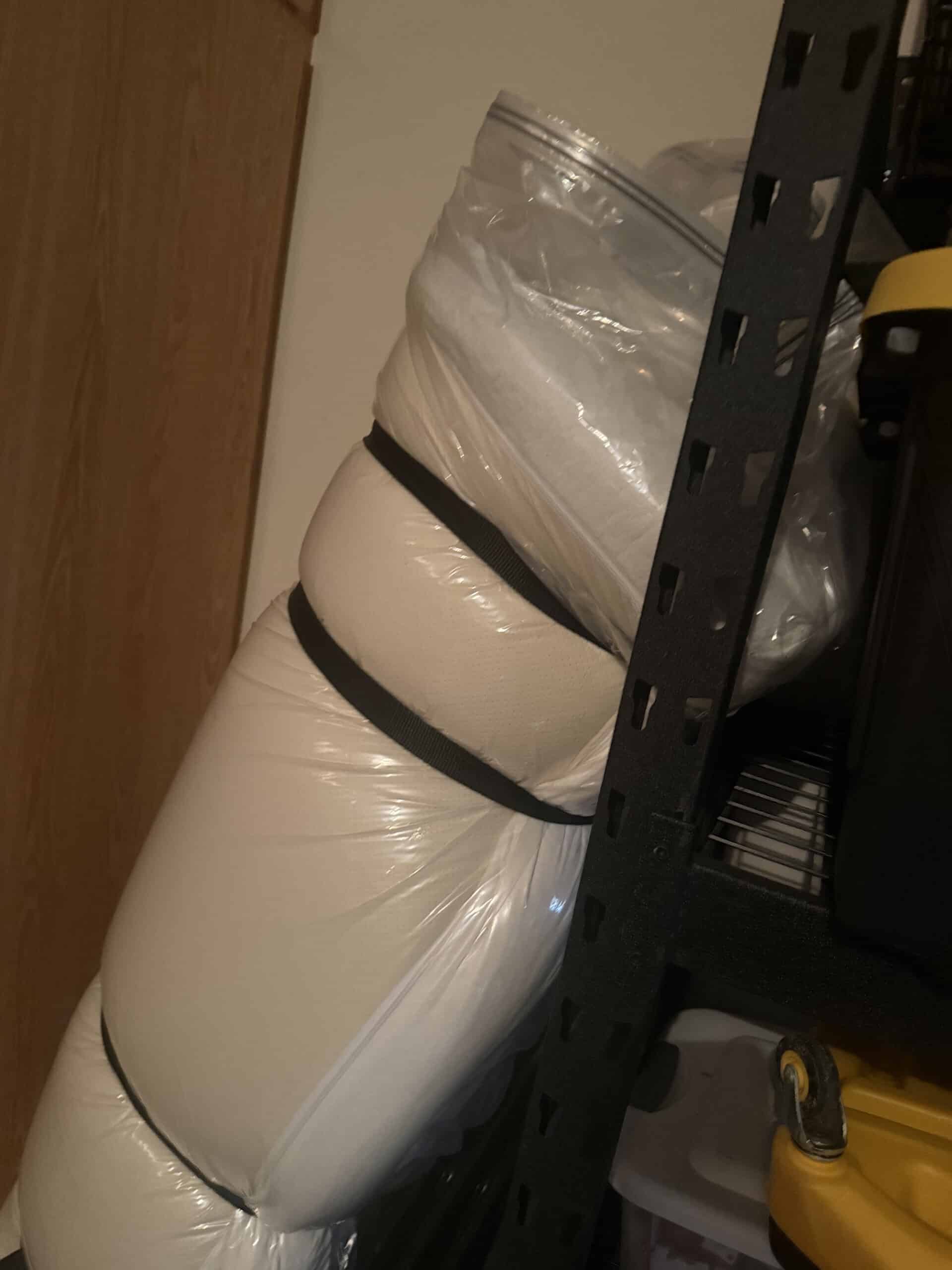
Mine has been sealed in a heavy plastic bag for over six months, and it lives in the garage, which is not climate controlled.
The bag has no tears. That is the property that actually matters for a long storage stretch, and it is why the weight of the plastic is worth paying for rather than treating as a detail.
What has changed is the bag rather than the mattress. It is visibly slack now, and the mattress has expanded back out against the straps I put around it. Those straps are what is actually holding the shape at this point, not the bag.
It went into the bag knowing which type it was, which is most of why I have not worried about it. It is compressed and it has held.
The honest boundary is that it is still bagged. I cannot tell you how it feels once it is opened or how long it takes to recover, because I have not opened it. What I can tell you is what six months of an uncontrolled garage does to the packaging, which is loosen it.
Climate Control Matters Less Than People Say
Storage companies sell climate control hard, and for a mattress the specific thing worth paying for is humidity control rather than temperature.
Heat alone does not ruin foam at the temperatures a garage reaches. Foam is manufactured with heat, and a hot garage in a dry climate is a fairly benign environment.
Humidity is different. Damp air plus a sealed bag is the combination that grows mold, and a humid basement is worse for a mattress than a hot dry garage.
So the question to ask about your storage space is not how hot it gets. It is whether things stored there come out damp.
How to Bag One for a Long Stretch
Make sure it is completely dry first. If it has been cleaned, give it far longer to dry than seems necessary, since foam holds moisture well below the surface.
Use a heavy-gauge bag rather than a thin one. Thin plastic tears on the way into storage, and a torn bag is worse than no bag because it lets damp in and holds it.
Store it flat and put nothing on top of it. Flat is the single most important choice for anything beyond a few weeks.
Get it off the floor if you can. A pallet or a couple of boards stops moisture wicking up through concrete, which is the usual source in a garage.
Move it on wheels rather than carrying it. A bagged mattress is awkward and slippery, and dropping it is how bags tear. Our roundup of furniture dollies for moving covers what to use.
What to Check When You Unbag It
Smell it first. A musty odor is the signal that moisture got in, and it is the one problem that does not resolve on its own.
Look at seams and the underside for staining or dark patches. Mold shows up at the edges before the middle.
Give it time before judging the feel. Foam that has been compressed takes hours to days to return to full loft, and a mattress judged in the first ten minutes will feel wrong.
If it smells fine and looks clean, air it out uncovered for a day before putting bedding on it. Our guides on mattress sagging and when to replace your mattress cover what is recoverable and what is not.
When Storage Is the Wrong Call
Storing a mattress that was already near the end is usually a waste of space and money. Our guide on how long mattresses last is the reality check.
Six months of storage fees on a five-year-old mattress often exceeds what a replacement costs, and you still end up with a five-year-old mattress.
The case for storing is a mattress with real life left, or one you specifically want back. That is a different calculation from storing something because throwing it away feels wasteful.
Worth reading next: what a mattress protector is for, since a protected mattress goes into storage in much better condition than an unprotected one.
Mattress Storage FAQ
How long can a mattress stay in a bag?
Six months to a year is realistic in a dry space, and longer is possible if conditions are good. Time is not the limiting factor. A mattress that went in clean and dry, is stored flat with nothing on top, and is kept somewhere that does not get damp will be fine well past six months.
Will a mattress get moldy in a sealed bag?
Only if moisture went in with it or gets in through a tear. Sealed plastic around a dry mattress in a dry space is fine. Sealed plastic around a mattress that was even slightly damp traps that water against foam, which is exactly how mold starts.
Does a mattress need to breathe in storage?
Not if it is genuinely dry. The sealed bag is protecting it from dust and damp, and opening it to let it breathe in a humid space does more harm than good. In a damp environment, breathability helps; in a dry one, sealing wins.
Can you store a mattress on its side?
For a few days, yes. For months, no. Side storage lets the mattress sag along its length, and springs and foam both take a set in that shape. Flat with nothing stacked on it is the way to store anything long term.
Does a garage work for mattress storage?
In a dry climate, yes. Heat is not the enemy people assume, since foam is manufactured with heat. Humidity is the real risk, so a hot dry garage is a better storage space for a mattress than a cool damp basement.
How long does a mattress take to recover after storage?
Give it hours to a couple of days before judging it. Compressed foam expands gradually, and a mattress assessed within minutes of unbagging will feel firmer or flatter than it will end up. Airing it uncovered for a day is worth doing anyway.
What kind of bag should I use for long storage?
A heavy-gauge one. Thin plastic tears during the move into storage, and a torn bag lets damp in and holds it, which is worse than no bag at all. Weight of plastic is the specification that matters for anything beyond a couple of weeks.
Should I put the mattress directly on the floor?
Preferably not, particularly on concrete. Moisture wicks up through a slab and a pallet or a couple of boards breaks that path. It costs nothing and removes the most likely source of damp in a garage.
