
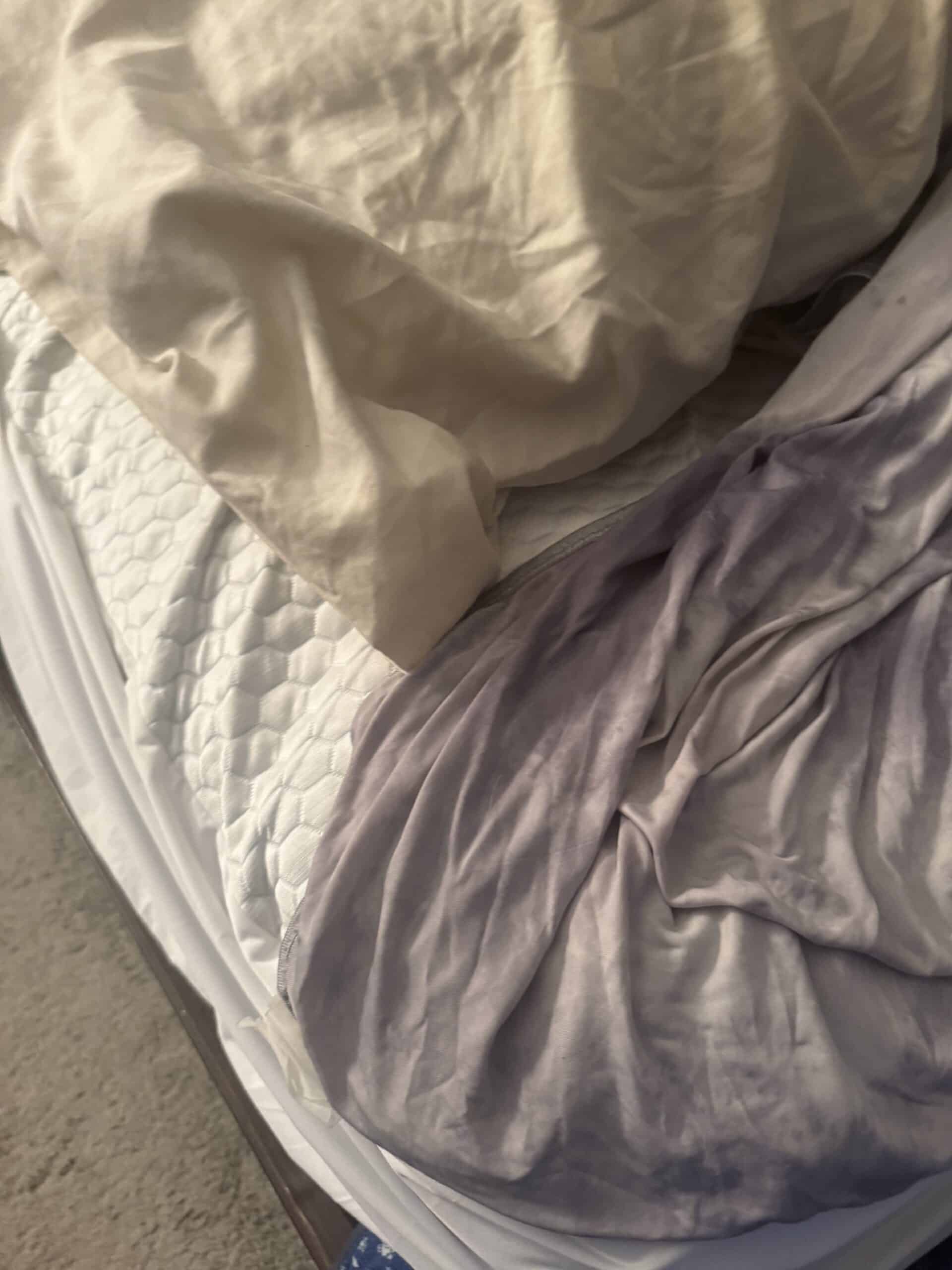
Start with the layer closest to you and work outward. A cooling blanket sits directly against your skin all night and costs the least of the major changes, which makes it the sensible first purchase for most people who sleep hot.
The instinct is to start with the mattress, since that is where the heat feels like it comes from. Mattresses are also the most expensive thing to change, and plenty of people fix the problem without touching theirs.
Quick Answer
Buy a cooling blanket first, then a pillow, then a topper if the problem persists. Address room humidity separately, since damp air blocks the evaporative cooling your body relies on and no bedding fixes that. Expect to spend across a few purchases rather than solving it in one.
Key Points
- The layer touching your skin matters most per pound spent
- Blankets cost less than toppers and are easier to reverse
- Humidity is a separate problem from temperature
- Buying one at a time tells you what actually worked
- A mattress swap should be the last resort, not the first
- Airflow in the room limits what any bedding can do
Order of Purchase
| Order | Item | Why here | Rough cost |
|---|---|---|---|
| 1 | Cooling blanket | Directly against skin, cheapest real change | Low |
| 2 | Cooling pillow | Head heat is what most people notice first | Low |
| 3 | Dehumidifier | Different problem, needs its own fix | Moderate |
| 4 | Cooling topper | Addresses the mattress without replacing it | Moderate to high |
| 5 | New mattress | Only if everything above failed | High |
Why the Blanket Comes First
Whatever covers you traps heat against your body, and a heavy duvet undoes a great deal of what everything underneath is trying to do. Changing it is the shortest path between a purchase and a difference you can feel.
Cost matters here too. A cooling blanket is a fraction of what a topper runs and a small fraction of a mattress, so the wrong guess is cheap and the right one is obvious quickly.
It is also the easiest to reverse. A blanket that does not suit you goes in a cupboard, and a topper that does not suit you is bulky and awkward to store or return. Options sit in cooling blankets.
How I Built Mine
I bought mine in this order: pillows first, then the dehumidifier, then the cooling blanket, then the topper. That happened over time rather than in one go, which I would recommend for a reason that only became clear afterwards.
The blanket makes the most difference by a clear margin. I love that thing, and if I were starting again it is what I would buy first rather than fourth.
The dehumidifier is the one I am least sure about on heat. I do not know that it helps with temperature, and it does help with humidity, which is a real thing and a different thing. That distinction took me a while to separate.
The whole setup came to somewhere around two hundred and fifty dollars, spread across those purchases. That is the honest range for anyone wondering whether this is a fifty dollar problem or a five hundred dollar one.
Buying one at a time is what let me work out that the blanket was doing the heavy lifting. Bought as a batch, I would have had a setup that worked and no idea which part mattered.
My experience covers one person in a dry desert climate in an apartment with air conditioning. It does not cover humid heat, shared beds where two people have different preferences, or night sweats, which behave differently and are worth raising with a doctor.
Humidity Is Its Own Problem
Your body sheds heat by evaporating sweat, and humid air is already carrying close to all the moisture it can hold. When that route is blocked, a room feels hotter than the thermostat reads and no bedding changes it.
That makes a dehumidifier a fix for a different problem rather than a better version of the same one. Somebody in a genuinely damp bedroom may get more from it than from any cooling product.
Measure before buying. A hygrometer costs very little, and readings consistently above sixty percent point at humidity while readings in the forties and fifties point elsewhere. More sits in whether a dehumidifier helps sleep.
What Each Layer Actually Does
Cooling blanket
Sits against you and moves heat away instead of trapping it. Largest effect for the smallest spend, and the easiest to undo if it does not suit.
Cooling pillow
Handles head and neck heat, which is what most people notice first. Immediate to feel, and it delays the warm surface rather than preventing it. Detail sits in why pillows get hot.
Cooling topper
Addresses heat from the mattress across your whole torso. Slower to notice than a pillow because the effect is gradual across the night rather than immediate.
Dehumidifier
Removes moisture so sweat can evaporate. Not a cooling device, and the thing to reach for when a room feels muggy rather than hot.
What the Bed Cannot Fix
A hot room limits everything above. Cooling products move heat from your body into the air around you, and if that air is already warm there is nowhere for it to go.
Airflow does more than any purchase in a genuinely hot bedroom. A fan costs less than any item on this list and addresses the constraint the others run into, covered in cooling a bedroom.
Night sweats that soak bedding are a separate matter from feeling warm, and that pattern deserves medical attention rather than another purchase.
Buy One at a Time
Changing several things at once produces a setup that works and no information about why. That matters when something wears out and you need to know what to replace.
Give each change a week or two before judging it. Sleep varies naturally night to night, and two nights tells you very little either way.
Keep receipts and check return windows, particularly on toppers, where the bulk makes returns awkward and the trial periods are shorter than people assume.
When to Replace the Mattress
A topper is the cheaper test of whether the mattress is the problem. If adding one solves it, the mattress was retaining heat and you have avoided a much larger purchase.
If a topper, a blanket, a pillow, and decent airflow still leave you hot, the mattress is a reasonable next step. Memory foam retains more heat than most constructions, and that comparison sits in memory foam against hybrid.
Age matters too. A mattress near the end of its life is worth replacing for several reasons at once, covered in when to replace a mattress.
Related Reading
- the first purchase
- pillows for head heat
- comparing two layers directly
- what a topper delivers
- when the mattress is the cause
- the whole setup together
Frequently Asked Questions
What should I buy first if I sleep hot?
A cooling blanket. It sits directly against your skin, costs less than a topper or a mattress, and is the easiest change to reverse if it does not suit you.
Is a cooling topper or a cooling blanket better?
The blanket for most people starting out, since it touches you directly and costs less. A topper addresses mattress heat across your torso and makes more sense once the cheaper layers are in place.
Does a dehumidifier help with heat?
Not directly. It removes moisture so sweat can evaporate, which is a different mechanism from cooling. In a damp room that matters a lot, and in a dry room it does very little for temperature.
How much does a cooling sleep setup cost?
Spread across a blanket, pillow, and topper it can run to a few hundred dollars, and buying over time spreads that. A blanket alone is a small fraction of it and often enough on its own.
Should I buy everything at once?
One at a time works better. Changing several things together leaves you with a setup that works and no idea which part is doing it, which matters when something needs replacing.
Do I need a new mattress if I sleep hot?
Usually not, and it should be the last thing you try. A topper tests whether the mattress is the cause for far less money, and plenty of people never need to replace one.
Will cooling bedding work in a hot room?
Only partly. These products move heat from your body into the surrounding air, so warm air limits them. Airflow from a fan costs less and addresses the constraint they run into.
