
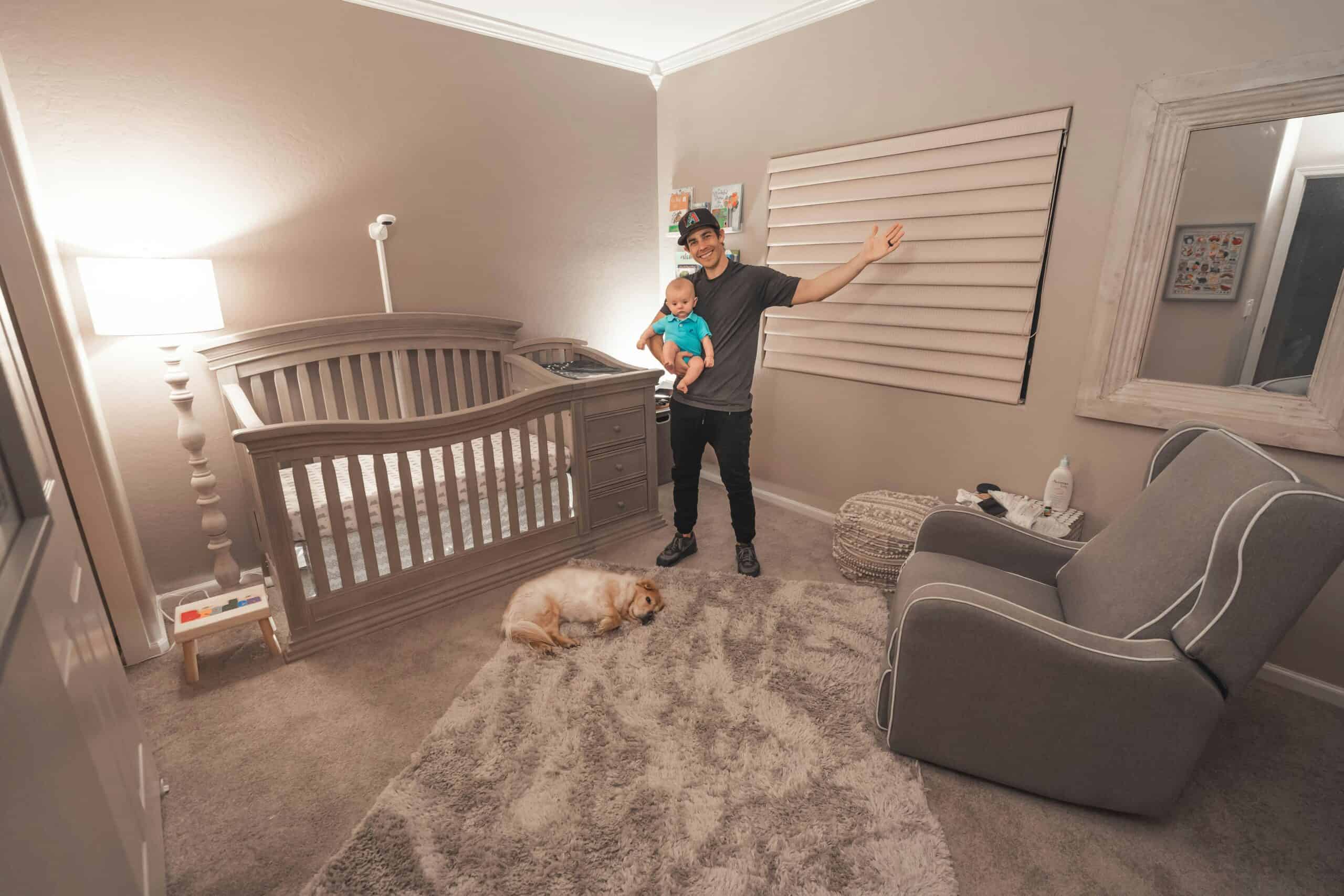
Nursery blackout has one requirement no other room has, and it outranks the darkness question entirely. Corded blinds are a documented strangulation hazard for young children, and safety organizations recommend cordless products in any room where a child sleeps or plays.
After that, the problem is the same one every blackout project faces: light gets in at the edges rather than through the fabric. Our roundup of blackout curtains for sleep covers the general case.
Types at a Glance
| Type | Best for | Limitation |
|---|---|---|
| Cordless cellular blind | Safety plus insulation | Edge gaps remain |
| Side-channel cordless roller | Genuine darkness | Permanent fitting |
| Portable travel blackout | Grandparents, hotels, naps | Suction fails over time |
| Perfect-fit frame blind | uPVC windows, rentals | Frame-dependent |
| Blind plus blackout curtain | Total darkness | Cost and bulk of both |
| Motorized cordless | No cords, no reaching | Batteries or wiring |
How We Picked
Selections are cordless throughout and grouped by how they handle window edges, since cord safety is a requirement rather than a feature and edge sealing is what produces darkness.
Descriptions come from documented specifications rather than hands-on evaluation of every option.
1. A Cordless Cellular Blackout Blind, Best Overall
Why It Stands Out
Cordless operation removes the hazard entirely, and the honeycomb structure insulates as well as blocking light.
Nursery temperature matters alongside darkness, and a blind that reduces heat gain through the window addresses both.
Worth Knowing
Light still enters at the sides unless fitted with channels.
Cells collect dust and are awkward to clean. Our note on whether a cooling bedroom helps covers temperature.
This suits most nurseries. Skip it if only total darkness matters.
Check Price on Amazon2. A Side-Channel Cordless Roller, Best Darkness
Why It Stands Out
Tracks down both sides capture the edges of the blind, which is the only common consumer arrangement that approaches genuine darkness.
Matters more in a nursery than elsewhere, since daytime naps are the point rather than an afterthought.
Worth Knowing
Requires drilling into the window recess.
Costs considerably more than a plain roller. Our roundup of blackout blinds for shift workers covers the same mechanism.
This suits owned homes with daytime nappers. Skip it if you cannot drill.
Check Price on Amazon3. A Portable Travel Blackout, Best for Away From Home
Why It Stands Out
Suction or static cling panels attach to any window without fixings, which matters enormously for travel with a baby on a nap schedule.
Packs small enough to go in a changing bag, and works at grandparents’ houses and hotels alike.
Worth Knowing
Adhesion weakens with temperature and dust, and failures happen mid-nap.
Sizing is approximate. Our roundup of smart sleep masks covers portability.
This suits families who travel. Skip it as the permanent nursery solution.
Check Price on Amazon4. A Perfect-Fit Frame Blind, Best for Rentals
Why It Stands Out
Clips into the gasket around a uPVC window, holding the blind flush to the glass with no side gap and no drilling.
Also sits inside the frame rather than hanging, which puts it further from a cot.
Worth Knowing
Only works on uPVC or similar frames with the right gasket.
Cannot be moved to a different window. Our note on blackout curtains versus blinds covers the choice.
This suits uPVC windows in rented homes. Skip it for wooden or metal frames.
Check Price on Amazon5. A Motorized Cordless Blind, Best Convenience
Why It Stands Out
Operates by remote or app, so there is no cord, no reaching over a cot, and no waking a sleeping baby to adjust it.
Scheduling suits a nap routine that runs at the same times daily.
Worth Knowing
Battery-powered models need recharging, and motors make noise.
More expensive and more to fail. Our roundup of blackout curtains that dont reach the floor covers automation.
This suits an established routine. Skip it if a manual blind is reachable.
Check Price on Amazon6. A Blind and Blackout Curtain Together, Best Total Darkness
Why It Stands Out
The blind covers the glass and a curtain on a wrap-around track covers the recess edges, addressing both failure points.
Curtains add sound absorption as well, which is a secondary benefit in a nursery.
Worth Knowing
Two products to buy, fit, and keep clean.
Curtains must be out of reach of a cot. Our roundup of wrap-around curtain tracks covers edge coverage.
This suits committed daytime nap schedules. Skip it in a small room.
Check Price on AmazonCord Safety Is Not Optional
Looped blind cords and inner cords are a recognized strangulation risk for young children, and safety bodies recommend cordless window coverings in homes with children.
The risk is not limited to the obvious pull cords either, since inner lift cords running through some designs can form a loop if a single slat breaks.
Cot placement matters just as much as the product choice, and the standard guidance is to keep cots and any climbable furniture away from windows entirely rather than relying on the covering alone.
Where existing corded blinds cannot be replaced straight away, cord cleats and tension devices are genuinely interim measures rather than solutions, and replacement remains the recommendation. Our note on bedroom setup in a hot climate covers room layout.
Why Darkness Matters for Naps
Naps happen in daylight
Which is when the room is brightest and hardest to darken.
Light is the main circadian signal
Darkness supports the association between the room and sleep.
Summer evenings are the other problem
An early bedtime in July means putting a child down in full daylight.
Consistency helps routines
A room that looks the same at every sleep time removes one variable.
Temperature and Ventilation
Blackout products change the thermal behavior of a room, and in a nursery that deserves attention rather than being a side effect.
A blind blocking daylight also blocks solar heat gain, which helps considerably in a room that would otherwise warm through an afternoon nap.
The opposite applies in winter, where cellular blinds reduce heat loss through the glass overnight.
What gets lost is the ability to open a window behind a fitted blind easily, and safe sleep guidance generally emphasizes a comfortable room temperature rather than a warm one.
Checking that a blind can be raised without disturbing a sleeping child, or that ventilation comes from elsewhere in the room, is worth doing before the fitting is permanent. Our roundup of weighted blankets anxiety covers heat management.
Where the Light Actually Comes In
Blackout fabric is opaque, and a sample held to a window blocks essentially everything.
Installed in a window, that same fabric leaves a gap down each side, another over the top of the roller, and a third along the bottom edge.
Daylight is bright enough that those gaps light a room noticeably, which is why blinds adequate at night fail for daytime naps.
An outside mount that overlaps the wall on all four sides blocks more than an inside mount, at some cost to appearance. Our roundup of blackout curtains for rooms that stay dim covers partial solutions.
Other Light Sources in a Nursery
Monitors, humidifiers, and air purifiers all carry indicator lights, and a genuinely dark room makes each one obvious.
Tape over an LED is crude and entirely effective, and a good number of devices have a display-off or dimming setting buried in the menu that is worth finding first.
Night lights are a deliberate exception to all of this, and warmer colors are generally suggested over blue-white ones in any sleep environment.
Door gaps let hallway light spill in as a bright strip along the floor, which a simple draft excluder or door sweep addresses at almost no cost. Our roundup of night lights for sleep covers deliberate lighting.
Planning for Later
Nursery decisions get made for a newborn and then live with a toddler, which changes what matters.
A child who can stand and reach will pull on anything within range, so a blind that hangs low or a curtain that reaches the floor becomes something to climb rather than a window covering.
Blackout needs frequently increase rather than decrease over the first few years, since a toddler who wakes at first light is a harder problem than a newborn who wakes regardless.
Room-darkening also becomes part of a routine a child recognizes, which is an argument for a fitted solution rather than something rearranged nightly.
Buying once for the toddler years rather than twice is usually the cheaper path, since the products that suit a two-year-old also suit a newborn. Our roundup of bedroom setups for shift workers covers the later stage.
What to Look For
Cordless, without exception
The one requirement that outranks everything else in this room.
Side channels or a frame fitting
What separates darkness from dimness.
An outside mount where possible
Overlapping the wall blocks the edge light an inside mount leaves.
Something portable as well
Naps away from home need a travel option regardless of what is fitted.
Common Mistakes to Avoid
Corded blinds in a child’s room
A documented strangulation hazard, and cordless alternatives exist at every price.
Judging by fabric alone
Every blackout fabric is opaque, and edge sealing is what differs.
Inside mounting for daytime naps
Neater in appearance and leaves gaps on all four sides.
Forgetting the device lights
Monitors and humidifiers are obvious once the window is genuinely dark.
Recommended Reading
See our roundup of blackout curtains for sliding glass doors, our note on using red light in a bedroom, our roundup of white noise machines, and a roundup of bedroom humidifiers.
Nursery Blackout FAQ
Do nursery blinds need to be cordless?
Yes. Looped and inner blind cords are a recognized strangulation hazard for young children, and safety bodies recommend cordless coverings.
Why does my blackout blind still let light in?
The fabric is opaque and the edges are not. Light comes down both sides, over the roller, and along the bottom.
What actually makes a room dark?
Side channels that capture the blind’s edges, or an outside mount overlapping the wall on all four sides.
Can I do this in a rental?
Perfect-fit frame blinds clip into uPVC gaskets without drilling. Portable suction panels work temporarily and lose adhesion over time.
Do I need one for travel too?
If naps happen away from home, yes. A portable panel keeps a nap routine intact at grandparents’ houses and hotels.
Does a dark room help naps?
Light is the main circadian signal, and naps happen when the room is brightest. Consistency also removes a variable from the routine.
What about night lights?
A deliberate exception. Warmer colors are generally suggested over blue-white light in sleep environments.
Where should the cot go?
Away from windows entirely, which is standard safety guidance regardless of what window covering is fitted.
