
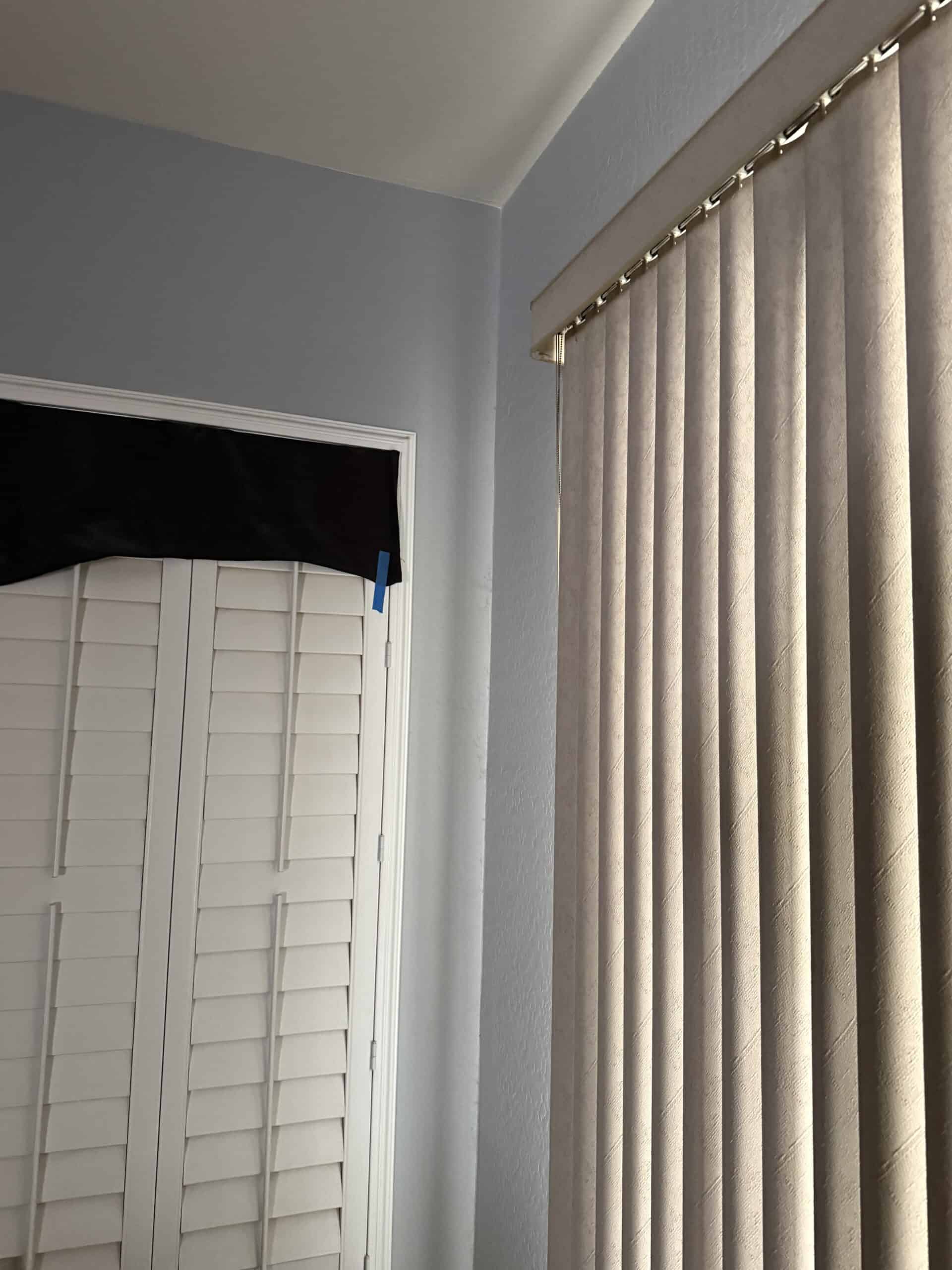
My bedroom is dim rather than fully dark, and that is not the curtains’ fault. The windows have blackout panels on rods and they do their job. The sliding door has blinds, and blinds let light through in a way fabric does not, so the room settles at dim and stays there. I sleep fine in it.
That situation is more common than the product pages suggest. Most homes have at least one opening that cannot take a curtain, and once one light path stays open, upgrading the curtains on the other windows does very little. Our roundup of blackout curtains for sleep covers the standard case.
Work Out Which Opening Is the Problem
Before spending anything, stand in the room with everything closed and find where the light actually comes from. It is usually one place rather than several, and it is usually the opening that could not take a normal curtain.
Sliding doors, skylights, transom windows, and anything with fitted blinds instead of fabric are the usual culprits. Better curtains on the windows that already work will not change the result.
Quick Answer
Identify the single opening letting light in and address that one, rather than upgrading curtains elsewhere. If it cannot be covered, a sleep mask closes the remaining gap for less than the cost of one panel.
1. An Extra-Wide Panel for the Problem Opening, Best Overall
Why It Stands Out
Covering the opening that leaks is the only change that moves a room from dim toward dark. On a sliding door or a wide window, that means a panel sized well past the frame rather than one matched to it.
Fabric blocks light in a way slats and vanes cannot, so replacing or covering a blind is usually the step that works.
Worth Knowing
A door in daily use needs a covering that moves aside easily, which is why people end up with blinds on them in the first place. Weigh how often the door opens before committing.
Wide panels are heavy, so the rod rating matters as much as the fabric. Our roundup of window insulation kits covers that specific case.
This suits a room with one identified leak. Skip it if the door needs constant access.
2. A Wrap-Around Rod, Best for Edge Light
Why It Stands Out
Straight rods end level with the window, so the fabric does too, leaving a vertical strip at each side. A wrap-around rod returns the panel to the wall and closes it.
On a room already close to dark, side gaps are often the last remaining path.
Worth Knowing
The return depth has to clear whatever is already at the window, including blinds and trim. Measure from the wall to the front of the existing covering.
This does nothing about an uncovered opening elsewhere, so fix the main leak first. Our roundup of no-drill curtain rods covers the hardware.
This suits rooms where the curtains are right and the edges leak. Skip it while a bigger gap remains open.
3. A Sleep Mask, Best Value
Why It Stands Out
A mask closes the remaining gap for very little regardless of what the room does, which makes it the cheapest fix available and often the sensible one.
For a room that is already comfortable at dim, this beats rebuilding the window treatments to chase full darkness.
Worth Knowing
A mask darkens your eyes rather than the room, so it does nothing for a partner and nothing for waking naturally to daylight.
Contoured designs with eye cups let you blink, which flat masks pressing on the lids do not. Our roundup of sleep masks covers the styles.
This suits anyone whose room cannot go fully dark. Skip it if you cannot sleep wearing one.
4. Blackout Blind Inserts, Best for Fitted Openings
Why It Stands Out
Where a window has fitted blinds and no room for curtains, a blackout blind or insert fits inside the frame and blocks what slats leak.
Inside-mount also removes the side gap by putting the material within the recess.
Worth Knowing
Inside-mount still leaks around the recess edges unless the fit is tight, so it improves considerably without being a seal.
These need measuring accurately and often ordering to size, which is slower than buying panels. Our comparison of blackout curtains and blinds covers the difference in what they block.
This suits fitted openings with no curtain option. Skip it if a panel would fit.
5. Layered Curtains Over Existing Blinds, Best Upgrade Path
Why It Stands Out
Hanging blackout panels in front of blinds keeps the daytime light control the blinds provide and closes what they leak at night.
It also avoids removing anything, which matters in a rental where the blinds came with the place.
Worth Knowing
The rod has to sit outside the blind’s footprint or the curtain will not close flat against the wall, which reintroduces the gap you were closing.
Two layers on a door in daily use is twice as much to move aside. Our guide to layering blackout curtains covers the technique.
This suits rentals and doors with fitted blinds. Skip it if the door opens constantly.
6. Foam Gap Sealing Strip, Best Small Fix
Why It Stands Out
Adhesive foam closes the gaps left at the top and sides of a panel or a blind, which on a nearly dark room is often the last visible line of light.
It costs almost nothing and needs no hardware.
Worth Knowing
Adhesive foam lifts paint on some finishes, which matters in a rental. Test a small section first.
It also degrades in direct sun and is worth treating as a yearly consumable. Our guide to stopping light leaking around curtains covers the full set of gaps.
This suits a room already close to dark. Skip it while a whole opening is uncovered.
Dim Room Fixes at a Glance
| Fix | Addresses | Cost | Best for |
|---|---|---|---|
| Extra-wide panel | The uncovered opening | Highest | Sliding doors |
| Wrap-around rod | Side gaps | Moderate | Rooms already close |
| Sleep mask | Your eyes only | Lowest | Rooms that cannot go dark |
| Blind insert | Fitted openings | Moderate | No curtain option |
| Layering over blinds | What slats leak | Moderate | Rentals |
| Foam gap strip | Last visible lines | Lowest | Nearly dark rooms |
Why My Room Stays Dim
The blackout curtains I have are standard rather than thermal, and they hang just clear of the floor on rods. They stay put rather than being pushed around, and they do what they are supposed to do on the windows they cover.
The sliding door is the reason the room is dim. It has blinds rather than curtains, and blinds let light through around and between the slats no matter how they are angled. Nothing I do to the window curtains changes that, because the light is not coming through the windows.
It is dark enough that I sleep with ease, which is the part worth saying plainly. Dim is not a problem to be solved. It is a state a lot of bedrooms sit in, and the useful question is whether it interferes with sleep rather than whether the room passes some standard for darkness.
If it did bother me, the honest fix would be covering the sliding door properly rather than buying better curtains for windows that are already handled. That is the diagnosis this whole article rests on, and I arrived at it by standing in the room and looking at where the light actually was.
How to Choose for a Dim Room
Where is the light actually coming from?
Stand in the room with everything closed and find the source. It is usually one opening rather than several, and it is usually the one that could not take a curtain.
Can that opening take fabric?
Fabric blocks light; slats and vanes do not. If the leaking opening has blinds, adding a curtain over them is more effective than upgrading anything else.
Does the room need to be dark, or dark enough?
These are different targets. A room comfortable at dim needs nothing. Chasing full darkness for its own sake is how people spend money without improving their sleep.
Would a mask do it?
For one sleeper in a room that cannot go fully dark, a mask closes the gap for a fraction of the cost of new window treatments.
Fix the Room or Fix the Sleeper?
The case for fixing the room
It works for everyone in it, needs no compliance at bedtime, and lets you wake naturally rather than to an alarm in the dark. If a partner also wants dark, this is the only approach that helps both.
The case for a mask
It is cheap, immediate, and works in a room where one opening genuinely cannot be covered. For a single sleeper who is otherwise content, spending on window treatments to chase the last of the light is often money that would do more elsewhere. Our comparison of sleep masks and blackout curtains covers the trade.
Common Misconceptions
That better curtains fix a dim room
If the light is entering through an uncovered opening, fabric quality on the other windows changes nothing. Diagnose before buying.
That blinds are equivalent to curtains
Slats and vanes leak at every join regardless of the material rating. A room with blinds on the main opening will not go fully dark.
That dim is a failure
Plenty of people sleep well in a room that is not fully dark. The measure that matters is your sleep, not the room.
That you have to cover everything
One opening is usually responsible. Finding it is cheaper than treating every window in the room. Our note on whether blackout curtains make waking harder covers the cost of total darkness.
Related Reading
See our note on how high to hang blackout curtains, our guide to how long blackout curtains last, our room darkening shade picks, and a guide to sleeping during the day.
Dim Room FAQ
Why is my room still light with blackout curtains up?
Usually because light is entering somewhere the curtains do not cover, most often a sliding door, a skylight, or a window with fitted blinds. Stand in the room with everything closed and find the source before buying better curtains for windows that already work.
Do blinds block as much light as curtains?
No. Light passes between and around slats or vanes regardless of the fabric rating, so a room whose main opening has blinds will not go fully dark. Adding a curtain over the blinds is the usual fix.
Is a dim room bad for sleep?
Not necessarily. Plenty of people sleep well without full darkness, and the useful measure is whether you sleep rather than how the room scores. If light is genuinely waking you, that is worth addressing; if not, dim is fine.
Should I get a sleep mask instead of new curtains?
For one sleeper in a room with an opening that cannot be covered, often yes. It costs a fraction of new window treatments and works immediately. It does nothing for a partner and stops you waking naturally to daylight.
Can I put curtains over existing blinds?
Yes, and it is usually the best upgrade in a rental since nothing gets removed. The rod needs to extend past the blind’s footprint so the curtain closes flat against the wall, otherwise you reintroduce the gap.
What about the gap at the sides?
Wrap-around rods carry the fabric back to the wall, which straight rods cannot do. On a room already close to dark this is often the last remaining path, though it is worth fixing any fully uncovered opening first.
Do I need thermal curtains for darkness?
No. Thermal linings target heat rather than light, and standard blackout fabric blocks light perfectly well. Thermal is worth paying for if insulation matters to you, not for darkness.
How dark does a bedroom need to be?
Dark enough that light does not wake you or delay you falling asleep. That varies between people, and chasing total darkness for its own sake is a common way to spend money without improving anything.
Recommended Reading
See our note on making a bedroom dark.
