
Foam mattresses can technically sit on the floor, and most manufacturers would rather you did not. The reason has nothing to do with the frame itself and everything to do with what the foam is resting on: foam conforms to whatever is underneath it, including gaps, and it stays conformed.
That single property explains most of the advice in this area. Our comparison of bed frames covers the support types.
Quick Answer
Foam needs continuous or closely spaced support, commonly around three inches or less between slats. A platform bed, a solid base, or a frame with close slats all work. Wide-slat frames and bare floors both cause problems, for different reasons.
Key Points
- Foam sags into gaps and does not recover.
- Around three inches between slats is the usual guidance.
- A box spring is the wrong base for most foam mattresses.
- Floor placement traps moisture underneath.
- Warranties frequently specify the base required.
Why Foam Is Different
An innerspring mattress has a coil unit that distributes weight across its whole surface, so it spans gaps in a base without much consequence. The structure does the work.
Foam has no such structure. It compresses wherever pressure is applied and conforms to whatever it rests on, so a gap under it becomes a place the foam settles into. Over months that becomes permanent.
This is why a foam mattress on an old wide-slat frame develops ridges matching the slat pattern, and why people mistake that for the mattress failing. Our roundup of slat supports and replacement slats covers the fix.
What Counts as Adequate Support
A platform bed
Designed for exactly this, with slats close together or a solid deck. The straightforward answer for a foam mattress, and the reason platform beds became standard as foam took over the market.
A slatted frame with close spacing
Fine if the gaps are small enough. Measure rather than assume, since spacing varies considerably between frames that look similar and manufacturers rarely advertise it.
A solid platform or bunkie board
A thin rigid panel laid over existing slats converts a wide-slat frame into an adequate base without replacing the frame. It costs far less than a new bed and adds barely any height.
A box spring
Generally not suitable. Box springs are designed to flex under innerspring mattresses, and that flex is precisely the opposite of what foam needs, which is an even surface that does not move under load.
What Mine Is On
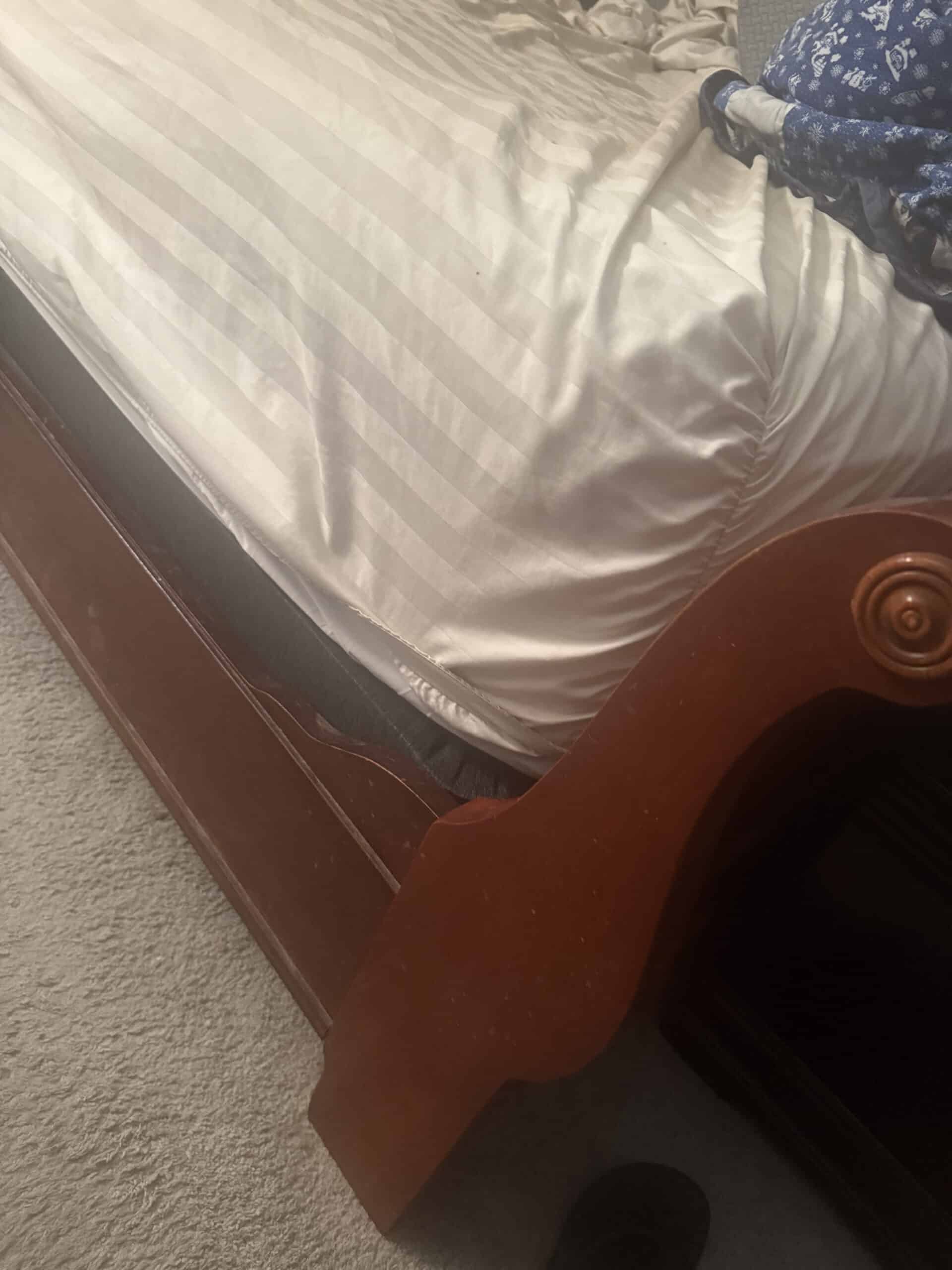
Mine is a memory foam mattress on a large wooden frame, and it has worked without any problem I have noticed.
The mattress has not developed dips or ridges, which is the thing I would expect if the support underneath were inadequate. I have never lifted it to measure the slat spacing, so I cannot tell you what the gaps are, only that whatever is under there has been sufficient.
The frame is also solid and heavy, which I suspect matters more than it gets credit for. It does not shift, it does not creak, and there has been no gradual sagging in the middle that would show up as a dip in the mattress over time.
What I would take from that is that a substantial frame and a foam mattress is a combination that works, and I got there by having a heavy frame already rather than by choosing it for the mattress. Anyone buying both at once has the opportunity to check the spacing, which I did not.
What I cannot compare is foam on a box spring, on a metal frame, or on the floor, since I have not tried any of those.
Signs the Base Is the Problem
A dip that follows the slat pattern, in regular stripes rather than a single hollow, points squarely at spacing. That pattern does not occur from ordinary mattress wear.
A single sag in the middle of the bed usually means the center support is missing or has settled, particularly on queen and larger frames where the load concentrates there.
Sagging that appears within the first year on a new mattress is worth investigating as a support problem before assuming the mattress is defective, since foam responds to its base quickly. Lifting the mattress and looking at what is underneath takes a few minutes and is the first diagnostic step. Our note on when to replace a mattress covers distinguishing wear from a base issue.
Can Foam Go on the Floor?
It can, and there are two problems. The first is airflow: foam traps moisture, and a mattress with no gap underneath has nowhere for that moisture to go, which over time encourages mold and mildew growth on the underside.
The second is practical. Floors are colder, dust and allergens sit at floor level, and getting up from a mattress on the floor is harder on knees and backs. That last point matters more with age than people anticipate.
People who do this successfully generally lift the mattress periodically to let it dry out and avoid humid rooms. That is a routine rather than a fix. Our note on cleaning a mattress covers moisture problems.
Center Support Matters Too
Queen and larger frames generally need a center support leg reaching the floor, and leaving it out is a common cause of sagging that people blame on the mattress.
The load in the middle of a bed is substantial, and a frame relying on side rails alone will flex there over time. That flex transfers directly into a foam mattress, which conforms to it and eventually keeps the shape.
If your frame came with a center leg and it is sitting in a box somewhere, that is worth fixing before replacing anything else. Our roundup of frames that do not squeak covers construction quality.
Check the Warranty First
Mattress warranties commonly specify what constitutes adequate support, including maximum slat spacing and center support requirements for larger sizes.
Using an unsuitable base can void a claim, which matters most in the first years when a warranty is worth something. Reading that section before buying a frame is a five-minute job.
Manufacturers vary, so the figure in your paperwork is the one that applies rather than a general rule. Our note on whether you need a box spring covers the related question.
Foam Mattress Support FAQ
Do I need a special frame for a memory foam mattress?
Not special, and it does need adequate support. Closely spaced slats, a solid platform, or a bunkie board over existing slats all work. What foam cannot handle is wide gaps, since it sags into them permanently.
How far apart should slats be?
Around three inches or less is the figure commonly cited, and your mattress warranty may specify something different. Measuring the gaps on a frame you already own takes a minute and settles it.
Can I use a box spring with foam?
Generally not recommended. Box springs flex under load, which suits innerspring mattresses and works against foam, which needs an even unyielding surface. A solid platform is the appropriate base.
Can I put a foam mattress on the floor?
It works and it traps moisture underneath with nowhere to escape, which encourages mold on the underside over time. People who do this successfully lift the mattress periodically to let it dry and avoid humid rooms.
Why does my foam mattress have ridges?
Usually slat spacing. Foam settles into gaps and the pattern eventually becomes permanent, which people mistake for the mattress failing. A bunkie board or closer slats prevents it, and existing ridges do not come out.
Do I need a center support leg?
On queen and larger frames, yes. Side rails alone flex under the load in the middle of the bed, and that flex transfers into a foam mattress as sagging. A missing center leg is a common and easily fixed cause.
Will the wrong base void my warranty?
It can. Mattress warranties frequently specify support requirements, and a claim can be refused where the base did not meet them. Checking that section before buying a frame is worth the five minutes.
What is a bunkie board?
A thin rigid panel laid across existing slats to create a continuous surface. It converts a wide-slat frame into an adequate base for foam without replacing the frame, and it adds very little height.
Recommended Reading
See our note on bed frames and platform beds, and stopping a bed frame shifting, and choosing a mattress.
