
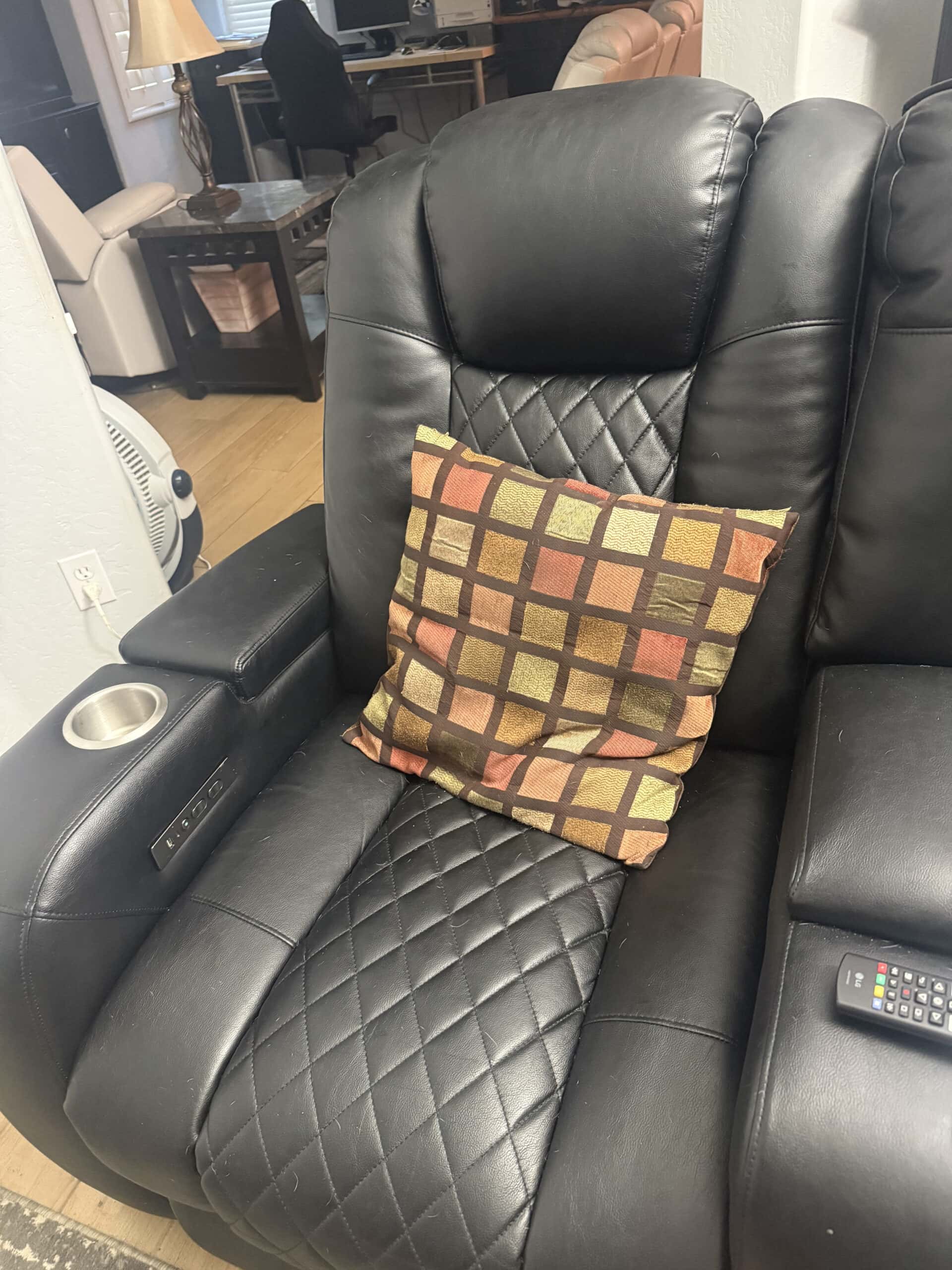
A recliner is an unusual product to evaluate for sleep, because the thing that makes it worse than a bed is also what makes it good for a nap. It keeps you from sinking too deep too fast.
Mine is a standard electric button recliner, about three years old, and I nap in it when I nap. I usually stop it partway rather than taking it fully back, and the sleep feels lighter than sleep in bed does. Our note on why you feel worse after a nap covers why that matters. Powered chairs have their own quirks, and our note on why an electric recliner stops partway covers the controls.
Types at a Glance
| Type | Best for | Limitation |
|---|---|---|
| Power recline | Stopping at any angle | Needs an outlet, costs more |
| Manual lever | Simplicity, price | Fixed stop positions |
| Power headrest | Neck support while reclined | Adds cost |
| Wall-hugger | Small rooms | Less total recline travel |
| Glider or swivel | Movement, nursing | Less stable when reclined |
| Lift chair | Getting in and out | Medical pricing |
How We Picked
Selections are grouped by recline mechanism and support features, since angle control and neck position are what decide whether a chair works for sleeping rather than only for sitting.
Descriptions come from documented specifications rather than hands-on evaluation of every option.
1. A Power Recliner With Adjustable Headrest, Best Overall
Why It Stands Out
Power recline stops anywhere in its travel rather than at preset positions, which matters because the useful nap angle is frequently partway rather than fully back. Anyone with swelling or lower back pressure should look at the zero gravity style before a standard recliner.
A separately adjustable headrest handles the neck independently of the body angle, which is the part most chairs get wrong.
Worth Knowing
Requires a nearby outlet, and it will not recline in a power cut.
More motors means more that can eventually fail. Our roundup of nap pillows covers additional support.
This suits daily use for both sitting and napping. Skip it if the chair is purely occasional.
2. A Manual Recliner, Best Value
Why It Stands Out
A lever mechanism costs considerably less, needs no power, and has fewer components that can fail over a decade.
Reliable in a way motorized furniture is not, which matters for something used daily.
Worth Knowing
Fixed stop positions mean you take the angle the chair offers rather than the one you want.
The lever action requires more effort to operate. Our note on how long a nap should be covers the timing side.
This suits occasional napping. Skip it if you want fine angle control.
3. A Wall-Hugger Recliner, Best for Small Rooms
Why It Stands Out
The seat slides forward as the back goes down, so the chair needs only a few inches of clearance behind it rather than a couple of feet.
That is the difference between fitting a recliner into a small room and not having one at all.
Worth Knowing
The mechanism typically offers less total recline travel than a standard chair.
Sliding forward means it occupies more floor space in front. Our roundup of bedroom gear for different schedules covers small-space sleeping.
This suits apartments and tight layouts. Skip it if you have the clearance for a standard chair.
4. A Zero Gravity Recliner, Best for Circulation
Why It Stands Out
Zero gravity positioning raises the legs above the heart, a position associated with reduced pressure on the lower back.
Useful for anyone who finds a conventional recline leaves their legs uncomfortable.
Worth Knowing
The position is fairly far back, which works against keeping a nap light.
Frames tend to be more visually utilitarian. Our note on sleeping with lower back pain covers positioning.
This suits circulation and back concerns. Skip it if you want a light twenty minute nap.
5. A Recliner With Lumbar Support, Best for Back Comfort
Why It Stands Out
Adjustable lumbar support fills the gap at the lower back that appears as a chair reclines, which is where unsupported reclining becomes uncomfortable.
Matters more the longer you stay in one position.
Worth Knowing
Adjustable lumbar is frequently bundled into higher-priced models rather than sold separately.
A cushion achieves much of the same for far less. Our roundup of lumbar support pillows covers the cheaper route.
This suits back sensitivity. Skip it if a cushion would do.
6. A Compact Push-Back Recliner, Best Simplicity
Why It Stands Out
No lever and no motor. Leaning back reclines the chair, which is the simplest mechanism available and the least to go wrong.
Frequently smaller and lighter than mechanism-driven recliners.
Worth Knowing
Recline is shallow and the footrest is usually separate or absent.
Less support at full extension. Our roundup of foot massagers covers footrest alternatives.
This suits light napping in a small space. Skip it for extended sleeping.
Why Partial Recline Suits Naps
Sleep depth is influenced by how comfortable and supported the body is, and a fully flat position is what a bed provides precisely because it produces deep sleep.
A short nap wants the opposite. Waking from deep slow-wave sleep produces the grogginess people associate with naps going wrong.
A partially reclined position is less conducive to sinking into deep sleep, which for a twenty minute nap is a feature.
I stop mine partway rather than taking it fully back, and the sleep feels lighter than sleep in bed does. That is consistent with the mechanism rather than a coincidence. Our note on napping with insomnia covers when to skip naps entirely.
Where the Chair Goes Matters
Placement affects whether a recliner works for napping as much as the chair itself does.
Light is the main variable, since a chair facing a window gets daylight straight into your eyes, and daytime light is exactly what suppresses the drift into sleep.
Facing away from a window, or having something to draw across it, resolves most of that without moving anything permanently.
Sound matters less than people expect. A chair in a room with household noise frequently produces a lighter nap than a silent bedroom, which suits a twenty minute nap rather than working against it.
Temperature is worth thinking about too, since a chair in a warm sunny spot is comfortable for sitting and works against sleep depth in a way that helps here. Our roundup of blackout curtains covers controlling light.
The Headrest Is the Part That Matters
Sleeping in a chair puts the neck into an unsupported position that a bed never does, since the head naturally wants to fall either sideways onto a shoulder or forward onto the chest.
A power-adjustable headrest addresses that directly by moving independently of the back angle.
Mine has one operated by its own button, and it is genuinely the most useful feature on the chair for this particular purpose, more so than the recline mechanism itself is.
Chairs without one need a cushion or a rolled towel or a travel pillow to fill the same role, all of which work perfectly well and none of which stay in position the way a built-in headrest does. Our roundup of cervical pillows covers the alternative.
Where Recliners Fall Short
The arms
Arm position is frequently awkward on recliners generally, and mine is no exception when sitting in it for a while.
Sustained pressure points
A chair distributes weight less evenly than a mattress over hours.
Overnight sleeping
Occasionally fine for most people, and not a substitute for a proper bed on any regular basis.
Turning over
Effectively impossible in a chair, which is a large part of why extended sleep in one is less restorative.
Upholstery and Long-Term Use
Material affects daily comfort more than any specification on a listing, particularly for a chair used for hours at a time.
Leather and faux leather wipe clean easily and hold body heat, which becomes noticeable during a nap in a warm room.
Fabric breathes considerably better and holds dust, pet hair, and spills in a way that needs actual cleaning rather than wiping.
Performance fabrics sit between the two, offering stain resistance without the heat retention, at a higher price.
For a chair specifically used for napping, breathability matters more than it would for occasional sitting, since a warm surface against your back for twenty minutes is the difference between comfortable and not. Our roundup of cooling sheets covers the same problem in bed.
None of those is a reason to avoid a recliner for napping, and they are the reasons a recliner is not a bed, which is a distinction worth keeping clear when comparing the two.
What to Look For
Stopping anywhere in the travel
Power recline gives angle control that fixed positions do not.
Independent headrest adjustment
The single most useful feature for sleeping rather than sitting.
Clearance behind the chair
Measure before ordering, or choose a wall-hugger mechanism.
Arm height and width
Awkward arms are the most common daily complaint and the hardest to fix afterward.
Common Mistakes to Avoid
Buying for full recline only
The useful nap angle is frequently partway rather than flat.
Ignoring the headrest
Neck position is what makes chair sleep uncomfortable, more than the recline.
Not measuring clearance
Standard recliners need real space behind them, which is easy to overlook.
Treating it as a bed replacement
Regular overnight sleeping in a chair is worth raising with a doctor rather than normalizing.
Recommended Reading
See our roundup of sleep products for daytime nappers, our note on how naps affect night sleep, our roundup of recovery tools for bedtime tension, and a note on building a bedtime routine.
Recliners for Napping FAQ
Is a recliner good for napping?
For short naps, yes. A partially reclined position is less conducive to deep sleep, which avoids the grogginess that comes from waking out of it.
Do you nap in yours?
Yes, when I nap it is in the recliner. It is mainly a chair for sitting and relaxing, and napping is secondary to that.
Should it recline fully?
Not necessarily. I usually stop mine partway, and the sleep feels lighter than sleep in bed, which suits a short nap.
What feature matters most?
An adjustable headrest. Neck position is the thing a chair handles worse than a bed, and adjusting it independently addresses that directly.
Power or manual?
Power stops anywhere in its travel rather than at preset positions. Manual costs less, needs no outlet, and has fewer parts to fail.
What about small rooms?
Wall-hugger mechanisms slide the seat forward as the back goes down, needing only a few inches of clearance behind.
Any downsides?
Arm position is frequently awkward, you cannot turn over, and pressure distribution is worse than a mattress over long periods.
Can I sleep in one overnight?
Occasionally is fine. Doing it regularly is worth mentioning to a doctor, since it is often a workaround for something else.
