
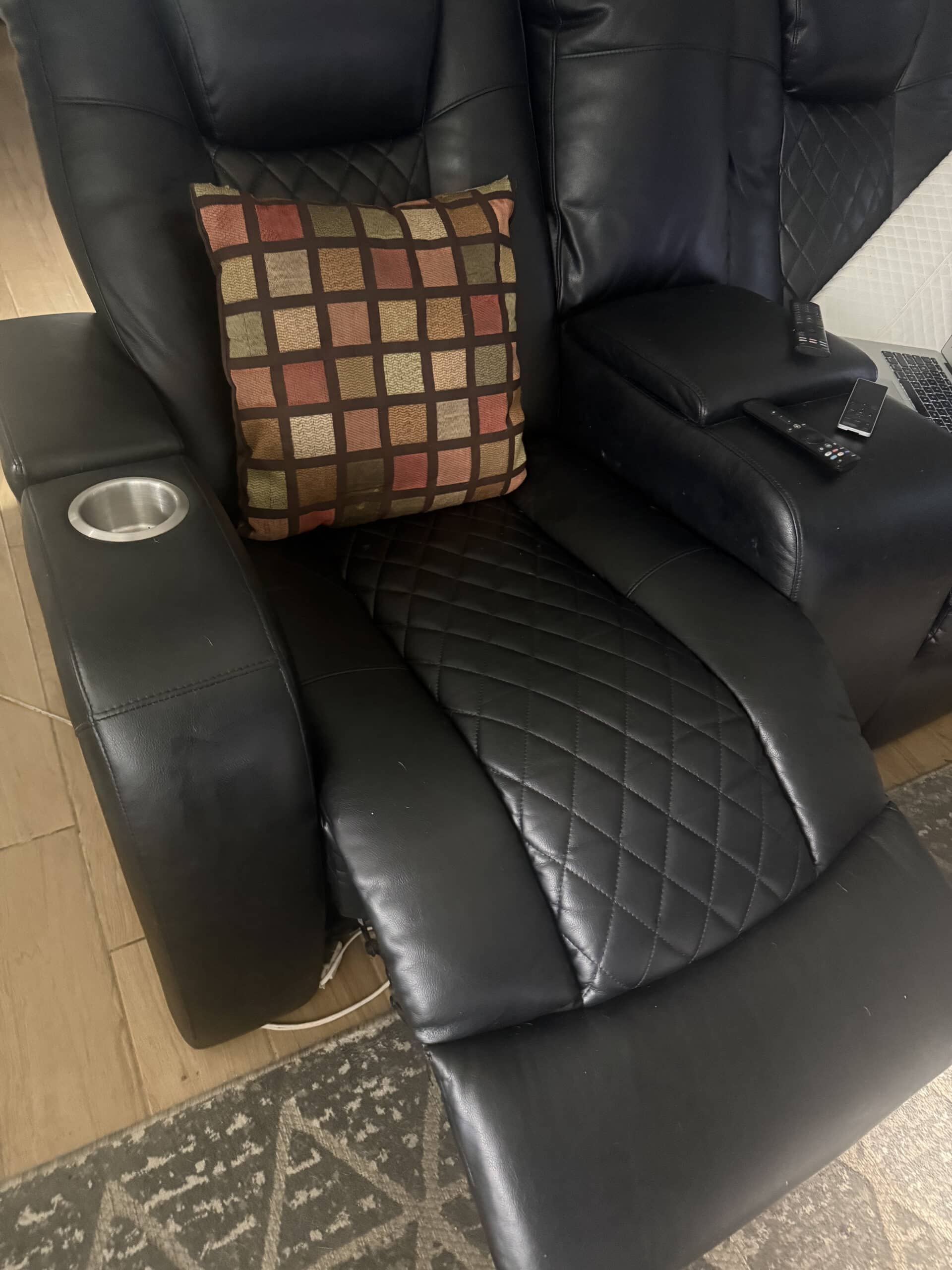
Three different things get described the same way, and only one of them is a problem. You stopped it yourself, the mechanism paused and needed a second press, or something is genuinely failing.
Mine does the first two. I stop it partway on purpose because that is the position I want, and separately it sometimes needs the button pressed twice to keep going, more often when extending than retracting. It has always done that, which is the detail that matters. Our roundup of recliners for napping covers the chairs.
Quick Answer
A quirk that has existed since new is a characteristic of the chair. A behavior that appeared recently or is getting worse is a fault worth investigating.
Three Different Situations
| What happens | What it means |
|---|---|
| You release the button where you want it | Normal, that is the control working |
| Needs a second press to continue, always has | Characteristic of the chair |
| Stops at the same point every time, new behavior | Obstruction or mechanical binding |
| Stops at random points, worsening | Motor, wiring, or control fault |
| Stops and will not restart | Power, thermal cutout, or failed motor |
| Stops with a grinding noise | Stop using it and inspect |
Stopping It Yourself Is the Point
Electric recliners hold whatever position you release the button at, and that is the main advantage over a manual lever chair.
A manual recliner has fixed detents, meaning a small number of preset positions the mechanism locks into. An electric one is continuous.
I stop mine partway on purpose because that is the angle I actually want for napping, which sits somewhere between fully upright and fully extended.
That is not the chair stopping. That is the chair doing exactly what a powered mechanism is for, and it is worth separating from the situations below.
Anyone describing their chair as stopping partway should check first whether they simply released the button, because the two feel similar in the moment. Our note on sleeping in a recliner covers positioning.
The Press-Twice Behavior
Mine sometimes pauses partway through extending and needs the button released and pressed again to continue.
It has done that since I got it, which places it in a different category from something that started recently.
The most common explanation is a mechanism that meets a point of higher resistance in its travel, where the geometry of the linkage changes and the motor briefly draws more current.
Extending is where that shows up more often, since extending works against gravity while retracting is partly assisted by it and by your own weight.
A chair that has always done this at exactly the same point in its travel is behaving consistently, and consistency is generally the clearest sign that nothing is actively degrading. Our note on how long a topper lasts covers wear.
When It Is Actually a Problem
The behavior is genuinely new
A chair that never did this and now does is telling you something changed.
It is getting worse
More frequent, or requiring more presses, means progression.
There is a noise
Grinding, clicking, or straining is mechanical rather than electrical.
It will not restart at all
That is a power, thermal, or motor failure rather than a pause.
Obstruction Is the Most Common Real Cause
Recliner mechanisms sweep through a large space underneath and behind the chair, and anything in that space stops them.
The usual culprits are the power cable itself, a rug edge, a baseboard, or something that fell down the side of the seat and lodged in the frame.
Wall-hugger designs need less clearance behind them than traditional recliners, and traditional ones frequently need several inches that people do not leave.
A chair that stops at exactly the same point every time is describing an obstruction rather than an electrical fault, since electrical problems tend to be less repeatable.
Checking that means unplugging the chair, tipping it forward if you can do so safely, and looking at the linkage rather than guessing.
Thermal Cutouts Exist
Recliner motors have thermal protection that shuts them down when they overheat, and the chair then refuses to move until it cools.
That is most likely after repeated cycling, which is why it turns up when someone is adjusting position over and over rather than during normal use.
The behavior is distinctive. The chair stops, will not respond at all for a period, then works normally again later.
That is protection functioning rather than a fault, and the response is to wait rather than to keep pressing the button.
Repeated thermal cutouts during ordinary use are a different matter, since that suggests the motor is working harder than it should be. Our roundup of recliners for sleeping covers motor types.
Power and Connections
Electric recliners have more connections than people expect, and any of them can work loose over years of the chair being moved.
There is the wall outlet, the transformer brick, the connection into the chair, and frequently a separate connector at the motor itself under the seat.
Intermittent behavior that comes and goes without a pattern points at a connection rather than a motor, since motors tend to fail in one direction.
Chairs with a battery backup pack have another failure point, and a dead backup battery can cause odd behavior even with mains power connected.
Checking connections is free and takes a few minutes, which makes it the sensible first step before anything else.
Position matters for comfort as much as for the mechanism, and where you settle the chair affects how well you actually rest in it. Our note on choosing a pillow for your sleep position covers head support at different angles.
What to Check, In Order
Whether you simply released the button
The most common answer, and the easiest to rule out.
Behind it and underneath
Cable, rug, wall clearance, and anything lodged in the frame.
Every single connection
Outlet, transformer, chair inlet, and the motor connector.
Whether it has always done it
A longstanding quirk is characteristic. A new one is a fault.
Common Mistakes to Avoid
Treating a longstanding quirk as a fault
A chair that has always paused at the same point is behaving consistently.
Repeatedly pressing through a thermal cutout
The motor is protecting itself. Waiting is the correct response.
Not leaving clearance behind the chair
Traditional recliners need several inches. Wall-huggers need less but not none.
Working on it while plugged in
Unplug before putting hands anywhere near the mechanism.
Recommended Reading
See our note on whether you need a pillow in a recliner, our roundup of how long should a nap be, our note on feeling worse after a nap, and a roundup of throw blankets.
Electric Recliner FAQ
Why does my electric recliner stop partway?
Three possibilities. You released the button, the mechanism paused at a point of higher resistance, or something is genuinely wrong. The first is by far the most common.
Does yours do it?
Both of the harmless versions. I stop it partway on purpose because that is the position I want, and it sometimes needs a second press to keep extending. It has always done that.
Is needing to press twice a fault?
Not if it has always happened. A behavior present since new is a characteristic of that chair. One that appeared recently or is worsening is worth investigating.
Why does it happen more when extending?
Extending works against gravity while retracting is partly assisted by it and by your weight, so the motor draws more current on the way out.
What if it stops at the same point every time?
That pattern suggests an obstruction rather than an electrical fault. Check behind and underneath for the cable, a rug edge, or something lodged in the frame.
Why did it stop and refuse to restart?
Possibly a thermal cutout after repeated cycling. The motor shuts down to protect itself and works normally once it cools. Waiting is the right response.
Could it be the power supply?
Frequently. There are more connections than people expect, including one at the motor under the seat. Intermittent behavior with no pattern points at a connection.
When should I get it serviced?
Any grinding or straining noise, a behavior that is getting worse, or a chair that will not restart after cooling.
