
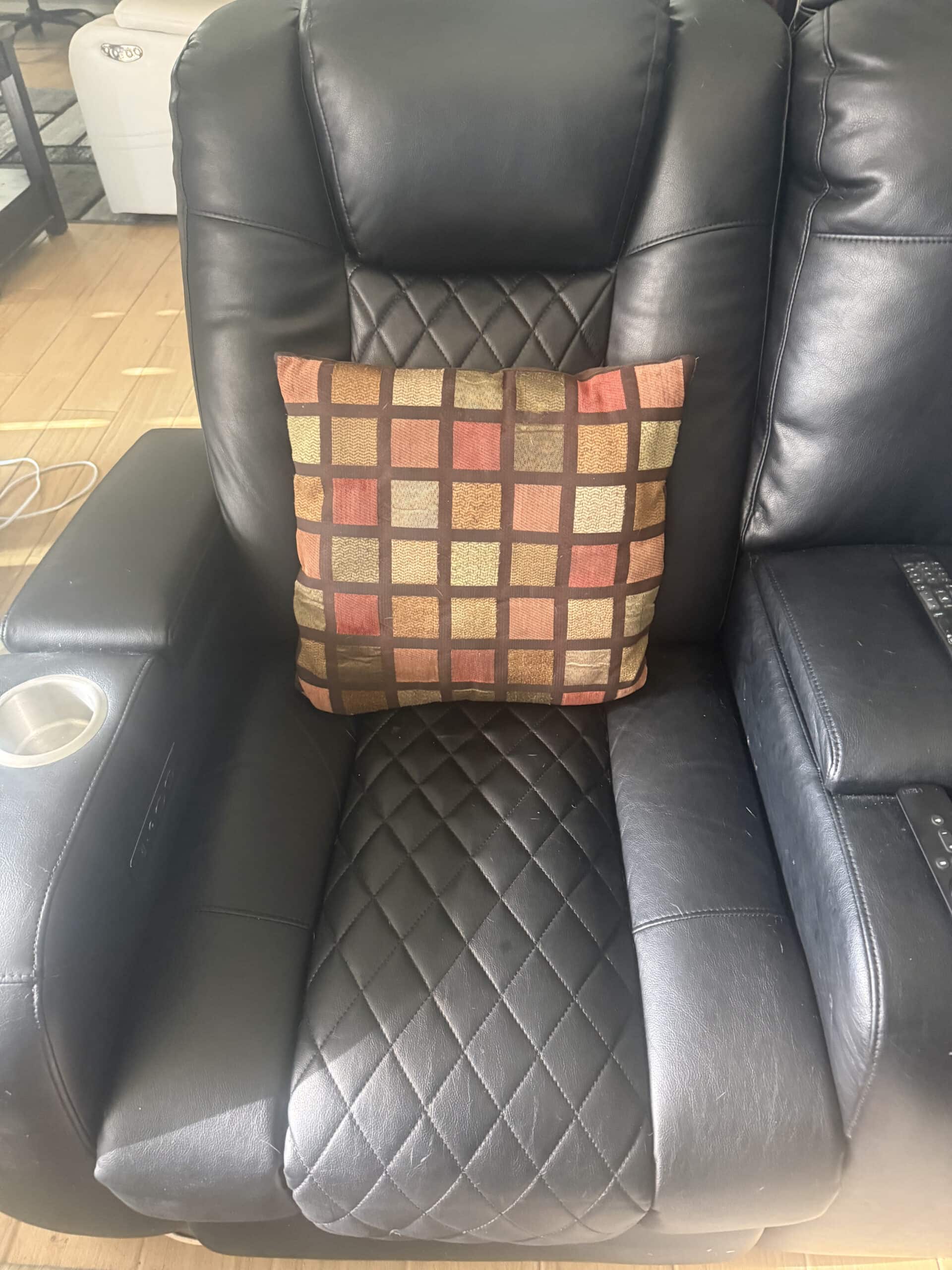
Not strictly. A recliner with an adjustable headrest supports your head on its own, which is what the adjustment exists for. Plenty of people add a pillow regardless, and that is a preference rather than a correction.
Mine has an adjustable headrest that could replace the pillow entirely. I use a throw pillow in it anyway because I prefer it, which is about as honest as this question gets. Our roundup of recliners for napping covers the chairs.
Quick Answer
An adjustable headrest handles support. A pillow adds softness and lets you change position without adjusting the chair. Neither is wrong.
Support Options Compared
| Setup | Best for | Limitation |
|---|---|---|
| Adjustable headrest alone | Correct neck angle, no clutter | Firm, fixed until you adjust it |
| Throw pillow | Softness, easy repositioning | Slides, no structured support |
| Cervical pillow | Defined neck support | Shaped for lying flat, not reclining |
| Small lumbar pillow | Lower back rather than head | Different problem entirely |
| Headrest plus pillow | Both, which is what I do | Can push the head too far forward |
| Nothing at all | Fully reclined positions | Head unsupported at partial recline |
What the Headrest Is Actually For
Recliner headrests adjust because the correct head angle changes with how far the chair is reclined.
Sitting upright, your head sits forward of the seat back and needs the headrest to come forward to meet it.
Fully reclined, your head naturally falls back in line with your spine, and a headrest pushed forward becomes an obstruction rather than support.
That is the reason the adjustment exists, and it is also why a chair set once and never changed feels wrong at some positions and fine at others.
Mine adjusts by button, and it does the job well enough that a pillow is genuinely optional rather than necessary. Our note on choosing a pillow for your sleep position covers head angle.
Why People Add a Pillow Anyway
Softness
Upholstered headrests are firm, and a pillow is not.
Faster than adjusting
Moving a pillow takes a second. Adjusting the chair takes longer.
Side positions
Turning your head sideways is more comfortable against something soft.
Habit
Which is a legitimate reason and the one nobody admits to.
A Throw Pillow Is Not a Neck Pillow
The pillow I use in the recliner is a throw pillow, which is soft and unstructured and offers no defined neck support at all.
That works because the headrest is providing the actual support, and the pillow is adding a softer surface on top of it.
A cervical pillow is a different object entirely, shaped with a raised bolster to hold the neck in a specific position while lying flat.
Those shapes are designed around a horizontal spine, and a reclined chair puts you at an angle where the contour no longer lines up with your neck.
That is why I do not use the cervical pillow in the chair. Different position, different requirement, and using the shaped one there would work against the headrest rather than with it. Our roundup of cervical pillows covers those.
The Head-Forward Problem
Adding a pillow on top of a headrest that is already adjusted forward pushes your head further forward than it should be.
That flexes the neck, which is the same posture problem as sleeping on a pillow that is too thick in bed.
The fix is adjusting the headrest back to compensate, so the pillow occupies space the headrest gives up rather than adding to it.
People who add a pillow without touching the headrest are the ones who report neck stiffness from a recliner, and the chair usually gets blamed for it.
Getting that combination right is worth a few minutes, since the whole point of a powered headrest is that it moves. Our note on why an electric recliner stops partway covers the controls.
Where the Pillow Ends Up
A pillow in a recliner does not stay where you put it, and that is a practical difference from a pillow in a bed.
The seat back is angled rather than flat, so gravity works on the pillow constantly and it slides downward over the course of sitting there.
Getting up and sitting back down resets it, which is why the problem is more noticeable during a long uninterrupted session than during normal use.
A pillow with some texture to its cover grips upholstery better than a smooth one, which is a small thing that makes a real difference.
Wedging it between the headrest and the seat back rather than resting it on the surface also helps, since the pillow is then held rather than balanced. Our roundup of throw blankets covers the rest of the setup.
Lumbar Is a Separate Question
Head support and lower back support are different problems, and a pillow behind your head does nothing for either your lumbar curve or the reverse.
Recliners vary considerably in lower back support, and a chair that feels fine for twenty minutes can feel unsupported after an hour.
A small firm cushion at the lower back addresses that, and it wants to be firm rather than soft since the job is filling a gap rather than cushioning.
Adding both a head pillow and a lumbar cushion is common, and they do not interfere with each other because they sit in different places.
Some recliners have adjustable lumbar built in, which is worth using before adding anything. Our roundup of recliners for sleeping covers models with it.
How Long You Sit Changes It
Twenty minutes in a recliner is a different situation from two hours, and support that feels unnecessary at the start becomes noticeable later.
A brief nap rarely produces complaints regardless of setup, because there is not enough time for a small misalignment to matter.
Longer sessions are where the headrest angle and the presence or absence of a pillow start showing up as stiffness.
That is worth knowing if you are evaluating a chair, since sitting in one for five minutes in a showroom tells you almost nothing about the two-hour experience.
What to Look For
Whether the headrest actually adjusts
Many recliners have a fixed back and no separate headrest movement.
Firmness that suits you
A soft headrest may need no pillow. A firm one frequently gets one added.
Room for a pillow without pushing forward
The headrest has to be able to move back to make space.
Lumbar support separately
Head and lower back are different problems needing different solutions.
Common Mistakes to Avoid
Adding a pillow without adjusting the headrest
That pushes the head forward and flexes the neck, which the chair gets blamed for.
Using a cervical pillow in a reclined chair
Those contours are shaped for a flat position and do not line up at an angle.
Setting the headrest once and never changing it
Correct head angle changes with recline position, which is why it adjusts.
Judging a chair in five minutes
Support problems show up over an hour or two, not immediately.
Recommended Reading
See our roundup of cervical versus reading pillows, our note on sleeping in a recliner, our roundup of lumbar support pillows, and a note on how long a nap should be.
Recliner Pillow FAQ
Do you need a pillow in a recliner?
Not if the chair has an adjustable headrest doing its job. Plenty of people add one anyway for softness, which is a preference rather than a fix.
Do you use one?
Yes, a throw pillow. The adjustable headrest could replace it entirely and I like the pillow, so both are in there.
Should I use a cervical pillow?
Generally not in a recliner. Those are contoured for a flat spine, and a reclined chair puts you at an angle where the shape no longer lines up.
Why does my neck hurt after using a recliner?
Frequently a pillow added on top of a headrest already adjusted forward, which pushes the head into flexion. Adjust the headrest back to make room.
What about lower back support?
Separate problem. A small firm cushion at the lumbar curve, and firm rather than soft since the job is filling a gap rather than cushioning.
Is a throw pillow enough?
If the headrest is providing the actual support, yes. A throw pillow adds a softer surface rather than structured support.
How should I set the headrest?
Forward when upright, since your head sits ahead of the seat back. Back as you recline, since your head falls in line with your spine.
Why does it feel fine at first and worse later?
Small misalignments need time to register. Twenty minutes rarely produces complaints. An hour or two is where setup starts mattering.
