
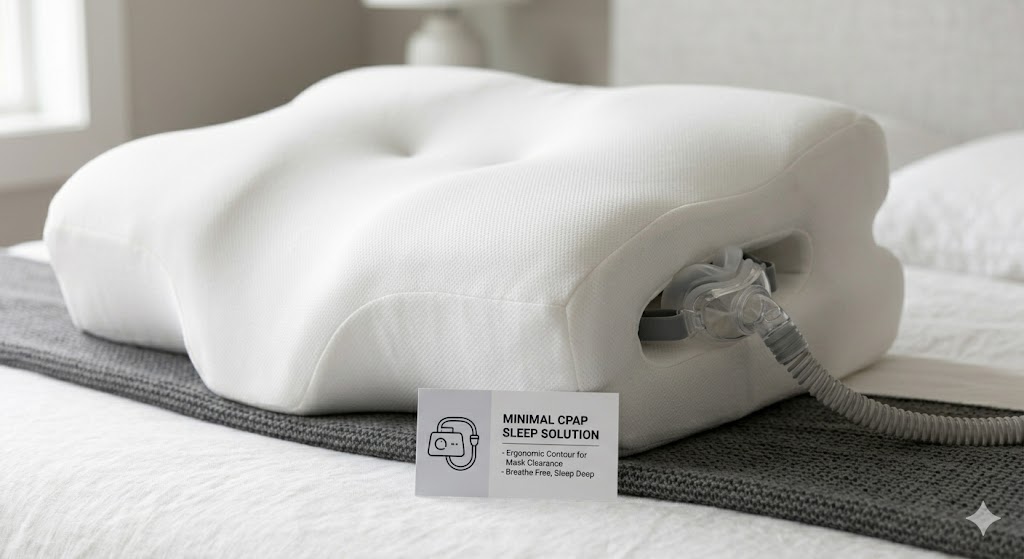
The first time a side sleeper tries a CPAP mask on a regular pillow, the mask wins for about ninety seconds. Then the cheek presses into the pillow surface, the seal lifts, and the room fills with the soft hiss of escaping air. A CPAP pillow exists for that exact moment. The corner cutouts and recessed channels let the mask sit where a regular pillow would push against it, so the seal holds and the therapy keeps doing its job through the night.
This guide covers the five CPAP pillows worth considering in 2026, organized by mask style and sleep position rather than by some abstract ranking. Nasal pillow masks, nasal masks, and full face masks all sit differently against a pillow surface, and the right pick depends as much on which mask you wear as on how you sleep. Our CPAP accessories guide covers the hoses, filters and chamber parts that sit around the pillow.
None of the picks below treats sleep apnea. CPAP therapy treats sleep apnea. These pillows are comfort and compliance tools that keep the mask sealed so the prescribed therapy can do what it was prescribed to do. If you are new to CPAP or your prescription is changing, that conversation belongs with your sleep physician.
Last updated: May 28 2026 | By Austin Murphy
This article is for general information only and is not medical advice. If you have or may have sleep apnea, please consult a qualified healthcare provider for diagnosis and treatment.
Quick Verdict
- Best for most CPAP side sleepers: the Contour Products CPAP Pillow 2.0 handles every common mask style and ships in two loft heights.
- Skip if you wear a full face mask: the standard cutout depth on most CPAP pillows is too shallow for a larger frame; step up to the EnduriMed instead.
Disclosure: RestRight is reader-supported. As an Amazon Associate, we earn from qualifying purchases made through links on this page, at no extra cost to you.
Why CPAP Pillows Matter for Side Sleepers
CPAP therapy works on a simple bargain. The machine delivers pressurized air through the mask, the mask stays sealed against the face, and the airway stays open during sleep. Any break in that seal breaks the bargain. Air leaks reduce delivered pressure, fragment sleep with their own noise, and over time train CPAP users to avoid side sleeping or to give up on the therapy.
The American Academy of Sleep Medicine’s 2019 clinical practice guideline on positive airway pressure therapy treats adherence as central to whether CPAP works in real life, and recommends ongoing follow-up specifically to troubleshoot the problems that drive non-adherence1. Mask discomfort and air leaks are among the top reasons cited by patients who reduce or abandon their therapy2. A pillow that lets you side sleep without breaking the mask seal addresses one piece of that problem directly.
I am a side sleeper without sleep apnea, so the research voice runs through this article rather than first-hand testing notes. The specs, dimensions, and materials below come from manufacturer documentation and verified purchaser reports, cross-checked against the design principles that the underlying clinical literature supports.
What to Look for in a CPAP Pillow
Cutout Design
CPAP pillows use one of two cutout patterns. Corner cutouts recess the pillow surface at the four corners, which suits nasal pillow masks and low-profile nasal masks. Side channels run the full length of both edges, giving more room for full face masks and any mask with a larger frame. A few pillows combine both, with corner cutouts plus a central back-sleeping zone for users who rotate between positions.
Loft Height
Side sleeping needs a pillow tall enough to keep the head, neck, and spine in a straight line. The CPAP wrinkle is that the cutout has to be deep enough to keep the mask off the bottom of the recess. A pillow that is too thin pushes the mask back into contact. A pillow that is too thick strains the neck regardless of mask clearance. The pillows on this list that ship in two loft heights handle this better than fixed-height options.
Fill Material
CPAP users tend to hold a sleep position longer than average because rolling around carries the cost of disturbing the seal. Fill that compresses unevenly through the night or builds pressure points becomes a bigger problem for CPAP users than for regular side sleepers. Memory foam and shredded foam hold loft better than polyester. Down alternative is the softest option but compresses more under sustained head weight.
Hose Routing
The CPAP hose connects the mask to the machine and has a fixed length. Some pillows include a channel or attachment point that keeps the hose moving with you when you change sides. It is a small feature with an outsized effect on whether you wake up because the hose pulled tight against your shoulder.
Cover and Cleaning
CPAP equipment lives on the same hygiene schedule as the mask itself, and a removable, machine-washable cover is the easy version of that maintenance. Bamboo and cotton blends sit more comfortably against face contact zones than polyester knits.
Best CPAP Pillows in 2026
1. Contour Products CPAP Pillow: Best Overall
Best Overall CPAP Pillow | Price: ~$60
The Contour 2.0 keeps showing up as the recommendation in sleep apnea forums and verified purchaser reviews for a reason that matches the design. Both sides carry shoulder cutouts deep enough to clear the major mask styles, a center zone supports back sleeping when the night calls for it, and the memory foam holds its loft for the full night instead of flattening under sustained head weight.
Two loft heights ship under the same product family. The standard height suits broader-shouldered sleepers, and the low-profile version works for narrower frames or anyone who finds standard CPAP pillows too tall.
Key Features
- Bilateral shoulder cutouts that fit nasal pillow, nasal, and full face masks
- Memory foam that holds loft through the night
- Two loft heights to match shoulder width
- Machine-washable cover
- Works for left, right, and back sleeping
PROS:
- The most widely recommended CPAP pillow across sleep apnea communities
- Memory foam keeps consistent loft instead of collapsing overnight
- Two loft heights cover most shoulder widths
- Cutouts work for every common mask style
CONS:
- Memory foam holds some heat, so hot sleepers may want a cooling cover
- Larger full face masks may still touch the cutout edges
- $60 sits above budget pillow alternatives
Best for: CPAP side sleepers who want the broadest mask-style compatibility and a track record they can verify in any sleep apnea forum.
2. EnduriMed CPAP Pillow: Best for Full Face Masks
Best CPAP Pillow for Full Face Masks | Price: ~$70
Full face masks are the hardest case for a CPAP pillow. The frame protrudes further from the face than a nasal mask, and the standard cutout depth on most pillows leaves the mask edges contacting the pillow surface during side sleeping. The EnduriMed runs noticeably deeper cutouts than the Contour 2.0, sized around full face mask geometry rather than scaled down for the more common nasal masks.
The foam runs medium-firm, which matters here. Softer foam at the cutout edges collapses under head weight during the night and slowly closes up the clearance that drew you to the pillow. Firmer foam holds the cutout shape through the hours when you are not paying attention to it.
Key Features
- Deeper cutouts sized for full face mask frames
- Medium-firm memory foam that resists edge collapse
- Bamboo cover that feels soft against face contact zones
- Removable, washable cover
- Accommodates left and right side sleeping
PROS:
- Cutout depth handles full face mask profiles that defeat standard pillows
- Firmer foam holds the cutout edges through the night
- Bamboo cover sits comfortably against the face
- Cover comes off for washing without dismantling the pillow
CONS:
- Deeper cutouts give nasal pillow mask users more clearance than they need
- Heavier than standard pillow alternatives
- $70 is the highest entry on this list
Best for: Full face mask CPAP users whose standard CPAP pillow does not give the mask frame enough room to clear during side sleeping.
3. Therapeutica CPAP Pillow: Best for Neck Pain
Best CPAP Pillow for Neck Pain | Price: ~$75
Sleep apnea and neck pain often overlap. The cervical positioning that contributes to airway obstruction at night also generates morning stiffness, and a generic CPAP pillow handles the mask clearance side of the problem while leaving the cervical alignment side to chance. The Therapeutica builds the cutouts into a contoured orthopedic shape designed for both sides of the issue at once.
The pillow ships in five sizes based on shoulder width and body frame rather than a single one-size design. Sizing matters here more than it does on a generic pillow, because the cervical contour depends on the head and shoulder geometry of the person using it. Too small and the shoulder gap reopens; too large and the neck strains in the other direction.
Key Features
- Orthopedic cervical contour for back and side sleeping
- Mask cutouts integrated into the cervical support shape
- Five sizes based on shoulder width
- Firm orthopedic foam construction
- Holds shape across extended use
PROS:
- Treats cervical alignment and mask clearance as one design problem
- Sized to the sleeper rather than averaged across all sleepers
- Durable foam holds its geometry over years of use
- The contour helps morning neck stiffness independent of CPAP
CONS:
- Wrong size measurement gives up most of the benefit
- Firmer feel than memory foam pillows, with an adjustment period
- $75 is the premium tier of this list
Best for: CPAP users dealing with significant neck pain alongside their sleep apnea, where mask clearance alone leaves the cervical issue unresolved.
4. Sleep Innovations CPAP Contour Pillow: Best Budget Pick
Best Budget CPAP Pillow | Price: ~$35
The Sleep Innovations pillow does not match the cutout depth of the EnduriMed, the orthopedic precision of the Therapeutica, or the community track record of the Contour 2.0. What it does well is the basic CPAP pillow job at a price that removes the barrier to trying the format at all. Bilateral cutouts clear the mask during side sleeping, memory foam holds adequate loft, and the cover comes off for washing.
The case for this pillow is the $35 entry point. New CPAP users get to confirm a CPAP-specific pillow helps before committing $60 or $75 to a premium option, especially before they know which mask style they will settle on long term.
Key Features
- Bilateral cutouts at a budget price
- Memory foam construction
- Machine-washable cover
- Standard loft height
- Available widely on Amazon
PROS:
- The accessible price makes trying a CPAP pillow low-risk
- Bilateral cutouts solve the core mask clearance problem
- Memory foam holds loft well enough for the price tier
- Cover comes off for the regular hygiene maintenance CPAP equipment needs
CONS:
- Cutouts run shallower than the premium options on this list
- Cervical support is basic rather than orthopedic
- Foam compresses more over years than the Contour 2.0
Best for: First-time CPAP pillow buyers testing the format before committing to a premium option, or anyone whose mask style may still change in the first months of therapy.
5. Beckham Hotel Collection CPAP Pillow: Best Soft Feel
Best Soft Feel CPAP Pillow | Price: ~$45
Some CPAP users find memory foam pillows uncomfortable against the face, or find the structured feel of a foam pillow disrupts the way they sleep on regular pillows the rest of the day. The Beckham Hotel Collection CPAP Pillow takes a different approach: down alternative fill inside a body with integrated cutout panels that handle mask clearance without the rigid, contoured feel of foam options.
The tradeoff is honest. Down alternative fill compresses more under head weight than memory foam, so the cutout clearance shrinks slightly through the night. For nasal pillow and nasal mask users this is fine. Full face mask users should not pick this pillow.
Key Features
- Down alternative fill for a softer, more adjustable feel
- Integrated cutout panels for mask clearance
- Hotel-style outer cover
- More malleable shape than foam alternatives
- Accessible price tier
PROS:
- The soft feel reads closer to a regular pillow than foam CPAP pillows do
- Down alternative lets the pillow flex around the mask during sleep
- Outer cover feels comfortable against face contact zones
- $45 sits in an accessible middle of the price range
CONS:
- Cutout clearance shrinks under head pressure compared to foam options
- Not the right pick for full face masks
- Cervical support runs lighter than the foam alternatives
Best for: Nasal mask or nasal pillow mask users who prefer the feel of a traditional soft pillow and want the mask clearance benefit without committing to a foam construction.
Which CPAP Pillow Fits Your Situation
| Your situation | Contour 2.0 | EnduriMed | Therapeutica | Sleep Innovations | Beckham |
|---|---|---|---|---|---|
| Nasal pillow mask, side sleeper | Best fit: every mask style, two heights | Workable: more depth than needed | Workable: orthopedic feel may not suit | Best fit: covers the basics at low cost | Best fit: soft feel, adequate clearance |
| Full face mask, side sleeper | Workable: may touch cutout edges | Best fit: deeper cutouts sized for full face | Workable: depends on mask frame | Skip: cutouts too shallow | Skip: fill compresses under head weight |
| Significant neck pain plus CPAP | Workable: basic cervical support | Workable: not orthopedic | Best fit: built for both problems together | Skip: cervical support too generic | Skip: soft fill, no cervical structure |
| First CPAP pillow, testing the format | Workable: premium price for a test | Skip: premium price, narrow use case | Skip: sizing decision before you know your needs | Best fit: low cost, solves the core problem | Workable: middle price, narrow use case |
| Hot sleeper | Workable: foam holds some heat | Workable: bamboo cover helps | Workable: orthopedic foam runs warm | Workable: basic foam | Best fit: down alternative breathes better |
| Rotates between back and side sleeping | Best fit: central back-sleeping zone | Workable: primarily side-sleep design | Best fit: designed for both positions | Workable: basic side and back support | Workable: soft fill adapts but compresses |
Prices above are approximations and shift with Amazon sales and seasonal promotions. Verify current pricing before purchase.
How to Choose a CPAP Pillow by Mask Style
Mask style narrows the decision more than any other variable. A nasal pillow mask sits at the base of the nostrils with minimal frame and asks the least of a CPAP pillow. A nasal mask covers the bridge of the nose and needs moderate cutout clearance. A full face mask covers nose and mouth and needs the deepest cutouts you can find.
The shorthand: nasal pillow mask users can stop at the Sleep Innovations at $35. Nasal mask users should look at the Contour 2.0 at $60. Full face mask users need the EnduriMed at $70, with the standard Contour 2.0 sitting on the borderline.
Sleep position runs second. Strict back sleepers usually manage with a regular pillow because back sleeping does not push the pillow against the mask. Strict side sleepers benefit most. Combination sleepers should weight the choice toward whichever position they spend more hours in.
Loft is third. Broader-shouldered sleepers need taller loft to keep the head and spine aligned. Narrower-shouldered sleepers need shorter loft. Pillows that ship in two heights handle this better than fixed-height options.
When to See a Doctor
A CPAP pillow is a comfort and adherence tool, not a treatment. The therapy itself is the treatment, and that therapy depends on a real diagnosis from a sleep physician. Reach out to a healthcare provider if any of the following apply:
- You suspect you may have sleep apnea but have not been formally diagnosed. Common signs include loud snoring, witnessed pauses in breathing during sleep, gasping or choking awakenings, persistent daytime sleepiness, or morning headaches.
- You have been prescribed CPAP but are using it less than four hours per night, or have stopped using it. Early non-adherence patterns predict long-term non-adherence2, and the fix usually requires troubleshooting with your sleep physician rather than working through it alone.
- Your CPAP machine is delivering therapy but you feel worse than before, or symptoms like daytime sleepiness, morning headaches, or witnessed apneas are returning. Pressure settings, mask fit, or other equipment issues may need adjustment.
- You experience new or worsening symptoms like chest pain, severe headaches, or significant mood changes. These are signs to seek prompt medical attention, not pillow advice.
The American Academy of Sleep Medicine specifically recommends ongoing follow-up after CPAP initiation to address the issues that drive non-adherence1. A pillow change is one piece of that, but the larger picture is the relationship with the sleep medicine team that prescribed the therapy.
Our Take on CPAP Pillows
The right CPAP pillow is the one that lets you sleep on your side without breaking the mask seal. For most CPAP users, the Contour Products CPAP Pillow 2.0 at $60 is the safe starting point. Two loft heights cover different shoulder widths, the bilateral cutouts handle every common mask style, and the long track record in sleep apnea communities means thousands of users have already done the testing for you.
The exceptions are straightforward. Full face mask users should step up to the EnduriMed at $70 for the deeper cutouts. CPAP users with significant neck pain should consider the Therapeutica at $75, where the sizing decision matters more than the brand. The Beckham Hotel Collection at $45 fits users who want a softer feel with a lighter mask style. The Sleep Innovations at $35 is the right first-CPAP-pillow choice for anyone testing the format before paying premium.
The pillow is one variable in a larger system. Mask fit, pressure settings, humidification, sleep position, and the rest of the sleep environment all matter. If a pillow change does not solve the problem, that is a signal to call the sleep clinic rather than buy another pillow.
Frequently Asked Questions
What is the best CPAP pillow in 2026?
The Contour Products CPAP Pillow 2.0 at around $60 is the strongest all-around pick. Bilateral cutouts handle every common mask style, two loft heights cover different shoulder widths, and the sleep apnea community track record is the longest on this list. Full face mask users should consider the EnduriMed instead.
Do CPAP pillows actually make a difference?
For side sleepers using CPAP, yes. Standard pillows contact the mask frame and break the seal that makes the therapy work. A CPAP pillow with cutouts positioned for your mask style eliminates that contact. Back sleepers often manage with a regular pillow since back sleeping does not push the pillow into the mask.
Can I use a regular pillow with my CPAP machine?
You can, and many CPAP users do. Strict back sleepers usually have no issue. Side sleepers tend to run into mask leaks because the pillow surface pushes against the mask frame. If you side sleep and experience leaks or contact discomfort, a CPAP-specific pillow is the most direct fix.
Which CPAP pillow works best for full face masks?
The EnduriMed CPAP Pillow. Its cutout depth is sized specifically around full face mask geometry, where the standard cutout depth on most CPAP pillows leaves the mask edges contacting the pillow surface during side sleeping.
What loft height should I choose for a CPAP pillow?
The head and neck should form a straight line with the spine during side sleeping. Broader shoulders need higher loft. Narrower shoulders need lower loft. If you fall between sizes on a pillow that ships in standard and low profile, broader-shouldered side sleepers should choose standard.
How often should I replace a CPAP pillow?
Memory foam CPAP pillows typically hold their shape for two to three years of nightly use. Down alternative pillows compress faster, often within a year. Watch for the cutouts looking shallower than when new, or the pillow feeling lower in the morning than at bedtime.
Does a CPAP pillow replace my sleep apnea treatment?
No. A CPAP pillow supports your CPAP therapy by maintaining the mask seal. It does not treat sleep apnea on its own. Sleep apnea treatment depends on the diagnosis, prescription, and follow-up from a sleep medicine team.
What if my CPAP pillow does not solve my mask leak problem?
The issue is probably elsewhere. Mask fit, mask cushion condition, pressure settings, and head strap tension are the common culprits. Call your CPAP equipment supplier or sleep medicine team rather than buying another pillow. Persistent leaks deserve professional troubleshooting.
Related Reading
Explore more: Nasal Strips That Open Your Nose for Quieter and Easier Brea.
Recommended Reading
See also our guides to pillows for fibromyalgia sufferers.
Sources
- Patil SP, Ayappa IA, Caples SM, Kimoff RJ, Patel SR, Harrod CG. Treatment of Adult Obstructive Sleep Apnea With Positive Airway Pressure: An American Academy of Sleep Medicine Clinical Practice Guideline. J Clin Sleep Med. 2019;15(2):335-343. View source
- Shaukat R, Gamal Y, Ali A, Mohamed S. Adherence to Positive Airway Pressure Therapy in Patients With Obstructive Sleep Apnea. Cureus. 2022;14(6):e25946. View source
More Pillow Guides
Start with the foundation principles of pillow selection by sleep position.
Our guide to whether you need a humidifier with a CPAP covers the other comfort problem people try to solve with hardware.
