
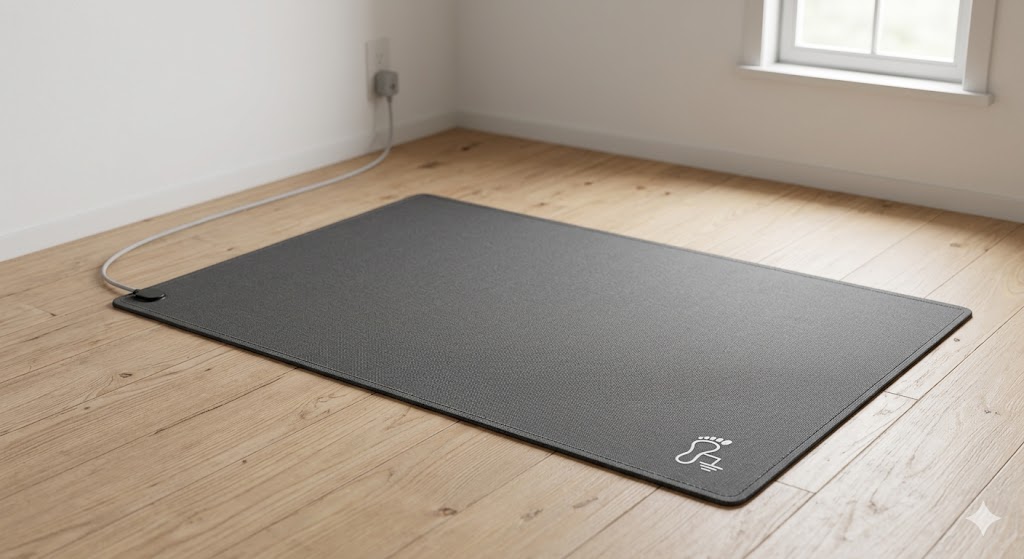
Grounding mats are a wellness product built on a specific theory: that maintaining a low-voltage electrical connection between your body and the earth produces measurable physiological benefits. The theory has a small body of peer-reviewed research behind it, much of which is positive but most of which carries significant limitations. The research base is also dominated by a handful of researchers with financial ties to the grounding product industry, and mainstream medical bodies have not endorsed the practice for pain relief or sleep.
This guide takes the same honest approach as our best grounding sheets for sleep guide. It lays out what the research shows and where the limits sit, then covers product picks for readers who want to try grounding mats, understanding the evidence landscape. The products are real. The conductivity claims, materials, and safety features are verifiable. What you choose to do with the underlying theory is yours to decide.
If you are looking for pain relief interventions with stronger evidence behind them, our guide to best mattress toppers for back pain covers a category with more substantial clinical research. For chronic pain specifically, a healthcare provider visit will help more than any wellness product.
Last updated: May 28 2026 | By Austin Murphy
This article is for general information only and is not medical advice. Grounding mats are a wellness product, not a treatment for any medical condition. If you have chronic pain, sleep disruption, inflammation-related conditions, or any health condition you hope to address, please consult a qualified healthcare provider.
Quick Verdict
- Best for readers curious about grounding at low entry cost: the BioEnergy Health mat at around $60 is the right starting point for testing the format.
- Skip if you expect clinical-grade pain relief: the research base on grounding is small and largely industry-affiliated; for chronic pain, talk to a healthcare provider about treatments with stronger evidence.
Disclosure: RestRight is reader-supported. As an Amazon Associate, we earn from qualifying purchases made through links on this page, at no extra cost to you.
What the Research Actually Shows About Grounding
The published research on grounding spans about two decades and totals roughly two dozen peer-reviewed studies. The most cited paper is a 2012 review by Chevalier and colleagues in the Journal of Environmental and Public Health, which summarizes the proposed mechanisms and the early study findings1. A 2015 review in the Journal of Inflammation Research by Oschman and colleagues covers grounding’s hypothesized effects on inflammation specifically2.
The studies that exist generally show measurable effects in small samples. A 2004 study by Ghaly and Teplitz in the Journal of Alternative and Complementary Medicine measured changes in cortisol patterns and self-reported sleep, pain, and stress in 12 subjects sleeping grounded for eight weeks3. A 2019 randomized controlled trial by Chevalier and colleagues found pain reduction and quality-of-life improvements in 32 bodyworkers grounded during sleep4.
Three honest qualifications matter for any reader weighing this evidence. The sample sizes are small. The Ghaly study had 12 subjects; the Chevalier bodyworkers’ trial had 32. The studies report positive effects in groups too small to draw broad clinical conclusions from, and the field has not produced the large multi-center trials that establish a treatment as clinically validated for pain or sleep.
Second, the researchers are connected. The foundational grounding literature is dominated by a small group of authors who share affiliations with the Earthing Institute and have financial relationships with grounding product manufacturers. Mainstream evidence-based medicine treats this pattern with caution, even though the studies are published in peer-reviewed journals. Independent replication outside this researcher’s network is limited.
Third, major medical bodies have not endorsed grounding for pain or sleep. No clinical practice guideline from the American Academy of Sleep Medicine, the American Academy of Pain Medicine, the American College of Rheumatology, or comparable bodies mentions grounding as a recommended intervention. Mayo Clinic and similar medical centers have generally discussed grounding skeptically in patient-facing content. The absence of mainstream medical endorsement is itself a meaningful signal about where the evidence sits.
More Research Information
One important boundary specifically for chronic pain readers: the published grounding research has not established efficacy for specific pain conditions like arthritis, fibromyalgia, or chronic inflammatory conditions, despite supplement-style marketing that often implies otherwise. The Chevalier bodyworkers’ study measured general pain and quality-of-life improvements in healthy massage therapists, not patients with diagnosed pain conditions. Extending those findings to arthritis or fibromyalgia goes beyond what the research supports.
None of this means grounding does not work. The evidence does not yet support the confident “research-backed pain relief” claims that grounding product marketing typically makes. If you want to try a grounding mat, the risk profile is low for users with properly grounded outlets and the potential benefit is real enough that some users report meaningful improvements. The honest framing treats grounding as a wellness practice with limited and contested research support that some people find helpful, rather than a clinically validated pain or sleep treatment.
What to Look for in a Grounding Mat
Conductivity
A grounding mat only does what it claims to do if it maintains consistent electrical contact between your skin and the ground port of the outlet. Silver fiber mats weave conductive silver strands throughout the material; these provide the highest and most consistent conductivity. Carbon fiber mats use conductive carbon threads or coatings; these work at a lower price point with somewhat less conductivity longevity. Either type should be verified with a continuity tester before first use and periodically thereafter, since conductivity degrades over time with use and washing.
Connection Safety
Grounding mats connect to the ground port of a standard three-prong outlet through a cord with a built-in resistor (typically 100k ohms) that limits current flow to safe levels. The resistor is the critical safety component. Verify any grounding mat you buy includes a resistor in its connection cord. Confirm your home wiring includes properly grounded outlets before using any grounding product. A standard outlet tester from any hardware store costs about $10 and resolves this in 30 seconds.
Mat Size and Placement
Mat size determines how much skin contact you maintain. A small foot mat covers feet and lower legs when seated or lying back-down. A half-body mat covers from torso to knees during sleep. A full-bed grounding sheet covers the entire sleep surface. More contact area generally produces stronger effects if the underlying theory is correct, though it also raises the price. Match the mat size to your sleep position and movement pattern.
Material Comfort
A grounding mat is in contact with skin for 7 to 9 hours every night during sleep use. Stiff, rough, or chemically treated surfaces become a sleep disruption problem that defeats the grounding purpose. Cotton with silver fiber generally feels closest to a standard sheet. Vegan leather and PU surfaces are more durable but less comfortable for direct skin contact. Choose based on whether the mat sits under sheets (durability matters more) or against skin (comfort matters more).
Verification Included
Mats that ship with continuity testers let you confirm conductivity is working before and during use. This is a meaningful inclusion at any price point. Mats without testers require you to buy one separately or operate without verification, which means you cannot confirm the mat is doing what it claims to do.
Best Grounding Mats in 2026
1. BioEnergy Health Grounding Mat: Best Entry Point
Best Entry-Cost Grounding Mat | Price: ~$60
Check Price on AmazonThe BioEnergy Health mat is the practical answer to “where do I start if I want to try grounding without committing to a $200 purchase?” Carbon-based conductive surface, resistored cord, included continuity tester, and a cushioned foam base that sits comfortably under feet during desk use or at the foot of the bed during sleep. At $60, it removes the financial barrier to testing whether grounding produces any noticeable effect for you.
The trade-off at this price is conductivity consistency. The carbon-coated surface provides functional grounding contact, but the consistency across the full mat surface is lower than silver fiber alternatives. For a first-mat experiment, the function is adequate. For long-term sustained use, the premium silver fiber options below hold conductivity longer.
Key Features
- Carbon-coated conductive surface
- Resistored connection cord (100k ohm)
- Continuity tester included
- Cushioned foam base for foot or sleep contact
- Compact size for desk or bed-foot placement
PROS:
- Lowest practical price for a grounding mat with safety features
- Continuity tester included at this price point
- Cushioned base comfortable for foot contact
- Removes the cost barrier to testing grounding
CONS:
- Carbon coating conductivity less consistent than silver fiber alternatives
- Smaller surface area than half-body or full-bed mats
- Less comfortable for direct skin contact than fabric alternatives
Best for: First-time grounding mat buyers who want to test the format before investing in a premium option, and anyone who wants the lowest-risk financial experiment in grounding therapy.
2. Hooga Grounding Mat: Best Verified Conductivity
Best Verified Conductivity Grounding Mat | Price: ~$75
Check Price on AmazonHooga is the brand on this list that provides the most transparent technical documentation. The product ships with conductivity verification guidance and detailed setup instructions, and the cotton-and-conductive-fiber surface combines reasonable comfort with documented conductivity specs. In a category where most marketing relies on vague claims, the Hooga’s documentation transparency is a meaningful differentiator.
The mat is a half-body size, which covers more skin contact area than the BioEnergy foot mat but less than a full-bed grounding sheet. The cotton blend surface is softer than vegan leather alternatives but less durable. For buyers who want to verify the mat is working with the documentation to interpret the results, the Hooga at $75 is the right pick.
Key Features
- Silver and carbon conductive fiber blend
- Cotton blend surface for direct skin contact
- Documented conductivity specifications
- Continuity tester and setup guide included
- Half-body coverage
PROS:
- Most transparent technical documentation in the category
- Cotton surface comfortable for all-night skin contact
- Mid-range price between budget and premium options
- Detailed setup guide useful for first-time users
CONS:
- Half-body size less coverage than full-bed alternatives
- Cotton blend requires gentle washing to maintain conductivity
- Documentation requires some technical understanding to interpret
Best for: Skeptical buyers who want verified conductivity documentation rather than marketing claims, and readers who want to understand whether their mat is working.
3. Ultimate Longevity Grounding Mat: Best Dual Use
Best Dual-Use Grounding Mat | Price: ~$89
Check Price on AmazonThe Ultimate Longevity mat is designed for both desk use during the day and sleep use at night. A silver fiber conductive surface in a leatherette base that handles repositioning between desk and bed, plus a longer cord that reaches outlets further from either workstation. For buyers who want to use grounding during seated work hours in addition to overnight use, the dual-purpose design is convenient.
The argument for dual-use grounding is that the underlying theory, if correct, suggests cumulative hours of contact produce stronger effects than overnight-only sessions. Whether this is true depends on whether grounding works, which the research has not yet established. The mat itself is sound; the dual-use case depends on accepting the theory.
Key Features
- Silver fiber conductive surface
- Leatherette base for durability and repositioning
- Longer connection cord (typically 15 to 20 feet)
- Designed for both desk and bed use
- Standard resistored cord for safety
PROS:
- Single mat covers daytime and nighttime use cases
- Silver fiber conductivity consistent across the surface
- Longer cord increases placement flexibility
- Durable leatherette handles daily repositioning
CONS:
- Higher price than sleep-only mats
- Leatherette less comfortable against bare skin than cotton
- Requires repositioning between desk and bed
Best for: Buyers who want to test grounding during both seated work and overnight sleep, and who accept the underlying premise that more contact hours may produce stronger effects.
4. GroundLuxe Mattress Cover: Best Full-Surface Coverage
Best Full-Surface Grounding Mat | Price: ~$149
Check Price on AmazonThe GroundLuxe covers the full width of a queen or king bed as a mattress cover, eliminating the contact-break problem that smaller mats face when sleepers shift position during the night. Carbon fiber conductive layer in a vegan-leather surface with elastic straps that fit any bed size. The complete kit includes the cord with 100k ohm resistor, outlet tester, and adapter.
The full-surface coverage is the right choice for buyers who shift frequently during sleep and want continuous contact regardless of position. The vegan-leather surface is more durable than cotton alternatives but less soft against bare skin, so it works best under a sheet rather than as the direct sleep surface. At $149, the price reflects the larger surface area rather than premium conductive materials.
Key Features
- Full bed-width coverage (queen or king)
- Conductive carbon-infused vegan leather surface
- Elastic straps for any bed size
- Complete kit with cord, tester, adapter
- 100k ohm resistor in cord
- Easy to clean
PROS:
- Full-surface coverage eliminates position-change contact breaks
- Complete kit includes everything needed for setup
- Durable vegan leather handles daily use without conductivity degradation
- Easy to clean surface for long-term use
CONS:
- Carbon conductivity less than silver fiber alternatives
- Vegan leather less comfortable than cotton for direct skin contact
- Full-surface setup requires more effort than mat placement
- Mid-premium price tier
Best for: Sleepers who move frequently during the night and want continuous contact through position changes, and buyers who prefer a full sleep-surface solution over a smaller mat.
5. Earthing Elite Sleep Mat: Most Established Brand
Most Established Grounding Brand | Price: ~$199
Check Price on AmazonEarthing.com is the original grounding products company. Clint Ober, who founded it, also funded and helped initiate much of the early grounding research now cited across the field. That history is a strength for buyers who want the product line most directly connected to the underlying theory, and it is also the basis for the industry-funding concern noted earlier. Readers should know both.
The Elite Sleep Mat is a half-body silver fiber mat in a soft cotton base, with a coiled cord that includes the standard 100k ohm safety resistor and a continuity tester. The mat is genuinely comfortable for all-night skin contact, the silver fiber conductivity is consistent across the surface, and the brand provides the most detailed setup documentation in the category. At $199, the price reflects premium positioning and the brand’s direct connection to the foundational research.
Key Features
- Silver fiber conductive weave in cotton base
- Half-body coverage
- Coiled cord with 100k ohm resistor
- Continuity tester included
- Direct brand connection to foundational grounding research
- Comprehensive setup documentation
PROS:
- Cotton and silver fiber surface most comfortable for direct skin contact
- Most established brand in the grounding category
- Comprehensive documentation and customer support
- Direct connection to the company that originated grounding products
CONS:
- Most expensive option on this list
- The brand connection that some buyers value is the same connection that drives industry-funding concerns about the research
- Half-body size less coverage than full-surface alternatives
Best for: Buyers who want the product line most directly connected to the foundational grounding research and who value the most comfortable skin-contact surface available.
Which Grounding Mat Fits Your Situation
| Your situation | BioEnergy | Hooga | Ultimate Longevity | GroundLuxe | Earthing Elite |
|---|---|---|---|---|---|
| First-time buyer testing the format | Best fit: lowest entry cost | Workable: more documentation | Skip: dual-use overkill for a test | Skip: full surface too much for a test | Skip: premium price for a test |
| Wants verified conductivity documentation | Skip: limited documentation | Best fit: most transparent specs | Workable: standard claims | Workable: standard claims | Workable: brand reputation |
| Wants to ground during desk work plus sleep | Workable: works for both | Skip: half-body sleep focus | Best fit: designed for dual use | Skip: full-bed coverage only | Skip: sleep focus |
| Moves frequently during sleep | Skip: small contact area | Workable: half-body coverage | Skip: smaller mat shifts during night | Best fit: full-surface coverage | Workable: half-body coverage |
| Wants softest direct skin contact | Skip: foam base | Workable: cotton blend | Skip: leatherette surface | Skip: vegan leather | Best fit: cotton and silver fiber |
| Tight budget | Best fit: lowest price | Workable: mid-range price | Skip: higher mid-range | Skip: premium price | Skip: highest price on list |
Prices above are approximations and shift with Amazon sales and seasonal promotions. Verify current pricing before purchase.
How to Use a Grounding Mat Safely
Verify the outlet first. Buy a standard outlet tester from any hardware store for $5 to $10, plug it into the outlet you plan to use, and confirm the indicator lights show correct wiring with a working earth ground. If the tester shows an open ground or any wiring fault, use a different outlet or have an electrician check the wiring before proceeding.
Confirm the mat includes a resistored cord (typically 100k ohms) before plugging it in. The resistor is the critical safety component that limits current flow to safe levels. Plug the cord into the ground port of the outlet and connect the other end to the mat per the manufacturer’s instructions. Use the included continuity tester to verify conductivity before first use and periodically thereafter.
If you ever feel tingling, mild shock, or any unusual electrical sensation while using a grounding mat, stop immediately and have your outlet wiring inspected. Quality grounding cords include resistors that prevent this in normal conditions, but a fault in home wiring can cause problems the cord alone cannot prevent.
When to See a Doctor
A grounding mat is a wellness product, not a medical treatment. The following situations call for medical evaluation rather than a mat purchase:
- Chronic pain that disrupts daily life or sleep should be evaluated by a healthcare provider. Pain management is medically directed, and underlying causes need professional diagnosis. The American Academy of Sleep Medicine treats chronic insomnia as a clinical condition with established treatments5, none of which involve grounding products.
- Diagnosed arthritis, fibromyalgia, or other chronic inflammatory conditions warrant medical care from a rheumatologist or pain specialist. A grounding mat may complement medical care if your provider approves it, but should never replace evidence-based treatments.
- Persistent insomnia, defined as difficulty falling or staying asleep at least three nights per week for three months or longer, deserves a sleep medicine evaluation.
- Symptoms suggesting sleep apnea, such as loud snoring, witnessed pauses in breathing, gasping awakenings, or daytime sleepiness despite adequate sleep time, need a sleep study rather than a wellness product.
- Any new or worsening symptoms that you hope to address with a grounding mat are signs to talk to a doctor first. A wellness product may complement medical care but should never replace it.
Grounding mats sit alongside other wellness practices like aromatherapy, meditation apps, and supplements, all of which can support general wellbeing for some users but none of which substitute for medical evaluation when something is genuinely wrong.
Our Take on Grounding Mats
The honest summary on grounding mats matches the summary on grounding sheets: the product category is real, the safety profile is low for users with properly grounded outlets, and the small body of peer-reviewed research is not nothing. At the same time, the research is dominated by industry-affiliated authors, the sample sizes are too small to support strong clinical claims, and mainstream medicine has not endorsed the practice. The pain-specific claims that grounding marketing makes are especially limited; no published trial has established efficacy for arthritis, fibromyalgia, or specific chronic pain conditions.
For readers who want to try a grounding mat on those terms, the BioEnergy Health mat at $60 is the right starting point. The Hooga at $75 is the right pick for buyers who want verified conductivity documentation. The Ultimate Longevity at $89 fits buyers who want desk and sleep grounding from one mat. The GroundLuxe at $149 covers the full bed surface for sleepers who move frequently. The Earthing Elite at $199 is the premium option from the company most directly connected to the foundational research.
If you try a grounding mat for several weeks and notice no difference in your pain, sleep, or general wellbeing, the honest answer is that grounding may not produce a noticeable effect for you. That outcome is common and reflects the evidence base. For chronic pain specifically, interventions with stronger evidence (medical treatment of the underlying condition, physical therapy, cognitive behavioral therapy for chronic pain, evidence-based pharmacological options under medical supervision) generally produce more reliable results than grounding does.
Frequently Asked Questions
Do grounding mats really work?
A small body of peer-reviewed research has reported measurable effects on cortisol patterns, inflammation markers, and self-reported pain and sleep quality in subjects sleeping grounded. The studies are small and often industry-affiliated. Some users notice clear benefits; others notice nothing. The evidence supports trying grounding if you are curious, but does not support confident claims it will work for you.
What is the best grounding mat in 2026?
For most readers trying grounding for the first time, the BioEnergy Health mat at around $60 is the practical starting point. Buyers who want verified conductivity documentation can choose the Hooga at $75. Buyers who want premium silver fiber comfort step up to the Earthing Elite at $199.
Can a grounding mat help with chronic pain?
The published research has not established grounding as effective for specific chronic pain conditions like arthritis or fibromyalgia. Small studies have reported subjective pain improvements in healthy adults and massage therapists, but extending those findings to diagnosed chronic pain conditions goes beyond what the research supports. For chronic pain, talk to a healthcare provider about treatments with stronger evidence. A grounding mat may complement medical care if your provider approves, but should not replace it.
How do I know if my outlet is properly grounded?
Buy an outlet tester from any hardware store for $5 to $10. Plug it into the outlet you plan to use. The indicator lights tell you whether hot, neutral, and ground connections are correctly wired. If the tester shows an open ground or any wiring fault, use a different outlet or have an electrician check the wiring.
Are grounding mats safe to use during sleep?
For users with properly grounded outlets and grounding cords that include the standard 100k ohm safety resistor, the risk profile is low. The resistor limits current flow even if a wiring fault were to introduce unexpected voltage. If you feel tingling or any unusual electrical sensation, stop using the mat immediately and have your wiring inspected.
How long should I try a grounding mat before deciding if it works?
The studies that have reported positive effects generally used four to eight weeks of nightly use. If you try a grounding mat consistently for two months and notice no change, the honest answer is that grounding likely is not producing a noticeable effect for you. That outcome is common and is not a failure of the product or you.
Why does the mainstream medical community treat grounding skeptically?
The peer-reviewed research base is small compared to other interventions, much of it comes from researchers with financial ties to the grounding product industry, and the proposed biological mechanism is not consistent with how mainstream physiology describes the body’s redox regulation. None of this means grounding does not work, but the evidence has not yet met the standard mainstream medicine uses to endorse a practice.
Should I use a grounding mat instead of seeing a doctor for chronic pain?
No. A grounding mat is a wellness product, not a medical treatment. Chronic pain, especially pain that disrupts daily life or sleep, deserves medical evaluation. Underlying causes need professional diagnosis, and effective treatment depends on identifying what is causing the pain. A grounding mat may complement appropriate medical care if your healthcare provider approves it, but should never replace medical evaluation.
Related Reading
Explore more: massage balls trigger point relief, wfh back pain relief, how to relieve pain better sleep, how to sleep better with chronic pain, and tens units for pain relief.
Recommended Reading
See also our guides to how to relieve pain better sleep.
Sources
- Chevalier G, Sinatra ST, Oschman JL, Sokal K, Sokal P. Earthing: Health Implications of Reconnecting the Human Body to the Earth’s Surface Electrons. J Environ Public Health. 2012;2012:291541. View source
- Oschman JL, Chevalier G, Brown R. The effects of grounding (earthing) on inflammation, the immune response, wound healing, and prevention and treatment of chronic inflammatory and autoimmune diseases. J Inflamm Res. 2015;8:83-96. View source
- Ghaly M, Teplitz D. The biologic effects of grounding the human body during sleep as measured by cortisol levels and subjective reporting of sleep, pain, and stress. J Altern Complement Med. 2004;10(5):767-776. View source
- Chevalier G, Patel S, Weiss L, Chopra D, Mills PJ. The Effects of Grounding (Earthing) on Bodyworkers’ Pain and Overall Quality of Life: A Randomized Controlled Trial. Explore (NY). 2019;15(3):181-190. View source
- Sateia MJ, Buysse DJ, Krystal AD, Neubauer DN, Heald JL. Clinical practice guideline for the pharmacologic treatment of chronic insomnia in adults: An American Academy of Sleep Medicine clinical practice guideline. J Clin Sleep Med. 2017;13(2):307-349. View source
