
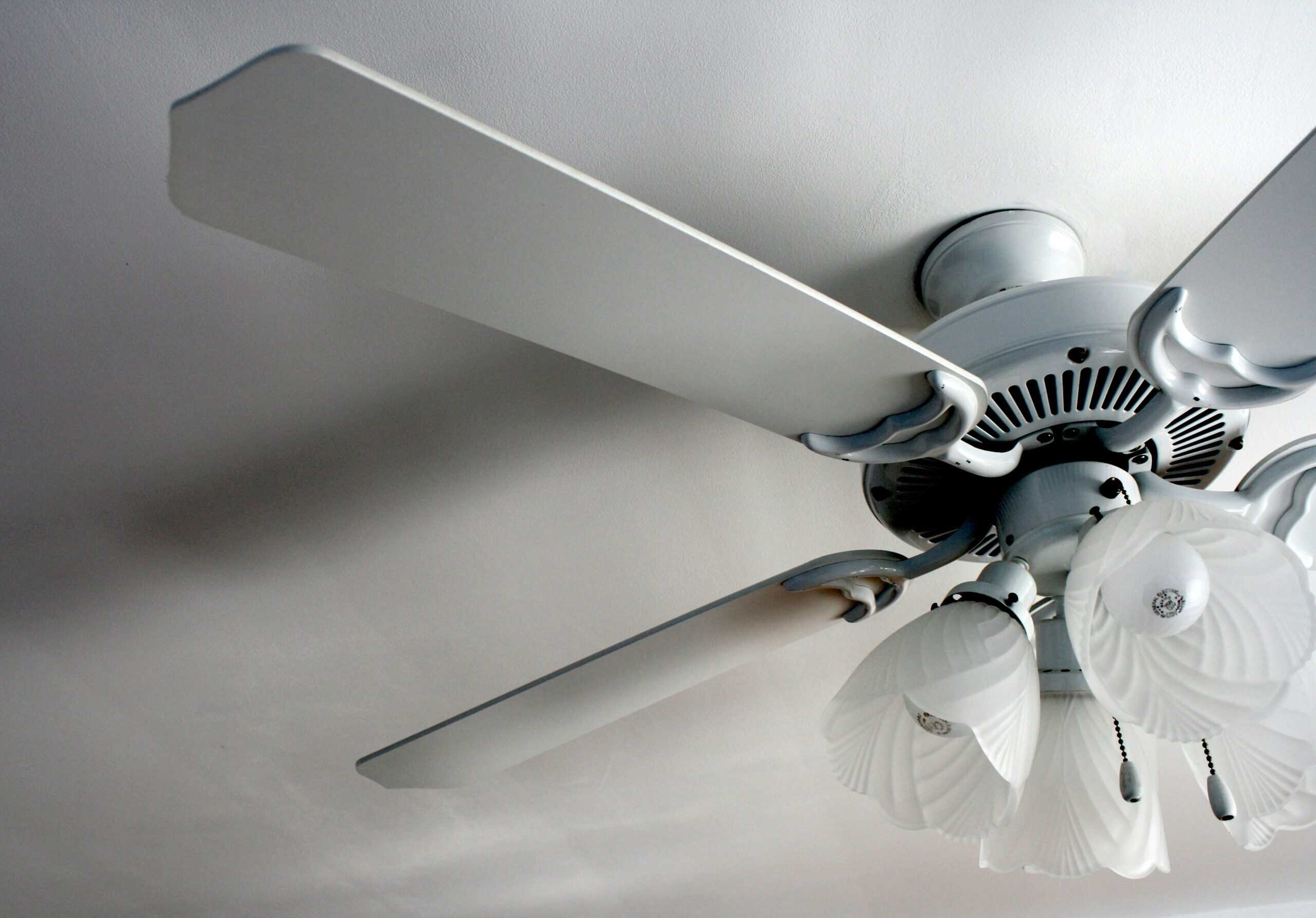
A wobbling ceiling fan is almost never a failing motor. It is blade weight that has drifted out of balance, a blade iron bent slightly out of plane, a downrod set screw that has worked loose, or a mounting bracket that was never properly tight. All four are inexpensive to fix, and three of them need no electrical work at all.
Knowing which one you have saves the most money in this category. People replace whole fans over a wobble that a two-dollar balancing clip would have solved, and they replace blades when the blade iron is the part that is bent.
Before any of it: switch the fan off at the breaker, not just at the wall switch or the remote, for anything that involves opening a housing. Blades, blade irons, downrods and balancing are mechanical jobs. The capacitor and the pull chain switch sit inside the switch housing on a wired fixture, and if you are not comfortable there, an electrician is the right call. Choosing a whole new fan instead is covered in ceiling fans for bedrooms.
| Symptom | Most likely part | Electrical work | Relative cost |
|---|---|---|---|
| Wobble at all speeds | Blade balancing kit | No | Very low |
| Wobble that got worse suddenly | Loose downrod or bracket | No, but power off | Low |
| One blade visibly out of plane | Blade iron | No | Low |
| Hangs too low or too high | Downrod of a different length | No, but power off | Low |
| Runs on one speed only | Capacitor | Yes | Low |
| Pull chain does nothing | Pull chain switch | Yes | Low |
If you want the short version: start with a balancing kit, because it costs almost nothing and fixes the most common complaint. Check the downrod set screws and the mounting bracket next, since both loosen over years of vibration. Only after those three come up clean is it worth buying blades, and the capacitor and switch are last because they are the only parts behind a live housing.
Key Takeaways
- Wobble is a balance and mounting problem far more often than a motor problem.
- Blade irons bend more easily than blades and are cheaper to replace.
- Downrod length sets blade height; aim for roughly seven feet of clearance to the floor.
- Blade sets must be replaced as a matched set, never individually.
- A fan stuck on one speed is usually a failed capacitor, not a dying motor.
- Cut power at the breaker before opening any housing, and get help if unsure.
How We Picked
Selection followed the diagnostic order above, because the cheapest fix is also the most likely one and buying in the wrong order wastes money. Each entry below names the symptom it addresses.
Compatibility was the main filter. Downrods vary in diameter and in whether they take a set screw or a pin, blade irons are specific to blade mounting-hole patterns, and capacitors are specified by microfarad values printed on the original. A part that nearly fits is useless here.
After that the criteria were material quality where vibration is involved, whether a kit includes the hardware it needs, and whether the part is serviceable without specialist tools. Each entry is a product class rather than a single model, since fan parts are brand-specific and stock shifts.
1. A Blade Balancing Kit, Best Overall for Wobble
Why It Stands Out
A balancing kit is a plastic clip and a set of adhesive weights, and it addresses the single most common ceiling fan complaint for the price of a coffee. Blades absorb moisture and dust unevenly over years, and a few grams of difference at the tip becomes visible wobble at speed.
The method is simple. Slide the clip along one blade until the wobble stops, then stick a weight on the blade top at that point. No tools, no power off, no disassembly.
Worth Knowing
Work through the blades systematically rather than guessing. The clip identifies which blade and where, and skipping that step turns it into trial and error.
Balancing cannot fix a bent blade iron or a loose mount. If the wobble changes character as the fan speeds up, or you can move the fan body by hand, the problem is mechanical rather than balance.
Best as the first purchase for any wobbling fan. Skip it if you can already see one blade sitting lower than the others, where the iron is the problem.
Check Price on Amazon2. A Replacement Downrod, Best for Height and a Loose Mount
Why It Stands Out
Downrods set how far the fan hangs below the ceiling, and getting that right affects both airflow and whether the fan clears a tall person. A longer rod on a vaulted ceiling brings the blades into the room where they actually move air.
Replacing one also forces you to check the set screws and the ball joint, which is where a slowly worsening wobble usually originates.
Worth Knowing
Downrod diameter varies between manufacturers, and so does the retention method. Measure the outside diameter and note whether the original uses a set screw, a cross pin or both before ordering.
Aim for roughly seven feet from the floor to the blades for a standard room, more if anyone tall uses the space. Blade height is part of why a ceiling fan moves air rather than cooling it works better at some mounting heights than others.
Best for vaulted ceilings, flush-mounted fans that feel too close, and any fan whose mount has loosened. Skip it on a standard eight-foot ceiling where the fan already clears comfortably.
Check Price on Amazon3. Replacement Blades and Blade Irons, Best for a Warped Set
Why It Stands Out
Blade irons, the metal arms between the motor and the blade, bend from being knocked or from someone leaning on a blade while cleaning. A bent iron holds its blade out of plane, and no amount of balancing corrects it.
Irons are also the cheaper half of the assembly. Replacing one bent iron costs a fraction of a blade set and solves the problem outright.
Worth Knowing
Blades must be replaced as a matched set, because weight variation between old and new blades reintroduces the wobble you were fixing. Irons can be replaced individually if the replacement matches.
Check for warp before buying anything: measure from each blade tip to the ceiling with the fan off and turn it by hand to compare. Wood blades warp in humidity, which is worth knowing in a room running a humidifier all winter.
Best for a visibly uneven blade set and for fans whose blades have warped. Skip blade replacement until you have confirmed the irons are straight.
Check Price on Amazon4. A Replacement Capacitor, Best for a Fan Stuck on One Speed
Why It Stands Out
A fan that will only run on high, or only on low, or hums without starting, usually has a failed capacitor rather than a dying motor. The part costs a few dollars and sits in the switch housing.
Because the alternative diagnosis is replacing the whole fan, this is the highest-value repair in the category when the symptom matches.
Worth Knowing
This is electrical work inside a housing wired to mains. Cut power at the breaker, confirm it is dead, and if you are not comfortable identifying the part and the wiring, have an electrician do it.
Capacitors are specified by microfarad values and the number of windings they serve, printed on the body of the original. Photograph it before removing it and match the specification exactly.
Best for the specific symptom of lost speed settings or a fan that hums without turning. Skip it if the fan runs normally on all speeds, since the capacitor is not your problem.
Check Price on Amazon5. A Canopy and Mounting Bracket Kit, Best for a Loose or Noisy Mount
Why It Stands Out
The bracket at the ceiling takes the entire weight and all the vibration, and a bracket that was fitted to a box not rated for a fan is both a wobble source and a safety issue. A proper fan-rated bracket and canopy fixes both.
Mount noise is the other reason to look here. A rhythmic click or tick that follows blade rotation often comes from the canopy or the ball joint rather than the motor.
Worth Knowing
Ceiling fans need a box rated for fan support, not a standard lighting box. If you are unsure what is above the canopy, that is the thing to establish before anything else, and it is electrician territory.
Rubber isolation washers in some kits cut transmitted noise noticeably, which matters if the fan is above a bed. Mechanical noise travels through structure the same way a squeaking bed frame does.
Best for a fan you can rock by hand, for mount-related ticking, and for any installation you suspect was done on a lighting box. Skip it if the bracket is solid and fan-rated.
Check Price on Amazon6. A Pull Chain Switch, Best for a Dead Setting
Why It Stands Out
Pull chain switches wear out mechanically, and a chain that clicks through positions with nothing happening on one of them is a worn switch rather than a motor fault. The part is cheap and widely available in standard configurations.
Replacing it also recovers a fan that someone has pulled too hard on, which is the usual cause of a chain that comes away in your hand.
Worth Knowing
Switches are specified by the number of speeds and the number of wires, commonly three-speed four-wire. Count the wires on the original rather than assuming.
This is inside the switch housing, so the same rule applies: power off at the breaker, and call someone if you are unsure. Many people skip the repair entirely and add a remote or receiver kit instead, which bypasses the chain altogether.
Best for a worn or broken chain and a dead speed position. Skip it if a remote conversion suits you better, since that solves the symptom without the chain.
Check Price on AmazonHow to Choose a Ceiling Fan Part
Diagnose in cost order
Balance, then mounting, then blades and irons, then electrical parts. Working in that order means the cheap fixes get ruled in or out before you spend real money.
Measure rather than matching by model
Downrod diameter, blade mounting-hole spacing and capacitor values all vary within a single brand’s range. Measure the part in your hand.
Matched sets where balance matters
Blades always as a set. Irons can be individual if identical. Mixing weights is how a balanced fan becomes an unbalanced one.
Whether the job crosses into electrical
Blades, irons, downrods, balancing and the canopy are mechanical. The capacitor and the switch are not. Decide which side of that line you are comfortable on before ordering.
Balancing Against Replacing
When balancing is the answer
A steady wobble present at all speeds on a fan that is solidly mounted with visibly even blades. That is weight distribution, and a clip and a few weights resolve it.
When parts are the answer
A wobble that appeared suddenly, a fan you can move by hand, one blade sitting lower than the rest, or a lost speed setting. Those are mechanical or electrical faults, and balancing them only hides a problem that will come back. If the fan is also simply too loud at the speed you need, the fix may be a different fan, which is the question in quiet fans for sleeping.
What Trips People Up
Replacing the fan over a wobble
It is the most expensive possible response to the cheapest possible fault. Balance and mounting account for most wobbles.
Buying one blade
A single new blade weighs differently from five aged ones, so the fan comes back out of balance. Sets only.
Working with the wall switch off
A wall switch can leave the fixture live depending on how it was wired. The breaker is the only reliable disconnect, and confirming the circuit is dead takes seconds.
Getting the direction wrong afterward
After any blade or iron work, check the rotation direction is still what you want for the season. Which way it should turn is covered in fan direction for sleeping, and it is easy to flip a switch during a repair without noticing.
Worth reading next: ceiling fan against floor fan covers whether the repair is worth making at all, floor fans for bedrooms is the alternative while a fan is out of service, how many fans a bedroom needs answers whether to add one instead, and fan and air conditioner combinations covers running them together.
Ceiling Fan Parts FAQ
Why does my ceiling fan wobble?
Usually uneven blade weight after years of dust and humidity, a loose downrod set screw, a bent blade iron, or a mounting bracket that is not tight. A balancing kit addresses the first; the others are mechanical checks.
Is a wobbling ceiling fan dangerous?
A mild balance wobble is not, though it is noisy and wears bearings. A fan you can move by hand, or one mounted to a box not rated for fan support, should be looked at before you keep running it.
Can I replace just one ceiling fan blade?
You should not. A replacement blade will not match the weight of the aged set, which puts the fan back out of balance. Replace blades as a matched set, though blade irons can be swapped individually.
What length downrod do I need?
Enough to leave roughly seven feet from floor to blades on a standard room, and more on a vaulted ceiling to bring the blades down where they move air. Measure from the ceiling to the fan’s blade plane rather than guessing.
Why does my fan only run on one speed?
Most commonly a failed capacitor in the switch housing, which is an inexpensive part. A worn pull chain switch produces a similar symptom, and both require working inside a wired housing with the breaker off.
Do I need an electrician?
Not for balancing, blades, irons or a downrod. For the capacitor, the pull chain switch, or anything involving the ceiling box and its rating, call one if you are not confident, and cut power at the breaker regardless.
Will a remote conversion fix a broken pull chain?
It can, since a receiver kit takes over speed control and leaves the chain unused. It is still electrical work inside the housing, so the same precautions apply.
