
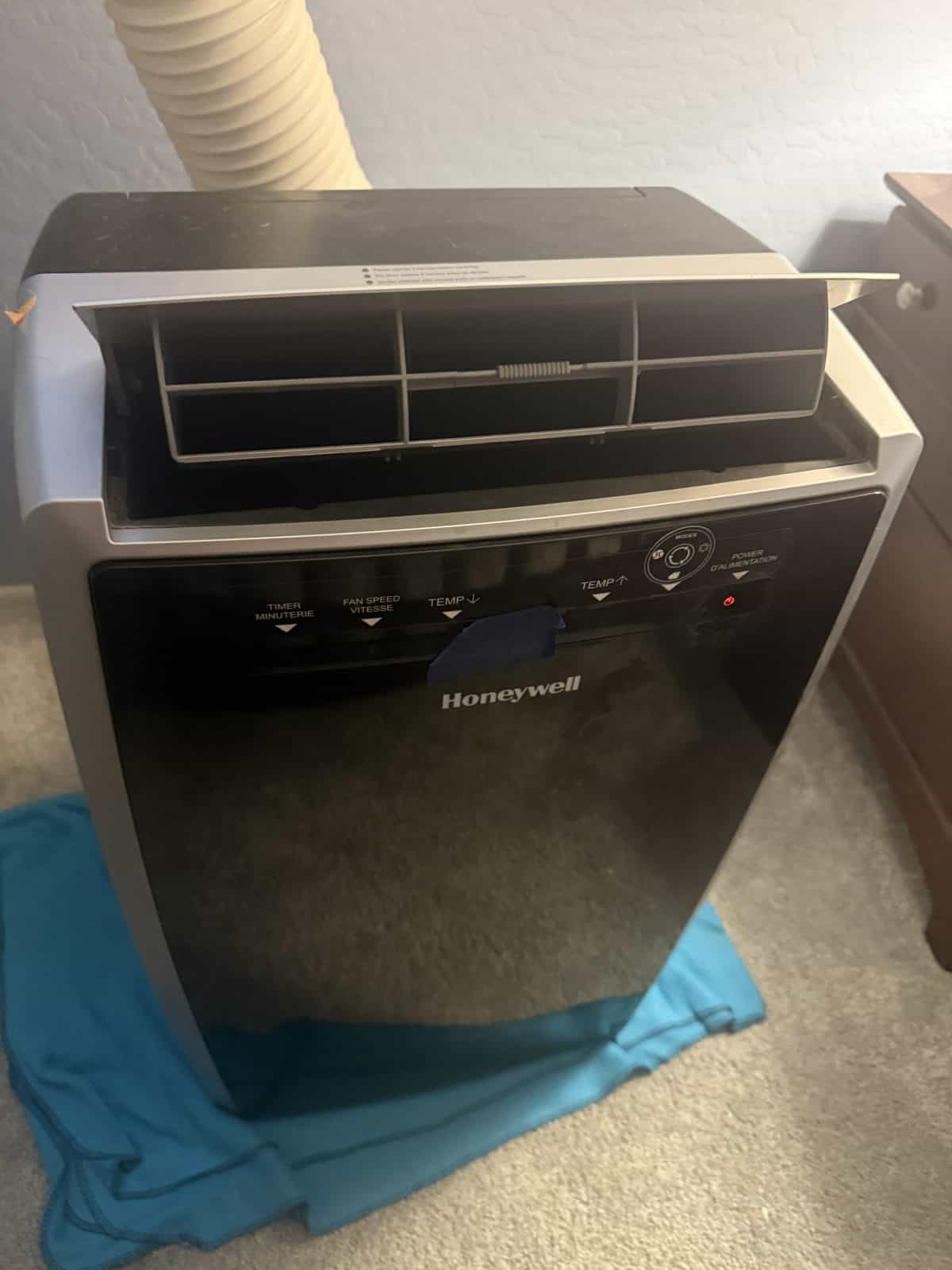
August in Phoenix, my bedroom hits the high 80s by 10 p.m. and stays there until sunrise. If you’ve lived through a desert summer in a poorly insulated house, how to keep your bedroom cool in summer is not a soft-furnishing question. It’s a sleep question. If you’re shopping, start with our guide to the best space heaters for bedroom.
Quick Verdict:
- Best for hot-climate sleepers without central AC in the bedroom: a window AC plus a percale sheet swap does more for tossing and turning than any single upgrade.
- Who should skip this: sleepers in cool climates who run cold already; these fixes assume you’re fighting heat, not chasing it.
Disclosure: RestRight is reader-supported. As an Amazon Associate, we earn from qualifying purchases made through links on this page, at no extra cost to you.
Why Cooling Your Bedroom for Summer Matters
Body temperature drops a degree or two as you fall asleep. That drop is part of the signal that tells your brain to release melatonin and shift into deeper stages of rest. When the room fights that drop, sleep onset stretches out, and the night fragments.
You wake more. Even sweat. Maybe you dream weirdly and remember it, which usually means lighter sleep all night.
Most sleep guidance points to roughly 65 to 68 degrees as the bedroom target. That number is useful, but it’s an average.
Your own comfort range depends on what you sleep under, what your mattress traps, and what your room does after midnight. In Arizona, my room doesn’t hit 68. It hits 78 on a good night.
So I stopped chasing the number and started layering fixes that drop my skin temperature, which is the variable that actually matters for staying asleep. Bedding makes the biggest difference per dollar.
Memory foam mattresses trap heat, and most modern pillows do the same. Cotton percale sheets breathe; sateen and microfiber don’t. A heavy comforter holds your body heat against you like a thermos.
The five picks below cover the layers that actually matter: a tower fan for airflow, a window AC for rooms central AC misses, a cooling sheet set, an active bed cooling system, and blackout curtains that block radiant heat before it gets in. Each one targets a different failure mode.
Sizing comes before shopping, because a unit that is too large cools the room fast and then shuts off without pulling the moisture out. The calculator below works out cooling capacity from room dimensions, sun exposure, ceiling height and how many people sleep there. It also gives the airflow figure if you are using fans rather than cooling.
What to Look for When Cooling a Bedroom
Real Airflow, Not Just Noise
A loud fan isn’t a powerful one. CFM, cubic feet per minute, is the actual airflow rating. Tower fans run 400 to 600 CFM on high; a small box fan can push 1,500 CFM, but moves it in a tight cone.
Pick based on room layout, not decibels.
BTU That Matches the Room
For window or portable AC, the BTU rating maps to room size. A rough rule: 5,000 BTU for up to 150 square feet, 8,000 for 200 to 350, 12,000 for 400 to 550.
Undersized, and the unit runs constantly without catching up. Oversized and it short-cycles, leaving the room damp.
Breathable Bedding Over “Cooling” Marketing
Genuine breathability comes from fiber and weave, not from gel-infused marketing copy. Long-staple cotton in a percale weave breathes. So does linen, eucalyptus, and bamboo viscose.
Skip anything that lists “cooling technology” without telling you the fiber.
Active Cooling Where Passive Fails
If your mattress runs hot no matter the sheets, a chilled-water or thermoelectric bed cooling system circulates cold water through a pad on top of the bed. These cost more than every other fix on this page combined.
They also work when nothing else does.
Heat Blocked Before It Enters
Western and southern windows pull in radiant heat all afternoon and re-radiate it for hours after sunset. Thermal blackout curtains, layered against the window, cut that load by a measurable amount.
The room is cooler at bedtime because it was less hot at 5 p.m.
1. Lasko Wind Curve Tower Fan, Best Airflow Upgrade
Best for moving air without window space | Price: ~$70
A tower fan won’t drop the room temperature, but it pulls heat away from your skin, which is what you actually feel. The Lasko Wind Curve oscillates across a wide arc, runs three speeds, and is quiet enough to leave on overnight.
I run one between the AC vent and the bed to push cooled air across the mattress instead of letting it pool at the ceiling. The remote and timer matter more than they sound; I almost always set it for four hours so it cuts off before sunrise when I don’t need the noise.
Key Features
- Three speeds with widespread oscillation
- Built-in ionizer (optional)
- Remote control and programmable timer
- The tower form factor fits slightly in bedroom corners
PROS:
- Quiet on low and medium
- Tall enough to push air over a bed
- Cheap entry into real airflow
- Easy to move from room to room
CONS:
- High speed is louder than the spec suggests
- Doesn’t lower the room temperature on its own
- Plastic build feels light
Best for: sleepers in any climate who want better airflow across the bed without installing anything.
2. Midea U-Shaped Window Air Conditioner, Best for Rooms Central AC Misses
Best window AC for bedroom installs | Price: ~$330
The U-shaped design lets the window close through the unit, which kills the air leaks that every standard window AC suffers from. It uses an inverter compressor, which means it ramps up and down instead of slamming on and off.
The result is a much quieter operation and lower power draw than a comparable BTU non-inverter unit. I’d want this in any back bedroom that runs five degrees hotter than the rest of the house because the central system can’t catch up.
The 8,000 BTU model covers roughly 350 square feet.
From my own experience, setting up an indoor air conditioner is the first thing I do when the Arizona heat arrives each summer, and it is the single change that decides whether I toss all night or actually sleep. A unit sized to the room and set on a timer is what I lean on when the desert refuses to cool off after dark.
Key Features
- U-shape lets the window close around the unit
- Inverter compressor for variable speed
- Wi-Fi control with app scheduling
- Rated quieter than most window units (around 42 dB on low)
PROS:
- Genuinely quiet for a window AC
- Energy use is reasonable on hot nights
- The window closes through the unit, sealing out hot air
- Strong cooling for the size class
CONS:
- Heavy and awkward to install alone
- Won’t fit narrow windows; check dimensions twice
- The app can disconnect intermittently
Best for: bedrooms that run hotter than the rest of the house, or homes without central AC.
3. Mellanni 100% Cotton Percale Sheet Set, Best Breathable Bedding Swap
Best cooling sheet set under $80 | Price: ~$60
If you sleep on sateen, microfiber, or polyester blends and you sleep hot, this swap alone will change how the bed feels. Percale is a tighter, plain weave of long-staple cotton.
It feels crisp and breathes immediately. The difference under your skin is obvious the first night.
I switched mine years ago and won’t go back to sateen even in winter. Mellanni’s percale runs more affordable than the boutique cotton brands without giving up much in finish, and it holds up through frequent washing.
For deeper coverage on weave choice, see our guide to cooling sheets for hot sleepers and the differences between percale and sateen sheets.
Key Features
- 100% long-staple cotton in percale weave
- Deep pockets fit mattresses up to 16 inches
- Multiple sizes and color options
- Machine washable, gets softer with washing
PROS:
- Genuine breathability, not “cooling” marketing
- A crisp hand feel that wakes the bed up
- Holds up to repeated washing
- Reasonable price for real cotton
CONS:
- Wrinkles more than sateen out of the dryer
- Crisp feel is divisive; some sleepers prefer the silky drape of sateen
- Thread count is moderate; not a luxury weight
Best for: hot sleepers who currently sleep on sateen, microfiber, or jersey and don’t know what they’re missing.
4. ChiliSleep Chilipad Cube Bed Cooling System, Best Active Cooling
Best chilled-water bed system | Price: ~$700
When passive fixes aren’t enough, an active cooling pad changes the math entirely. The Chilipad Cube circulates chilled water through tubing in a thin pad that lies on top of your mattress and under your sheet.
You set a temperature on the control unit, and the pad holds the bed surface there. For sleepers fighting a memory foam mattress that traps heat, or a partner who runs warm, this works when nothing on the list above does.
The cost is real and so is the noise of the cooling unit, but the cooling itself is not theater. This pairs naturally with the bed cooling system category if you want to compare alternatives.
Key Features
- Chilled water circulation through a top-of-mattress pad
- The temperature range is roughly 55°F to 110°F
- Single or dual-zone configurations available
- App control and scheduled cooling
PROS:
- Cools the bed surface, not just the room
- Dual zone works for couples with mismatched preferences
- App scheduling lets you cool down only when needed
- Hardware quality has improved with each generation
CONS:
- Expensive compared to every other fix on this list
- The control unit makes an audible noise at higher fan speeds
- Tubing and pad take up bedside space
- Distilled water refills are a small ongoing chore
Best for: serious hot sleepers, couples with mismatched preferences, anyone stuck on a heat-trapping mattress.
5. Nicetown Thermal Blackout Curtains, Best Heat Blocker
Best window heat blocker under $50 | Price: ~$40 per panel
Western and south-facing windows are the hidden reason your bedroom is so hot at bedtime. The room cooks all afternoon, then radiates that heat back into the air after sunset.
Thermal blackout curtains layered against the glass block a measurable share of the radiant load. The room is cooler at 10 p.m. because it was less hot at 5 p.m.
I run a pair on my west-facing window. Drawing them at 3 p.m. is part of my summer routine. If you want stronger light-blocking, too, the best blackout curtains for sleep roundup covers more options.
Key Features
- Triple-weave thermal-insulated polyester
- Blackout-rated for room darkening
- Available in standard window sizes and many colors
- Rod-pocket and grommet versions
PROS:
- Cuts the room’s afternoon heat load
- Doubles as a light blocker for shift workers
- Affordable per panel
- Hangs heavy enough to seal the edges
CONS:
- Polyester construction, not natural fiber
- Wrinkles set in shipping; it takes a few days to drop out
- Heavy panels are a pain to wash
Best for: bedrooms with western or southern exposure that run hot at bedtime regardless of the AC.
Which Cooling Fix Fits Your Situation
| Your situation | Tower Fan | Window AC | Percale Sheets | Bed Cooling System | Thermal Curtains |
|---|---|---|---|---|---|
| Hot bedroom, no central AC reaching it | Workable, moves air | Best fit, actual cooling | Workable, helps at the skin | Workable, surface only | Best fit, cuts radiant load |
| Sleeps on a heat-trapping memory foam mattress | Skip, won’t reach the mattress | Workable, cools the room, not the bed | Best fit, biggest skin-level fix | Best fit, solves the mattress directly | Workable, helps on the skin |
| Couple, one runs hot, one runs cold | Workable, directional | Skip, cools the whole room | Workable, neutral on temperature mismatch | Best fit, dual-zone solves this | Workable, affects both equally |
| Hot climate, west or south-facing window | Workable, air movement helps | Best fit, handles the load | Best fit, pairs with the AC | Workable, over the top of other fixes | Best fit, blocks the source |
| Restlessness or insomnia made worse by heat | Workable, skin-level cooling helps | Workable, quiets the room temp swings | Best fit, first thing to fix | Best fit, removes the mattress as a wake-up trigger | Workable, steady bedtime temp |
| Tight budget, one fix only | Best fit, biggest impact per dollar | Skip, too expensive as a single fix | Best fit, affordable real change | Skip, wrong tier for budget pick | Workable, cheap and useful |
| Mild climate, occasional hot stretches | Best fit, handles it most nights | Skip, overkill | Workable, nice upgrade | Skip, overkill | Workable, useful but not required |
Prices above are estimates and shift with seasonal sales and stock levels.
How to Stack the Fixes in the Right Order
Don’t buy everything. Cooling a bedroom is layered, and the layers compound.
Start at the cheapest layer that addresses your specific failure mode and work up only if the night still wakes you. If the room itself is the problem, fix the room first.
That’s the AC and the curtains. If the room is fine and the bed is the problem, fix the bed.
That’s sheets and the cooling pad. A tower fan goes on top of either path because it costs little and helps move whatever cooled air you have across your skin.
The order I’d recommend, cheapest to most expensive: percale sheets, thermal curtains, tower fan, window AC, and active bed cooling. Most people don’t need the last one.
If I had to pick one upgrade for a hot sleeper in a hot climate without a huge budget, I’d buy the percale sheets first. They’re affordable, you feel the difference the same night, and they make every other fix work better.
After that, the window AC is for your central system, which can’t reach the bedroom. The active cooling pad is the last move, the one you make when everything else still isn’t enough.
Frequently Asked Questions
What is the best temperature to keep your bedroom in summer?
Most sleep guidance points to 65 to 68°F. That’s a starting point, not a rule.
What matters more is the trend through the night. A room that drifts up from 70 to 78 by 3 a.m. will wake a hot sleeper more reliably than a room that holds at 72.
Does a fan actually cool a room or just move hot air?
A fan doesn’t lower the room temperature. It moves air across your skin, which speeds evaporation and pulls heat away from your body.
That’s still useful for sleep because skin temperature, not room temperature, is what your body responds to. Pair the fan with anything that actually cools the air, and you get both.
How can I cool my bedroom without AC?
Stack the passive fixes. Close west and south-facing windows during the afternoon heat, hang thermal curtains, swap to percale or linen sheets, lose the heavy comforter for summer, and run a fan to pull cool night air through after sunset.
None of these is dramatic alone. Together, they shift the room by several degrees.
Why does my bedroom get hotter than the rest of the house at night?
Three usual reasons. The room has a western or southern window that radiated heat all afternoon, the central AC ductwork has long or restricted runs to that room, or the room is over a garage, attic-adjacent, or otherwise poorly insulated.
A window AC or thermal curtains target the first two; insulation work targets the third.
Are cooling sheets actually cooler, or is it marketing?
Some are real, some are marketing. Genuine cooling comes from breathable natural fibers in an open weave: long-staple cotton percale, linen, eucalyptus, and bamboo viscose.
Skip anything that says “cooling technology” without naming a fiber. A $60 percale set will outperform a $200 polyester sheet with cooling claims every night.
Will a cooling mattress topper help if my mattress runs hot?
Yes, but expectations matter. A passive cooling topper, gel-infused or phase-change foam, helps a little.
An active topper that circulates chilled water or thermoelectric cooling helps a lot. If your mattress is the main heat trap, you need an active solution rather than a passive one.
How much does a bed cooling system cost to run?
Most chilled-water systems draw roughly 80 to 150 watts on average through the night, which works out to a few cents per hour in most U.S. markets.
Cheaper than running a window AC, far cheaper than running central AC at a colder setpoint to compensate.
Does drinking cold water before bed help you sleep cooler?
Slightly, and not for long. Pre-cooling your body by drinking cold water or taking a cool shower an hour before bed gives you a head start on the body-temperature drop that signals sleep.
The effect is real but small. The fixes that actually keep you cool through the night are the ones around the room and the bed, not the ones inside you.
Recommended Reading
See also our guides to bedroom air conditioners, and space heaters for bedroom.
Related Reading
Explore more: bedroom air conditioners, how to keep sheets from pilling, air quality monitors for bedroom, how to choose bedroom essentials, space heaters for bedroom, and dehumidifiers for bedroom.
Related guides: how to keep a duvet in place.
Hot climates need a fuller approach than one product. A complete cooling setup covers building it out.
