
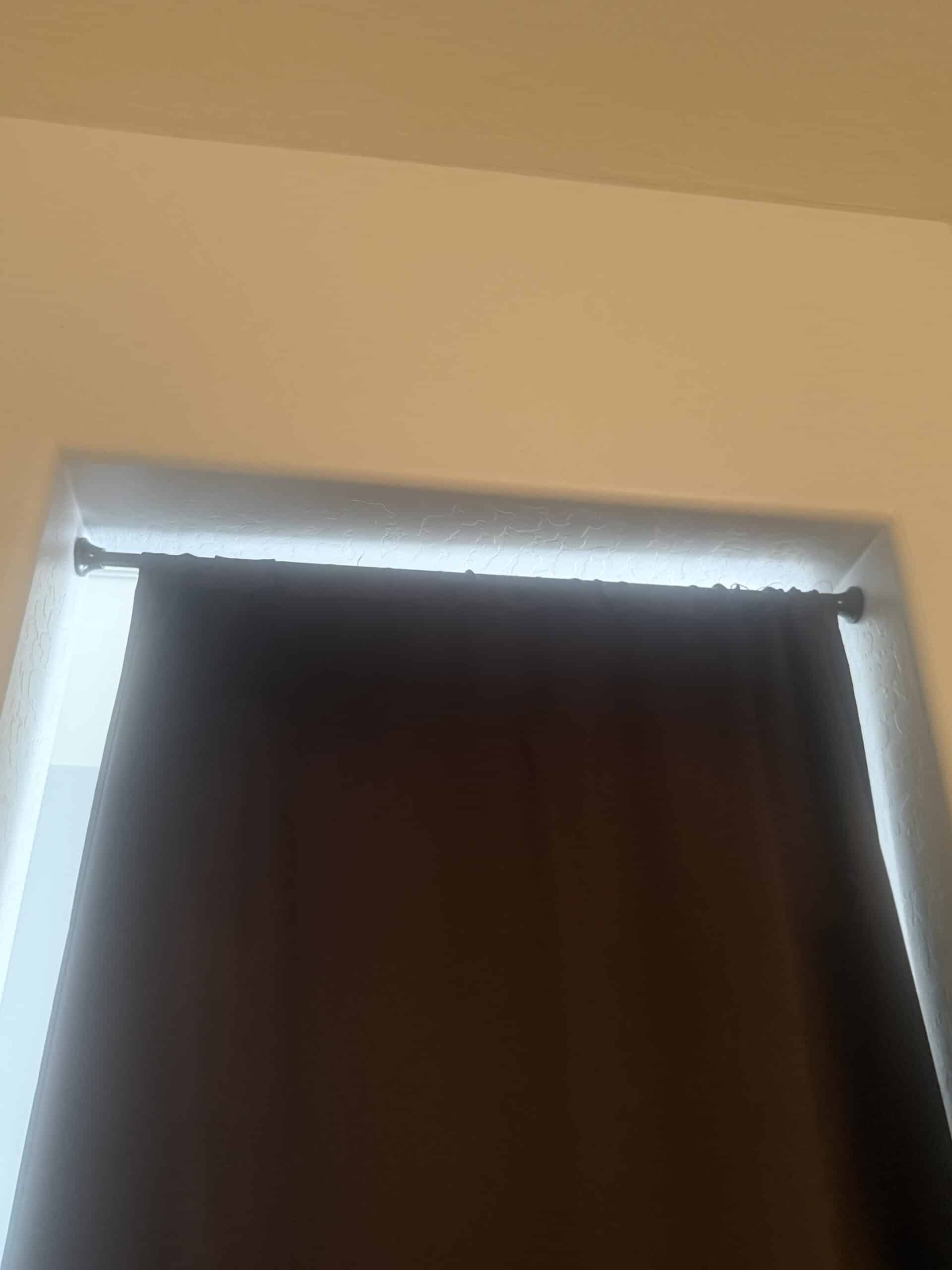
The rod holding my doorway curtain is a tension rod, it goes through several passes a day, and it has never come down. That runs against the usual advice, which treats tension mounting as a compromise that will eventually let go, and it is worth saying up front because it changes what most people should buy.
A doorway rod does a harder job than a window rod. Window curtains get drawn sideways along the rod; doorway curtains get pushed through, which loads the rod outward instead. Most rod advice is written for the first case and assumes the second is riskier than it turns out to be. Our roundup of no-drill blackout curtain rods covers tension mounting on windows. Tension is the usual approach where drilling is out, and our note on tension rods and heavy curtains covers whether it holds.
Why Doorways Are Different
A curtain across a doorway takes a sideways shove several times a day, sometimes with an arm full of laundry behind it. The force is applied at panel height rather than at the rod, so what actually matters is whether the rod stays seated in the frame under a lateral nudge.
Doorframes help more than window recesses do. They are usually square, the sides are solid, and the span is narrower than a window opening, which is the combination tension rods handle best.
Quick Answer
A tension rod sized correctly for the doorframe holds fine for daily use and needs no fixings, which suits rentals. Mounted rods are the answer for wide openings, heavy panels, or a frame that will not grip.
1. A Tension Rod, Best Overall
Why It Stands Out
No drilling, no brackets, no marks left behind, and about a minute to fit. In a rental that combination is difficult to beat, and it removes the question of whether the frame can take screws.
Fitting inside the frame also puts the panel within the opening, so there is no gap at the sides that a wall-mounted rod can leave.
Worth Knowing
Rating matters more than length. A rod stretched near the top of its adjustment range grips weakly, which is where most tension failures come from rather than from daily use.
Seat it firmly and check it after a week. A rod that is going to slip usually does so early. Our note on how high to hang curtains covers placement.
This suits most doorways and every rental. Skip it on an unusually wide opening.
2. A Wrap-Around Mounted Rod, Best Coverage
Why It Stands Out
Mounting outside the frame with returns that curve back to the wall covers the opening plus the edges, which closes the vertical light gaps a frame-width panel leaves.
Wall mounting also carries far more weight than tension does, so heavy blackout or thermal panels are no problem.
Worth Knowing
This means drilling into the wall beside the frame, which a rental may not allow and which leaves holes.
Returns need clearance, so check nothing is mounted on the wall where the rod would curve back. Our guide to stopping light leaks around curtains covers edge gaps.
This suits owned homes wanting maximum darkness. Skip it if you cannot drill.
3. A Frame-Mounted Bracket Rod, Best Middle Ground
Why It Stands Out
Small brackets screwed into the doorframe itself hold securely without touching the wall, which leaves smaller and easier-to-fill holes than wall mounting.
Frame mounting also keeps the panel within the opening, so the fit is tidy.
Worth Knowing
Wooden frames take screws well and metal ones may not, so check what your frame is before buying brackets.
This still counts as a fixing in a tenancy, even though the holes are small. Ask before assuming.
This suits owned homes and tolerant landlords. Skip it on a metal frame without the right fixings.
4. A Heavy-Duty Tension Rod, Best for Wide Openings
Why It Stands Out
Thicker tubing and stronger internal springs let a tension rod span a wider doorway without sagging in the middle, which is where standard rods give up.
Wider grip pads also spread the pressure across more of the frame, improving hold on painted surfaces.
Worth Knowing
These are visibly chunkier, which matters if the rod is on show in a living space.
Heavy-duty still has a rated span, and the same rule applies about not stretching near the limit. Our roundup of window insulation kits covers other frame-fitted solutions.
This suits wide doorways and heavy panels. Skip it on a narrow frame where a standard rod fits.
5. A Magnetic Rod, Best for Metal Frames
Why It Stands Out
Magnetic ends attach to steel doorframes with no drilling and no tension, which solves the case where a metal frame will not take screws and a tension rod cannot grip smooth painted steel.
They also move easily if you want the curtain somewhere else.
Worth Knowing
These only work on ferrous metal, so test with a fridge magnet before ordering.
Magnetic hold is weaker than tension or screws, so keep panels light. A shove through a heavy curtain can detach one end.
This suits steel frames. Skip it on wood or aluminum.
6. A Sprung Cafe Rod, Best for Light Panels
Why It Stands Out
Thin sprung rods fit narrow openings and suit lightweight panels, which is enough for a closet doorway or anywhere the curtain is decorative rather than light-blocking.
They cost very little and disappear visually behind the fabric.
Worth Knowing
These will not hold a blackout panel, which is heavier than the fabric they are designed for. Matching the rod to the panel weight is the whole decision here.
Thin rods also bow in the middle over a wider span. Our comparison of blackout curtains and blinds covers when fabric is the right choice at all.
This suits light or decorative panels. Skip it for blackout fabric.
Doorway Rods at a Glance
| Type | Needs fixings | Weight it holds | Best for |
|---|---|---|---|
| Tension rod | No | Moderate | Most doorways, rentals |
| Wrap-around mounted | Yes, wall | Highest | Maximum darkness |
| Frame-mounted bracket | Yes, frame | High | Owned homes |
| Heavy-duty tension | No | Higher | Wide openings |
| Magnetic | No | Low | Steel frames |
| Sprung cafe rod | No | Lowest | Light panels |
What Mine Has Actually Done
The rod holding my doorway curtain is a tension rod. The doorway leads to a bathroom and a closet, there is no door in the frame, and the curtain gets pushed through several times a day rather than drawn aside. Tension rods skip the drilling, though it helps to know what the pressure does to painted drywall before relying on one.
It has never fallen. Not once since it went up, and it has not needed reseating either. The panel is a standard blackout curtain rather than a thermal one, so it is not the heaviest fabric available, and the opening is a normal doorframe rather than an unusually wide span.
That is the useful data point, because the common advice is that tension rods are a temporary compromise that will eventually let go under this kind of use. In a doorframe of ordinary width, with a panel within the rod’s rating, that has not been my experience at all.
What I would take from it is that the failure mode people warn about is probably about span and weight rather than about pushing. A rod stretched near the top of its range on a wide opening is a different proposition from one seated snugly in a doorframe.
I have used one rod in one doorway, so I cannot compare mounted, magnetic, or heavy-duty versions from experience. Those sections are research rather than something I have run side by side.
What to Look For in a Doorway Rod
How wide is the opening?
Measure and buy a rod whose range comfortably contains that width rather than one that reaches it at full extension. Overstretching is where tension rods fail.
How heavy is the panel?
Blackout fabric is heavier than decorative curtain material, and thermal heavier again. Match the rod rating to the panel rather than to the opening alone.
What is the frame made of?
Wood takes screws and grips tension pads well. Smooth painted metal grips less, and only ferrous metal takes a magnetic rod.
Can you drill?
In a rental, usually not, which makes tension the practical default. In an owned home, mounted rods carry more and allow returns that close the side gaps.
Tension or Mounted?
The case for tension
No fixings, no marks, one minute to fit, and in an ordinary doorframe with a reasonable panel it holds. For most doorway curtains this is the sensible choice rather than the compromise it is usually described as.
The case for mounted
Wide openings, heavy or thermal panels, and any setup where you want returns curving back to the wall to close the edges. Mounting carries more weight and covers more, at the cost of holes. Our roundup of blackout curtains for sleep covers what hangs from either.
Common Doorway Rod Mistakes to Avoid
Buying the longest adjustable rod
A rod at the top of its range grips weakly. Choose one whose span comfortably contains your opening rather than one that only just reaches.
Hanging a heavy panel on a light rod
Blackout and thermal fabric are heavier than they look. Rod failure is usually a weight problem rather than a mounting problem.
Assuming a magnetic rod works on any metal
Aluminum frames are not magnetic. Test with a fridge magnet before ordering one.
Skipping the check after a week
A tension rod that is going to slip generally does so in the first few days. One check tells you whether it seated properly. Our note on how long blackout curtains last covers the fabric side of upkeep.
Related Reading
See our note on layering blackout curtains, our room darkening shade picks, our guide to whether blackout curtains help with noise, and a roundup of door draft stoppers.
Doorway Rod FAQ
Will a tension rod hold a curtain in a doorway?
In an ordinary doorframe with a panel inside its rating, yes, and it holds up to daily pushing better than the usual advice suggests. Failures generally come from stretching the rod near the limit of its span or hanging fabric heavier than it was designed for.
How do I stop a tension rod slipping?
Seat it firmly when fitting, choose a rod whose range comfortably contains the opening, and check it once after a week. A rod that has not moved in the first few days rarely starts later.
Can I mount a curtain rod on the doorframe itself?
Yes, with small brackets, and it holds far more than tension while leaving smaller holes than wall mounting. Wooden frames take screws well; metal frames may need different fixings or rule it out.
What rod do I need for a blackout panel?
One rated for the weight rather than just the width, since blackout fabric is considerably heavier than decorative curtain material. Thin sprung cafe rods will not hold blackout panels and bow in the middle.
Do magnetic curtain rods work?
On ferrous steel frames, yes, and they will not attach to aluminum or wood. Hold is weaker than tension or screws, so keep the panel light. Test the frame with a fridge magnet before ordering.
Should the rod go inside or outside the frame?
Inside keeps the panel within the opening and looks tidy, which suits tension mounting. Outside with returns covers the edges too, which blocks more light but needs drilling into the wall.
How wide should the rod be for a doorway?
Wide enough to span the frame with adjustment left over. If the curtain is mounted outside the frame for light blocking, the rod should extend several inches past each side so the panel can overlap.
Will the rod damage a rental doorframe?
Tension rods leave no holes, though the grip pads can mark paint over time, particularly on a freshly painted frame. Frame-mounted brackets leave small fillable holes. Wall mounting leaves the largest ones.
Recommended Reading
See our note on making a bedroom dark.
