
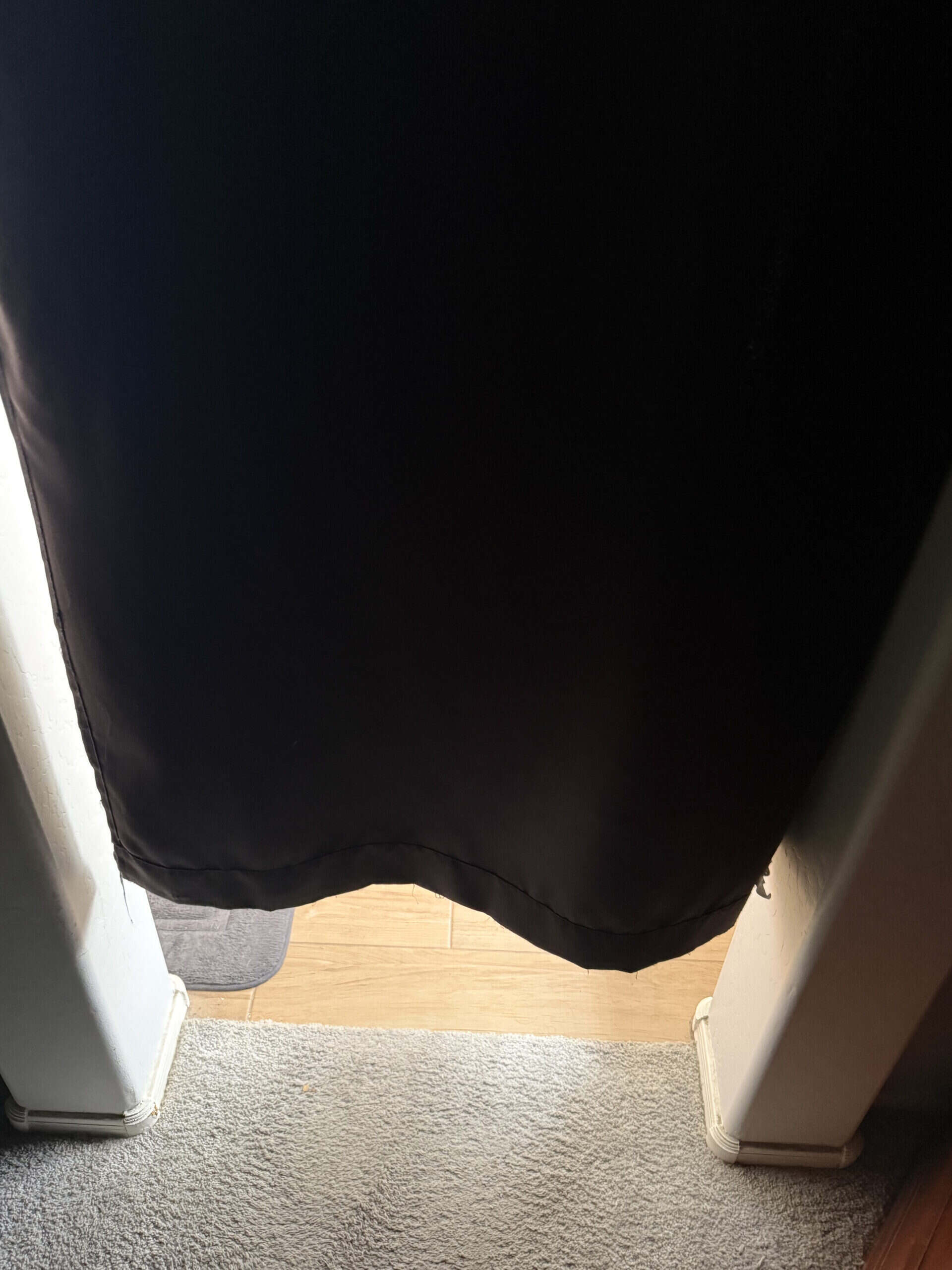
Plenty of homes have a doorway with no door in it. The opening leads to a bathroom, a closet, or a hallway, and whoever built it decided a door was optional. A curtain across that frame does three jobs at once: it blocks the light coming through, it gives some privacy, and it slows the air moving between the two spaces. Our roundup of blackout curtains for sleep covers the window version.
Doorway Curtain Options at a Glance
| Type | Blocks light | Walk-through | Best for |
|---|---|---|---|
| Blackout panel, short drop | Most of it | Easy | Bathroom and closet doorways |
| Blackout panel, full length | Most, plus the floor gap | Awkward | Openings rarely walked through |
| Tension rod panel | Depends on fabric | Easy | Rentals |
| Magnetic screen | Little | Hands-free | Airflow and pets |
| Thermal panel | Most of it | Heavier to push | Temperature differences |
| Beaded or fabric strip | None | Easiest | Decoration only |
The short version: a blackout panel on a rod, hung short enough to walk through comfortably, handles a bathroom or closet doorway well. Full-length looks tidier and drags every time you pass, which is why most people who try it end up shortening it.
How We Picked
Options are grouped by how they handle being walked through, since that is the constraint a doorway adds that a window does not. Light blocking is weighted alongside it, because a doorway curtain is usually there to stop light from an adjoining room reaching a bed.
Selections reflect construction, mounting method, and fabric behavior. Descriptions come from product research except where personal use is stated directly.
1. A Short-Drop Blackout Panel, Best Overall
Why It Stands Out
A blackout panel hung to stop above the floor blocks the light through the opening while staying out of the way of your feet. On a doorway used several times a night, that clearance is what makes the curtain survivable.
Blackout fabric also gives real privacy, since a lit room behind a thin curtain shows a silhouette in a way an opaque panel does not.
Worth Knowing
Stopping short leaves a strip of light along the bottom, which is the trade you accept for being able to walk through. How much that matters depends on your sightline from the bed rather than on the fabric.
Doorway rods take repeated pushing rather than gentle sliding, so a firmly mounted rod matters more here than on a window. Our roundup of no-drill curtain rods covers mounting without holes.
This suits bathroom and closet doorways. Skip it if the opening is rarely used and you want full coverage.
2. A Tension Rod Panel, Best for Rentals
Why It Stands Out
A tension rod fits inside a doorframe with no fixings, which suits a rental and takes about a minute to put up.
Mounting inside the frame also puts the fabric within the opening, so there is no gap at the sides the way a wall-mounted rod can leave.
Worth Knowing
The received wisdom is that tension rods slip under repeated pushing, since a doorway curtain gets shoved rather than drawn. In practice a properly seated rod inside a snug frame holds fine, and the failures tend to come from an oversized span or a panel heavier than the rating.
Seat it firmly when you put it up and check it once after a week, since a rod that is going to slip usually does so early. Our note on how high to hang blackout curtains covers positioning.
This suits rentals and doorway openings generally. Skip it for a very wide span or an unusually heavy panel.
3. A Thermal Doorway Panel, Best for Temperature
Why It Stands Out
Doorways between rooms at different temperatures move a surprising amount of air, and a lined panel slows that in a way thin fabric does not.
The extra weight also helps the panel hang flat rather than swinging after someone walks through.
Worth Knowing
Thermal linings are heavier, which returns to the rod question, and heavier panels are more effort to push aside repeatedly.
Blocking airflow to a bathroom can trap humidity, so consider whether the room has other ventilation. Our note on bedroom humidity control covers managing damp air.
This suits doorways between warm and cool spaces. Skip it on a bathroom with no extractor.
4. A Magnetic Screen, Best Hands-Free
Why It Stands Out
Magnetic panels part when you walk into them and close behind you, which suits carrying laundry, a basket, or anything that occupies both hands.
They also let pets pass without the curtain being left open.
Worth Knowing
Screen mesh blocks very little light, so this solves the walk-through problem and not the darkness one. For a bathroom light at night it will not help.
Magnets also weaken over time and stop closing fully, which shows first at the bottom.
This suits airflow and pets. Skip it if light is the reason you want a curtain.
5. A Wide Panel With Side Overlap, Best Privacy
Why It Stands Out
A panel wider than the opening overlaps the frame at both edges, which closes the vertical gaps an exactly sized curtain leaves when it settles.
For a bathroom doorway, those side gaps are the privacy problem rather than the fabric itself.
Worth Knowing
More fabric means more to push through and more bulk gathered at the side when open.
Overlap only works if the rod extends past the frame too, or the panel simply bunches. Our guide to stopping light leaks around curtains covers edge gaps.
This suits bathroom doorways. Skip it on a narrow opening where bulk would obstruct.
6. A Weighted-Hem Panel, Best for Staying Put
Why It Stands Out
Weights in the hem stop a doorway panel swinging for several seconds after someone walks through, which matters when the person walking through is going back to bed.
A panel that settles quickly also reseals the opening faster.
Worth Knowing
Weighted hems add to the total weight the rod carries, which matters more on a tension rod than a mounted one.
Weights can also thump against a door frame as the panel settles, which is its own kind of disturbance at night.
This suits doorways used during the night. Skip it if the panel already hangs still.
The Doorway Curtain I Use
The one I use hangs in a doorway leading to a bathroom and a closet. There is no door in that frame at all, just the curtain, and it went up because the opening needed something rather than because it came with the room.
It does all three jobs. It blocks the light, it gives privacy, and it slows the air between the two spaces, and I would struggle to say which of those was the main reason. That is probably the honest answer for most people in this situation.
The panel is a standard blackout curtain rather than thermal, and it stops around a foot or two above the floor. That is deliberate. Full-length in a doorway would be awkward, since you would be walking into fabric every time you passed through, and it is a doorway used several times a day.
The gap under the hem does leave a light strip. What I noticed is that it is cut off by the bed frame when I am lying down, so from the position that actually matters, it is not visible. Standing in the room you can see it; in bed you cannot. That is worth knowing before assuming a short panel ruins the darkness, because where you look from decides it.
The panel stays put rather than getting pushed around, which on a doorway is not a given. What I cannot compare is how magnetic screens, tension rods, or thermal panels behave here, since I have used one arrangement.
What to Look For in a Doorway Curtain
How often is it walked through?
A doorway used several times a day needs clearance at the bottom. Full-length looks tidier and becomes something you push through every time.
Where does the light come from?
A bathroom light behind a thin panel defeats the purpose. Blackout fabric is what stops light and silhouettes both, and thin decorative panels stop neither.
Can the rod take repeated pushing?
Doorway curtains get pushed rather than drawn, which is harder on a tension rod than a window curtain ever is. Mounted rods hold better where the wall allows.
Does the width overlap the frame?
Side gaps are where privacy fails on a doorway. A panel wider than the opening, on a rod that extends past it, closes them.
Short Drop or Full Length?
The case for short
You can walk through it without pushing fabric aside, the hem never drags on the floor, and it settles back into place quickly. For a doorway in regular use, this is the practical choice and the reason most people end up here.
The case for full length
It closes the strip of light at the bottom, which matters if your sightline from the bed includes it. Worth it on an opening you rarely walk through, and a nuisance on one you use at night. Our roundup of room darkening shades covers other ways to handle a stubborn light path.
What Trips People Up
Using a decorative panel for a lit room
Thin fabric shows a silhouette and passes light. If the doorway leads to a bathroom that gets used at night, blackout fabric is the only version that works.
Hanging it full length in a busy doorway
It looks right and becomes tiresome within a week. Clearance at the bottom is what makes a doorway curtain something you keep.
Undersizing the rod for the span
Tension rods hold well within their rated width and slip when stretched near the limit. Match the rod to the opening rather than buying the longest adjustable one available.
Ignoring the side gaps
A panel sized exactly to the opening leaves vertical gaps at both edges once it settles. Overlap is what closes them, and it needs a rod wider than the frame. Our note on whether blackout curtains help with noise covers another thing an opening lets through.
Worth reading next: our guide to layering blackout curtains, our note on how long blackout curtains last, our door draft stopper picks, and a comparison of blackout curtains and blinds, and making a bedroom dark.
Doorway Curtain FAQ
Can you use a blackout curtain instead of a door?
For a bathroom, closet, or hallway opening, yes, and plenty of homes are built this way. It blocks light, gives visual privacy, and slows airflow between the spaces. It does not block sound meaningfully, which is the one job a door does that a curtain cannot.
Should a doorway curtain reach the floor?
Usually not, if the doorway gets used. Full-length means walking into fabric every time you pass, and the hem drags. Stopping above the floor leaves a strip of light and makes the curtain something you can live with.
Will the gap at the bottom ruin the darkness?
It depends on your sightline. A light strip visible standing up is often hidden by a bed frame or furniture from where you actually lie down. Check from the bed rather than from the doorway before deciding it matters.
Is a tension rod strong enough for a doorway?
Usually yes, provided it is seated firmly and the span is within its rating. Doorway curtains get pushed rather than drawn, which sounds harder on tension mounting than it turns out to be in practice. Failures tend to come from an overstretched rod rather than from daily use.
How wide should the panel be?
Wider than the opening, with the rod extending past the frame on both sides. A panel sized exactly to the doorway leaves vertical gaps at the edges once it settles, and those are where privacy fails first.
Will a curtain over a bathroom doorway trap humidity?
It can, particularly a thermal panel on a bathroom without an extractor fan. If the room relies on the doorway for air movement, a lighter panel or leaving it open after showering is worth considering.
Do magnetic screens block light?
Barely. Mesh solves the walk-through problem and lets pets pass, and it does very little about a bathroom light at night. If darkness is why you want a curtain, blackout fabric is the only version that delivers it.
How do I stop it swinging after I walk through?
A weighted hem settles the panel faster, which matters on a doorway used during the night. The trade is extra weight on the rod, and weights can thump against the frame as the curtain settles.
