
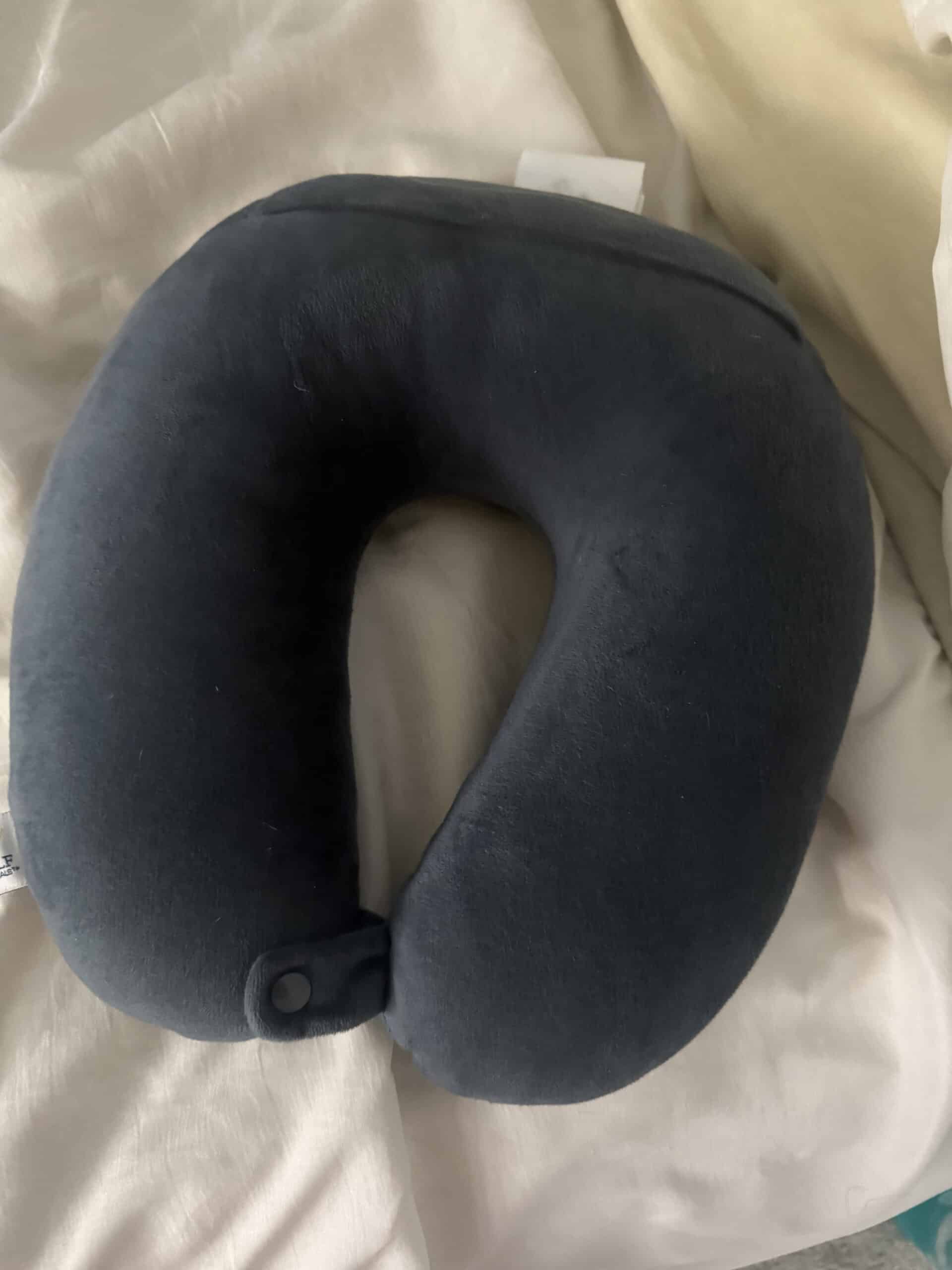
A car seat reclines, an airplane seat barely does, and that difference changes what a travel pillow needs to do. On a plane the pillow stops your head falling forward off a near-vertical seat back. In a passenger seat that already tilts, the problem is usually sideways lean toward the window or the driver. Pillows sold on airplane comfort do not always solve the car version. Our roundup of travel pillows for neck pain covers the category more broadly.
Quick Verdict
A U-shaped memory foam pillow handles most passenger seat sleeping and packs badly, which matters less in a car than in a carry-on. Choose a wraparound or side-support design if your head falls sideways rather than forward, and prioritize breathable covers on long summer drives. See also our guide to pillows that clip to a bag. Sleeping in a cab is its own problem, and our truck driver sleep gear guide covers it.
Key Takeaways
- Car seats recline, so the failure is sideways lean rather than forward drop.
- Packability matters far less in a car than on a plane.
- Memory foam holds heat, which shows on long summer drives.
- A pillow that works for the passenger is unsafe for the driver.
- Headrest position affects fit more than pillow shape does.
How We Picked
Pillows are grouped by which direction they support, since the passenger seat problem differs from the airplane problem. Heat retention is weighted alongside support, because road trips happen in summer and a car warms in a way a cabin does not.
Selections reflect construction, fill material, and support geometry. Descriptions come from product research except where personal use is stated directly.
1. A U-Shaped Memory Foam Pillow, Best Overall
Why It Stands Out
The U-shape supports the neck on both sides, which addresses the sideways lean that a reclined car seat produces. Memory foam holds that support rather than compressing flat under the weight of a head. Most road trip picks come back to the classic U shape, which is worth understanding before trying anything else.
In a car the usual drawback of this design matters far less, since bulk is a luggage problem rather than a back seat one.
Worth Knowing
Memory foam retains heat against the back of the neck, which becomes noticeable on a long drive in summer. Ventilated foam or a breathable cover helps and does not eliminate it.
Fit against the headrest matters more than people expect. A pillow that pushes the head forward on a car headrest is worse than none. Our note on sleeping with neck pain covers head position.
This suits most passengers. Skip it if your car headrest already sits forward.
2. A Wraparound Support Pillow, Best for Sideways Lean
Why It Stands Out
Wraparound designs brace the head against the shoulder rather than cradling the neck from behind, which targets the specific failure of a reclined seat where the head tips toward the window.
They also sit lower against the neck, so they interfere less with a car headrest than a bulky U-shape does.
Worth Knowing
These enclose more of the neck, which is warmer again than a standard U-shape. On a hot drive that is a real trade.
They also take a moment to fit properly rather than simply being placed, which is fine at the start of a drive and irritating if you keep adjusting.
This suits passengers whose head falls sideways. Skip it in hot weather without a breathable version.
3. A Ventilated or Cooling-Cover Pillow, Best for Summer Drives
Why It Stands Out
Perforated foam and breathable covers move heat away from the back of the neck, which is the complaint that ends most long summer drives with a damp collar.
A removable cover also washes, which matters for something pressed against skin repeatedly.
Worth Knowing
Cooling covers reduce heat build-up rather than actively cooling. In a car without working air conditioning, the pillow will still feel warm.
Ventilation channels also make foam slightly softer, so support may be marginally lower than a solid block. Our roundup of cooling pillows for hot sleepers covers the same principle at home.
This suits summer road trips. Skip it if heat has never bothered you.
4. An Inflatable Travel Pillow, Best for Packing Light
Why It Stands Out
Inflatable pillows deflate to almost nothing, which suits a road trip where the car is already full or where the pillow needs to come inside at a hotel.
Adjustable firmness also lets you set the support level, which fixed foam does not allow.
Worth Knowing
Air feels different from foam and some people find it unstable, since the head can shift the air rather than being held by it.
Valves leak slowly and punctures end the pillow, so a patch is worth having on a long trip. Our note on inflatable neck braces and neck hammocks covers the feel.
This suits full cars and hotel stops. Skip it if you dislike air support.
5. A Headrest Cushion, Best Fixed Support
Why It Stands Out
Cushions that strap to the headrest stay in position rather than being adjusted every time someone shifts, which suits a passenger dozing on and off across a long drive.
Side wings on some designs catch the head before it tips fully sideways.
Worth Knowing
Anything attached to a headrest must not interfere with the headrest doing its actual job, which is restraining the head in a collision. Fit it so the headrest itself still contacts properly.
Straps also mean the cushion stays in the car rather than going into a hotel with you.
This suits regular passengers on long routes. Skip it if the pillow needs to travel with you.
6. A Compact Packable Pillow, Best for Multi-Stop Trips
Why It Stands Out
Compressible foam pillows squash into a stuff sack and expand again, which suits a trip involving hotels, flights, and a car rather than one long drive.
They give a foam feel with a fraction of the packed size.
Worth Knowing
Compressed foam takes time to fully recover, so a pillow pulled out of a sack is not immediately at full loft.
Repeated compression also shortens the life of the foam compared with one left uncompressed.
This suits mixed-transport trips. Skip it for a single car journey where space is available.
Road Trip Pillows at a Glance
| Type | Supports | Heat | Packs down |
|---|---|---|---|
| U-shaped memory foam | Both sides of the neck | Warmest | Poorly |
| Wraparound | Head against shoulder | Warm | Moderately |
| Ventilated or cooling | Both sides | Coolest foam | Poorly |
| Inflatable | Adjustable | Coolest overall | Smallest |
| Headrest cushion | Behind and beside | Varies | Stays in the car |
| Compact packable | Both sides | Warm | Well |
The Pillow I Take
Mine is a U-shaped memory foam pillow and I have had it more than five years. It comes out for road trips sometimes rather than every time, and for the occasional long flight.
The two things I notice are the same two things people complain about with this design. It is bulky, and although mine has a clip for attaching to a bag, a U-shaped foam pillow hanging off luggage is still a large object swinging around. In a car that matters far less than on a plane, which is part of why it still gets used for drives.
It also gets hot. Memory foam holds heat against the back of the neck, and on a long drive in summer that becomes something you notice rather than something you tolerate quietly. If I were buying another, a ventilated version is what I would look at first.
What has held up is the support. After five years the foam still holds its shape rather than flattening, which is the failure I would have expected first in something compressed against a headrest repeatedly.
Worth being clear on what I cannot compare. I have used one pillow of one type, so wraparound, inflatable, and headrest-mounted designs are research here rather than experience. What I can tell you is what years with a U-shaped foam pillow are actually like. There is more on whether travel pillow clips do anything in a separate guide.
What to Look For in a Road Trip Pillow
Which way does your head fall?
Forward drop is an airplane problem. In a reclined car seat the head usually goes sideways, which argues for side support or a wraparound rather than a pillow chosen for chin support.
How does it sit against the headrest?
Car headrests are angled forward for safety, and a thick pillow behind the neck can push the head into an uncomfortable position. Test it in the actual seat rather than assuming.
Will it be hot?
Memory foam holds heat, and a car in summer is warmer than a cabin. Ventilated foam or a breathable cover is worth having if drives happen in warm weather.
Does it need to leave the car?
Headrest cushions stay put and stay behind. If the pillow follows you into hotels or onto a plane, packability comes back into the decision.
Foam or Inflatable for a Car?
The case for foam
Consistent support with no setup, and in a car the bulk that counts against foam elsewhere barely matters. For a single long drive, foam is the easier choice.
The case for inflatable
Packability and adjustable firmness, which matter on a trip with hotels and flights rather than one drive. It runs cooler too, since there is no foam holding heat against the neck. Our comparison of memory foam and alternative fills covers the materials.
Common Road Trip Pillow Mistakes to Avoid
Buying for the plane and using it in the car
The two seats fail differently. A pillow chosen to stop forward head drop may do nothing about sideways lean in a reclined seat.
Interfering with the headrest
The headrest restrains the head in a collision. Anything strapped to it or wedged behind it should not stop it doing that.
Using one while driving
Neck pillows restrict head movement, which is exactly wrong for a driver checking mirrors and blind spots. These are passenger equipment.
Ignoring heat on summer drives
Memory foam against the neck in a warm car is the complaint that ends up with the pillow on the back seat unused. Ventilation is worth paying for if you drive in summer. Our roundup of cooling pillows covers the fabrics that help.
Recommended Reading
See our roundup of pillows for neck pain, our note on why your neck hurts after side sleeping, our memory foam pillow picks, and a guide to sleep gear for neck and back tension, and choosing the right pillow for your sleep position.
Road Trip Pillow FAQ
Are travel pillows different for cars and planes?
The seats fail differently. An airplane seat is close to vertical, so the head falls forward. A car seat reclines, so the head tends to fall sideways. A pillow chosen for one does not automatically solve the other, and side support matters more in a car.
Can the driver use a neck pillow?
No. Neck pillows restrict head rotation, which is the opposite of what a driver needs for mirrors and blind spots. They are passenger equipment, and that applies to headrest cushions with side wings as well.
Why does my memory foam pillow get so hot?
Memory foam is dense and holds heat against the skin, and the back of the neck is a place you notice that quickly. Ventilated foam with perforations or a breathable cover reduces it, though nothing eliminates it entirely on a warm drive.
Will a travel pillow interfere with the headrest?
It can. Car headrests sit forward deliberately as part of the restraint system, and a thick pillow behind the neck can push the head into an awkward angle or reduce how the headrest contacts. Fit it in the actual seat before a long trip.
Is inflatable or foam better for a road trip?
Foam gives consistent support with no setup, and its bulk matters far less in a car than in luggage. Inflatable packs smaller, runs cooler, and lets you adjust firmness, which suits trips with hotel stops or flights attached.
How long does a travel pillow last?
Good memory foam holds its shape for years rather than flattening, which is longer than most people expect from something compressed repeatedly. Covers wear out first, so a removable washable one extends the useful life.
Do I need side support or chin support?
In a reclined car seat, side support usually matters more, since the head falls toward the window or the driver rather than forward. Chin-supporting designs are aimed at the upright airplane seat problem.
Should the pillow stay in the car?
If it is only ever used on drives, a headrest-mounted cushion stays put and needs no packing. If it travels with you to hotels or onto flights, packability comes back into the decision and a compressible or inflatable design earns its place.
