
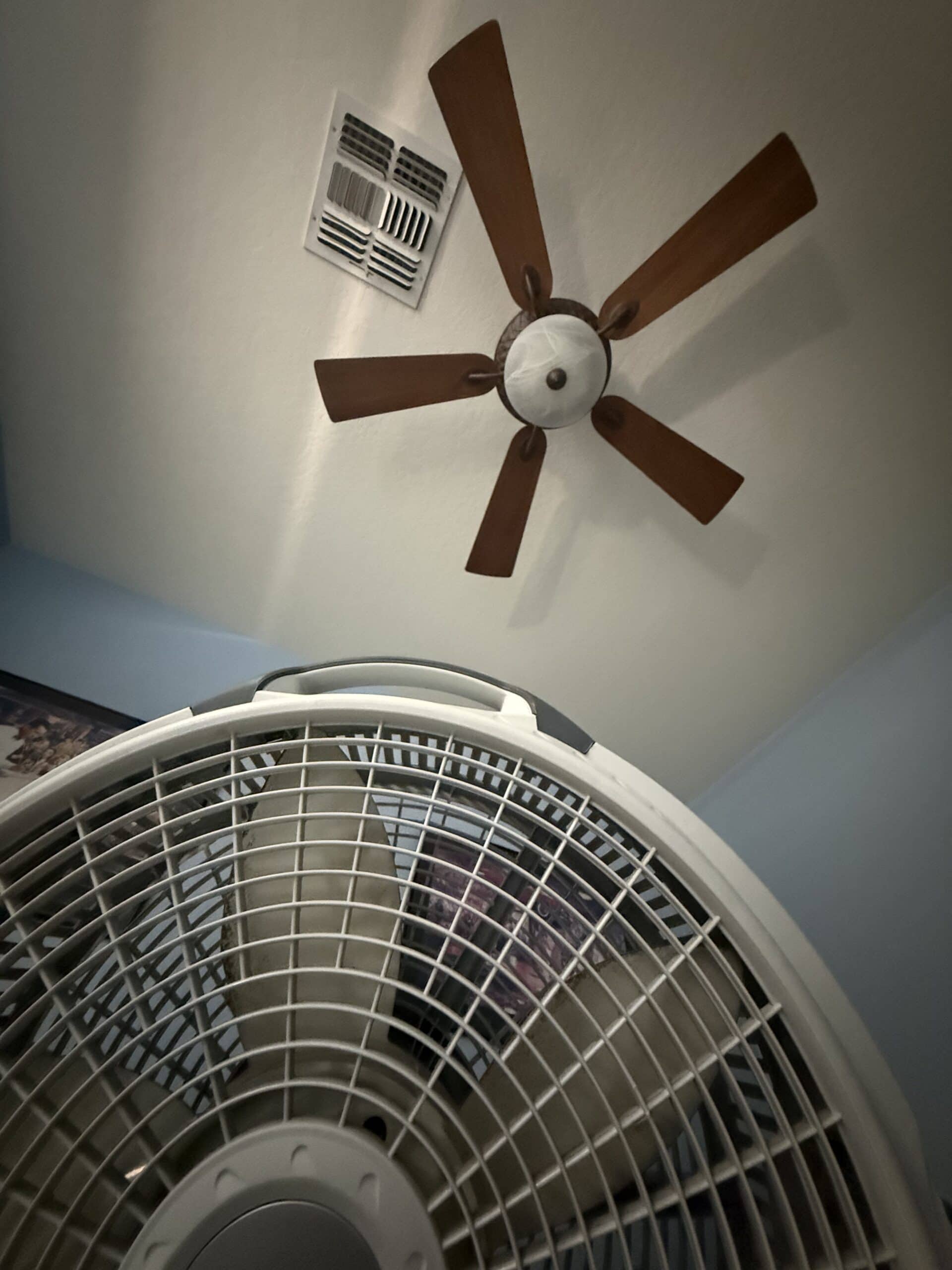
A ceiling fan moves air around the whole room. A floor fan pushes a stronger stream at one part of it. Neither lowers the temperature, and which one helps you sleep depends on whether you want gentle circulation or directed airflow.
Quick Verdict
A ceiling fan suits people who want even, quiet circulation without a draft on them. A floor fan suits people who want stronger airflow they can aim, or who use fan noise as part of falling asleep. Running both together is common and works better than either alone in hot conditions.
Key Takeaways
- Neither fan lowers room temperature
- Ceiling fans circulate, floor fans direct
- Floor fans usually move more air where you are
- Fan noise helps some people sleep and disturbs others
- Direct airflow on your face can dry sinuses and eyes
- Running both handles hot nights better than one
How We Compared
We looked at what each does mechanically, since the two work differently rather than one being a better version of the other.
Perceived cooling mattered more than airflow figures, because what matters is air moving across your skin rather than around the room.
Noise counted as both a benefit and a cost, since consistent sound helps some sleepers and keeps others awake.
Cost, installation, and renter compatibility all factored in, since a ceiling fan is a fixture and a floor fan is a purchase.
Ceiling Fan and Floor Fan at a Glance
| Criterion | Ceiling fan | Floor fan |
|---|---|---|
| Airflow pattern | Whole room, downward | Directed stream |
| Perceived cooling at the bed | Gentle, even | Stronger, aimable |
| Noise | Low, sometimes a hum | Higher, more consistent |
| Installation | Fixed, often an electrician | None, plug in |
| Renter friendly | Only if already fitted | Yes |
| Floor space | None | Takes a corner |
| Winter use | Reverse to circulate warm air | Limited |
Ceiling Fans, Pros and Cons
- Circulates the whole room evenly
- Takes no floor space
- Quieter than most floor fans
- Reversible for winter air circulation
- Cannot be aimed at one part of the bed
- Needs installation and usually cannot be added by a renter
- Develops a wobble or hum as it ages
Suits bedrooms that already have one, people sharing a bed with different preferences, and anyone who dislikes a draft on them. Skip if you want strong directed air.
Floor Fans, Pros and Cons
- Aimable, so you control where the air goes
- Moves more air at the bed than a ceiling fan usually does
- Provides consistent sound that some people sleep better with
- No installation, works in any rental
- Takes floor space and needs an outlet
- Louder, which cuts both ways
- Can dry eyes and sinuses if pointed directly at you
Suits renters, people who want stronger airflow, and anyone who uses fan noise as a sleep cue. Skip if noise keeps you awake or floor space is tight.
Which Actually Cools You More?
The floor fan, in most bedrooms. Cooling from a fan comes from air moving across your skin and speeding evaporation, so the fan putting more air where you are wins. Direction matters as much as which fan, and our note on which way a ceiling fan should spin covers the setting.
A ceiling fan moves a large volume of air and spreads it across the whole room, so what reaches the bed is gentler.
Neither changes the temperature. A fan in an empty room does nothing except use electricity, which is why leaving one running for an empty bedroom is wasted.
Winner: floor fan for directed cooling, though the gentler ceiling fan suits people who find strong airflow uncomfortable.
Which Is Better for Sound?
Depends entirely on which side of it you are on. A floor fan produces steadier, louder sound that masks street noise and household activity.
For people who fall asleep to consistent noise, that is a feature rather than a side effect, and it is why some people run a fan year-round.
Ceiling fans are quieter, which suits light sleepers and anyone who wants circulation without sound.
Winner: a tie, decided by whether you want the noise, and masking generally sits in white noise machines.
Which Suits Renters?
The floor fan, without qualification. It plugs in, moves with you, and needs no permission.
Ceiling fans are fixtures. If your rental has one, use it, and if it does not, adding one is usually electrical work you cannot do.
Winner: floor fan, decisively.
Which Costs Less to Run?
Both use modest power, and ceiling fans generally draw less for the air they move because larger slower blades are more efficient than smaller faster ones.
The difference over a season is small enough that it should not decide the choice.
Both cost far less to run than air conditioning, which is the more useful comparison, covered in bedroom air conditioners.
Winner: ceiling fan marginally, and not by enough to matter.
How I Run Both
I use both fans at the same time, and I think the floor fan does more work.
The floor fan is partly for sound as well as air. I like consistent noise when I am falling asleep, and it provides that alongside the airflow.
It points to the side rather than directly at me. That gets the air moving through the room without a stream on my face all night.
My ceiling fan runs year-round, and the air conditioning only comes on during Arizona summer. The fans are the constant and the cooling is seasonal.
What I would not claim is that this is optimal. It is what I have settled into, and someone who dislikes fan noise would find the floor fan intolerable rather than helpful.
Which Fits Your Situation
| If this is you | Better choice |
|---|---|
| Renting with no ceiling fan | Floor fan |
| Want noise to fall asleep | Floor fan |
| Sharing a bed, different preferences | Ceiling fan |
| Dislike air blowing on you | Ceiling fan |
| Very hot bedroom | Both together |
| Light sleeper sensitive to sound | Ceiling fan |
| Dry sinuses or eye irritation | Ceiling fan, or aim the floor fan away |
Running Both Together
This is more common than either alone in hot bedrooms, and the two do different jobs rather than duplicating each other.
The ceiling fan keeps the whole room moving so no pocket of warm air sits still. The floor fan puts a stronger stream where you actually are.
Aiming the floor fan across the bed rather than at it gets the air moving without the drying that direct airflow causes.
A floor fan positioned at a window pulls cooler outside air in during the evening, which does more than recirculating warm indoor air, covered in bedroom cooling setups.
The Verdict
The floor fan wins for directed cooling, renters, and anyone who wants the sound. The ceiling fan wins for even circulation, quiet, and shared beds where one person dislikes airflow.
If you are choosing one, buy the floor fan. It costs less, needs no installation, and you can aim it or move it if it turns out not to suit you.
If you already have a ceiling fan, adding a floor fan is a small purchase that covers what the ceiling fan cannot, and running both is the answer for hot nights.
Common Misconceptions
That fans cool a room
They move air and do not lower temperature. The cooling is on your skin, which is why a fan running in an empty room does nothing.
That ceiling fans always run quieter
Most do, and an unbalanced blade or a worn motor produces a hum or wobble that is harder to ignore than steady fan noise.
That stronger airflow is always better
Direct air on your face dries eyes and sinuses overnight, and plenty of people wake congested from it without connecting the two.
That a fan replaces air conditioning
In genuinely hot conditions it does not, since moving hot air across you has limits, covered in why you wake up hot every night.
Recommended Reading
- ceiling fans for bedrooms
- bedside and floor fans
- bedside against tower fans
- cooling setups
- sound masking
- quiet fan options
- waking up hot
- bedroom air conditioners
- cooling bedding layers
Part of our guide to cooling a bedroom for better sleep.
Ceiling Fan vs Floor Fan FAQ
Which cools better for sleeping?
A floor fan usually, because it puts more air directly where you are. A ceiling fan spreads air across the whole room, so what reaches the bed is gentler.
Can I use both at once?
Yes, and it works better than either alone on hot nights. The ceiling fan keeps the room moving and the floor fan handles the bed.
Do fans actually lower the temperature?
No. They move air, and the cooling happens on your skin through evaporation. A fan running in an empty room accomplishes nothing.
Should the fan point directly at me?
Often better not to. Direct airflow all night dries eyes and sinuses, and aiming across the bed rather than at it still moves the air.
Which is quieter?
Ceiling fans generally, though an aging one can develop a hum or wobble that is more distracting than steady floor fan noise.
Is fan noise good for sleep?
For people who like consistent sound, yes, since it masks street and household noise. For others it prevents sleep entirely, and there is no general answer.
What if I rent?
A floor fan, since it needs no installation and moves with you. Ceiling fans are fixtures and adding one is usually electrical work you cannot do.
