
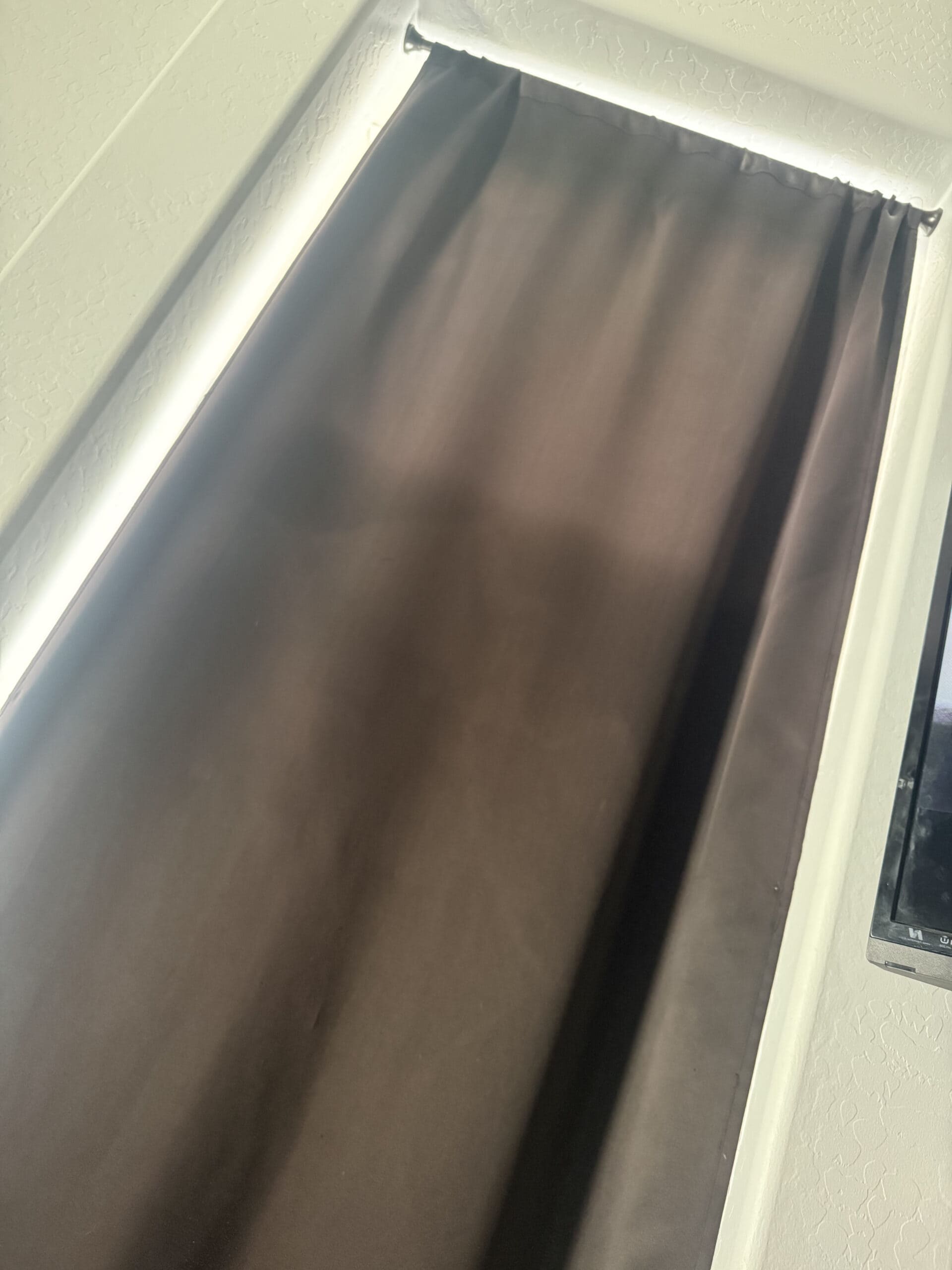
Less than people expect, because you push through a curtain without thinking about it in a way you never do with a door. Doorway curtains get in the way mainly in the first week, and after that the friction is small enough that most people stop registering it at all.
The complaints that do stick are specific rather than general, and they are worth knowing before you hang one. Our roundup of doorway curtains for privacy and light control covers the panels themselves.
Quick Answer
Passing through is easy and quickly becomes automatic. The real annoyances are a panel that swings back into you, one that catches on a full hamper or a vacuum, and carrying something in both hands. None of those are dealbreakers, and all of them are worse with a light unweighted panel.
Key Takeaways
- The learning curve is days, not weeks.
- Carrying things with both hands is the genuine friction point.
- Swing-back is the complaint people report most.
- Weight at the hem solves more than width does.
- A curtain that stops above the floor snags on less.
- You lose a latch, which matters for some doorways and not others.
| Situation | Friction Level | What Helps |
|---|---|---|
| Walking through empty-handed | None after a few days | Nothing needed |
| Carrying a laundry basket | Real | Shoulder through, or tie back |
| Vacuum cord or hose | Occasional catch | Hem above the floor |
| Panel swings back at you | Common early on | Weighted hem |
| Needing privacy with a latch | Not solved | A curtain is not a door |
| Pets pushing through | Usually fine | They adapt fast |
What Actually Bothers People
Swing-back is the leading complaint. You push the panel aside, it travels past vertical, and it comes back into your shoulder as you clear the frame.
Both hands full is the second. With a basket or a tray there is no free hand, so you end up shouldering through and feeling the fabric drag across whatever you are carrying.
Snagging is the third and it is mostly about hem height. A panel that touches the floor gets under a vacuum head, catches on a hamper lid, and collects whatever is on the floor near the doorway.
Noise is the quiet one nobody mentions. Fabric on a rod makes a soft sound with every pass, which some people find preferable to a latch clicking and others notice more than they expected.
Guests are the fifth and it is social rather than practical. People hesitate at a curtained doorway in a way they do not at an open one, because it is not obvious whether pushing through is allowed.
That hesitation fades once someone has done it once. It is worth knowing if the opening leads somewhere visitors need to use.
Several Passes a Day for Three or Four Years
The doorway curtain I use hangs in a doorway leading to a bathroom and a closet. It is a blackout panel, standard rather than thermal, and it stops a foot or two above the floor.
It goes through several passes a day. That has been the pattern for three to four years and the rod holding it has never come down.
What I noticed is about sightlines rather than about traffic. The panel is cut off by the bed frame when I am lying down, so from the position that actually matters, it is not visible.
Worth noting what kind of doorway that is. It leads to a bathroom and a closet, so it is a route rather than a boundary between two rooms anyone sits in.
What I cannot tell you is how a floor-length panel behaves in the same spot, or how this would go in a high-traffic doorway between two living spaces. Mine is short and the route is short, so treat the snagging sections as how the problem works rather than as something I have fought.
The Fixes for Each Complaint
For swing-back
Weight the hem. Sewn-in weights, a hem rod, or even a length of chain in the hem gives the panel enough mass to fall straight rather than rebound.
For both hands full
A tieback on one side, used when you know you are carrying things through. It takes a second and it removes the problem entirely for that trip.
For snagging
Raise the hem. A panel that clears the floor by an inch or two catches on almost nothing, and our roundup of blackout curtains that do not reach the floor covers that length.
For the rod itself
Size it properly and keep the panel within its rating. Our guide to whether tension rods fall down with blackout curtains covers the failure mode, and our roundup of curtain rods for doorways covers what to use.
What You Give Up Compared With a Door
A latch, first of all. A curtain cannot be closed against a pet, a child, or a draft in the way a door can, and no amount of weighting changes that.
Sound is the second. A panel absorbs a little and blocks almost nothing, so a curtain between a sleeping space and a noisy room is not going to do the job people hope for.
Full darkness at the edges is the third. A curtain hung on a rod leaves gaps at the sides and top unless it overlaps the frame generously, and our guide to stopping light leaking around blackout curtains covers closing those.
Where a Doorway Curtain Makes the Most Sense
Doorways you pass through rather than sit beside. A route to a bathroom or a closet is ideal, because nobody is spending time on either side of it.
Openings with no door at all, where the alternative is nothing. Here the comparison is not curtain against door, it is curtain against an open hole.
Openings where the alternative would be a door you would have to hang yourself. The cost difference is large enough that a curtain buys you time to decide whether the door is worth it.
Rentals and anywhere you cannot modify the frame. Our comparison of blackout curtains versus blinds covers the window version of that decision, and our guide to making a bedroom dark covers where a doorway panel fits in the wider job.
Recommended Reading
Frequently Asked Questions
Do doorway curtains get in the way?
Far less than people expect after the first few days, because pushing through becomes automatic. The genuine friction points are carrying something with both hands, a panel that swings back at you, and a floor-length hem that snags. All three have straightforward fixes.
How long does it take to get used to one?
Days rather than weeks for most people. The adjustment is learning to lead with a hand or a shoulder, which happens without deliberate effort. Pets adapt quickly too.
Do they swing back at you?
Light unweighted panels do, and it is the most common complaint. A weighted hem, a hem rod, or heavier fabric makes the panel fall straight instead of rebounding. This is the single best upgrade.
Should a doorway curtain touch the floor?
Not usually. A hem that clears the floor by an inch or two snags on far less, stays cleaner, and moves more predictably. Floor-length looks better and costs you in practicality.
Can you get privacy from a doorway curtain?
Visual privacy, yes, and nothing close to what a door gives you for sound. There is no latch, so anyone or anything can push through. Decide based on which kind of privacy you actually need.
Do doorway curtains block light?
A blackout panel blocks most of what comes through the opening and leaks at the edges. Overlapping the frame generously on both sides and at the top is what closes the gaps. Perfect darkness needs more than a single hanging panel.
What about carrying laundry through?
This is the real annoyance and the fix is a tieback on one side. Hook it back before a trip with your hands full and release it after. Most people only bother on laundry day.
Is a curtain better than no door at all?
For most openings that lack a door, comfortably yes. You gain visual separation and light control for very little money and no modification to the frame. The comparison that matters is against an open doorway rather than against a hung door.
