
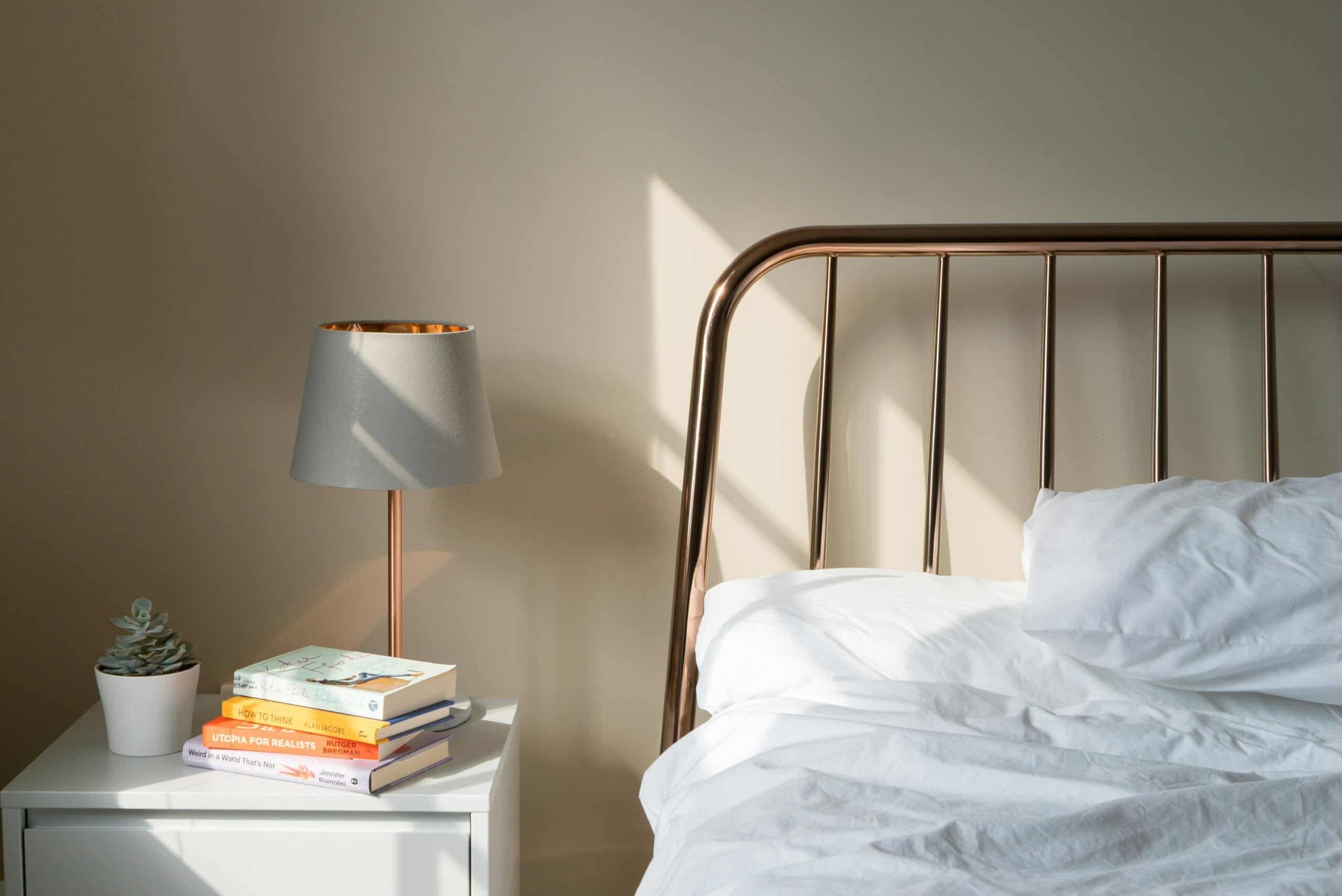
The bedroom is the only room where the furniture has to perform medical work. The bed supports your spine for a third of every day. The light source determines how easily you fall asleep. The nightstand decides whether your phone ends up six inches from your head or six feet away. The alarm clock controls how the day starts. Get these wrong and the bedroom works against sleep; get them right and the room sets you up for sleep before you even lie down. Comparing options? See our best space heaters for bedroom roundup.
Most bedroom setups grew by accumulation rather than design. A nightstand from a previous apartment. A lamp inherited from a parent. Sheets bought on sale years ago. The result functions, but rarely well. The guide below covers each essential category in turn: what the piece does for sleep specifically, the design and material considerations that matter, and where to spend versus save. The goal isn’t a magazine bedroom; it’s a setup that actively supports falling asleep, staying asleep, and waking up well.
Read top to bottom for a complete bedroom setup. Skip to specific sections for replacing or upgrading one piece at a time.
Key Takeaways
- The nightstand surface and bedside light are the two most impactful pieces of bedroom furniture beyond the bed itself, since they control what’s reachable at night and what the room looks like in the last waking minutes.
- Warm-temperature bulbs (under 2700K) at the bedside reduce blue-light exposure in the evening, which helps the circadian system prepare for sleep.
- Bed frames matter less than people assume. The bed’s support comes from the mattress; the frame just elevates it. Spend modestly here.
- Sheet thread count is overrated. Fiber quality and weave matter more for sleep comfort than the number on the package.
- A dedicated alarm clock (not your phone) keeps the phone out of arm’s reach overnight, which removes the single largest sleep-disrupting habit for most adults.
How to Use This Guide
The category sections below are ordered by sleep impact, not by traditional “essential” ranking. Bedside lighting first because evening light exposure directly affects sleep onset. Nightstand second because it controls what’s accessible at night. Linens third because they touch you for the entire sleep period. Bed frame, storage, and decor follow because they affect sleep less directly.
Each section ends with a link to the relevant roundup for specific product picks. Use the roundups for which model to buy; use this guide for what to buy and why.
Bedside Lighting: Lamps, Reading Lights, and Bulb Temperature
The light next to the bed does more work than most owners give it credit for. It’s the last light source before sleep and the first one after waking. The American Academy of Sleep Medicine notes that evening light exposure (particularly blue-spectrum light from screens and bright overhead bulbs) suppresses melatonin production and delays sleep onset. The bedside lamp is the corrective: a warm, dim light source that lets you read or wind down without triggering the wake-up signal that brighter cool-spectrum light produces.
The two specifications that matter for a bedside lamp are color temperature and dimmability. Color temperature under 2700K (warm white) is the target for evening use. Dimmability matters because a single bright setting is wrong for both reading (too dim) and the last final minutes before sleep (too bright). A lamp with three brightness levels or full dim control handles both cases.
For dedicated reading specifically, a focused reading light at the bedside outperforms general bedside ambient light. The focused beam keeps light off the partner’s side of the bed and reduces overall light spill in the room. See the best bedside lamps for reading before bed for the picks.
For waking up, sunrise alarm clocks gradually brighten the room over roughly half an hour before the target wake time, mimicking natural dawn. They’re particularly useful in winter or for early risers who wake before natural sunlight. See the best wake-up light alarm clocks.
Nightstands and Bedside Surfaces
The nightstand’s job is to put exactly the right things within arm’s reach: water, lamp, reading material, alarm clock. Its job is also to NOT put certain things within reach: your phone, your laptop, work notes. The surface size and drawer count determine which.
For most sleepers, a single small drawer plus an open surface large enough for a lamp, glass of water, and book is enough. Larger nightstands with multiple drawers store more but encourage clutter, which over time fills the surface and pushes essentials off it.
Height matters more than the showroom catalog suggests. The nightstand surface should sit at or slightly above the top of the mattress so reaching the lamp doesn’t require sitting up. Mattress-and-foundation combinations vary widely in total height; measure before buying.
Material matters less than people think for sleep purposes. Wood, metal, upholstered, or modern composite all work. Stability matters: a tippy nightstand becomes a nighttime hazard.
Bed Frame and Headboard
The bed frame elevates the mattress, contains the foundation, and provides aesthetic anchor for the room. None of these jobs require premium spending. A solid, well-constructed metal or wood frame in the appropriate size works as well as a designer frame for sleep purposes.
The headboard adds support for sitting up to read but otherwise is decorative. Padded headboards make extended reading more comfortable than wood or metal. Tall headboards block light from headboards-side windows.
What matters: solid construction with no creaking joints (loose frame joints become a long-term irritant as they squeak with every movement), appropriate size match to your mattress (a queen frame with a king mattress is unstable), and bed-frame slats spaced no more than 3 inches apart for foam mattress support (wider spacing can cause sagging over years).
Platform beds eliminate the need for a separate box spring or foundation. Storage beds add under-bed drawers but reduce floor-level airflow under the mattress (which can matter in humid climates).
Bed Risers, Rails, and Safety Accessories
Bed risers raise the bed by several inches, creating under-bed storage space and making it easier for taller sleepers to get in and out. For seniors and people with hip or knee issues, the right bed height (about knee-height when standing) reduces strain on the legs during the dozens of in-and-out transitions per week. Bed risers are the easy adjustment when the existing frame’s height isn’t right.
Bed rails serve safety functions for elderly users, recovery from surgery, and people prone to falling out of bed. They’re not just for medical settings; many older adults benefit from one bed rail on the active side. See the best bed rails for elderly for the supportive options.
For sleepers with mobility limitations, a transfer rail or grab handle near the bed gives a secure handhold for sitting up and standing.
The Bedroom Essentials Decision Matrix
Most bedrooms don’t need every category equally. The right setup depends on the household, the room’s lighting, and your specific sleep needs. The matrix below maps common scenarios to their essential priorities and the satellite guide for each.
| Your Situation | Critical Essentials | Approach | Detailed Guide |
|---|---|---|---|
| New bedroom setup (apartment move-in) | Bed frame, nightstand, bedside lamp with warm bulb, dedicated alarm clock, sheets | Start with the basics; add storage and decor over time | Bedside lamps |
| Older adult or aging-in-place | Bed at knee-height, bed rail on active side, easy-reach nightstand, warm lighting | Safety and ease of in-and-out transitions are primary | Bed rails for elderly |
| Light-sensitive sleeper | Warm bedside lamp (under 2700K), sunrise alarm clock, no overhead bright lighting after sunset | Control evening light exposure and morning waking | Wake-up lights |
| Small bedroom (apartment-sized) | Compact nightstand, under-bed storage, single bedside lamp, no overhead clutter | Maximize floor space without sacrificing essentials | Compact bedside lamps |
| Co-sleepers with different schedules | Two independent bedside lamps, dedicated alarm clocks (not phone alarms), reading light with focused beam | Independent lighting prevents one partner waking the other | Focused reading lights |
| Heavy reader (in bed) | Focused reading light, supportive headboard, reading pillow or wedge | Position-and-light combination for extended reading | Bed wedge pillows |
| Phone-as-alarm habit | Dedicated alarm clock, charging station outside the bedroom, sunrise alarm if light-sensitive | Move the phone out of arm’s reach for better sleep hygiene | Wake-up alarm clocks |
| Recovery from injury or surgery | Bed rail, bed at appropriate transfer height, easy-reach nightstand, possibly wedge pillow | Mobility support during recovery period | Bed rails |
The matrix is a planning tool, not a strict rule. Treat “Critical” essentials as the buy-first list and let the rest accumulate based on observed needs.
Sheets, Pillowcases, and Linens
Sheets touch your skin for the entire sleep period. The material and weave affect temperature regulation, moisture wicking, and how the bed feels against the skin. Thread count is the most marketed metric and the least useful one. Above about 400 thread count, additional thread count is mostly marketing.
What matters: fiber type, weave structure, and care characteristics. Long-staple cotton (Egyptian, Pima, Supima) outperforms short-staple cotton for both feel and durability. Linen breathes better than cotton in hot weather but creases more. Tencel and bamboo blends offer moisture-wicking similar to linen with the feel of cotton.
Weave matters: percale weave is crisp and cool to the touch, ideal for hot sleepers. Sateen weave is smoother and slightly warmer, suiting cooler sleepers or those who like a silkier feel.
Pillowcases match the sheet set in most cases but can be upgraded independently. Silk or satin pillowcases reduce hair friction and may benefit some sleepers with skin concerns.
📑 Recommended Read: The bedside lamp choice has more sleep impact than most furniture decisions because it determines what your eyes see in the 60 minutes before sleep. Warm-temperature bulbs paired with dimming control let the room signal sleep rather than wakefulness. See the best bedside lamps for reading before bed for warm-spectrum picks with proper dim ranges.
Alarm Clocks: Dedicated vs. Phone-Based
The phone alarm is the most common alarm method and one of the more disruptive sleep habits. The phone within arm’s reach overnight means you check it before sleep, possibly during night wakings, and immediately on waking. Each check exposes the brain to bright light, alerting content, and the cognitive load of social media or email. Sleep quality suffers measurably.
A dedicated alarm clock lets the phone live in another room or across the bedroom on a charger. The clock handles the wake-up function; the phone handles the rest of the day. Pairing this with a sunrise alarm clock (which uses gradually brightening light as the wake signal) often produces more pleasant wake-ups than a buzzer alarm alone.
The clock face should be either backlit on demand only (not constantly visible glowing) or in a position where you don’t see it from the pillow. Constant visible clock numbers at 3 AM create anxiety loops; a covered clock face removes that trigger.
See the best wake-up light alarm clocks for the picks.
Bedroom Storage and Organization
Bedroom clutter affects sleep more than people credit. Visual clutter in the last waking minutes activates the cognitive load that the brain is trying to wind down from. A bedroom with everything in its place reduces this activation; a bedroom with visible piles maintains it.
Under-bed storage handles seasonal clothing, extra linens, and rarely-used items without crowding closets. The shallow under-bed space (3 to 6 inches typically) limits what fits but the volume can be substantial across the full bed footprint.
Dresser sizing depends on closet capacity. Bedrooms with large closets don’t need extensive dresser storage; bedrooms with small closets benefit from a tall dresser. A bench at the foot of the bed adds both seating and lid-style storage in a small footprint.
The principle: storage that’s easy to put away gets used; storage that’s hard to access stays empty. Drawer pulls that work, doors that don’t stick, and storage at body-friendly heights all matter for daily use.
Bedroom Decor That Affects Sleep
Rugs add warmth and noise dampening. A bedside rug specifically gives a soft landing for feet in the morning, which makes getting out of bed feel less harsh in cold seasons.
Plants add minor air-quality benefits and visual calming. Plants may modestly reduce particulate matter; the larger effect is psychological. Best bedroom plants tolerate lower light: pothos, snake plant, ZZ plant, peace lily.
Wall color matters for the morning more than the evening. Light-colored walls reflect early morning light, brightening the room faster; dark walls absorb light and keep the room darker for longer (potentially helpful for shift workers or those who sleep past sunrise).
Curtains and window treatments overlap with the cool-bedroom and dark-bedroom guidance. For sleep specifically, blackout curtains or layered shades are the highest-impact decor choice. See bedroom cooling and darkening coverage for related picks.
Mattress Protectors and Toppers
Mattress protectors extend mattress life and protect against spills, sweat, and allergens. They’re worth the modest investment because they preserve the much-larger mattress investment. Waterproof protectors are sweat-and-spill-proof; basic protectors handle allergens and dust mites.
Mattress toppers are a different category: they modify the feel of an existing mattress without replacing it. A too-firm mattress can be softened with a memory foam topper; a too-soft mattress can be firmed with a latex topper. See the best mattress toppers for seniors for options that add joint support to existing mattresses.
For pregnant sleepers, body pillows and wedge pillows substantially improve sleep position comfort. See the best pregnancy pillows and the best bed wedge pillows for specialty support options.
Spending Tiers: When to Spend, When to Save
Spend on: bedside lamp (used twice daily, affects sleep quality), sheets (touch your skin all night, replaced every few years), and dedicated alarm clock (replaces the phone-in-bedroom habit). These categories produce sleep impact disproportionate to their cost.
Save on: bed frame (the mattress does the work, the frame just holds it), nightstand (basic function is what matters), most decor (cosmetic, doesn’t affect sleep), and headboard (decorative unless you do significant in-bed reading).
The pattern: spend where the item interfaces with sleep behavior; save where it’s structural or cosmetic. A premium bed frame doesn’t make a premium mattress work better; a premium bedside lamp can directly improve evening wind-down.
Common Bedroom Setup Mistakes
Bright overhead lighting as the only light source. Forces you to choose between a dark room and a wide-awake brightness level. Add bedside lighting at minimum; consider task lighting for closet and dresser zones separately.
Phone on the nightstand. The single most disruptive sleep habit for most adults. Move the charger out of the bedroom or to a wall outlet across the room.
Wrong-height bed. Too low makes getting up hard on knees and hips; too high makes getting in feel like climbing. Bed risers or different frame can fix this without replacing the mattress.
Wall-clock placement visible from the pillow. Reading the clock at 3 AM creates anxiety. Either remove the visible clock face or face it away from the pillow.
Cluttered nightstand surface. Visual clutter activates cognition right before sleep. Keep the nightstand surface to lamp, water, book, alarm clock.
Cool-spectrum bulbs (high Kelvin) at the bedside. Bright white or daylight bulbs suppress melatonin. Warm white (2700K or lower) is the correct color temperature for evening use.
Buying sheets by thread count alone. Above ~400 thread count, additional count is mostly marketing. Fiber quality and weave matter more.
Frequently Asked Questions
What’s the minimum bedroom setup for good sleep? Bed, mattress, two pillows, sheet set, bedside lamp with warm bulb, and dedicated alarm clock. Everything else is upgrade tier. Many sleepers function well on this minimum.
How much should I budget for bedroom essentials? Beyond the mattress itself, a basic bedroom (frame, nightstand, lamp, alarm clock, sheets, basic decor) totals a few hundred to a thousand dollars depending on quality tier. The lamp and sheets are worth premium dollars; frame and nightstand can be budget without losing function.
Do I need a headboard? Optional. Headboards make extended in-bed reading more comfortable and visually anchor the room. Many bedrooms work fine without one.
What color temperature should my bedside bulb be? Under 2700K (warm white) for evening use. Anything 3000K or higher (cool white, daylight) suppresses melatonin and delays sleep onset.
Should I use a smart bulb at the bedside? Optional but useful. Smart bulbs can shift color temperature throughout the day (cooler in the morning, warmer in the evening). Manual warm bulbs work too.
Are blackout curtains worth it? For light-sensitive sleepers, shift workers, or anyone in a bedroom that faces streetlights or sunrise-direction windows: yes. The sleep impact is substantial. For others, regular curtains plus a sleep mask is a workable substitute.
How often should I replace sheets? Quality sheets last a few years with normal use and proper care. Replace when they thin noticeably, when stains and discoloration persist after washing, or when the elastic on fitted sheets fails.
What’s the right thread count for sheets? 300 to 500 for most weaves. Higher numbers above 800 are usually marketing rather than functional improvement. Fiber type matters more than thread count.
Should I keep my phone in the bedroom? Keeping the phone out of the bedroom is the cleaner setup. The phone affects sleep through light exposure, cognitive activation, and overnight checking habits. A dedicated alarm clock plus phone-in-other-room is the cleaner setup.
How important is the bed frame for sleep quality? Less than people assume. The mattress does the sleep work; the frame holds it. Spend modestly on the frame; spend more on the mattress and pillow.
References
- American Academy of Sleep Medicine. Healthy Sleep Habits and the Impact of Light Exposure on Circadian Rhythm. sleepeducation.org/healthy-sleep/healthy-sleep-habits
Recommended Reading
See also our guides to bedroom air conditioners, and space heaters for bedroom.
Related Reading
Explore more: bedroom air conditioners, how to choose sleep aids, air quality monitors for bedroom, space heaters for bedroom, how to keep your bedroom cool in summer, dehumidifiers for bedroom, how to choose a weighted blanket, and The Side Sleeper’s Guide to Waking Up Without a Kinked Neck.
Also see: jersey sheets, silk sheets, tencel sheets, bedroom floor lamps.
- If money is the constraint, where the cheap wins actually are.
- If you cannot drill anything, what changes when you are renting.
- how to improve sleep quality naturally
- anti snore devices
