
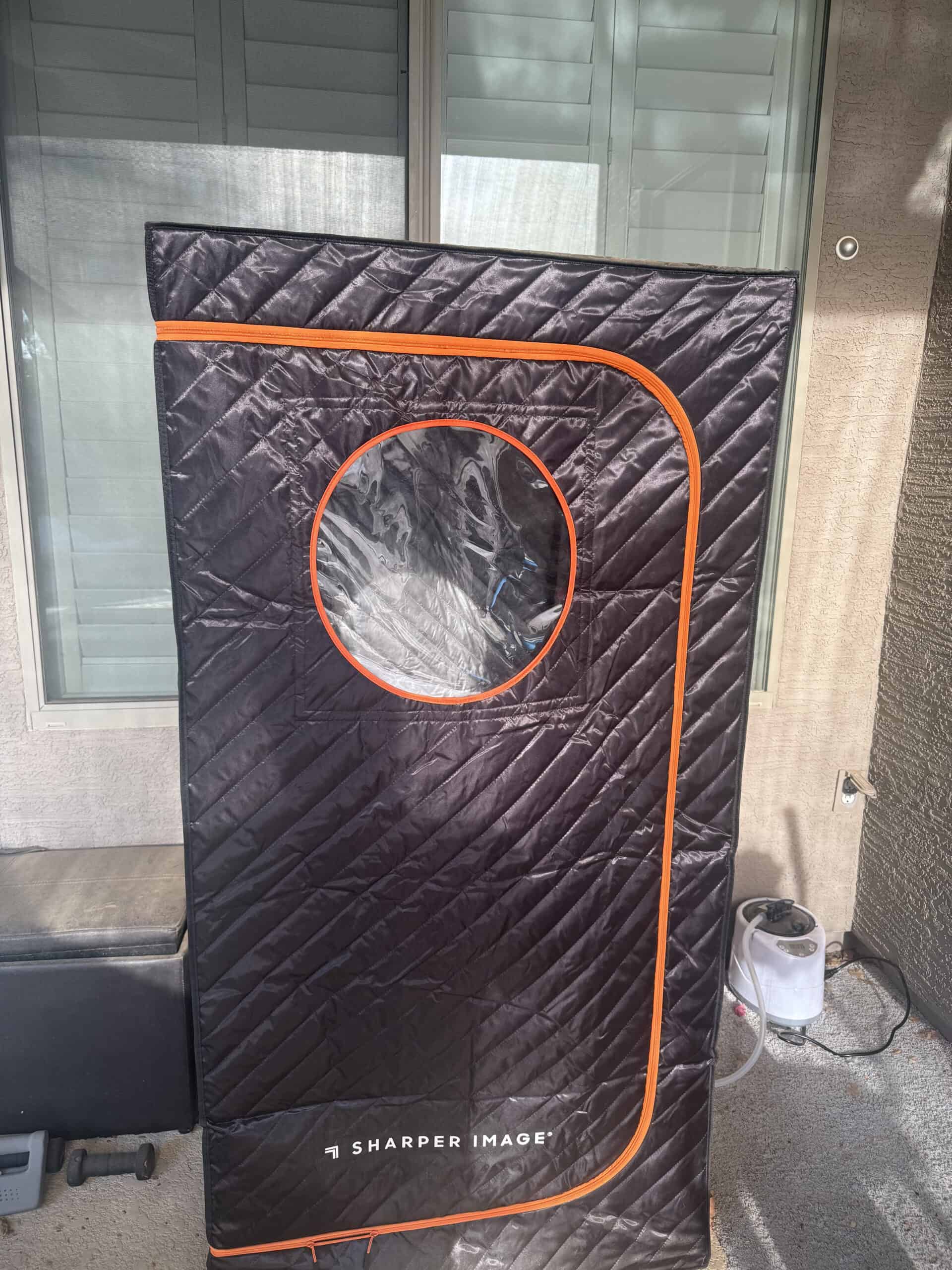
My first portable sauna lasted about six months. The wiring burnt out and after that it would not work at all, which is the whole failure story: no dramatic event, no warning, just a unit that stopped heating and never heated again.
I replaced it with a different model rather than the same one, and that second unit has been going over a year. Two units is not a study, and it is more than most people writing about these have. Our roundup of portable saunas covers the category.
A Safety Note
Portable saunas draw significant power through a heating element, and electrical faults carry fire risk. Never use one with damaged wiring, a scorched connector, or any burning smell. Use the supplied cable rather than an extension lead, do not run one unattended, and follow the manufacturer’s instructions on placement and clearance.
Quick Answer
The common failure is the heating unit or its wiring rather than the tent. It usually presents as no heat at all. Repair is rarely practical, and replacement is normally the outcome.
What Fails
The heater or generator unit
The component doing the work and the one that goes. This is what failed on mine.
Wiring and connectors
The junction between cable and unit carries the load and heats up in normal use, and that is where failure tends to appear.
Zips and seams on the tent
Annoying rather than terminal. A tent with a failed zip still works imperfectly; a dead heater does not work at all.
Controls and timers
Where a unit has a control panel, that is another thing to fail. Simpler units have less to go wrong. Our note on whether portable saunas are safe covers the risks.
How Mine Failed
It ran fine, then it did not. The wiring burnt out and afterward the unit would not work at all, which meant the sauna itself was intact and useless.
Six months is not a long life for something under regular use. I used it for twenty to thirty minute sessions several times a week, which is regular rather than heavy.
What I could not tell from the outside was whether that unit was a bad example or the price point is simply unreliable. Mine cost under a hundred dollars, and at that price the electronics are where the savings come from.
The replacement is a different model and has passed a year on the same usage pattern, which suggests the first one was a bad unit rather than the whole category being six-month equipment.
Whether to Repair
Generally not, and the arithmetic is straightforward. A replacement heater unit frequently costs a large share of a new complete sauna, and at the budget end there is no meaningful gap between repairing and replacing.
Electrical repair on a heating element is also not a DIY job. Anything that burnt out once can do it again, and doing your own work on a mains-powered heater is not a sensible risk.
Where the tent has failed and the heater works, buying a replacement tent is more viable, since that is a fabric problem rather than an electrical one.
Check whether the manufacturer sells components separately before assuming either way. Some do, and many at this price point do not. Our roundup of sauna accessories covers what is available separately.
Warranty at This Price Point
Budget units carry short warranties, frequently a year or less, and claiming against one means dealing with a seller rather than a manufacturer.
Keep the order record and any packaging with model numbers. Six months into ownership is exactly when you no longer have either, and exactly when these fail.
Buying through a platform with its own returns process gives you a second route when the manufacturer is unreachable, which at this end of the market is worth something.
The realistic expectation is that an under-hundred-dollar sauna is close to disposable, and pricing it that way at purchase avoids disappointment later.
What You Are Actually Buying at This Price
Under a hundred dollars buys a fabric tent, a frame, a chair, and a heating unit. Three of those four are simple and durable; the fourth is where everything goes wrong.
The tent is fabric with a zip and a window. Barring a tear, there is little to fail, and mine outlived its own heater comfortably.
The frame is tubing that assembles and disassembles. It either fits together or it does not.
The heating unit is the entire electrical and mechanical content of the product, and it is where a manufacturer working to a budget makes its savings. Understanding that reframes what you are actually gambling on when you buy one.
It also explains why replacing the whole thing tends to make more sense than repairing part of it. You are not repairing a sauna, you are replacing the only complicated component in it.
Signs Something Is Going Wrong
Heating more slowly than it used to, or not reaching the temperature it used to, suggests the element is degrading.
Any burning smell, scorch marks near a connector, or warmth in the cable itself means stop using it. Those are fire risks rather than performance complaints.
Intermittent operation, where it works sometimes, generally precedes complete failure rather than resolving.
A tripping breaker is a clear signal to stop and not to reset and continue. Our note on how long a portable sauna takes to heat up covers what normal looks like.
Buying the Replacement
I chose a different model rather than the same one again, which felt obvious at the time and is worth stating as a principle: a unit that failed early has told you something about that product.
The current one is a one-person tent-style sauna with a steam generator pot, an included chair, a viewing window, and a metal frame. It lives outside in the backyard.
Simplicity has been the useful quality. Fewer electronic controls means fewer components between the plug and the heat.
Whether spending more would buy genuine reliability I cannot say, since I have only bought at the budget end. What I can say is that the second budget unit has outlasted the first by a factor of two so far. Our note on putting a portable sauna outside covers the placement.
Extending the Life
Let it dry properly between uses. Steam saunas put a lot of moisture into a fabric enclosure, and packing it away damp encourages problems in both the tent and anything electrical near it.
Store the generator unit somewhere dry rather than leaving it in the tent outdoors permanently.
Do not run it longer than the instructions allow. Twenty to thirty minutes is my session length and it is within what these are designed for.
Handle the cable and connector carefully, since that junction is where the load concentrates and where mine gave out.
Portable Sauna Failure FAQ
How long do portable saunas last?
My first lasted about six months and the replacement has passed a year on the same usage. At the budget end, treating one as semi-disposable sets a more realistic expectation than assuming years.
What usually breaks?
The heater unit or its wiring rather than the tent. Mine burnt out at the wiring and would not work at all afterward, with the fabric enclosure completely intact.
Can it be repaired?
Rarely worth it. Replacement heater units cost a large share of a whole new sauna at this price, and electrical repair on a heating element is not a DIY job.
Are there warning signs?
Slower heating, lower peak temperature, or intermittent operation all suggest a failing element. Burning smells, scorch marks, or a warm cable mean stop immediately.
Should I buy the same model again?
I did not. A unit that failed early has told you something about that product, and I chose a different model which has lasted considerably longer so far.
Is the warranty useful?
Short at this price point, often a year or less, and claiming means dealing with the seller. Keep the order record and model number, since six months in is when you no longer have either.
Does more money buy reliability?
I cannot say from experience, having only bought at the budget end. What is clear is that at under a hundred dollars the electronics are where the cost was saved.
How do I make one last?
Dry it properly between uses, store the generator unit somewhere dry, keep sessions within the stated limits, and be careful with the cable and connector where the load concentrates.
