
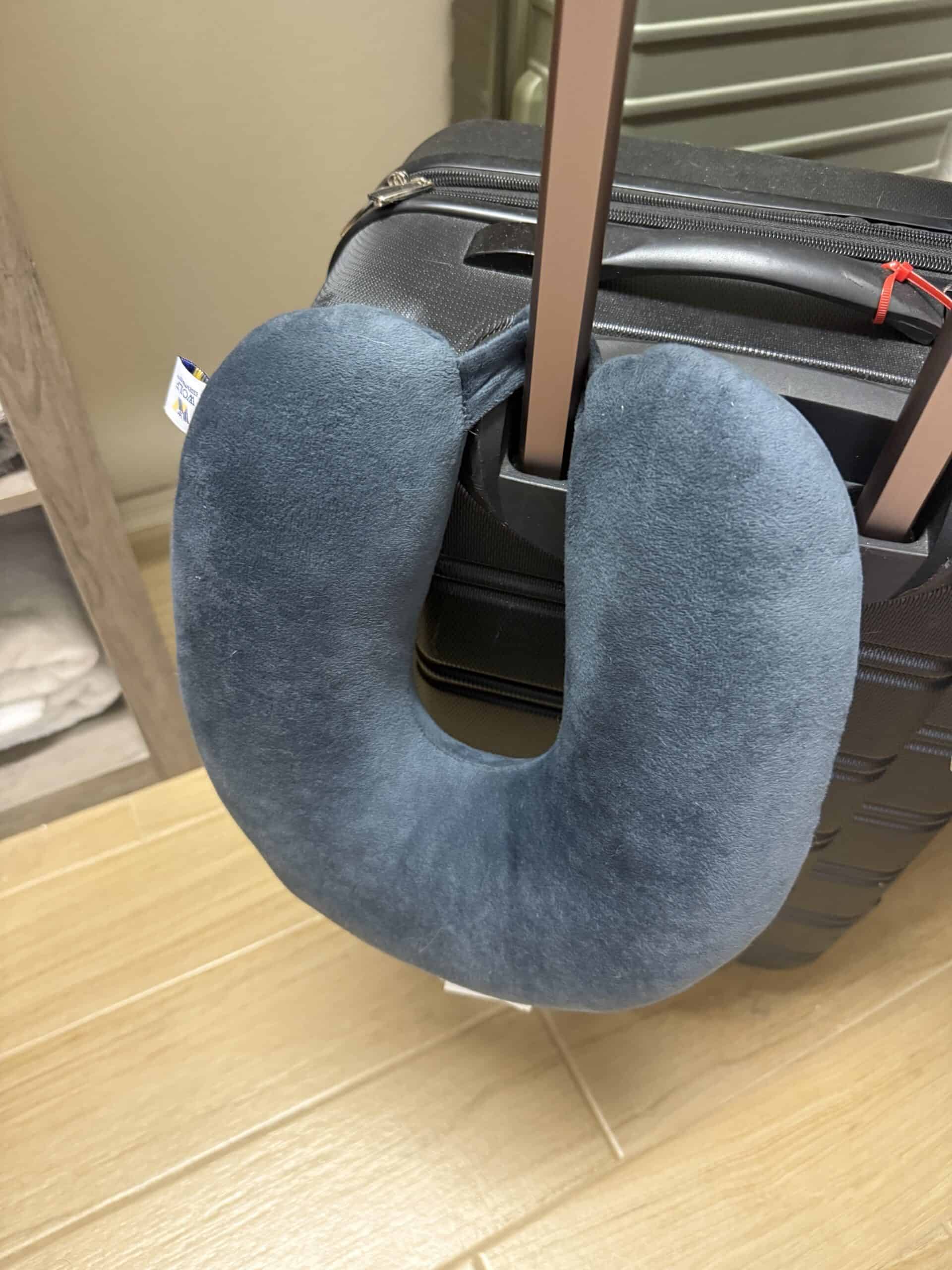
The packing problem is decided at purchase rather than at the suitcase. Memory foam does not compress, so a foam pillow is the same size in your bag as it is on your neck.
Mine is memory foam and bulky, and it has a clip for attaching to luggage. That clip is the whole packing strategy, because there is no version where it goes inside a bag without taking real space. Our note on what size travel pillow you need covers choosing one.
Quick Answer
Foam pillows attach to the outside of a bag. Inflatable and compressible ones pack inside. Which you own decides the method, and there is no technique that makes foam small.
Packing by Type
| Type | Packs to | Method |
|---|---|---|
| Memory foam | Full size | Clip to the outside |
| Inflatable | Very small | Deflate, roll, pocket |
| Microbead | Squashes somewhat | Compress into a gap |
| Compressible foam | About half | Stuff sack |
| Fiber fill | Compresses well | Squash into a corner |
| Inflatable with cover | Small plus cover | Cover packs separately |
Why Foam Will Not Compress
Memory foam is an open-cell structure that returns to shape, which is the property that makes it support your neck for hours without flattening.
That same property means squashing it into a bag achieves nothing lasting. It pushes back, and it will occupy the space it wants as soon as pressure comes off.
Forcing it into a compression sack for long periods is worse than useless, since prolonged compression can damage the cell structure and reduce how well it recovers.
So the answer with foam is not to pack it but to carry it, which is why every foam travel pillow ships with some form of attachment. Our roundup of travel pillows that attach to luggage covers those. Our note on cleaning a travel pillow covers that in more detail.
Attachment Types and Which Hold
Manufacturers solve the carrying problem several ways and they are not equally good.
Snap clips are the most common and the weakest, since the plastic gate opens under a sideways knock and the pillow is gone without a sound.
Loop-and-toggle systems thread around a handle and cannot fall off unless untied, which is slower to attach and considerably more secure.
Elastic straps with a buckle hold well and stretch over time, which shows up as a pillow gradually sitting lower on the bag.
Some pillows have a sleeve that slides over a luggage handle entirely. That is the most secure arrangement and it only works with upright wheeled bags.
Whichever it uses, the attachment is the part that decides whether you still own the pillow at the end of the trip. Our roundup of pillows for side sleepers covers those systems.
Making the Clip Work
Attach it high
A pillow clipped near the handle stays clear of wheels and does not swing into your legs while walking.
Use a fixed point
A luggage handle or a strap loop holds better than a zip pull, which can be pulled open by the weight.
Accept the swing
A U-shaped foam pillow hanging off a bag is a large object that moves. There is no arrangement that makes it discreet.
Check it after security
Clips come loose in the shuffle of unpacking and repacking, and a pillow left behind is a common loss. Our note on sleeping on a plane covers the rest of the setup.
None of those systems makes a foam pillow small, and they are the difference between carrying one comfortably and fighting with it at every connection.
How Mine Travels
Clipped to the bag, because there is no other option with a foam pillow of that size.
It is bulky and that has never changed in over five years, since bulk is not something a product improves at with age.
The support has held throughout, which is the trade being made. Foam that keeps its shape on your neck is foam that keeps its shape in your bag.
If I were buying again, packed size is the specification I would weigh more heavily, because the support was never the thing giving me trouble. Our note on why a travel pillow gets hot covers the other trade.
Inflatable Solves Packing and Costs Support
Deflated, an inflatable pillow fits in a jacket pocket, which removes the problem entirely.
It also lets you adjust firmness, so one pillow covers several fits rather than being the size it is.
What you give up is consistency. Air pressure changes with altitude and temperature, and slow leaks mean waking up on a flat pillow.
The valve is the failure point, and a pillow that will not hold air is not repairable in any practical sense. Our roundup of travel pillows for road trips covers both types.
What Counts as Carry-On
A travel pillow clipped to a bag sits in an awkward category, and rules vary more than people expect.
Most airlines treat a neck pillow as a personal item rather than counting it against your allowance, which is why clipping it outside is generally safe.
Budget carriers with strict single-bag policies are the exception, and a pillow hanging off a bag has occasionally been counted at the gate.
A pillow inside your bag never causes a problem and costs you the space, which is the trade for anyone flying with tight limits.
Inflatable pillows sidestep this entirely by fitting in a pocket, which is one more argument for them if you fly budget carriers often. Our note on memory foam pillows covers the flight itself.
Where It Goes on the Trip
On a plane the pillow is out and in use for most of the journey, so packing only really matters at either end of the trip.
Overhead lockers are where foam pillows get crushed by other bags, which is survivable and not ideal.
In a car, a foam pillow lives on the back seat and takes no thought, which is why road trips are where they suit best.
Walking between connections is the worst part of owning one, since that is when a swinging pillow is genuinely in the way. Our roundup of sleep gear for frequent travelers covers packing the rest.
Knowing which category your pillow falls into before a trip saves the exercise of trying to make a foam one behave like an inflatable one at the departure gate.
If You Must Pack Foam Inside
Put it in first and pack around it rather than trying to force it into a gap at the end.
Let it fill the middle of a soft bag, since clothes compress around foam better than foam compresses around clothes.
Do not leave it compressed for weeks, because prolonged pressure is the one thing that genuinely damages memory foam.
And give it time to recover after unpacking, since a pillow squashed for a day comes back within an hour rather than instantly.
Packing a Travel Pillow FAQ
How do you pack a memory foam travel pillow?
You generally do not. Clip it to the outside of your bag, which is why foam pillows ship with attachments. Mine has always traveled clipped on.
Can I compress memory foam?
Briefly, and it pushes back immediately. Prolonged compression damages the cell structure, so a compression sack is the wrong tool for long periods.
Where should I clip it?
High on the bag near the handle, on a fixed loop rather than a zip pull. It will still swing, and there is no arrangement that makes a U-shaped foam pillow discreet.
Are inflatable pillows better for packing?
Considerably. Deflated they fit in a pocket. What you give up is consistency, since air pressure shifts with altitude and slow leaks are common.
Does packing damage the pillow?
A day squashed in a bag is fine and it recovers within an hour. Weeks under pressure is what causes lasting damage to foam.
What if I have to pack it inside?
Put it in first and pack clothes around it. Foam does not compress around your belongings, and your belongings compress around foam.
Is bulk worth it for the support?
That is the trade. Mine has held its support for over five years and is the same bulky object it always was. If I bought again, packed size would matter more to me.
Do pillows get lost in transit?
Frequently, and usually because a clip came loose during security or a bag change. Checking it after each stage is worth the second it takes.
For the wider picture, see our guide to how to choose the right pillow for your sleep position.
