
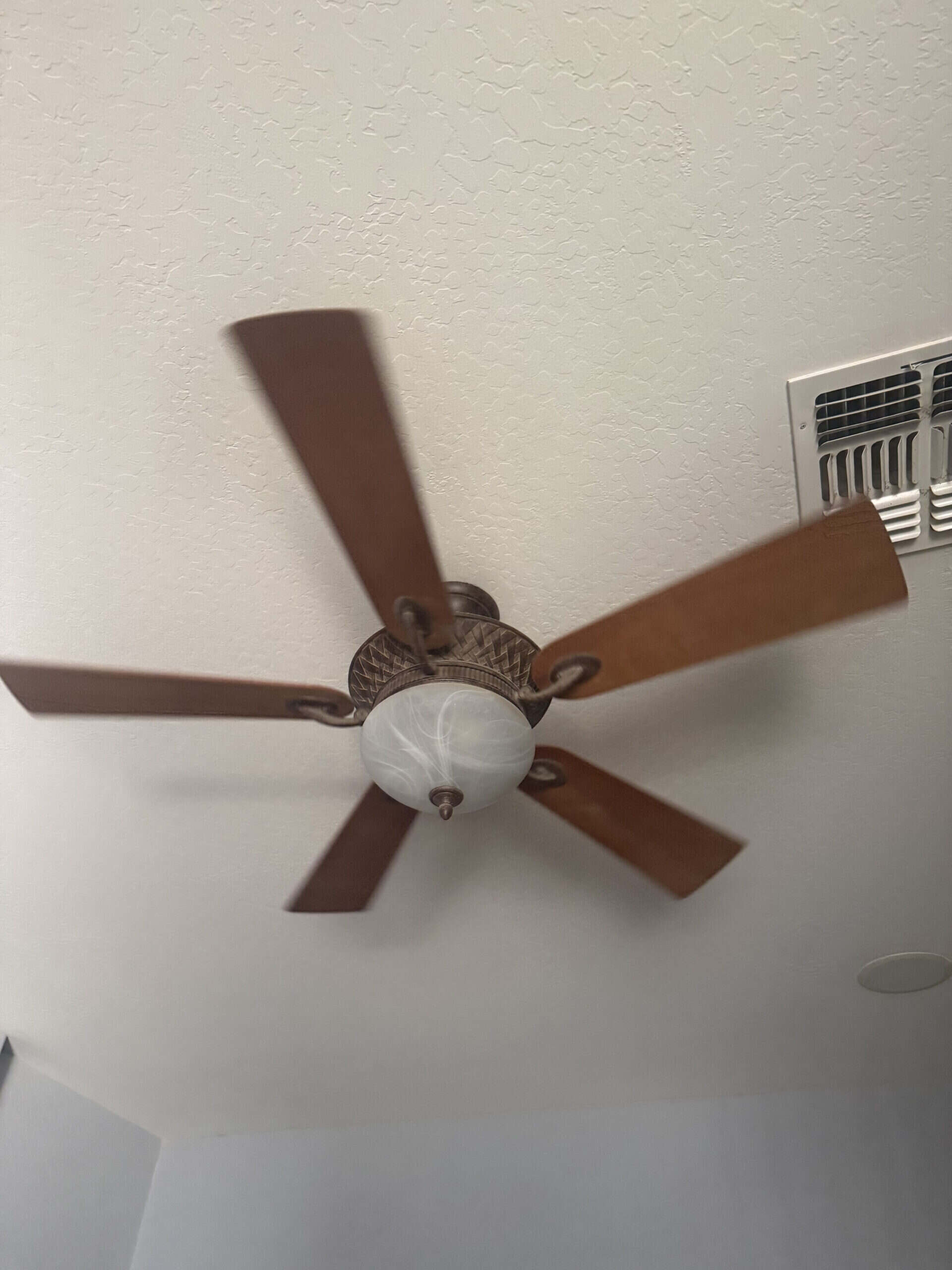
Counterclockwise in summer, clockwise in winter. That is the whole answer, and the reason most people have never checked is that a ceiling fan moves air either way, so nothing obviously breaks when it is set wrong.
Mine is currently running clockwise, which is the winter setting, and summer around here is exactly when the fan matters most of all. Working out that it had been running on the wrong direction the whole time is more or less the reason this article exists at all. Our roundup of ceiling fans for bedrooms covers the hardware.
Quick Answer
Counterclockwise viewed from below pushes air straight down and produces a cooling breeze on your skin. Clockwise pulls air up and pushes warm ceiling air down the walls without any draft.
Direction at a Glance
| Direction | Season | What it does |
|---|---|---|
| Counterclockwise | Summer | Downdraft, direct breeze, wind chill effect |
| Clockwise | Winter | Updraft, redistributes warm air, no draft |
| Counterclockwise on high | Hot nights | Maximum perceived cooling |
| Clockwise on low | Cold nights | Mixes ceiling heat without chilling you |
| Either, wrong season | Any | Works against what you want |
| Off | Mild nights | No noise, no air movement |
Why Counterclockwise Cools You
A ceiling fan does not lower room temperature. It moves air, and moving air over skin accelerates evaporation, which is what your body registers as cooling.
Blades angled and spinning counterclockwise push a column of air straight down beneath the fan, and that column reaches the bed directly.
The effect is entirely about air contacting you. Step out from under the fan and the cooling stops, because the room itself has not changed temperature at all.
That is also why running a ceiling fan in an empty room accomplishes nothing except using electricity, which is the single most common piece of ceiling fan advice and the one people ignore most.
For sleeping, the practical implication is that the fan needs to be over the bed rather than over the middle of a room that happens to contain a bed. Our note on whether ceiling fans cool a room covers the mechanism.
Why Clockwise Warms a Room
Warm air rises and collects against the ceiling, which is where the heat sits in any room with heating running.
Clockwise rotation pulls room air upward toward the fan and pushes the warm ceiling layer outward and down along the walls.
The point is that it does this without creating a draft you can feel, because the air comes down the walls rather than straight onto you.
Speed matters more here than in summer. Clockwise on high creates enough circulation to produce a draft anyway, which defeats the purpose entirely.
Low speed, clockwise, is the winter setting, and the effect is subtle enough that plenty of people conclude it does nothing and switch back. Our roundup of bedroom space heaters covers the heat source.
How to Tell Which Way Yours Spins
Stand directly underneath it
Direction is defined from below looking up, not from the side.
Feel for the downdraft
If you feel a breeze standing under it, it is counterclockwise.
Watch the leading edge
In summer mode the higher edge of each blade leads.
Check the switch on the housing
Most fans have a small slide switch on the motor body. Our roundup of ceiling fan remotes covers models with remote reversal.
Mine Was on the Wrong Setting
My fan has a reverse switch and I have used it, and it is currently running clockwise.
Clockwise is the winter direction, and summer here is brutal enough that cooling is the entire reason the fan runs at all.
That is a fairly ordinary mistake to make. The switch gets flipped once, the fan keeps moving air, and nothing about the room tells you the direction is wrong.
It is also the kind of thing that costs nothing to fix and takes about thirty seconds, which is why it is worth checking rather than assuming.
The fan runs mostly year-round here, so the direction should be changing twice a year and has not been. Our note on cooling sheets covers the bedding side.
Running a Ceiling Fan and a Floor Fan Together
I run both, and they do different jobs rather than duplicating each other.
The ceiling fan moves the whole room’s air in a broad circulation pattern, which is why it works on a room scale.
A floor fan produces a directed stream you can aim, which is far more effective at putting air on a specific person in a specific spot.
Running both means room-scale circulation plus targeted airflow, and in a hot climate that combination does considerably more than either alone.
The cost is noise from two sources, and floor fans are generally the louder of the two. Our note on ceiling fan versus floor fan covers the comparison.
Speed Matters as Much as Direction
Summer wants counterclockwise and enough speed to produce a breeze you can actually feel on skin.
Winter wants clockwise and low speed specifically, because the goal is circulation without draft.
Running a fan at maximum speed all night is the common approach and it is not necessarily the best one, since more speed also means more noise.
Finding the lowest speed that still produces the cooling you want is worth a few nights of experimenting, particularly if noise wakes you.
Some fans have a noticeable step between speeds where one setting is inadequate and the next is too loud, which is a hardware limitation rather than something you can adjust around.
The Thermostat Point
Because a fan cools people rather than rooms, running one lets you set an air conditioner higher while feeling the same.
Published guidance generally suggests a few degrees of thermostat adjustment is possible with a fan running, which is where the energy saving comes from.
That only works while somebody is in the room, which is why leaving fans running in empty rooms wastes the saving.
For a bedroom that runs overnight, this is one of the more straightforward efficiency measures available, since the fan is running anyway. Our roundup of bedroom air conditioners covers the cooling side.
Common Mistakes to Avoid
Never checking the direction
The fan moves air either way, so nothing tells you it is wrong. Mine has been on the winter setting.
Running clockwise on high in winter
That creates the draft the winter setting exists to avoid.
Leaving it on in an empty room
Fans cool people, not rooms. An empty room gains nothing.
Assuming the fan lowers temperature
A thermometer reads the same with the fan on. What changes is how the air feels on skin.
Recommended Reading
See our roundup of quiet fans for sleeping, our roundup of floor fans for bedrooms, our note on bamboo cooling blankets, and a roundup of cooling blankets.
Ceiling Fan Direction FAQ
Which way should a ceiling fan spin for sleeping?
Counterclockwise in summer, viewed from below. That pushes air straight down and produces the breeze that makes you feel cooler.
Which way is yours currently?
Clockwise, which is the winter setting. Summer here is brutal and cooling is the whole reason the fan runs, so that is backwards.
How do I check?
Stand directly underneath. If you feel a breeze, it is counterclockwise. Direction is defined from below looking up rather than from the side.
Where is the reverse switch?
Usually a small slide switch on the motor housing. Some fans reverse from the remote or a wall control instead.
Does clockwise actually help in winter?
On low speed, yes. It pushes warm ceiling air down the walls without creating a draft. On high it creates the draft it is meant to avoid.
Does a ceiling fan lower the temperature?
No. A thermometer reads the same. The fan moves air over skin, which accelerates evaporation and feels cooler.
Should I run a ceiling fan and a floor fan together?
They do different things. The ceiling fan circulates the room, the floor fan aims a stream at you. I run both, and in a hot climate the combination beats either alone.
What speed should I use?
In summer, the lowest speed that still produces a breeze you can feel. In winter, low specifically, since higher speeds create the draft you are trying to avoid.
