
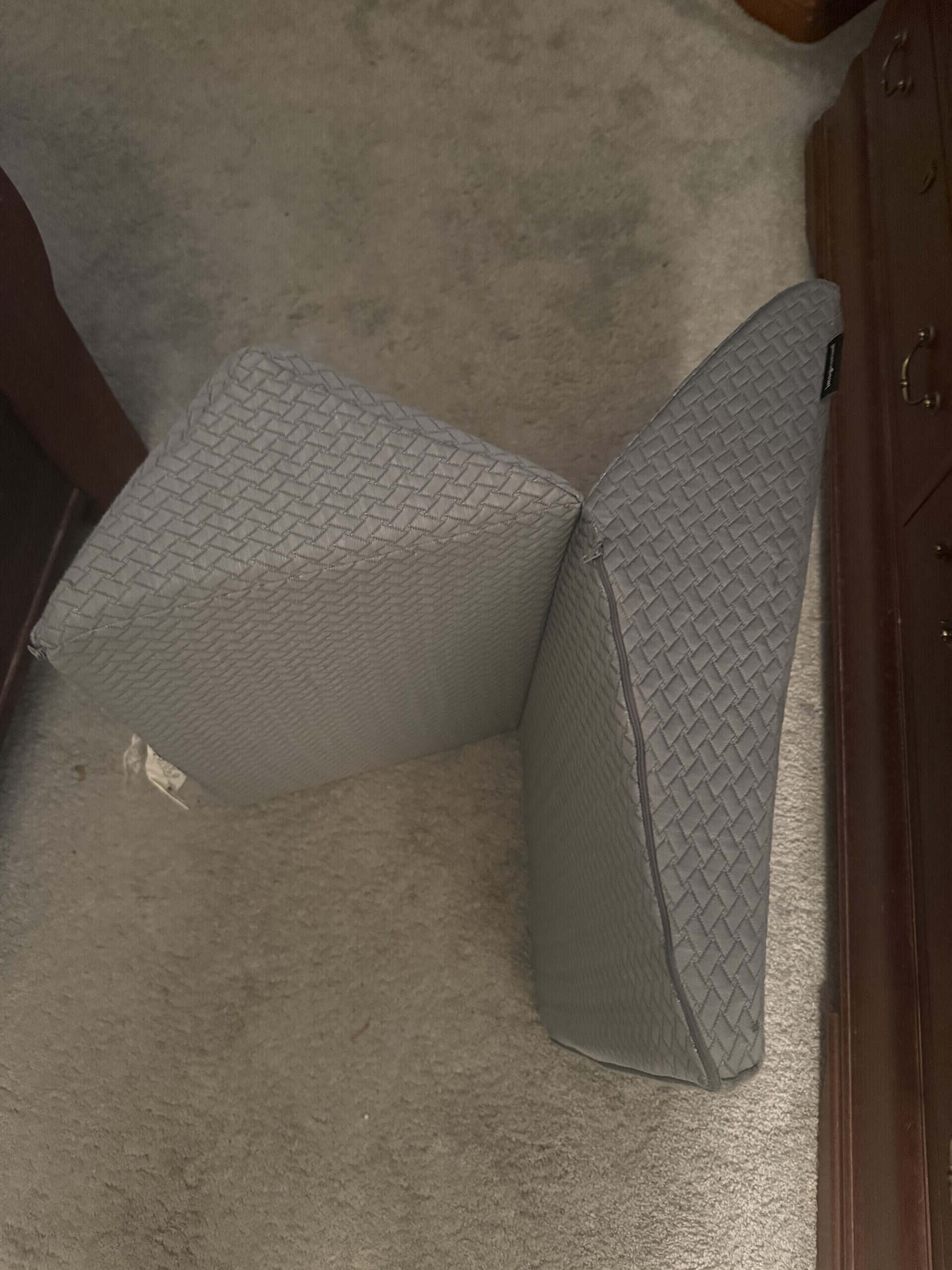
A fixed wedge gives you one incline and asks you to build the rest of your setup around it. Adjustable systems, whether they fold, stack, or hinge, let the same pillow serve leg elevation at a shallow angle and upper body support at a steeper one. That flexibility is the whole argument for them, and it comes with a real trade in stability, since anything with a joint has somewhere to shift. Our roundup of bed wedge pillows covers the fixed versions.
Quick Verdict
A folding multi-position wedge suits most people, since it changes angle in seconds and stores flat. Stackable layer systems give finer height control, and a hinged frame model is the sturdiest option if you want one setting to stay exactly where you put it.
Key Takeaways
- Folding wedges swap between leg and torso angles in seconds.
- Stackable layers give finer height steps than folding designs.
- Every joint is a potential place for the pillow to shift.
- Firmness matters more than adjustability for staying put.
- Cover fabric affects sliding more than most people expect.
How We Picked
Systems are grouped by how they change angle, since folding, stacking, and hinging behave differently under load and store differently when not in use. Stability is weighted alongside adjustability, because a wedge that moves while you are on it defeats the purpose regardless of how many positions it offers.
Selections reflect construction and documented adjustment ranges. Descriptions come from product research except where personal use is stated directly.
1. A Folding Multi-Position Wedge, Best Overall
Why It Stands Out
Folding wedges use two or three hinged foam sections that lock into different configurations, so the same pillow becomes a shallow leg ramp or a steeper back support depending on how you set it.
They also fold flat for storage, which matters for something that otherwise takes up a large share of a bed or a closet shelf.
Worth Knowing
The number of genuinely useful positions is usually smaller than the marketing count. Some configurations are stable and comfortable, and others exist because the geometry allows them.
Foam density decides whether the folded shape holds under weight. A soft folding wedge collapses toward flat as you settle onto it, which is the most common disappointment here. Our note on what wedge height you need covers matching the angle to the purpose.
This suits most people. Skip it if you only ever use one angle.
2. A Stackable Layer System, Best for Fine Height Control
Why It Stands Out
Systems built from separate foam layers let you add or remove height in small increments rather than jumping between two or three preset angles.
Layers can also be split between purposes, using a low stack under the legs and the remainder behind the back.
Worth Knowing
Stacked layers can slide against each other unless the system uses interlocking surfaces or a shared cover. Check how the layers are held together rather than assuming they stay aligned.
Storing several loose pieces is also harder than storing one folded object. Our roundup of bolster pillows covers a simpler single-piece alternative.
This suits anyone between two standard heights. Skip it if loose pieces would irritate you.
3. A Hinged Frame Wedge, Best for Stability
Why It Stands Out
Wedges with an internal frame and a locking hinge hold their angle mechanically rather than relying on foam stiffness, so the set position stays put under full weight.
This is the closest thing in the category to an adjustable bed at a fraction of the cost and with none of the installation.
Worth Knowing
Frames add weight and cost considerably more than foam-only designs. They are also less pleasant to lean against directly, so cushioning quality matters more.
Moving parts eventually loosen, and a hinge that develops play is the failure mode here. Our comparison of wedge pillows and adjustable beds covers the step up.
This suits anyone wanting the angle to stay exactly set. Skip it if weight or price matters.
4. A Convertible Wedge and Bolster Set, Best Versatility
Why It Stands Out
Sets pairing a wedge with a separate knee bolster cover both ends of leg elevation, letting you raise the calves with the wedge and support the knees independently.
The pieces also work separately, so the bolster has a use on nights the wedge stays in the closet.
Worth Knowing
Two pieces means two things to position and two things to store, and the bolster is easy to lose track of down the side of a bed.
Matching firmness between pieces matters, since a soft bolster under a firm wedge creates a step rather than a smooth line. Our roundup of knee pillows covers the bolster side separately.
This suits combined knee and calf support. Skip it if one piece would do.
5. An Inflatable Adjustable Wedge, Best for Travel and Storage
Why It Stands Out
Inflatable wedges set any angle within their range by how much air you put in, and they deflate to almost nothing when not needed.
For a spare room, a trip, or a small bedroom with no storage, that packability solves a problem foam cannot.
Worth Knowing
Air feels different from foam under weight, and some people find the surface unstable in a way foam is not. It also changes firmness slightly with room temperature.
Punctures end the pillow, so a patch kit is worth having. Our note on using a wedge pillow covers positioning whichever type you choose.
This suits travel and tight storage. Skip it if you want the feel of foam.
6. A Wedge With a Non-Slip Cover, Best Against Sliding
Why It Stands Out
Adjustability means nothing if the pillow travels down the bed. Covers with a grippy underside or a textured base hold position on sheets far better than smooth fabric.
This is also the cheapest variable to change, since a replacement cover costs a fraction of a new wedge.
Worth Knowing
Grippy fabrics tend to be less breathable, which matters if you sleep hot or use the wedge for long stretches.
Cover material also behaves differently with temperature, and some fabrics get noticeably slicker in a cold room. Our guide to stopping a wedge from sliding covers the full range of fixes.
This suits anyone whose wedge moves. Skip it if yours already stays put.
Adjustable Systems at a Glance
| Type | Angle changes | Stability | Stores |
|---|---|---|---|
| Folding multi-position | Preset configurations | Good if firm | Folds flat |
| Stackable layers | Fine increments | Depends on grip | Loose pieces |
| Hinged frame | Locked positions | Best | Bulky |
| Wedge and bolster set | By combination | Good | Two pieces |
| Inflatable | Continuous | Varies | Packs smallest |
| Non-slip cover | Not applicable | Improves any | Not applicable |
The Wedge I Use
Mine is a folding multi-position wedge with no brand tag on it anywhere, so I will not guess the maker. It spends most of its time under my legs while I am watching TV or working in bed, and occasionally I refold it and lean against it instead.
It is sturdy, which is the part I would emphasize to anyone choosing between designs. A folding wedge lives or dies on whether the foam holds its shape once you put weight on it, and mine does. It stays where I put it most of the time without any additional grip mat or strap.
The one thing that annoys me is the fabric. When the room is cold it gets a little slippery, and that is when the wedge is most likely to shift. It is not enough to make me replace anything and it is the kind of detail nobody mentions when describing these.
Worth being clear about the limits of that. I use it while awake rather than sleeping a full night on an incline, so I cannot tell you how a folding wedge holds up over eight hours or how the hinge behaves under a whole night of movement. For that, the research below applies rather than my experience.
What to Look For in an Adjustable Wedge
How firm is the foam?
This matters more than the number of positions. A soft folding wedge flattens toward horizontal as you settle onto it, which removes the angle you set.
How many positions are genuinely useful?
Marketing counts every configuration the geometry permits. In practice two or three are stable and comfortable, and the rest are technically possible.
Where does it store?
A wedge is a large object. Folding designs collapse flat, stackable layers become several pieces, and hinged frames stay bulky. That decides whether it lives on the bed permanently.
What is the cover like?
Grip against sheets is what stops it traveling, and it is the cheapest thing to change. Removable and washable matters too, for something that sees skin contact.
Adjustable or Fixed?
The case for adjustable
One pillow covering leg elevation and torso support, changed in seconds. If you want both jobs from one object, this is the category, and folding designs also store far better than a fixed triangle.
The case for fixed
No joints, nothing to shift, and generally firmer for the money. If you use one angle for one purpose, a fixed wedge does that better and costs less. Our comparison of wedge pillows and leg elevation pillows covers choosing by purpose.
Common Adjustable Wedge Mistakes to Avoid
Buying on position count
More configurations does not mean more useful ones. Firmness and stability matter considerably more than how many angles the geometry allows.
Ignoring foam density
A soft adjustable wedge collapses under weight and gives you an angle that changes as you use it. Firm foam is what holds a set position.
Overlooking the cover
Sliding is the most common complaint about wedges of every type, and the cover is the cheapest variable. Fabric behavior also changes with room temperature.
Assuming adjustable replaces an adjustable bed
A wedge changes the angle of a pillow, not the angle of the mattress. For a medical requirement to sleep inclined every night, those are different products. Our note on elevating your legs in bed covers what elevation does.
Recommended Reading
See our roundup of foam wedge pillows for leg elevation, our note on pillows for acid reflux, our body pillow picks, and a guide to sleeping with restless legs, and choosing the right pillow for your sleep position.
Adjustable Wedge FAQ
Are folding wedges as firm as fixed ones?
The good ones are, and the cheap ones are not. A folding wedge relies on foam density to hold its configuration under weight, so a soft one flattens toward horizontal as you settle onto it. Firmness is the specification that matters most in this category.
How many positions do I actually need?
Usually two: a shallow angle for leg elevation and a steeper one for propping up. Marketing counts every configuration the geometry permits, and most people settle into a small number of them within a week.
Do adjustable wedges slide more than fixed ones?
Not inherently, since sliding depends mainly on foam firmness and cover fabric rather than on whether the pillow folds. A firm adjustable wedge with a grippy cover stays put as well as a fixed one.
Can I use one for both legs and my upper body?
That is the main reason to buy one. A folding design changes between a shallow leg ramp and a steeper back support in seconds, which is what a fixed wedge cannot do without buying a second pillow.
Is a hinged frame worth the extra cost?
If you want the angle to stay exactly where you set it under full weight, yes, since a mechanical lock does not depend on foam stiffness. The trade is weight, price, and eventually a hinge that develops play.
Do inflatable wedges work as well as foam?
They adjust more finely and pack away to nothing, and the surface feels different under weight in a way some people dislike. Firmness also shifts slightly with room temperature. For travel and storage they solve a problem foam cannot.
How do I stop mine from sliding?
Start with the cover, since fabric against sheets is usually the cause and a grippy cover is the cheapest fix. A non-slip mat underneath works too. Firmer foam helps, because a wedge that compresses unevenly starts to travel.
Can I sleep on an adjustable wedge all night?
Many people do, and it depends on the design holding its angle for eight hours under a moving sleeper. Firm foam or a mechanical lock is what makes that work. If overnight incline sleeping is a medical need, discuss it with a doctor rather than choosing on product features alone.
