
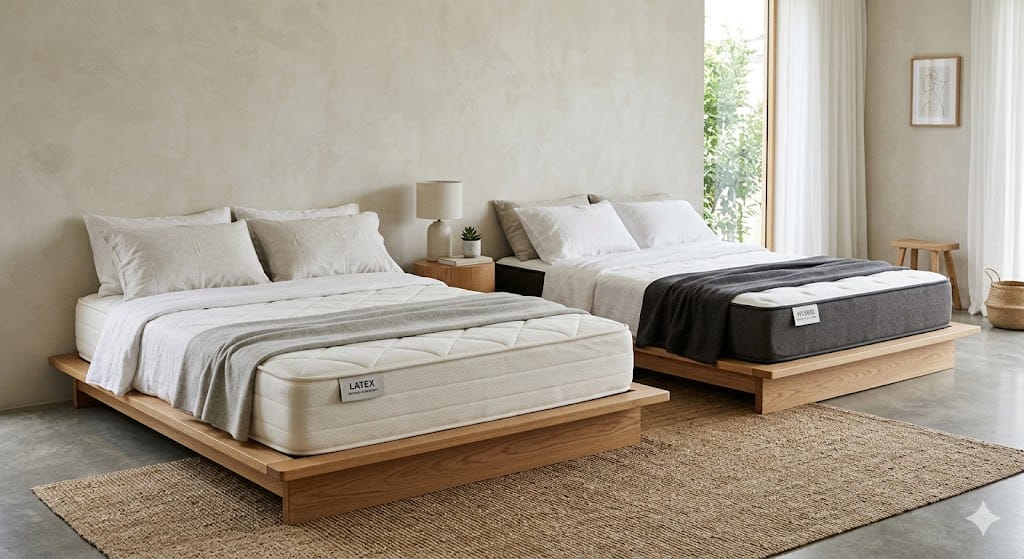
The mattress decision is one of the few purchases where you genuinely cannot afford to get it wrong. You will spend roughly a third of your life on whatever you choose, and the wrong mattress produces consequences that compound across years, back pain, bad sleep, daytime fatigue that follows you into your relationships and your work. For recommendations, see our best mattress toppers guide.
If you have narrowed your search down to hybrid versus latex, you have already filtered out most of what is on the market. Both are premium mattress categories. Both offer real advantages over basic memory foam or traditional spring mattresses. The choice between them is not about which is better in some absolute sense, but about which matches your specific sleep style, body type, climate, budget, and priorities.
This guide breaks down the actual differences between hybrid and latex mattresses in 2026, which one serves best, and how to decide with confidence. We cover construction, support, cooling, durability, motion isolation, edge support, value, and the specific scenarios where each type wins decisively.
What Is a Hybrid Mattress?
A hybrid mattress combines an innerspring coil support system with comfort layers of foam, latex, or other materials. The defining feature is the pocketed coil base, typically 800 to 1,500 individually wrapped coils that respond independently to body pressure.
The comfort layers above the coils vary by manufacturer. Most modern hybrids use a combination of memory foam (for pressure relief) and either gel-infused foam or natural latex (for cooling and bounce). Premium hybrids sometimes include cashmere wool, organic cotton, or specialty cooling materials in the top layer.
The coil layer is what distinguishes hybrids from foam mattresses. Pocketed coils provide responsive support that adjusts to your body without the sinking sensation of pure memory foam. The coils also create airflow throughout the mattress, addressing the heat retention problem that plagues solid foam construction.
A typical hybrid mattress is 11 to 14 inches thick. The coil layer accounts for roughly half the height, with comfort layers making up the rest.
What Is a Latex Mattress?
A latex mattress uses layers of latex rubber as the primary construction material, with no coils involved. The latex can be either natural (derived from rubber tree sap), synthetic (petroleum-based), or blended.
Natural latex is the gold standard for the category. The Dunlop and Talalay manufacturing processes produce different feels, Dunlop is denser and firmer, Talalay is softer and more responsive. Most premium latex mattresses use one or both, layered to create a specific feel and support profile.
Latex provides a fundamentally different sleeping surface than any other mattress material. It contours to the body without the deep sink of memory foam, returns to its original shape immediately when pressure is removed, and has a natural buoyancy that some sleepers describe as floating on the surface rather than sinking into it.
A typical latex mattress is 9 to 13 inches thick, made of 2 to 4 layers of latex of varying firmness. Many premium latex mattresses allow the user to rearrange the layers to adjust firmness, which is a unique feature of the category.
How Hybrid and Latex Mattresses Compare on the Criteria That Matter
The right choice depends on which criteria matter most for your specific situation. Here is how the two categories compare across the seven factors that drive most mattress satisfaction.
Support and Spinal Alignment
Hybrid mattresses excel at responsive support. The pocketed coil layer provides targeted lift under heavier areas (hips, shoulders) while allowing lighter areas (lower back, ankles) to settle into their natural position. This zoned support is particularly valuable for back sleepers and combination sleepers whose support needs change with position.
Latex mattresses provide consistent support across the entire surface. The latex itself has natural elasticity that contours without sinking, producing spinal alignment that some sleepers find more natural than the targeted zoning of a hybrid. Side sleepers with sensitive shoulders or hips often prefer latex because it cradles pressure points without creating the firm push-back that some hybrid coil systems produce.
For back sleepers and stomach sleepers, hybrid mattresses generally provide better support. For side sleepers, particularly those who weigh under 180 pounds, latex often produces better pressure relief.
Cooling and Temperature Regulation
Hybrid mattresses are generally cooler than latex mattresses, and significantly cooler than memory foam mattresses. The coil layer creates airflow throughout the mattress, dissipating heat that builds up under the body. For hot sleepers in warm climates, this airflow is the single biggest functional advantage of hybrid construction.
Latex mattresses are cooler than memory foam but warmer than hybrids. Natural latex has an open-cell structure that allows some airflow, but the dense material itself retains more heat than a coil-based system. For sleepers in cool climates or those who run cold, this is fine. For hot sleepers in warm climates, it can be a problem.
For sleepers in Phoenix, Las Vegas, Houston, Miami, or similar hot climates without consistent AC use, a hybrid is the safer choice. For sleepers in cooler climates, both work, with the choice driven by other factors. Our guide on the best mattresses for hot sleepers covers the broader cooling-mattress category.
Motion Isolation
Latex mattresses have excellent motion isolation. Movement on one side of the mattress does not transfer meaningfully to the other side. For couples where one partner moves frequently during sleep or has different sleep schedules, latex prevents disturbance better than most other materials.
Hybrid mattresses vary significantly in motion isolation depending on the coil system and comfort layers. Premium hybrids with high-quality pocketed coils and substantial foam layers can match latex for motion isolation. Budget hybrids with weaker coil systems often transmit motion noticeably.
For couples specifically, latex is the more reliable choice for motion isolation across price points. Premium hybrids can match it but require careful selection. Our guide on the best mattresses for couples covers this in more detail.
Edge Support
Hybrid mattresses have superior edge support due to reinforced perimeter coils used in most modern hybrid construction. You can sit on the edge of the bed without significant sinking, sleep close to the edge without feeling like you might roll off, and use the full surface area of the mattress without losing usable space.
Latex mattresses generally have weaker edge support. The consistent material throughout means edges compress similarly to the center, which can produce a feeling of rolling off when sleeping near the edge or sinking deeply when sitting on the edge to put on shoes.
For smaller mattresses (twin, full) where every inch of usable surface matters, a hybrid is the better choice. For king and California king mattresses, where edge usage is less critical, the difference matters less.
Durability and Lifespan
Latex mattresses are the most durable mattress type on the market. A high-quality natural latex mattress can last 15 to 20 years with proper care, far exceeding the 7 to 10-year lifespan typical of other mattress categories. The latex material itself is highly resistant to compression, sagging, and degradation.
Hybrid mattresses last 8 to 12 years on average, depending on coil quality and comfort layer construction. Premium hybrids with high-coil-count systems and quality foam layers approach the upper end of that range. Budget hybrids often show sagging and reduced support within 5 to 7 years.
For long-term value calculations, latex frequently produces a lower per-year cost despite a higher upfront price. A $2,500 latex mattress lasting 18 years costs $139 per year. A $1,500 hybrid mattress lasting 9 years costs $167 per year. The math often favors latex on durability alone.
Allergen and Chemical Considerations
Natural latex has documented antimicrobial and antifungal properties. The material is naturally resistant to dust mites, mold, and bacteria, significant advantages for allergy sufferers. Most natural latex mattresses are also free from the chemical flame retardants and adhesives common in foam mattress construction.
Hybrid mattresses vary widely on chemical content. Premium hybrids from CertiPUR-US certified manufacturers use materials with restricted chemical profiles. Budget hybrids may contain memory foam treated with chemicals that off-gas for weeks or months after delivery.
For allergy sufferers, sleepers with chemical sensitivities, or those prioritizing low-VOC bedrooms, natural latex is the clearer choice. Our guide on mattress protectors for allergies covers the protective layer that pairs with either mattress type for allergen management.
Price and Value
Hybrid mattresses range from $400 to $3,000+ for queen sizes, with the meaningful quality threshold around $800 to $1,200. Premium hybrids like Saatva Classic, Helix Midnight Luxe, and similar tier products run $1,500 to $2,500 and deliver excellent value for the materials and construction.
Latex mattresses range from $1,200 to $4,000+ for queen sizes, with the meaningful quality threshold around $1,800 to $2,500. Premium latex mattresses like PlushBeds Botanical Bliss, Avocado Green Mattress (with a latex layer), and Eco Terra run $2,000 to $3,500 and represent significant investments.
The price difference is substantial. A quality hybrid can be acquired for half to two-thirds the cost of a comparable-quality latex mattress. For budget-constrained buyers, a hybrid is the only practical option in the premium-quality tier.
The value calculation changes when you factor in durability. The longer lifespan of latex offsets some of the price difference over the full life of the mattress. But the upfront cost is real and meaningful for most buyers.
Who Should Choose a Hybrid Mattress
Hybrid mattresses are the right choice in several specific scenarios.
For back sleepers and stomach sleepers, the responsive coil support produces better spinal alignment than the consistent surface of latex.
For hot sleepers in warm climates, the airflow created by the coil layer addresses heat retention more effectively than latex.
For combination sleepers who change positions frequently throughout the night, the bouncy, responsive feel of hybrid construction makes position changes easier than the slower-rebounding feel of latex.
For couples on smaller mattresses (queen or smaller) where edge support matters, hybrid construction provides usable edge space that latex cannot match.
For budget-constrained buyers who need premium-quality construction at accessible prices, hybrids deliver more performance per dollar than latex in the under-$1,500 range.
For sleepers who specifically want a “traditional” mattress feel with bounce and responsiveness, a hybrid provides that experience without sacrificing modern pressure relief.
Who Should Choose a Latex Mattress
Latex mattresses are the right choice in different specific scenarios.
For side sleepers, particularly those under 180 pounds, the contouring pressure relief of latex addresses shoulder and hip pain better than most hybrid configurations.
For couples prioritizing motion isolation, latex outperforms most hybrids at matching price points and matches premium hybrids at higher price points.
For allergy sufferers and those with chemical sensitivities, natural latex provides hypoallergenic, low-VOC construction that hybrid mattresses can match only at the premium tier.
For long-term value calculation, buyers willing to pay more upfront for a substantially longer lifespan, latex produces better cost-per-year math in most scenarios.
For environmentally conscious buyers, natural latex is the most sustainable mattress material in commercial production. Hybrid construction inherently involves more synthetic materials.
For sleepers who specifically dislike memory foam’s sinking sensation and want responsive contouring without bounce, latex provides a unique feel that no other mattress material replicates.
Quick Comparison Table
| Criterion | Hybrid Wins | Latex Wins |
|---|---|---|
| Support for back/stomach sleepers | ✓ | |
| Pressure relief for side sleepers | ✓ | |
| Cooling for hot sleepers | ✓ | |
| Motion isolation for couples | ✓ | |
| Edge support | ✓ | |
| Durability and lifespan | ✓ | |
| Allergen and chemical profile | ✓ | |
| Lower upfront cost | ✓ | |
| Long-term value (cost per year) | ✓ | |
| Environmental sustainability | ✓ |
How to Make the Decision
If you are still unsure after reading the criteria above, three questions usually clarify the choice.
First, what is your primary sleep position? If you are a back or stomach sleeper, a lean hybrid. If you are a side sleeper, lean towards latex. If you are a combination sleeper, lean toward a hybrid for the easier position changes.
Second, are you a hot sleeper in a warm climate? If yes, the hybrid is the safer choice. If no, both work, and the choice is driven by other factors.
Third, what is your budget? Under $1,500, the hybrid is the only category with meaningful quality options. $1,500 to $2,500, both categories have excellent options, and the choice is driven by sleep-style preferences. Over $2,500, both categories offer premium options with the latex investment paying off in a longer lifespan.
For sleepers experiencing pain or specific conditions, our guides on the best mattresses for back pain, the best mattresses for side sleepers, and the best mattresses for couples cover the specific recommendations within each scenario.
Our Verdict
For most sleepers, a quality hybrid mattress is the practical choice. The combination of strong support, good cooling, accessible pricing, and broad sleep-style compatibility makes hybrids the right answer for the majority of buyers. Premium hybrids in the $1,500 to $2,500 range deliver excellent quality and serve well across years of daily use.
For sleepers with specific scenarios where latex excels, primarily side sleepers under 180 pounds, allergy sufferers, environmentally conscious buyers, and those prioritizing 15-20 year mattress lifespan, natural latex justifies the higher upfront cost. The investment pays off in better sleep and lower per-year cost.
For couples whose partners have different sleep needs, the best solution is sometimes a split-firmness mattress in either category rather than a compromise on a single firmness across the bed. Both hybrid and latex categories offer split configurations at the premium tier.
Whatever you choose, plan to test the mattress through a real return period, most quality manufacturers offer 100 to 365-night sleep trials. Use the trial. Sleep on the mattress for at least 30 nights before making a final decision. The first week feels different than the second month, and the second month is what your long-term experience will look like.
Pair the right mattress with the right mattress topper if you want to fine-tune the feel, the right pillow for your sleep position, and a thoughtful bedroom temperature and lighting setup, and you have addressed the major contributors to sleep quality. The mattress is the foundation, but it is not the only factor.
Frequently Asked Questions
Is a hybrid or latex mattress better for back pain?
Both can work for back pain, but the better choice depends on your sleep position. Back sleepers with back pain typically do better on hybrids because the coil zoning supports the lumbar curve while allowing the upper and lower body to settle properly. Side sleepers with back pain often do better on latex because the consistent contouring relieves pressure on hips and shoulders without creating misalignment. For specific recommendations, see our guide on the best mattresses for back pain.
Are latex mattresses worth the extra cost?
For specific scenarios, yes. Latex’s longer lifespan (15-20 years vs 8-12 for hybrids) often produces better cost-per-year math. Allergy sufferers, environmentally conscious buyers, side sleepers, and couples prioritizing motion isolation get specific benefits worth paying for. For most other buyers, a quality hybrid in the $1,500-$2,500 range delivers comparable performance at a lower upfront cost.
Which is cooler, hybrid or latex?
Hybrid mattresses are generally cooler than latex mattresses. The coil layer in hybrid construction creates airflow throughout the mattress, dissipating body heat more effectively than the dense latex material. For hot sleepers in warm climates, this is one of the biggest functional advantages of hybrid construction.
How long does a latex mattress last compared to a hybrid?
Natural latex mattresses typically last 15 to 20 years with proper care. Quality hybrid mattresses last 8 to 12 years. The longer lifespan of latex frequently offsets the higher upfront cost over the full life of the mattress, producing better cost-per-year value despite the larger initial investment.
Can side sleepers use a hybrid mattress?
Yes, but the hybrid needs the right configuration. Side sleepers benefit from softer comfort layers (memory foam or soft latex) above the coils to allow shoulder and hip contouring. Firmer hybrid configurations designed for back or stomach sleepers can create pressure points for side sleepers. Look for hybrids specifically marketed as side-sleeper-friendly or with medium-soft to medium firmness ratings.
Are latex mattresses good for couples?
Yes, latex is one of the best mattress materials for couples. The natural motion isolation of latex prevents one partner’s movement from disturbing the other, even better than most hybrids at matching price points. Couples with different sleep schedules, restless sleepers, or pets that share the bed all benefit from latex’s motion isolation properties.
How do hybrid and latex mattresses compare on edge support?
Hybrid mattresses have superior edge support due to reinforced perimeter coils used in most modern hybrid construction. Latex mattresses have weaker edge support because the consistent material throughout the mattress compresses similarly at the edges and the center. For smaller mattresses where every inch of usable surface matters, this difference is meaningful.
Which is better for allergy sufferers, hybrid or latex?
Natural latex is significantly better for allergy sufferers. Latex has documented antimicrobial and antifungal properties, naturally resists dust mites and mold, and is typically free from the chemical treatments used in many foam mattress components. Premium hybrids from CertiPUR-US certified manufacturers can be allergen-friendly but rarely match natural latex’s profile for sensitive sleepers.
Recommended Reading
See also our guides to latex pillows, and purple mattress review.
Related Reading
Explore more: why is my mattress sagging, latex pillows, memory foam vs latex mattress, purple mattress review, memory foam vs latex pillow, hybrid mattresses, The Ultimate Step-by-Step Guide on How to Clean a Mattress, and memory foam vs spring mattress.
