
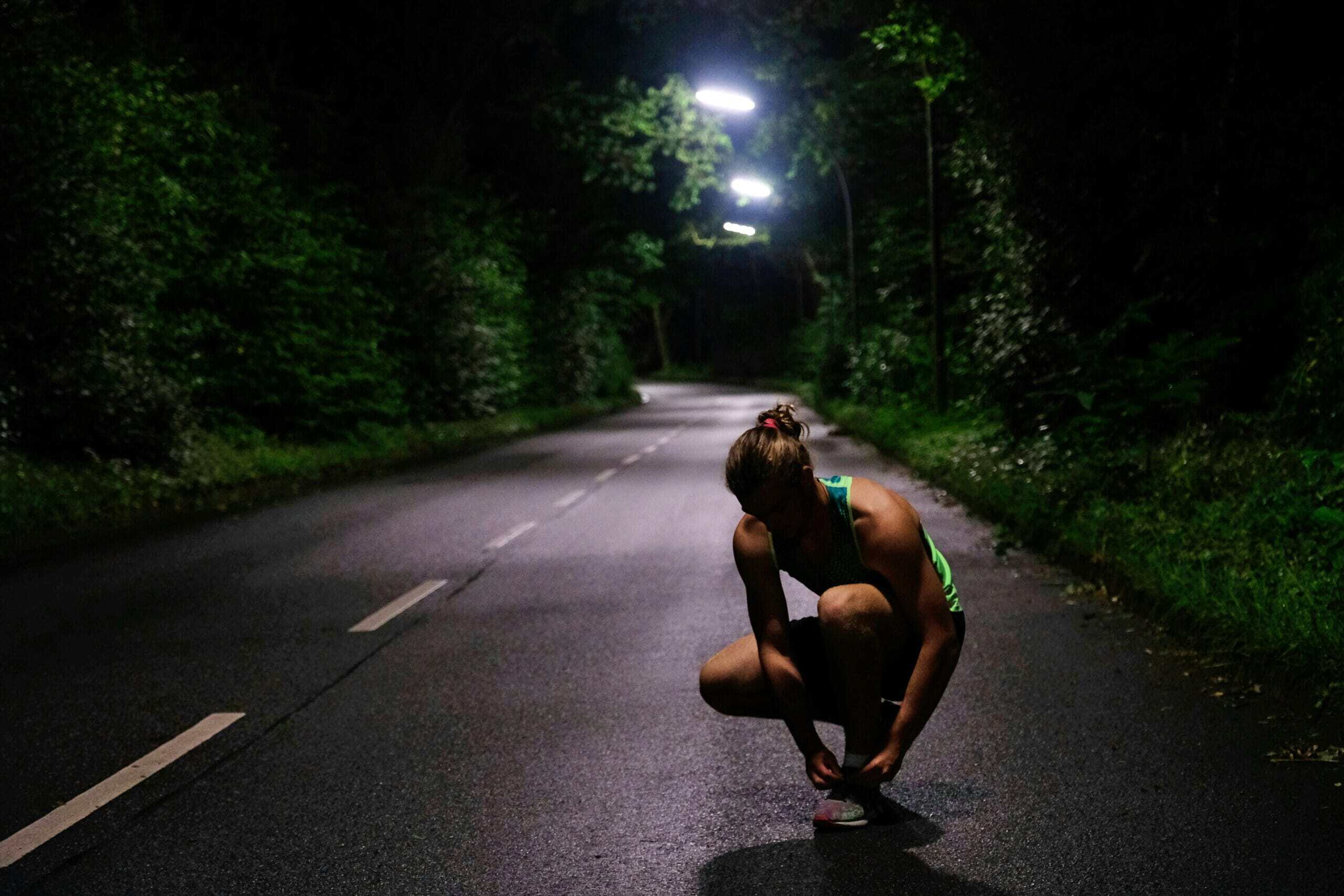
The standard advice is to avoid exercise in the few hours before bed. The reasoning is that exercise raises body temperature and sympathetic nervous system activity, both of which work against sleep onset. The advice has been treated as universal and absolute by most popular health writing.
The actual research picture is more nuanced. Some people find that late exercise improves their sleep. Others find even mild evening activity disruptive. The “no exercise within a few hours of bed” rule is a useful default, but it’s not the whole story, and ignoring exercise entirely because of the rule sometimes does more harm than the late workouts would have caused.
This guide walks through what exercise actually does to sleep biology, who’s most affected by timing, and how to figure out the right pattern for your situation.
Key Takeaways
- Exercise temporarily raises core body temperature and sympathetic nervous system activity, both of which can delay sleep onset if exercise ends close to bedtime.
- The disruptive effect is most pronounced for intense exercise close to bed; light to moderate activity is much less disruptive.
- Individual variation is substantial; some people handle late exercise well, while others are sensitive even to mild activity.
- Regular exercise at any time produces overall better sleep than no exercise; timing optimization matters less than getting consistent activity.
What Exercise Does to the Body That Affects Sleep
To understand the timing question, it helps to know what exercise actually changes that interacts with sleep biology.
Core body temperature rises. Exercise generates heat. Core temperature rises during the workout and stays elevated for a period afterward, depending on intensity. Sleep onset is closely tied to a drop in core body temperature; an elevated temperature works against this. The cooling-down period after exercise takes time, and if bedtime falls before cooling is complete, sleep onset is harder.
The sympathetic nervous system activates. Exercise triggers sympathetic activation: heart rate up, breathing faster, alertness elevated, stress hormones (cortisol and others) released. These effects persist past the end of the workout, depending on intensity and individual recovery rates. Sympathetic activity is the opposite of what’s needed for sleep onset; you can’t fall asleep in a “fight or flight” state.
Endorphins and other “feel-good” neurochemicals are released. The post-workout high involves dopamine, endorphins, and other neuromodulators that produce alertness and mood elevation. The effects fade over time, but the timing is similar to other exercise effects: hours rather than minutes.
Adenosine accumulation accelerates. The metabolic byproduct that produces sleep pressure accumulates faster during exercise. This is actually pro-sleep, but only after the other effects have dissipated. The competing signals (high adenosine pressure, but high sympathetic activity and warm core temperature) create the late-exercise tension.
The bottom line: exercise produces both pro-sleep effects (adenosine accumulation, eventual exhaustion) and anti-sleep effects (heat, sympathetic activity, alertness). Which dominates depends on timing, intensity, and individual recovery patterns.
The Classic Rule and Why It’s Not Universal
The traditional sleep hygiene advice to avoid exercise within several hours of bed comes from observing the average response to intense evening exercise. For most people doing high-intensity workouts, the body needs significant recovery time before sleep onset becomes easy. The standard buffer reflects the average cooling-down period.
What this advice misses:
Intensity matters more than the timing alone. A vigorous workout an hour before bed has different effects than a gentle walk an hour before bed. Lumping all “exercise” together obscures the real variable.
Individual variation is real. Some people genuinely sleep better after evening workouts. Others are highly sensitive to even mild evening activity. Generic advice doesn’t capture this range.
The cost of not exercising at all can outweigh suboptimal timing. People who avoid all evening exercise and then don’t fit in any exercise are worse off than people who exercise in the evening, even if the timing isn’t ideal. The biggest win is exercising regularly; the timing optimization is secondary.
Some recent research has been more positive about evening exercise. Several studies in recent years have found that moderate evening exercise doesn’t disrupt sleep for most participants and may even improve it. The exact effects depend on intensity, duration, and timing relative to bed.
What Affects How Late Exercise Hits You
Several factors determine whether late exercise will disrupt your sleep:
Intensity. Vigorous exercise (heavy lifting, intense cardio, HIIT, competitive sports) has more disruptive after-effects than moderate or light exercise (walking, easy cycling, gentle yoga, light strength work).
Duration. Longer sessions produce more cumulative effects on core temperature and sympathetic activation. A quick twenty-minute moderate workout dissipates faster than a ninety-minute intense session.
Time between the end and bedtime. More buffer is better. The same exercise three hours before bed has very different effects than the same exercise thirty minutes before bed.
Individual recovery rate. Fitness, age, and individual physiology all affect how quickly your body returns to baseline after exercise. Younger people often recover faster.
Hydration and nutrition. Dehydration after exercise makes sleep worse independently. Eating heavily right after exercise to refuel can also affect sleep if digestion is still active at bedtime.
Pre-existing sleep tendency. People who fall asleep easily can usually handle later exercise without trouble. People who already have sleep onset difficulties are more affected by late activity.
Patterns That Tend to Work
Across the variation, some patterns are reasonably safe for most people:
Morning exercise. Consistently, the safest timing for sleep. The activity is well before bed; the morning timing supports circadian function through the cortisol awakening response and light exposure that often accompanies outdoor exercise. People struggling with sleep onset who can shift workouts to the morning often see improvements.
Afternoon exercise. Also generally safe. The body has plenty of time to return to baseline before bed. The post-workout adenosine boost contributes to sleep pressure in the evening.
Early evening moderate exercise ending at least a couple of hours before bed. Works for most people. The workout finishes early enough that recovery is complete. Walking after dinner, easy cycling, gentle yoga, or moderate strength work in this window generally doesn’t disrupt sleep.
Brief, gentle activity close to bed. A short walk, light stretching, or gentle yoga in the wind-down period can actually help sleep by reducing physical restlessness and supporting cooling. These don’t raise core temperature or sympathetic activity significantly.
Patterns That Tend to Cause Trouble
Some patterns reliably produce sleep disruption for most people:
Intense workouts ending within an hour of bed. The body simply doesn’t have time to cool down and de-arouse. Core temperature is still elevated; sympathetic activity is still high. Sleep onset gets pushed back, and sleep quality suffers.
High-volume strength training in the evening for people with sleep onset difficulties. The combined heat, alertness, and pump effect takes time to resolve. People who already struggle to fall asleep tend to fare worse with this pattern.
Competitive sports or high-stress exercise late. The mental and emotional activation adds to the physical effects. A late-evening pickup game or competitive workout produces sustained alertness that takes hours to settle.
HIIT close to bed. High intensity followed by short rest is one of the more sleep-disruptive exercise formats when done late. The cardiovascular and sympathetic activation peaks repeatedly with limited recovery.
For pre-sleep difficulties more broadly, see our pillar on how to fall asleep faster.
How to Figure Out Your Pattern
Individual variation means generic advice can only get you partway. The right pattern for you requires some self-experimentation.
Try a structured test:
For a week, do your workouts at your current timing and track sleep quality (subjectively, or with a sleep tracker if you have one). Note sleep onset time, wake-ups, and morning energy.
For the next week, shift workouts significantly earlier (morning if possible, otherwise as early in the day as practical). Track the same metrics.
Compare. Most people see clear differences within two weeks of testing. If late workouts are disrupting your sleep, you’ll usually notice when you move them earlier. If timing wasn’t the issue, you won’t see much change and can return to whatever timing works for your schedule.
If you’re not sure, the safer default is earlier rather than later. If you have to choose between a morning workout and an evening workout for the same time investment, morning is usually the better choice for sleep purposes.
📑 Recommended Read: If late workouts are leaving you wired but not tired enough to fall asleep, supplements that support the natural pre-sleep wind-down can help. Magnesium in particular supports muscle relaxation after exercise. Check out our tested breakdown of the magnesium supplements for sleep for evidence-based options.
The Cool-Down Question
Several specific strategies help if you do exercise late and need to support faster recovery before bed.
Cool shower or bath after the workout, with time before bed. Helps body temperature return to baseline. Counterintuitively, a warm shower followed by exposure to cooler room air can also help, similar to the warm-bath effect that supports sleep onset.
Lower-intensity cool-down at the end of the workout. Don’t end a hard workout abruptly. The few minutes of easy movement let heart rate and sympathetic activity settle gradually.
Hydrate well. Dehydration affects sleep independently. Drinking enough water during and after exercise prevents this from being an additional problem.
Cool bedroom. If you’re going to bed with a slightly elevated core temperature, a cool room helps the body finish cooling. See our pillar on how to cool a bedroom for better sleep for the broader framework on bedroom temperature.
Light meal rather than heavy refuel. A big post-workout meal at 9 PM means active digestion at 10 PM, which competes with sleep onset. Lighter post-workout fueling close to bed works better for sleep.
Wind-down ritual. Reading, dim lights, calm activity in the time between exercise and bed. The signal-to-body that “this is wind-down” helps the sympathetic system step down.
For People Who Can Only Exercise Late
Many adults can only realistically fit exercise into evening hours. Work schedules, family responsibilities, or social commitments leave evening as the only window. The right answer isn’t “stop exercising”; it’s making the timing work as well as possible.
Practical adjustments:
Choose moderate intensity rather than high. Strength work or steady-state cardio at moderate effort produces less disruption than maximal efforts. Save the harder sessions for weekend mornings if possible.
Build in a real buffer between exercise end and bed. Even ninety minutes of wind-down time helps. If you finish at 9 PM and go straight to bed at 9:15, that’s the bad version. If you finish at 8:30 and don’t try to sleep until 10:30, the difference is substantial.
Manage the cool-down deliberately. Shower, dim the lights, change to comfortable clothes, transition the environment from workout to wind-down.
Watch your individual response. Some people genuinely sleep fine with late workouts. Others don’t. If your sleep is suffering, the workouts may need to move earlier, even at a scheduling cost.
Common Mistakes and How to Avoid Them
Skipping exercise entirely because of timing concerns. Worse for sleep than imperfectly-timed exercise. The pro-sleep effects of regular activity outweigh the timing issues.
Treating all “exercise” as equivalent. A walk and a HIIT session have very different effects on sleep. The intensity and type matter more than the simple fact of activity.
Following the “no exercise three hours before bed” rule rigidly. A reasonable default, but not absolute. If your only exercise window is late and the alternative is no exercise, the late workout is usually still beneficial.
Going straight from the workout to bed. Without a wind-down buffer, the body doesn’t have time to settle. Even an hour of dim activity helps.
Heavy eating right after late exercise. Compounds the sleep difficulty with active digestion. Lighter post-workout fueling close to bed works better.
Drinking caffeine pre-workout for late sessions. The caffeine timing is then bad twice. It interferes with sleep onset, and the workout itself becomes harder to wind down from.
Assuming your pattern is the same as everyone else’s. The variation is significant. Test your own response rather than assuming the average pattern applies to you.
Frequently Asked Questions
Is exercise before bed always bad for sleep? No. The disruption depends on intensity, duration, individual response, and buffer time before bed. Moderate exercise with a reasonable buffer is fine for many people. Intense exercise close to bed is problematic for most.
How many hours before bed should I stop exercising? The traditional rule is several hours, but the right number is individual. Some people need more buffer, some less. Intense exercise needs more buffer than light activity.
Does morning exercise actually help sleep? Usually yes. Morning exercise supports circadian rhythm and produces adenosine that builds sleep pressure through the day without the late-evening sympathetic issues. People struggling with sleep onset often see improvement when they shift workouts earlier.
Can I do yoga before bed? Gentle yoga in the wind-down period is usually helpful for sleep. Power yoga or intense flow close to bed is more like other intense exercises and has the same considerations.
What about evening walks? Light walking is one of the most sleep-friendly evening activities. The intensity is low; the body doesn’t get significantly hot or sympathetically activated; the movement helps wind down. Many people benefit from evening walks specifically.
Why do I feel wired after evening workouts? The combination of elevated core temperature, sympathetic activation, endorphin and dopamine release, and possibly caffeine if you took a pre-workout. All of these reverse over time, but the wind-down can take longer than the time before bed allows.
Is it OK to exercise if I’m already tired? Usually, yes for moderate exercise. Forcing intense exercise when significantly sleep-deprived is harder on recovery and produces more disruption. Light activity is generally fine even when tired.
How can I tell if my evening workouts are affecting my sleep? Self-test by trying a week or two of significantly earlier workouts and comparing sleep quality. If sleep improves with earlier timing, late exercise was likely contributing. If no change, timing wasn’t the issue, and you can train when it works for your schedule.
Recommended Reading
See also our guides to how to choose sleep aids, and how to sleep with sciatica.
Related Reading
Explore more: how to sleep in a hotel, how to sleep with tinnitus, Cold Feet, No Sleep? Why Freezing Toes Are Ruining Your Circ, nightlights better sleep, why sleep changes with age, Talking in Your Sleep? The Science Behind Somniloquy, how to sleep after knee replacement surgery, and how to sleep with sciatica.
