
Nobody sets out to own five cooling products. They accumulate, one purchase at a time, each solving the problem left over after the last one.
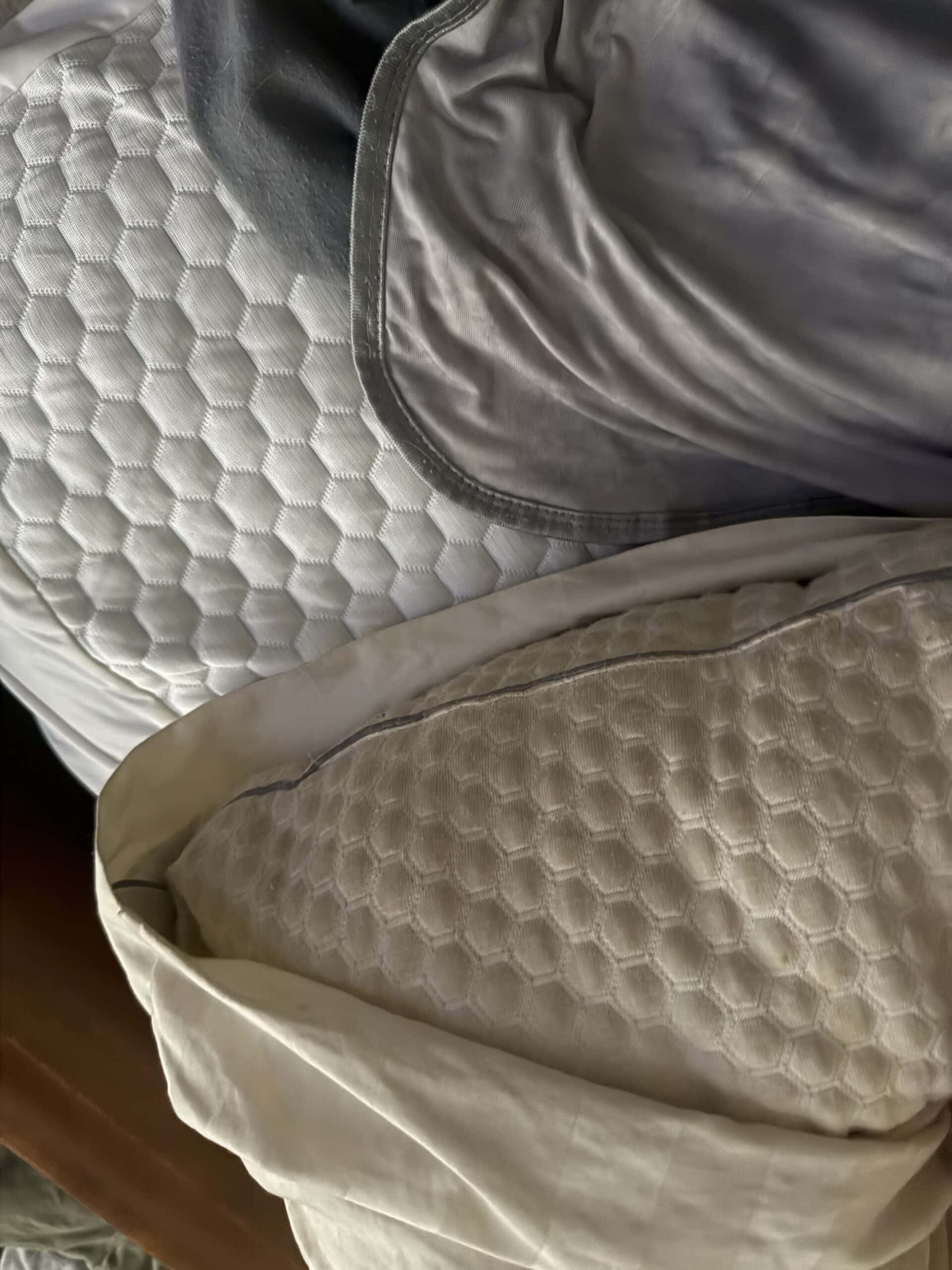
Mine are a cooling topper, a cooling blanket, a gel pillow, a portable air conditioner, and fans on the ceiling and floor. Every one was bought separately, and if I had to drop one it would be the topper. Our note on why a bed feels hot covers where this starts.
Quick Answer
Air temperature first, then what you sleep under, then what you sleep on. Adding one at a time and seeing whether it fixed the problem is more useful than buying a set.
What Each Layer Does
| Item | Addresses | Order to try |
|---|---|---|
| Fans | Air movement, evaporation | First, cheapest |
| Air conditioner | Actual room temperature | Second, most effective |
| Cooling blanket | Heat trapped under bedding | Third |
| Cooling pillow | Head and neck contact | Fourth, most localized |
| Cooling topper | Heat from the mattress | Last, most expensive |
| Blackout and curtains | Solar gain during the day | Alongside, different problem |
Why Accumulation Happens
Each product addresses a different part of the problem, and solving one leaves the others visible.
Cool the air and you notice the bedding trapping heat. Fix the bedding and you notice the mattress underneath. Fix that and the pillow is still warm.
That progression is why people end up with several rather than one, and it is not necessarily irrational. It is diagnosis by elimination, conducted with a credit card.
The alternative, buying a full set at once, means never learning which one was doing the work. Our note on cooling a bedroom covers the approaches.
What Actually Makes a Bed Hot
Understanding where the heat comes from explains why one product rarely solves it.
Your body produces heat continuously, and sleep requires core temperature to drop slightly. Anything preventing that loss interferes with falling asleep specifically.
Bedding traps the heat closest to you, which is why what you sleep under matters more than what you sleep on.
Mattress materials hold heat to varying degrees, with dense foam being the usual culprit, and that heat builds through the night rather than arriving at once.
Room air temperature sets the ceiling on all of it. A warm room means nothing else has anywhere to move heat to, which is the reason air conditioning outranks every other product here.
The Order I Would Recommend
Fans first
Cheapest by a wide margin, and moving air across skin speeds evaporation. It does not lower room temperature and it changes how warm you feel.
Air conditioning second
The only thing here that actually reduces air temperature. Everything else manages heat rather than removing it.
Bedding third
What you sleep under traps more heat than what you sleep on, so a cooling blanket does more than a topper for less money.
Mattress layer last
Most expensive, and it addresses the heat source furthest from your skin. Our roundup of cooling toppers covers that layer.
Which One I Would Drop
The topper, and that is a straightforward answer rather than a close call.
The reason is that my mattress runs hot and I keep it because it supports me properly. The topper is compensating for that rather than solving it, which makes it the layer doing the least direct work.
The portable air conditioner is the one I would keep longest, because it is the only thing that changes the actual temperature of the room rather than managing how heat moves around within it.
Fans would be second, on the same reasoning and for a fraction of the cost. Our note on whether a portable AC blows air on you covers running one in a bedroom.
Cost Against Effect
Ranking these by what they cost versus what they change puts them in a different order from how people usually buy them.
Fans are cheap to buy and cheap to run, and they change perceived temperature rather than actual temperature. Best value by a wide margin.
Bedding is a moderate one-off cost with no running cost, and it addresses the layer closest to your skin.
A cooling pillow is the cheapest of the sleep-surface products and the most localized in effect.
Air conditioning is expensive to buy and expensive to run, and it is the only thing that lowers room temperature. That combination is why it sits at the top on effect and not on value.
A topper is the most expensive sleep-surface layer and addresses the heat source furthest from your skin, which is the reason it is the one I would drop.
Where They Work Against Each Other
A cooling blanket over a cooling topper does less than either alone suggests, since the blanket has to move heat that the topper is also trying to move.
Air conditioning plus a cooling topper is partly redundant, because a cool room means the mattress is not the limiting factor anymore.
Fans and a portable air conditioner do complement each other, since the fan distributes the cooled air rather than duplicating what the unit does.
The pillow is the least redundant of the group, because head and neck contact is a genuinely separate problem from everything below it. Our note on using a cooling blanket and topper together covers that overlap.
That ordering also explains why people who buy a topper first are often disappointed. It is the most expensive item addressing the least accessible heat source, and if the room itself is warm there is nowhere for that heat to go regardless of what the mattress is made of.
What to Try Before Buying Anything
Open a window at night if outside is cooler than inside, which is free and frequently overlooked.
Close curtains during the day to reduce solar gain, which is a different problem from night-time heat and cheaper to solve.
Reduce bedding rather than replacing it, since a lighter duvet costs nothing if you already own one.
Shower before bed, which lowers skin temperature temporarily and helps with falling asleep specifically. Our roundup of blackout curtains covers the daytime side.
Five Is Probably More Than Necessary
I would not tell anyone to buy what I have. It accumulated over years of chasing a problem, and a fair amount of it overlaps.
Someone starting now with fans and an air conditioner would cover most of the ground, and could add bedding if that was not enough.
What made mine grow is that I kept a mattress that runs hot, which meant every other layer was compensating for a fixed constraint.
Where the constraint is fixable, fixing it directly is cheaper than managing around it. Where it is not, layers are what you have. Our note on insomnia versus light sleeping covers when none of this is the actual problem.
Cooling Products FAQ
How many cooling products do I need?
Fewer than I have. Fans and air conditioning cover most of it, with bedding as the next addition. I own five because they accumulated over years rather than because five is right.
What order should I buy in?
Fans first because they are cheapest, air conditioning second because it is the only thing that lowers room temperature, then bedding, then a pillow, then a topper.
Which one does the most?
The air conditioner, since everything else manages heat rather than removing it. Fans are second on cost-effectiveness rather than raw effect.
Which would you drop?
The topper. It compensates for a mattress that runs hot rather than solving anything, and it is the most expensive layer doing the least direct work.
Do these overlap?
Considerably. A cooling blanket over a cooling topper is partly redundant, and air conditioning makes the mattress layer less relevant since the room is already cool.
Should I buy a full set at once?
No. Adding one at a time tells you which one solved the problem. Buying a set means never learning what was doing the work.
What should I try first?
Opening a window, closing curtains during the day, and using lighter bedding. All free, and they solve the problem often enough to be worth trying first.
Why do you still have all five?
Because I keep a mattress that runs hot for support reasons, so every other layer is compensating for a constraint I have chosen not to change.
