
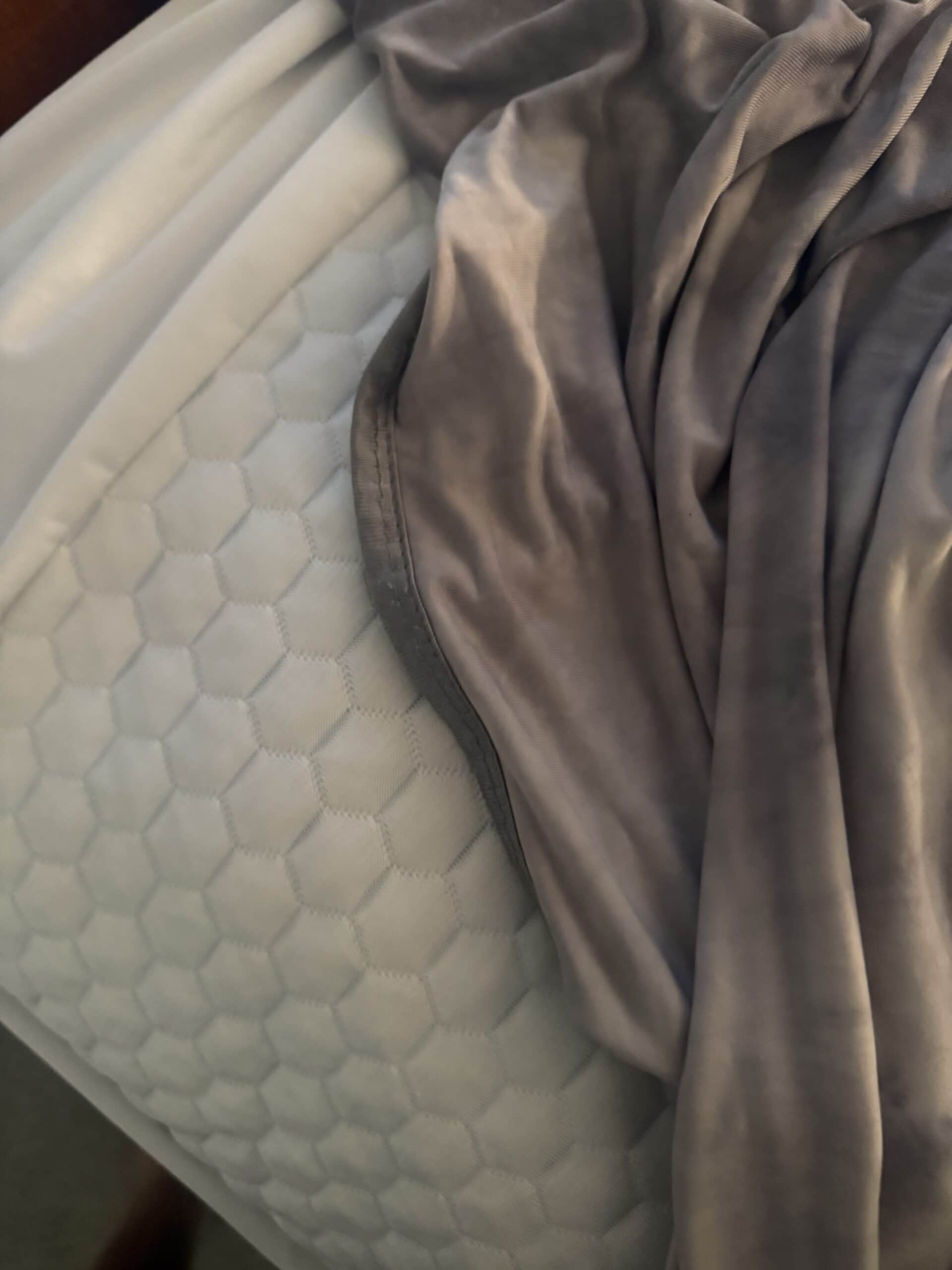
Yes, and they work on different parts of the problem rather than doubling the same effect. A topper handles what you lie on and a blanket handles what lies on you, so combining them covers both surfaces.
I use both, along with a gel cooling pillow. The topper is three or four years old and the blanket around eighteen months, and they are part of a setup rather than the whole of it.
A Quick Note
This covers bedding rather than medical advice. Night sweats that are new, drenching, or come with other symptoms are worth raising with a doctor rather than treated as a bedding problem.
Quick Answer
They stack usefully because they address different contact surfaces. Neither removes heat from a room, so both underperform if the room itself is hot. Air conditioning or a fan first, then bedding.
What Each Layer Does
| Layer | Surface | Mechanism |
|---|---|---|
| Cooling topper | Under you | Conducts heat away from back and hips |
| Cooling blanket | Over you | Conducts heat from the top surface |
| Cooling pillow | Head and neck | Conducts heat from a high-contact point |
| Sheets | Direct contact | Wicks moisture, affects everything above |
Every one of those works by conduction, which means moving heat from you into the material. None of them produces cold, which is why the room temperature underneath all of it still decides the outcome.
Why They Do Not Cancel Each Other Out
Heat leaves your body in every direction, and each layer intercepts a different portion.
Sleeping on a cooling topper with an ordinary blanket means the underside is handled and the top still traps heat. The reverse leaves your back warm against a mattress that holds heat.
Foam mattresses make the topper side matter more, since foam conforms closely and reduces airflow underneath you.
So the combination is not redundancy. It is covering two halves of the same problem, covered in cooling blanket against cooling topper.
How Mine Actually Work Together
The topper is the older of the two at three or four years, and the blanket is around eighteen months.
What I have noticed with the blanket is that it does very little until the room itself has come down. The air conditioning does the work first, and then the blanket is pleasant. On a hot room it barely registers.
That is worth saying because the marketing implies otherwise. These are conductive materials, not cooling devices, and they need somewhere to send the heat.
The topper feels more effective outside summer, which I think is the same principle. Less competing heat means the conduction does more, covered in whether a cooling topper works in winter.
I would not want to isolate which one is doing what, since they have always been used together alongside fans and air conditioning.
Getting the Order Right
Room temperature first
Air conditioning, a fan, or blocking daytime solar gain all do more than any bedding layer. Bedding manages heat that has somewhere to go.
Sheets before extras
Sheets sit between you and everything else, so a heat-trapping sheet undermines a cooling topper directly, covered in cooling sheets for hot sleepers.
Then the topper
The under-surface matters most on foam mattresses, which is where most people notice heat first.
Then the blanket
Cheapest to try, easiest to remove, and the one that depends most on the room already being reasonable.
Why the Cool Feeling Fades Either Way
Every conductive cooling product feels strongest in the first minute and less so after that, and understanding why prevents the assumption that yours has failed.
The initial sensation comes from a temperature difference. The material sits at room temperature and you are warmer, so heat moves quickly and you feel it leaving.
Once the material has absorbed your heat, that gap narrows. Conduction slows because there is less difference driving it, and the surface stops feeling cool even though it is still working.
That is why people flip a pillow or move to a fresh part of the bed. You are not finding a colder surface so much as one that has had time to release the heat it took from you earlier.
Airflow is what resets it. A material with air moving over it sheds absorbed heat back into the room and recovers, which is why fans make every other cooling layer work better.
Phase-change materials extend the effect by absorbing heat while changing state rather than simply warming up, and even those have a capacity that runs out.
None of that means the products do nothing. It means the cool-to-the-touch sensation and the actual heat management are two different things, and only the second one matters across a whole night.
Where Stacking Goes Wrong
Too many layers is the main way this goes wrong. Each addition brings insulation along with its conduction, and past a certain point the insulation simply wins out.
A mattress protector between you and a cooling topper blocks most of what the topper does, and people forget it is there.
Thick sheets do much the same thing rather more subtly, since a heavy cotton sheet sitting between your skin and a cooling surface prevents the contact conduction almost entirely.
And a partner with different preferences complicates all of it, since a blanket is easy to split and a topper is not, covered in bedroom gear for couples with different needs.
Seasonal Use of the Stack
The whole setup does not need to stay assembled year-round, and treating it as seasonal makes each part work better.
A cooling blanket in winter is a genuine question rather than an obvious no. Some people find it too cool once the room is cold, and others use it as a lighter layer under something warmer.
A topper is the layer most people leave in place all year, since removing and storing it is awkward and the effect in cold weather is mild.
Sheets are the easiest seasonal swap, and switching between percale or linen in summer and flannel in winter changes more than most people expect.
The gel pillow tends to stay year-round for the same reason as the topper. It is doing a small job continuously rather than a large one seasonally.
What is worth avoiding is running the full summer stack into a cold season out of habit, since a bed that is too cool disrupts sleep as effectively as one that is too warm.
What to Add First on a Budget
A fan, if you do not have one. Air movement helps evaporation and costs less to run than anything else here.
Then sheets, since they are the layer touching you and they affect whether anything above or below can work.
Then a blanket, because it is cheaper than a topper, easier to remove on a cool night, and quick to test.
A topper last, since it is the most expensive and the hardest to reverse if it turns out the room was the real problem, covered in bedroom cooling setups for hot climates.
Related Reading
- blanket against topper
- cooling blankets
- cooling mattress pads
- cooling sheets
- gel cooling pillows
- waking up hot
Frequently Asked Questions
Can you use a cooling blanket and a cooling topper together?
Yes. They address different contact surfaces, so the topper handles what you lie on and the blanket handles what lies on you.
Do they cancel each other out?
No. Heat leaves your body in every direction, and each layer intercepts a different portion of it rather than competing for the same heat.
Will they work in a hot room?
Poorly. Both work by conducting heat away from you, and that requires somewhere for the heat to go. Room temperature is the thing to fix first.
Does a mattress protector interfere?
Considerably. A protector between you and a cooling topper blocks most of the contact conduction, and it is easy to forget it is there.
Which should I buy first?
A fan, then sheets, then a blanket, then a topper. That runs cheapest and most reversible to most expensive and hardest to undo.
Can you have too many cooling layers?
Yes. Each layer adds insulation as well as conduction, and past a certain point the insulation wins and you sleep warmer.
Why does the cool feeling fade?
The material absorbs your heat and the temperature gap narrows, so conduction slows. Airflow resets it, which is why fans make every other cooling layer work better.
Do cooling products actually make you cold?
No. They conduct heat away from your skin, which feels cool on contact. Nothing in your bedding produces cold the way an air conditioner does.
Sources
American Academy of Sleep Medicine. Healthy Sleep Habits. https://sleepeducation.org/healthy-sleep/healthy-sleep-habits/
Sleep Foundation. Best Temperature for Sleep. https://www.sleepfoundation.org/bedroom-environment/best-temperature-for-sleep
Recommended Reading
See our note on choosing a mattress.
